International Research Journal of Engineering and Technology (IRJET)
e-ISSN: 2395-0056
Volume: 09 Issue: 10 | Oct 2022
p-ISSN: 2395-0072
www.irjet.net
Analysis of Fault Ride Through Capability of Single-Phase Solar Fed Inverter Gajender Singh1, Dr. M. K. Bhaskar2, Manish Parihar3, P. R. Bheel4 1ME
Scholar, Electrical Department, MBM Engineering college, Jodhpur, INDIA Electrical Department, MBM Engineering college, Jodhpur, INDIA 3,4Ph.D Scholar, Electrical Department, MBM Engineering college, Jodhpur, INDIA 2Professor,
---------------------------------------------------------------------***---------------------------------------------------------------------
Abstract - Today effective solar power generation is
Among them cost effective single stage topology having highest factor of comparison but consist of complex one cycle controller. To overcome this problem simple closed loop current and voltage controller with some modification has been implemented.
necessary for smart grid implementation. Also, reliable and protected solar inverter is necessary for effective smart grid. As contrary to traditional two stage system, a single-stage solar energy conversion system is implemented, resulting in increased efficiency and reduction of weight and size. Now-adays maximum power point tracking (MPPT), phase locked loop (PLL), closed loop current and voltage controller are combined in single stage. At the time of L-G fault occur near grid side, were high magnitude of grid current causes high switching of inverter current and voltage imbalance. This problem can be removed by using fast current error controlled SDBR switch. Also the solar inverter needs not to be disconnected from the grid during the fault conditions. Comparative results are obtained by simulation in MATLAB software.
1.1Fault Ride Through Capability At the time of connecting PV plants to grids, it is essential to provide them with dynamic support for the grid voltages. This dynamic support is referred to fault ride through (FRT) capability in which the PV plant should stay connected in the case of grid faults depending on the fault time duration [6]. They have also to provide support to the grid voltages by injecting reactive power. Considering the FRT capability, there are four major reasons for inverter disconnection during grid faults, which are the following ones: (i) over current at the ac side, (ii) excessive dc-link voltage, (iii) loss of grid voltage synchronization, (iv) the reactive current injection imbalance. If system remains connected during these abnormalities, it indicates improved FRT capability of system. The single stage single phase solar inverter with improved fault ride through capability [12]. MATLAB model has developed while keeping first two conditions in focus and achieved better results in simulation.
Key Words: Fault ride through, PV, Inverter control, Protection, SDBR, etc.
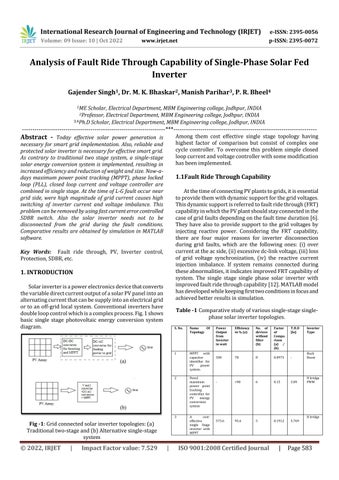
1. INTRODUCTION Solar inverter is a power electronics device that converts the variable direct current output of a solar PV panel into an alternating current that can be supply into an electrical grid or to an off-grid local system. Conventional inverters have double loop control which is a complex process. Fig. 1 shows basic single stage photovoltaic energy conversion system diagram.
Table -1 Comparative study of various single-stage singlephase solar inverter topologies.
Fig -1: Grid connected solar inverter topologies: (a) Traditional two-stage and (b) Alternative single-stage system
© 2022, IRJET
|
Impact Factor value: 7.529
|
S. No.
Name Of Topology
1
MPPT with capacitor identifier for PV power system.
2
Novel maximum power point tracking controller for PV energy conversion system
3
A costeffective single Stage inverter with MPPT
Power Output from Inverter in watt
Efficiency in % (a)
No. of devices without filter (b)
Factor of Compa rison (a) / (b)
T.H.D [Io]
Inverter Type
500
78
8
0.0975
-
Buck Boost
-
>90
6
0.15
3.09
H bridge PWM
573.6
95.6
5
0.1912
5.769
H bridge
ISO 9001:2008 Certified Journal
|
Page 583