International Research Journal of Engineering and Technology (IRJET) e-ISSN: 2395-0056

Volume: 09 Issue: 10 | Oct 2022 www.irjet.net p-ISSN: 2395-0072
International Research Journal of Engineering and Technology (IRJET) e-ISSN: 2395-0056
Volume: 09 Issue: 10 | Oct 2022 www.irjet.net p-ISSN: 2395-0072
1PG Scholar, Department of Civil Engineering, DRGIT&R, Amravati, Maharashtra, India.
2 Professor, Department of Civil Engineering, P.R. Pote Patil College of engineering and Management, Amravati, Maharashtra, India
3Assistance Professor, Department of Civil Engineering, DRGIT&R, Amravati, Maharashtra, India ***
Abstract - The Automated Highway System (AHS) idea establishesa new bond between moving objectsandthe road system. AHS designates a group of lanes on a restricted accessroadwherespeciallyequippedcars aredrivenentirely automatically. AHS employs vehicle and roadway control technologies that delegate control of the vehicle from the operator to the driver. To ensure safer and more convenient transportation, throttle, steering, and brakes are automatically regulated. AHS also makes use of communication, sensor, and obstacle detection technology to identifyandrespondtochangesintheoutside infrastructure. Inordertocoordinatevehiclemovement,avoidimpediments, and optimise traffic flow, the highway and the vehicles work together to increase safety and decrease congestion. In conclusion, the AHS idea blends communication technologies that link automobiles to highway infrastructure with a variety of intelligent technologies deployed on existing highwayinfrastructure.
Words: Entrance/Exit, Deployment, Automated Highways,andRoadwayInterfaces.
The automated highway system is a long-term transportationsystemwithseveralpotentialadvantagesin the future. AHS technology creates a new connection between roads and transportation networks. It is a driverless approach that operates automobiles through an automatic control system. For the design of an automated highway system, a variety of techniques connected to computing concepts, microelectronics, numerous sensors, and advanced civil engineering techniques are applied. In an automated highway system, the essential parts of any mechanicallypropelledvehicle thethrottle,steering,and braking are automatically operated. An automated highway system may readily satisfy the primary requirements of any traffic facility, such as coordinated vehicle flow, the removal of obstructions, an improvised traffic system, and safety. The recently developed intelligence algorithms are extensively used to link highway networks and the moving traffic on those networks.
Radio controls and mechanical mechanisms are used to manage the operation of this scientific apparatus. The
primaryideabehindthecreationofanautomatedhighway system is the increase in vehicle capacity on a road with fully managed traffic. The creative idea of an automated highway system has been significant in managing the transportation network in developed cities when compared to the behaviour of human drivers. The Intermodal Surface Transport Efficiency Act of 1991 was enacted (ISTEA), An effort was made to design and test early prototypes for completely automated automobiles andhighways.Withtheintentionofcreatingstandardsfor a fully automated highway system concept that would support and encourage the advancement of vehicle and roadwaytechnologies,thislegislationinspiredtheUSDOT to create the National Automated Highway System Research Programme (NAHSRP). Highway Automation Systems Amravati Page No. 2, Dr. Rajendra Gode Institute ofTechnologyandResearchTheNationalHighwaySystem Consortium was established by the US Department of Transportation in 1994. (NAHSC). The consortium includedmembersfromninekeyorganisationalcategories, including academia, local, state, regional, and federal governments, as well as the transportation, electronics, andcommunicationsindustries.Theconsortiumsupported boosting the program's knowledge and resources and insisted that the stakeholders' cooperation would be essentialinfosteringthesharedenthusiasmneededforthe early design and implementation of fully automated highway systems. Despite the fact that the US Department ofTransportationstoppedfundingtheNationalAutomated HighwaySystemsResearchProgramme(NAHSRP)in1997, research is still being done today, albeit in a sparse manner. With a greater emphasis on a shorter time horizon, many research undertaken by the National Automated Highway Systems Consortium (NAHSC) continue in part with a few federal programmes like the IntelligentVehicleInitiative(IVI).
• Develop new tools for controlling urban transportation. Automatedhighwaysystemswillcreateresourcesthatcan assistcitiesinovercomingobstaclesthatarekeepingthem fromimplementingcutting-edgetechnology.
• Studies will be conducted to demonstrate that an automated transportation system is not only doable but
International Research Journal of Engineering and Technology (IRJET) e-ISSN: 2395-0056
Volume: 09 Issue: 10 | Oct 2022 www.irjet.net p-ISSN: 2395-0072
will also help find a long-term solution to the city's mobilityissues.
• To research how factors including traffic volume, capacity, road characteristics, and surface characteristics affect accident rates on highway roads. Highway AutomationSystemsAmravati
• To analyse the annual, monthly, and per-mile accident statisticsforthechosenhighwayroad.
• To survey and record automated highway systems with driver and passenger safety features on the highways. There is still a long way to go before viable intelligent driver assistance systems and safety warning systems are available.
Many studies on the subject of automated highway systems have been conducted by a variety of researchers andvehicledevelopers.Thesestudiesshowtheadvantages ofusinganautomatedhighwaysystem.
Anthony Nuzzoloa Give some examples of the Advanced Traveler Advisory Tool's theoretical and practical applications (ATAT) It need to be able to support users using multimodal networks by recommending the optimal routes in accordance with their individual preferences. Such routes are distinguished based on an assessment of the perceived path utility codified in the Random Utility Theory. It demonstrates user requirements, TVPTA's logical andfunctional design,aswell astheframework for transit modelling, which provides tailored pre-trip information, and the learning process, which identifies user preferences. The second section outlines a metropolitan area implementation example of TVPTA concepts. The researcher's findings were given by the author in an effort to create an ATAT that could provide real-time data-based tailored information to the user. Its foundationisapathchoicemodellingframeworkthatmay present different paths based on individual travel preferences that are determined through a learning process. The theoretical foundation is built on individual path choice models that can offer other transport routes depending on the user's own travel preferences as recorded by a learning process of user behaviours. The authors'currentanalyses,whichfollowthedecisionsmade by a sample of students travelling in a major city, demonstrate the advantages of giving personalised information as well as the limitations of using aggregate models to provide travel advise. The initialization and updating of model parameters are among the other achievements of this research that experimental evidence also supports. In reality, even while the use of Stated Preferences interviews created on 2-alternative scenarios withaminimumof10observationsenablesustoestimate initial model parameters for an acceptable individual
HighwayAutomationSystemsRajendragode,D.O.PageNo. 6 Travel advise from the Institute of Technology and Research, Amravati: To generate statistically meaningful findings,a largenumberof observationsare required,and the updating procedure of individual model parameters is relativelyslow.Suchafindingpointstotheneedforfuture research into parameter updating methods, path choice modelling (e.g., examination of additional O/D pairs, user preferences, and model forms), and TVPTA implementation. They create a controller that directs a desired velocity at each part of the highway using a macroscopic traffic model similar to that in so that the density of the entire highwaycorresponds to a designated density profile. Their model is based on how real drivers behave. Although designing control laws for automated vehiclestomakethemactlikethosepiloted bypeopleisa possibility,thisisnottheonlystrategy.Thecreatedcontrol law is based on the inversion of the dynamics of traffic flow, which necessitates a specific controllability requirementfortheflowoftraffic.Whenthedensityinany area of thehighwaygets exceedinglylow,this conditionis broken.Theinformationfromtheentirehighwayisneeded forthecontrolactionataparticularspotintheroadway.A dynamic version of the control rule that solves the matrix inversion dynamically helps to fix this issue. This work doesnottakeintoaccountcommandsforchanginglanesor numerouslanes.
Similar to current high-occupancy-vehicle (HOV) or carpooling lanes, a driver choosing to use such an automatedhighwaymayfirstpassthroughavalidation lane. The system would then set the car's location, decide whether it will operate properly in automated mode, and deduct any tolls from the driver's credit account.Vehiclesthatareoperatingincorrectlywillbe directedtomanuallanes.
Thevehiclewouldnextbedirectedthroughagateand ontoanautomatedlanewhenthedriversteeredintoa merging area. Newly entering traffic would be coordinated with existing traffic using an automatic control system. Thedriver mayunwind till theturnoff oncetheywereinautonomousmode.Theoperationin reverse would remove the car from the road. The system would next need to determine whether the driver could regain control and decide what to do if theywereunconscious,ill,orevendead.
A mixed traffic system, in which automated and nonautomated cars use the road, is an alternative to this type of dedicated lane system. This strategy would yield the greatest benefits but would require more extensive adjustments to the transportation infrastructure.
2022, IRJET | Impact Factor value: 7.529 | ISO 9001:2008 Certified Journal |
International Research Journal of Engineering and Technology (IRJET) e-ISSN: 2395-0056
Volume: 09 Issue: 10 | Oct 2022 www.irjet.net p-ISSN: 2395-0072
In fact, a range of strategies that vary in the level of autonomy for each vehicle can be imagined for highway automation systems. Fully independent or "free-agent"vehicleswiththeirownproximitysensors would be on one end of the spectrum, allowing other vehicles to safely stop even if the vehicle in front appliedthebrakessuddenly.
Vehicles in the middle would be able to adapt to different levels of cooperation with other vehicles (platooning).Systemsthatdependlessormoreheavily on the highway infrastructure for automated support wouldbeattheoppositeend.However,themajorityof the technology would typically be installed in the vehicle.
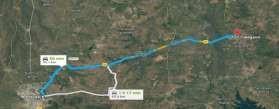
The high-speed, access-controlled toll road from AmravatitoTalegaonisIndia'snationalhighwaynumber6 (NH 6 has been renumbered NH 53 after renumbering all national roads by National Highway Authority of India in 2010year).ItlinksTalegaonwithAmravatiacrossastretch of55.1kilometres.Theroad isa sectionofthemajorEastWest national highway NH-6, often known as the G.E. (GreatEasternRoad).India'sNH-6travelsacrossthestates of Gujarat, Maharashtra, Chhattisgarh, Orissa, Jharkhand, and West Bengal. The cities of Surat, Dhule, Amravati, Nagpur, Raipur, Sambalpur, and Kolkata are all along the routeofthehighway.FromHaziratoKolkata,NH6travels over 1,949 kilometres, establishing crucial east-west connection for the entire region. The NH-6 study segment servesavarietyoftraffic,includingregional,suburban,and urban traffic. The construction next to the highway suggests a combination of land uses, including residential, commercial, and small- and medium-sized industrial facilities producing textiles, woollen blankets, ropes, timepieces,andotheritems,aswellasagriculturalandarid landson both sidesof the road.Future development along the roadway and in the influence region has considerable potential for the corridor as a whole, as is further detailed in this Report. Agriculture is the primary land use on both sides of the project corridor. This section of the Great Eastern Highway, which connects Kolkata and Hazira, two of the country's largest ports, sees a sizable volume of commercialbulktransportationactivity.
The Amravati district is traversed by the project highway corridor, which is located in the state of Maharashtra. Before reaching the conclusion of the project stretch at Talegaon, it goes through a number of large and minor urban centres, including Nandgaon Peth, Mozri, Tivsa, and Ramdara,amongothers,alongitslength.
AlsoknownastheAmravati-NagpurHighway,thecorridor. The highway has a central divider, two carriageways with eachtwolanes,pavedshoulders,sidedrainsonbothsides, andflyoversatsignificantcrossings.
Thestudyarea'squietfeaturesarelistedbelow;
55.1kmisequaltofourcarriagewaylanes. Thereare1majorbridges.
25NumbersforMinorBridges
2flyoverstotal.
BridgeOverRail:1No.
Culverts:86totalno.
11pedestrianunderpassesareallowed.
11vehicleunderpassesarerequired.
36numbersatmajorintersection. ServiceRoad:26.50kilometres.
15busbaystotal.
ComplexatTollPlaza=1Nos.
For analysis, almost all of the data was downloaded onto spreadsheets. The data was examined to identify issuesand shortcomingsin thecorridor. Because reducing accidents is AHS's primary goal, the project study focused on accident analysis. A floating referencing system was used to calculate accident rates for each segment measuringhalfamile.Rateswerespecificallysetonahalfmilebasis,movingforward everytenthofa milealongthe route.Additionally,severityrateswerecalculatedforevery half-milelengthoffloatingwater.Theserateswereusedto determine probable anomalous accident sites for future investigation. Trend-exhibiting segments were considered to have the most potential for realising the advantages of AHSapplications.
International Research Journal of Engineering and Technology (IRJET) e-ISSN: 2395-0056
Volume: 09 Issue: 10 | Oct 2022 www.irjet.net p-ISSN: 2395-0072
The amount of traffic on the route does not entirely determine its toll revenue. The potential impact of certain traffic features on toll income is considerable. Some of these characteristics of traffic include a portion of local traffic, a portion of passenger and commercial traffic, a portionoftrafficonrepeattrips,andaportionoftrafficon monthlypasses.
pasttocatchrecklesshighwaydriving.Themajorityofthe methods demand a lot of human work and concentration, which makes them challenging to put into practise. In this study, we propose to develop a system for the early detectionandwarningofrashdriving-relatedriskyvehicle driving behaviours. A buzzer, a control circuit, an IR transmitter, and an IR receiver are needed for the full implementation. The police employ a system to determine the speed limit based on the volume of traffic in the area. The control circuit calculates the distance travelled by the vehiclebetweentwopredeterminedpointsandshowsthat informationonsevensegmentdisplays.Additionally,ifthe carexceedsthespeedlimit,abuzzeralertsthepolice.
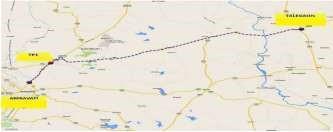
Fig 2 - TollPlazaLocationasTP1
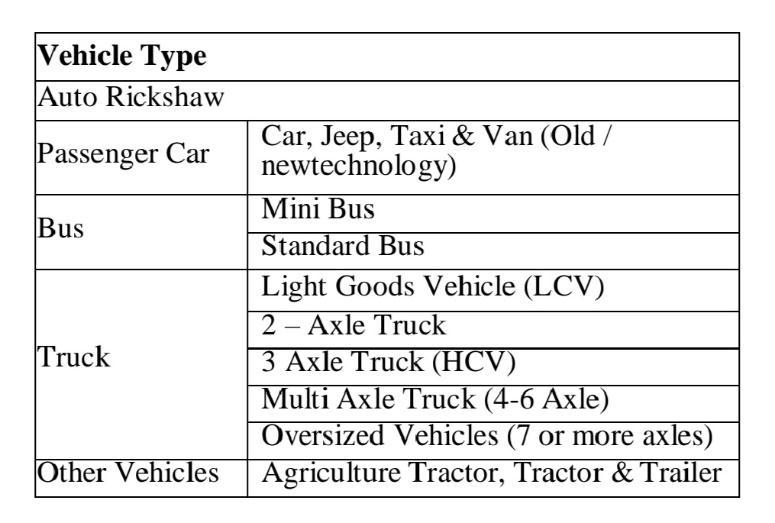
Understanding the modal split and traffic flow pattern on a roadway is the goal of a Classified Traffic Volume Count.Theconcessionaireoftheprojecthighwaydelivered theClassifiedTrafficVolumeCountsurveybasedonactual traffic data collected at toll plaza sites based on monthly data. The vehicles can be roughly divided into two categories: those that move quickly and are propelled by motors and those that move slowly and are propelled by humanpower.Toll-exemptvehiclesarecountedseparately and the vehicle groups are further divided to capture the toll-able vehicle classifications. Table lists the specific vehiclecategorizationsystemaccordingtoIRC:64-1990.
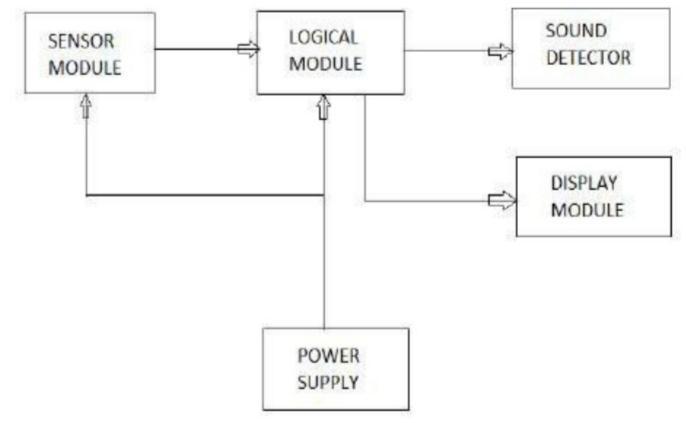
In this section, we've created a circuit for a highway speed checker that uses timers, counters, logic gates, seven-segment displays, and other electronic devices to identifyrecklessdriving.Itdisplaystheconventionalblock diagramofaspeedcheckerthatusesaTimerandaTimer's sensor module, logical module, power supply, sound detector, and display module to detect reckless driving on roads. A further logical module includes decade counters, clocks,andNANDgates.
This study describes a device that may spot reckless highway driving and notify the traffic authorities of any violations. There have been many gadgets created in the
Depending on the operation mode. The only difference between photodiodes and conventional semiconductor diodes is that the sensitive portion of the device may be uncovered(todetectvacuumUVorX-rays)orpackedwith a window or optical fibre connection to let light in. PIN junctions, as opposed to the more conventional PN junction, are also utilised by many diodes made expressly for use as photodiodes. An electron is excited when a photon with enough energy contacts a diode, producing a mobile electron and a positively charged electron hole. These carriers are swept away from the junction by the depletion region's built-in field if the absorption takes place there or one diffusion length distant from it. As a result,electronsflowtowardthecathodeandholestoward the anode, producing a photocurrent that travels to the
International Research Journal of Engineering and Technology (IRJET) e-ISSN: 2395-0056
Volume: 09 Issue: 10 | Oct 2022 www.irjet.net p-ISSN: 2395-0072
timer. The 555 Timer IC, an integrated circuit (chip) that implements a number of timer and multi-vibrator applications, is used in this instance. The 555 can operate inoneofthreeways:Monostablemode:The555performs as a "one-shot" in this mode. Timer, missing pulse detection,bounce-freeswitches,touchswitches,frequency divider, capacitance measurement, pulse-width modulation(PWM),andotherapplicationsareexamplesof applications.
The 555 chip can run in the astable, unrestricted mode, acting as an oscillator. Uses for pulse generation, logic clocks, tone creation, security alarms, LED and light flashers,pulsepositionmodulation,etc.IftheDISpinisnot connectedandnocapacitorisutilised,the555canfunction as a flip-flop in bistable mode or Schmitt trigger. Bounce freelatchedswitchesareamongtheiruses.
Different types of lane systems on automated highways:
Dependingonthenumberoflanes,theautomatedhighway system uses one of three basic types of road networks. Hereisalistofthem:
Thelongitudinalpaceoftrafficiscontrolledonthissortof highway,whichhasasingleautomaticlane.
Adiscretenumberofautomatedlanesmakeupthiskindof roadnetwork,andlongitudinal velocities are controlled in a manner that is proportional to the frequency of lane changes.
Discrete-lane motorway with a number of stops:
This kind of road networks also have a number of distinct lanes, but the control over the lanes is determined by the cars'enddestination.
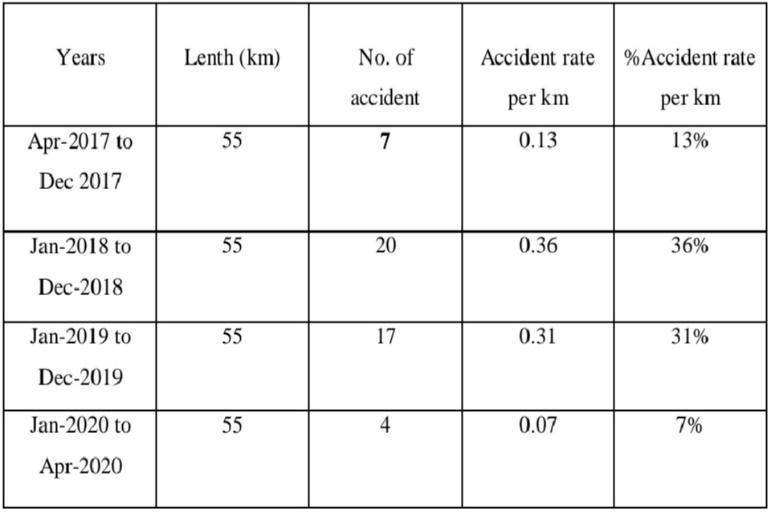
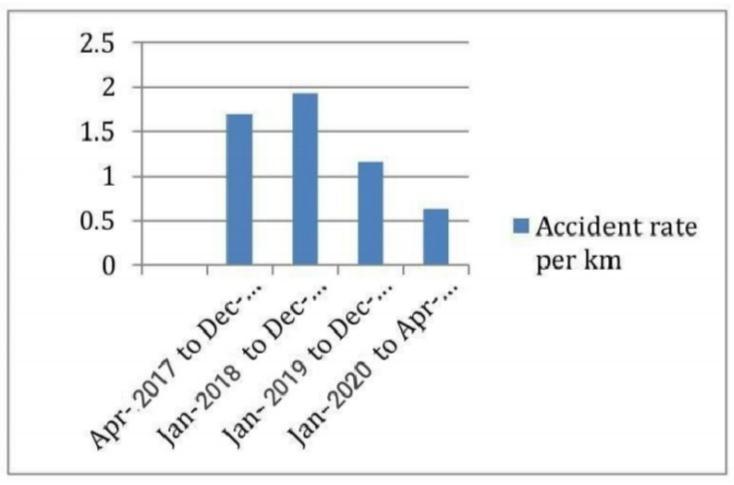
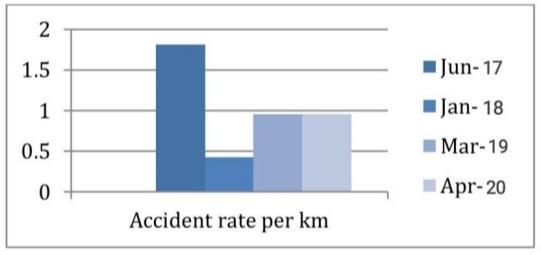
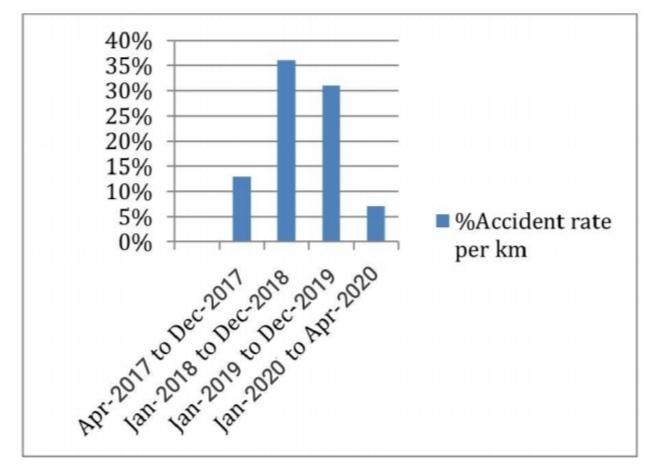
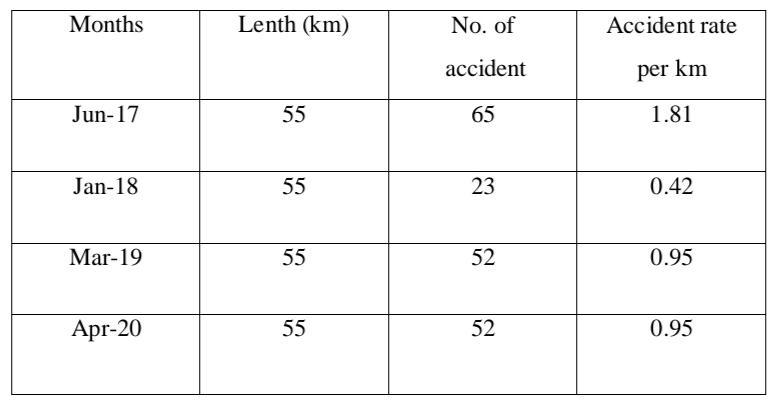
Accordingly, the number of accidents of all categories per km of each highway and street classification is used to indicate the total accident hazard. R=A/L Where L is the length of the control section in kilometres, A is the total numberofaccidentsthatoccurredduringtheyear,andRis the overall accident rate per km. Accident rate from April 2017toApril2020,allaccidentsincluded(Fatal,Grievous, Minor)
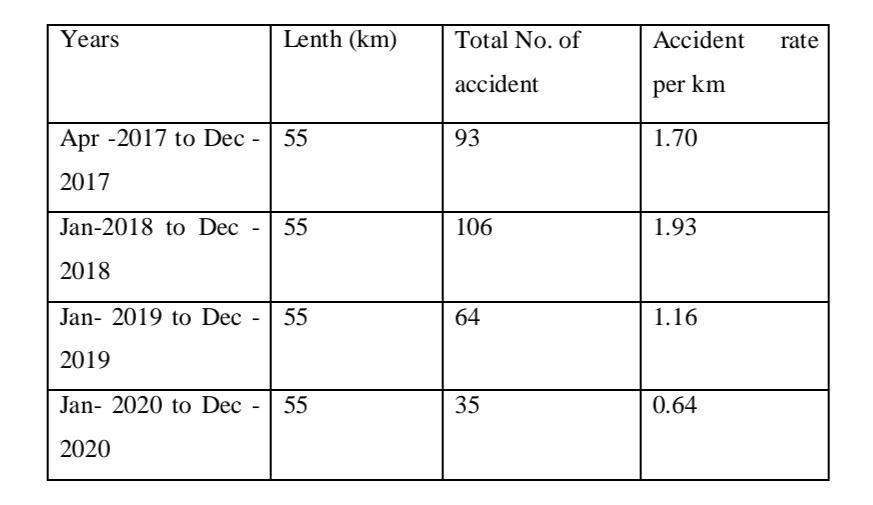
Fig 5 – TotalAccidentRateAmravatitoTalegaon
Fig 6 – TotalAccidentRateperkm AccidentRateApril2017toApril2020forFatal
Fig 7 – AccidentRateofFatalAmravatitoTalegaon
International Research Journal of Engineering and Technology (IRJET) e-ISSN: 2395-0056
Volume: 09 Issue: 10 | Oct 2022 www.irjet.net p-ISSN: 2395-0072
Accordingly, the number of accidents of all categories per km of each highway and street classification is used to indicatethetotalaccidenthazard.
Where, Ristheannualisedtotalaccidentrateperkm, Aisthe total number of accidentsthat occurredin a given year,and Listhecontrolsection'slengthinkilometres.
In order to fulfil its development objectives, Automated HighwaySystemsofferssignificanttransportationbenefits in terms of safety, efficiency, affordability and usability, as wellastheenvironment.
The division of the various control functions into discrete layers with well defined interfaces is a crucial component of the control design architecture. Each layer is then built with its own model that is appropriate for the functions for whichitisaccountable.
The models at the different layers differ from one another not just in terms of the formal structure (which might range from differential equations to state machines to static graphs), but also in terms oftheentitiesthatplayapartinthem.
The AHS is a sophisticated large-scale control system that requires advancements in communication, actuator, and sensor technology duringitscreation.
The fact that these techniques have developed to thepointwheretheymightbesuccessfullyapplied intheAHSprojectisanindicationoftheadvanced stateoftheart.
Despite what has been said, the failure of numerous federal programmes, like the National Automated Highway System Research Program (NAHSRP), can be attributed to the program's entanglementintechnologicaloptimism.
Numerous examples from AHS demonstrate the lack of both technical and non-technical showstoppers. However, cultural, institutional, and legal problems are equally important to address as technical ones. Furthermore, because theyaresocloselyrelatedtopeople'sperceptions, behaviours, consensus, and social changes based on those, these institutional and societal concerns cannotberesolvedinasingleday.
International Research Journal of Engineering and Technology (IRJET) e-ISSN: 2395-0056
Volume: 09 Issue: 10 | Oct 2022 www.irjet.net p-ISSN: 2395-0072
Creating cutting-edge concepts for futuristic passenger and cargo vehicles. While the majority of preceding projects focused on discrete areas of cities' mobility issues, AUTOMATED HIGHWAY SYSTEM focuses on the larger issue of urban transportation.
Disseminating new instruments for controlling urban transportation. AUTOMATED HIGHWAY SYSTEM will create tools that can assist cities in overcoming barriers that are keeping them from implementing cutting-edge technology. Examples include the lack of certification processes and the lackofviablebusinessmodels.
Eliminatingobstaclesthatpreventthewidespread adoptionofautomatedtechnologies.Someofthese restrictions are technological, while others are legaloradministrativeinnature.Forinstance,one such regulation practically forbids driverless cars from utilising public roads since it mandates that thedriverbeincontrolofthevehicleatalltimes.
1. Alexander Novikov & Pavel Pribyl, "ITS Control of Highways Capacity," SPbOTSIC-2016, St. Petersburg, Russia, 28-30 September 2016, 12th International Conference "Organization and Traffic Safety Management inLargeCities".
2."AutomatedHighwaySystem(PunetoMumbai)InIndia" by Sangeeta Mishra and Ajinkya Bavane, published in International Journal of Innovative Research in Science, Engineering,andTechnology,Vol.7,Issue5,May2018
3. "Automated Highway System," International Journal of AdvanceEngineeringandResearchDevelopment(IJAERD), Volume,NayanR.WasekarandAsst.Prof.FerozH.Khan
4.January 2017, Volume 4, Number 1, e-ISSN 2348-4470 Dr. Om Prakash and Sanju Meena, "The Study on Automated Highway Systems," The 2017 ISSN for the Imperial Journal of Interdisciplinary Research (IJIR) is 2454-1362,Volume3,Issue4.
5.Thepaper"AHS"byPetrosA.Ioannou.includesanindex and bibliographical references. ISBN 978-1- 4419-3264-8 DOI 10.1007/978-1-4757-4573-3 (eBook) ISBN 978-14757-4573-3
2022, IRJET | Impact Factor value: 7.529 | ISO 9001:2008 Certified Journal |