International Research Journal of Engineering and Technology (IRJET)
e-ISSN: 2395-0056
Volume: 09 Issue: 10 | Oct 2022
p-ISSN: 2395-0072
www.irjet.net
Stabilization of Black Cotton Soil through Zinc Slag Divyam Jethva, Prof. Ankita Sharma 1Divyam
Jethva, Student, Parul University, Vadodara, Gujarat. Sharma, Professor, Department of Transportation Engineering, Parul University, Vadodara, Gujarat. ---------------------------------------------------------------------***--------------------------------------------------------------------1.1 Need of the study Abstract - The development of a nation's economy is the 2Ankita
goal of industrialization. The environmental contamination caused by the byproducts and waste materials produced throughout the process is a key negative aspect among many others that are ignored in this process of economic progress. Since raw materials are at the heart of industrialization, many businesses rely heavily on non-renewable resources. As a result, non-renewable trash and byproducts are being produced at an increasing rate. One such hazardous waste substance is zinc slag. The zinc ore is melted at very high temperatures in the blast furnace to produce zinc slag. Globally, expanding soils and black cotton soil are major issues. It is regarded as a natural hazard because of its ability to expand and contract and the considerable harm it may do to buildings. But if the soil is adequately stabilized and maintained, these risks may be avoided. In order to stabilize the black cotton soil, this study uses modest amounts of fly ash and zinc slag to act as a binding agent between the slag and the soil.
The traditional techniques for stabilising the black cotton soil include largely applying lime and brick powder to the soil. Although expensive, these traditional techniques are efficient. These two materials range in price from 8 to 15 rupees per square metre, depending on the material's grade, whereas zinc slag is priced between 2 and 5 rupees per kilogramme. As a result, this approach is not only efficient but also cost-effective. Additionally, by effectively using the zinc slag, this process minimize any negative environmental effects. This strategy of stabilising black cotton soil is thus superior to traditional ways from both an economic and environmental standpoint.
1.2 Black Cotton Soil The Black Cotton soils have a very poor bearing capacity and are very compressible. The soils have excellent qualities for shrinkage and swelling. The soils have a very weak shear strength. Expansive soil is another name for black cotton soil.
Key Words: Black cotton soil, Fly Ash, Zinc Slag, Stabilization, Industrialization.
1.INTRODUCTION Black Cotton Soil is a cohesive soil. For civil engineers, it is a challenging or troublesome soil. It has the ability to swell during wet seasons and contract throughout the summer. It presents issues in both scenarios. When the Black Cotton Soil expands during the rainy season, the structure experiences uplift pressure, which causes heave in the foundations, plinth beams, first floors of buildings, canals, road surfaces, etc. When the soil contracts during the summer, walls, slabs, plinth protection, floors, etc. develop cracks due to shrinkage.
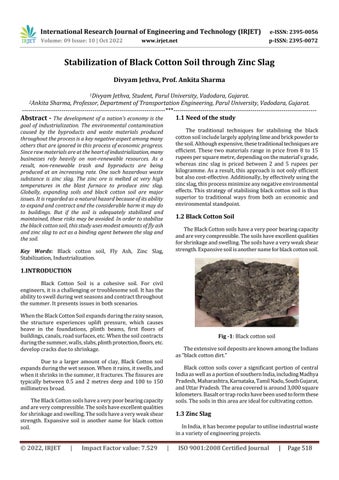
Fig -1: Black cotton soil The extensive soil deposits are known among the Indians as "black cotton dirt."
Due to a larger amount of clay, Black Cotton soil expands during the wet season. When it rains, it swells, and when it shrinks in the summer, it fractures. The fissures are typically between 0.5 and 2 metres deep and 100 to 150 millimetres broad.
Black cotton soils cover a significant portion of central India as well as a portion of southern India, including Madhya Pradesh, Maharashtra, Karnataka, Tamil Nadu, South Gujarat, and Uttar Pradesh. The area covered is around 3,000 square kilometers. Basalt or trap rocks have been used to form these soils. The soils in this area are ideal for cultivating cotton.
The Black Cotton soils have a very poor bearing capacity and are very compressible. The soils have excellent qualities for shrinkage and swelling. The soils have a very weak shear strength. Expansive soil is another name for black cotton soil.
© 2022, IRJET
|
Impact Factor value: 7.529
1.3 Zinc Slag In India, it has become popular to utilise industrial waste in a variety of engineering projects.
|
ISO 9001:2008 Certified Journal
|
Page 518