International Research Journal of Engineering and Technology (IRJET) e-ISSN: 2395-0056

Volume: 09 Issue: 10 | Oct 2022 www.irjet.net p-ISSN: 2395-0072
International Research Journal of Engineering and Technology (IRJET) e-ISSN: 2395-0056
Volume: 09 Issue: 10 | Oct 2022 www.irjet.net p-ISSN: 2395-0072
1Department of Mechanical Engineering, Sardar Patel College of Engineering, Maharashtra, India
2 Department of Mechanical Engineering, Sardar Patel College of Engineering, Maharashtra, India ***
Abstract - Recent aeronautical research reveals that a variety of potential aircraft designs, including those powered by hydrogen, alternative energy sources, and electricity, are currently being explored. The reduction in harmful pollutants while flying is what distinguishes them from conventional airplanes with regard to the potential improvementinenvironmentaleffects.onlyaftertakinginto consideration and analyzing the whole environmental impact over the course of a life.[1] To calculate the overall electrical environmental impact, of hydrogen, and alternativelyfueledaircraft, theparadigm for modeling and assessing air-handling technology is presented in this paper, which also gives a summary of the issues and strategies being used in this field right now. The initial step involves conceptually designing future concepts using the fundamental requirements of conventional aircraft. The concepts' environmental impact is then evaluated using such a life cycle assessment. Future designers' utilization of ecologically friendly materials is significantly influenced by electricity. To determine which parts of the proposed strategy have been covered in the studies published and which still need additional research, a rigorous search and screening methodology is used. Future designs may only greatly lessen their impact on the environment if a substantial part of renewable energy sources is used in the electricgenerationprocess.[2][3]
scientificliteratureand implementationinairplanessince environmental preservation is becoming more crucial in civil aviation. Although today's airplanes are largely intended to achieve the lowest Direct Operating Costs (DOC), it is pretty evident that good environmental preservation may be accomplished if Environmental Impact (EI) is minimized and used as the primary goal in plane design optimization. EI can be calculated using an ISO 14040 Life Cycle Assessment (LCA) covering the complete life cycle. LCA is characterized as the gathering andexaminationofdata on inputs,outputs,potential,and product systems during the duration of a system's life cycle.
The aviation industry's relatively large impact on climate changehasdrawnmoreattentioninrecentyearsbecause of the continued rise in passenger air freight and cargo transportation. About 2.5% of the world's CO2 emissions and non-carbon emissions are related to energy that affects the climatic system's radiative forcing and are producedbytheaviationindustryalone(RF).Thestudyof electric propulsion, the electrification of flight systems, and investment management in electric and hybrid aircraft designs have all increased steadily in the aviation industry.[4]Researchonliquidhydrogenisbeingdonefor industries like aviation safety, where electric, hydrogen, and hybrid planes could help the International Civil Aviation Organization achieve its motto. This paper highlightsthepotentialenvironmentaladvantagesofthese noveltechniquesandprovidesaresearcherfocus ontheir
As usually said, many aspects of a plane are computed begin early in the design phase, and don't change. The same is true for an airplane's EI, which is established by choices made during the conceptual design phase. As a result, the conceptual design must contain an LCA rather than just studying the contaminants that are released during aircraft operation. To summarize: An important design criterion that incorporates an LCA (calculating EI) into the target function for optimizing aircraft at the conceptual design stage is environmental preservation and protection. Despite continual improvements in air travel, fuel economy, and more efficient operational processes, the global demand for airline travel is rapidly drivingupoverallaircraftemissions.[5]Airtrafficdemand is forecast to increase on average by 4.5% yearly, while efficiency improvements are anticipated to happen at up to 1.5% yearly rates. Despite continual improvements in air travel, fuel economy, and more efficient operational processes, the global demand for airline travel is rapidly drivingupoverallaircraftemissions.Airtrafficdemandis forecast to increase on average by 4.5% yearly, while efficiency improvements are anticipated to happen at up to 1.5% yearly rates. If no significant improvements are made in comparison to road traffic, aviation-related CO2 emissionswouldlikelydualortripleuntil2050duetothe lengthy lifespan of aircraft (20–30 years). The aircraft sector is also criticized for a number of additional consequences, such as noise pollution, especially in areas close to airports. Traditional aircraft technological efficiency advancements are not enough to significantly reduce aviation's environmental impacts while also meeting the Paris Agreement's CO2 goals and Flightpath 2050's emission-reduction targets. On the other hand, airplane operation that is both sustainable and energy-
International Research Journal of Engineering and Technology (IRJET) e-ISSN: 2395-0056
Volume: 09 Issue: 10 | Oct 2022 www.irjet.net p-ISSN: 2395-0072
efficient can be facilitated by hybrid-electric and other electric-only propulsion systems. Here, fuel-cell-based, battery-powered, and possibly even hybrid-electric concepts of propulsion are used in place of conventional kerosene-powered jet engines to significantly reduce inflight Greenhouse Gas (GHG) production. Bio-feedstocks are used to find separate fuels for jet engines, and therefore electro fuels (e-fuels), that are produced using RES, have also been recognised as potential replacements for gasoline as a fuel and energy source. Indeed, research and development into reduced weight techniques has decreased aircraft weight and, like a result, fuel usage. Although cutting-edge technology can reduce in-flight emissions, other life cycle stages, such as raw material acquisition, production, and end-of-life, may have a greater impact on the environment (EoL). [6] As a result, there may be significant changes to the global flow of materialandenergyassociatedtotheaviation sector.Biofeedstocks are used to find separate fuels for jet engines, and therefore electro fuels (e-fuels), that are produced using RES, have also been recognised as potential replacements for gasoline as a fuel and energy source. Indeed, research and development into reduced weight techniqueshasdecreasedaircraftweightand,likearesult, fuel usage. Although cutting-edge technology can reduce in-flight emissions, other life cycle stages, such as raw materialacquisition,production,andend-of-life,mayhave a greater impact on the environment (EoL). As a result, there may be significant changes to the global flow of material andenergyassociatedtotheaviation sector. The supply of rechargeable batteries is linked to energyconsuming activities carried out in the automobile industry, which have an impact on more than only greenhousegasemissions.[7]Furthermore,itisnecessary to factor in the cost planning for new aircraft techniques. Because they require extremely little maintenance and repair and because electricity is a less expensive energy sourcethankerosene,electricairplanes,forexample,may be less expensive to operate. However, costs associated with production and recycling may be greater than they are for planes with kerosene-based engines. Social problemsarealsomorelikelytoariseatthebeginningofa lifecycle.Forinstance,theresourcesrequiredtobuildthe cellsusedinelectric airplanes arerareandvital,andthey must be mined in underdeveloped nations where child labour, corruption, and unsafe working conditions are common.Similartothis,producingtheidealfeedstocksfor theproductionof biofuelscompetes withfoodproduction andmightnotbewellreceivedbythelocals.Evaluationof the product's life cycle viability of developing airplane methods is required within this framework. A framework for modelling and assessing the assessment methods of proposed aircraft technology has in fact been built in order to appropriately conduct a literature assessment. Planes with kerosene-based engines. Social problems are alsomorelikelytoariseinthebeginningofalifecycle.For instance, the resources required to build the cells used in
electric airplanes are rare and vital, and they must be mined in underdeveloped nations where child labour, corruption, and unsafe working conditions are common. Similar to this, producing the ideal feedstocks for the productionofbiofuelscompeteswithfoodproductionand mightnotbewell receivedbythelocals.Evaluationofthe product's life cycle viability of developing airplane methods is required within this framework. A framework for modelling and assessing the assessment methods of proposed aircraft technology has in fact been built in order to appropriately conduct a literature assessment. Technology advancements in aircraft, sustainability considerations, indicators, evaluation procedures, life cycle phases, strategy and tactics of multi-disciplinary (research) data are all taken into account. This enables a thorough assessment of sustainability that considers the particulars of upcoming technical developments in aviation.Intheliteraturenowavailable,thisparadigmhas not yet been introduced, and the majority of studies that are currently available concentrate on certain sustainability factors or particular technologies. These studies have still not been thoroughly analysed. This paper's goal is to close a gap in research by thoroughly analysing the tools and techniques for evaluating and creating potential sustainable aviation technology. The components of the framework that have been thoroughly studied and those that still need more research are outlinedintheoverviewthatfollows.
According to the "Our Shared Future", Brundtland Commission's Report, the present generation should live sustainably in order to protect generations' possibility of living comfortably. The "triple bottom line," or the three components of sustainable development, are often addressed (environmental, economic as well as social). In contrast to the idea of relative sustainability, which is anchored in environmental and social dimensions, the concept of absolute sustainability has recently gained recognition. [8] The term "sustainable-oriented development inside the spectrum of one to multiple product life cycles'' has been used to define a Life Cycle Engineer (LCE) idea, which broadens the focus to include all three sustainability pillars. The LCE idea seeks to steer engineering procedures in a sustainable path from conceptionthroughdisposal.Giventhecurrentshiftinthe aviation sector toward new aircraft technology, the sustainabilityofevolvingflightsystemsandtheirpotential to reduce their environmental effect will depend on environmental components at each stage of their life cycles. An adaptive management modeling paradigm, showninFigure1,makesitpossibletoassessandenhance the production process as well as its interactions with relevant organizational components and the outside
International Research Journal of Engineering and Technology (IRJET) e-ISSN: 2395-0056
Volume: 09 Issue: 10 | Oct 2022 www.irjet.net p-ISSN: 2395-0072
environment. This section introduces the sustainability components and modeling methodologies for integrating multiscale physiologic, environment, or social and economicmodelsinordertoforecastthefutureofaviation.
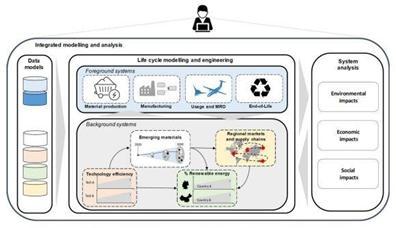
TherequirementforaunifiedLCEmodelingtechniquethat permits the production of a sizable number of profiles on the basis of changes in technology, geography, and also temporal characteristics makes it possible to conduct a meaningfulsustainabilityreviewofthefutureexpansionof aviation. The framework incorporates three modeling and function-buildingsystemsintoanindividualdatamodeling platform, as shown in Figure 1. [9] It contains model librariesthat display possible systemsin highcontrast(cf. statistical models), models that illustrate how the backgroundofthesysteminteractswiththeforegroundof the system, and models that depict the simulation used in engineering and life cycle modeling. The integrated model is also connected to data analytics techniques that enable the incorporation of key metrics as technological limitations in the advancement of these nanotechnology product chains, algorithms for assessing item chains with respecttotheirimpactsonsocietyandsociety,andSystem analysis. The relationship between each area of the framework and the engineering and assessment of emergingaviationtechnologyisclarifiedandreinforcedin the sections that follow. The necessary research problems are derived using the framework that was previously described.
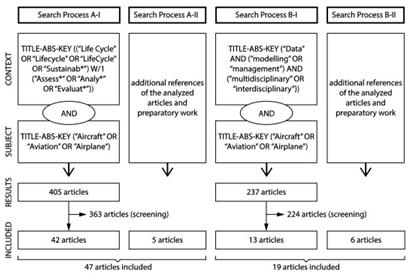
ThearchitectureofthesearchphrasesisshowninFigure2. Life-cycle sustainability-related terms and phrases are containedinthesearchquery"A".[10]
Now, in the framework of the particular frame and the proposedresearchquestions,arigoroustechnicalreviewis being applied to the study's objective. To ensure completeness and lessen the possibility of bias when selectingthelinkedarticles,athoroughsearchmethodwas applied. Based on the research objectives of this study, which are listed in upcoming sections, precise keywords were chosen and a set of multilayered search strings that describe the surroundings and the subject were created.
Toemphasizethegrowing significanceofinterdisciplinary data information in sustainability assessment and evaluation, query string "B" with the situation-specific (Multidisciplinary/Interdisciplinary Data Modeling/Management) is added to Assessment, Analysis, and Assessment (Aircraft, Airplane, and Aviation) for the samesubjects.TheScopusdatabasefromElsevierprovides in-depthanalysisandthoroughcoverageofmajorscientific literature. Utilizing data export, these searches were conducted in November 2019. [11] The outcomes of the information retrieval method were thoroughly screened. First, using technical criteria, only English-language publications which would be thoroughly examined were selected.Extrasymposiumpapersarebeingutilizedforthe study of the climate consequences of aviation and for building the methodology discussed in this paper, as opposed to publications from peer-reviewed scientific journals.Second,thecontentcriteriaforthedescriptionsof the reviewed papers were examined. The search process only includes papers that analyze the existing assessment ofbothconventionalandnewaviationpropulsionsystems. A.Duringthesearchprocess,onlypapersthataddressthe use of interdisciplinary models and/or product portfolio planning or maintenance are taken into consideration. B. The search process only includes papers that analyze the existingassessmentofbothconventionalandnewaviation propulsionsystems.A.[12]Duringthesearchprocess,only papers that address the use of interdisciplinary models and/or product portfolio planning or maintenance are taken into consideration. B. The entire contents of the objectsthatwerestillinthesystemhavebeengatheredin order to find the pertinent information. The assessment database (search operations A-II and B-II), which consists offorty-sevenpapersforscanningprocessAwithnineteen papers for research phase B, has been updated to include
International Research Journal of Engineering and Technology (IRJET) e-ISSN: 2395-0056
Volume: 09 Issue: 10 | Oct 2022 www.irjet.net p-ISSN: 2395-0072
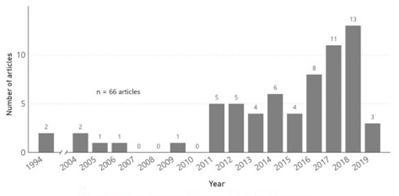
manyreferencesfoundduringthisphase.Thiscontribution analysesroughly66itemsintotal.
SeveralLCEanalysis ratingsystemswere usedtoevaluate these papers. Despite the 1990s LCA techniques' success, since 2010 there has been a concern about the sustainability of aviation combust systems and solutions. Notably, in 2017 and 2018, more study in this field was finished.
Accurate as well as complete multi-disciplinary structures playakeyroleinensuringeffectiveLCAresultsbymeeting the necessity for databases of LCI to assess the climate consequencesofnewaviationtactics,asdetailedin earlier section[16] Thus, methods that help organize multidisciplinary statistics have gained importance in the fieldofenvironmentallyfriendlyflying.
Numerous framework components have already been discussed in scientific literature evaluations, according to the study's analysis. There are still significant research gaps,nevertheless.Thekeyfindingsofthisstudyhavebeen outlined in the following part in order to address the researchquestionsindicatedinearliersection
The goals of the Paris Agreement, an increase in the price ofkerosene,andmodificationstothelegislativeprovisions of the framework, which include the European Union Emissions Trading System (EU ETS) and the Carbon Offsetting and Reduction Scheme, may all be significant contributingfactors.(CORSIA)[13][14]
Thenextpartfocusesoncategorizingthereviewedarticles discovered usingsearchtechnique A before goingthrough a thorough analysis of the evaluation results in the previous section for just a better comprehension of the worksofliteratureunderinvestigation.
Depending on the innovations suggested to create a more self-sustaining airplane launch process, the identical dimensions and markers examined, and the assessment methodologies used, the descriptive research design of publicationsiscarriedout.
The search strategy A-selected articles are initially discussedin thissection interms of the innovationstaken into consideration, the sustainable development features and markers applied, as well as the evaluation techniques used. This provides a preliminary framework and classification of the data and serves as the prelude to the upcomingsection’sin-depthanalysis.[15]
This part examines the chosen study in light of the fundamental components of the created framework.
Theenvironmentalimpactoftheaviationindustrycouldbe significantly reduced by using electricity or hydrogen in place of jet fuel since the procedure of battery-powered and hydrogen planes seems to be unconnected to emissions of carbon dioxide from fuel combustion. However, these CO2 benefits must be taken into account over the course of a specific life span and can only be attained if electric power or other hydrogen sources are derived from low-carbon sources. As an illustration, 98 airports globally had solar energy projects built as of 20151,andthenumberincreasedovertime.Thankstothe quickgrowthofrenewableenergyproductionandtheease of access at airports, electric and hybrid aircraft will be able to charge up in a way that reduces CO2 emissions. Accordingly, using such sources of renewable energy to manufacturehydrogenwouldhaveanegligibleoverallCO2 impact. In addition to cutting Emissions of co2, electric aircraft may boost the environment by doing away with chemtrails, which really are long, thin particles that occur largely in the aftermath of jet engines. Science does not support scenarios involving contrail emissions, although a few studies indicate they might be able to contribute to additionalglobalwarming.Itiscrucialtokeepinmindthat, inregardtoelectricalandhydrogenpropulsion,energyand hydrogenmaybothbeusedinavarietyofwaysinsidethe aviation industry. According to the ICAO's Thumb Rules, electricaltaxiing(E-taxi)maycutCO2byaround33kgfor every single minute ofuse.By using electric enginesas an extrasourceofthrustaftertakeoff,mixedaircraftcanhelp lower fuel usage and contrail production. This makes it possible for the airplane's sailing phase to be powered by smaller,morefuel-efficientengines.Additionally,hydrogen can be utilized for ground-handling vehicles, as demonstrated by runways all over the world. Examples
Factor value: 7.529 | ISO 9001:2008 Certified Journal | Page309
International Research Journal of Engineering and Technology (IRJET) e-ISSN: 2395-0056
Volume: 09 Issue: 10 | Oct 2022 www.irjet.net p-ISSN: 2395-0072
include projects that installed hydrogen fueling stations that manufacture hydrogen locally using the electrolysis method while employing renewable energy sources in Heathrow,Berlin,andLosAngeles.[17]
Fully electric aircraft hold great promise for improved air quality because they don't generate pollutants during fuel combustion. Hybrid-electric planes' reduced fuel consumption may help significantly raise regional air quality standards. In addition, because these components contributetotheemissionsoffineparticles,theyshouldall be taken into consideration when examining the air pollution effects of all types of aircraft, including those poweredbyelectricmotors,brakes,tires,androadsurface erosion.
SuchaswithCO2emissions,itisimportanttoconsiderthe electricity supply while evaluating the native environmentalvaluecomponentsofelectrificationbecause differentenergyproductiontechniquesmaystillcontribute to air pollution. In addition to broad trends, there are additional factors that must be considered. As aircraft become more fuel-efficient,their sizeand weight increase, allowing them to carry more people and fuel. The gas savings provided by higherhybrid model power efficiency could be offset by an increase in gasoline consumption. Therefore,itisclearthathybrid-electricaircraftcontribute toareductioninairpollutionemissionswhenassessedper person, but not necessarily when considered globally. Additionally, battery packs are installed in the majority of hybrid-electric aircraft for power supply and storage. Becauseofthepowerdensityandalsothenecessarypower supply of the battery, batteries as of now are quite heavy andcansignificantlyadduptotheaircraft’sweight.Alongterm approach for electric planes could turn out to be helpfulinassessingtheall-aroundenvironmentalinfluence and sustainability benefits of electric planes.[18] This approach encompasses the entire life span of an aircraft, assisting in the avoidance of social and environmental risks. The batteries being used in such aircraft are presently lithium-ion batteries. This battery's production proceduresmayproducepollutantsthataredetrimentalto both air quality and human health. Additionally, because batteries have a finite lifespan, they produce waste that contains dangerous and corrosive elements like lithium. However, as their use increases, there is room for battery life improvements that will lessen the negative effects on theenvironmentandhumanhealth.Alternativestolithium batteriesthataresustainablearealsobeingdeveloped.
This battery's production procedures may produce pollutants that are detrimental to both air quality and humanhealth.Additionally,becausebatterieshaveafinite
lifespan, they produce waste that contains dangerous and corrosive elements like lithium. However, as their use increases,thereisroomforbatterylifeimprovementsthat will lessen the negative effects on the environment and human health. There are also sustainable lithium battery substitutesbeingdeveloped.
Sinceelectrictrainsdocontainthenoisesourcesconnected to bothjetandcylinder engines,like compression,turbine noise, and more, the propulsion system may result in reduced aviation noise levels. The reduced jet velocities necessary for airplane operation may provide a major decrease in jet noise, depending on the layout of the aircraft.Becauseelectricairplanesproducelessnoise,they mightbemoreappropriateforusageindenselypopulated areas. This is supported by the Uber Uplift project, which aims fora 15 dB decrease in soundcompared toa regular helicopter of equal weight, and the quiet Pipistrel Alpha Electric,whichwillbeutilizedbymodernflightschools.
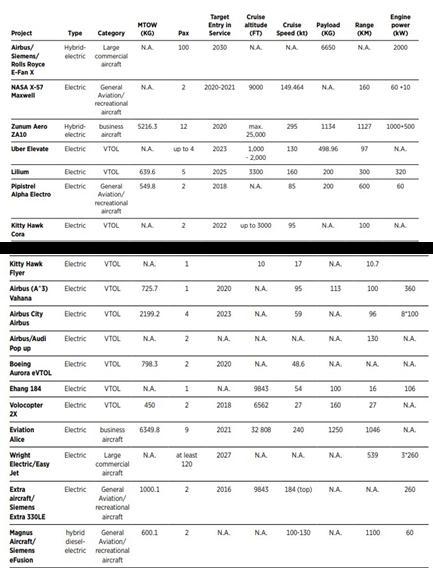
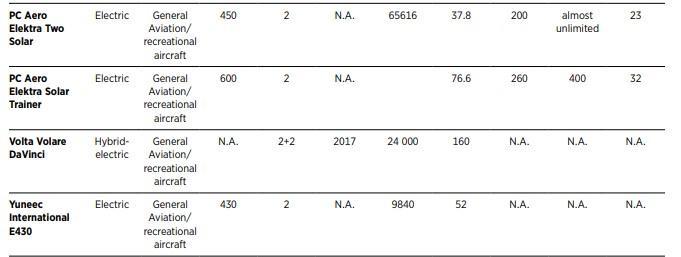
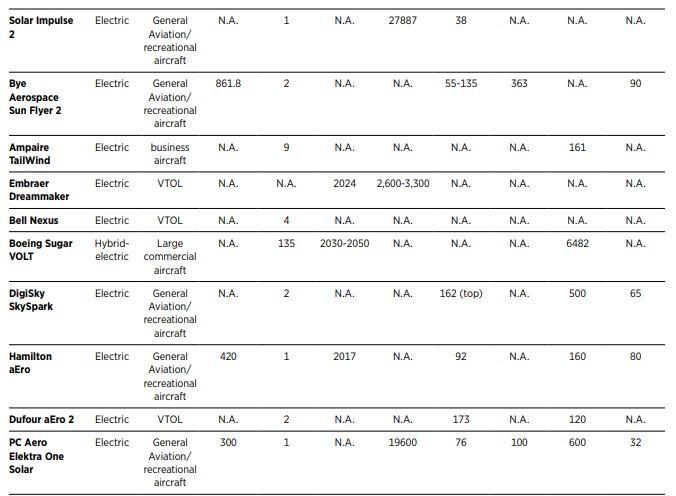
By using the Electric and Hybrid Aviation Platform for Innovation,theICAOSecretariatispresentlyconcentrating on industry advancements in hybrid and electric aircraft configurations (E-HAPI). This paper keeps a nonexhaustive list of innovations that have been widely acknowledged,fromsmallregionalandbusinessaircraftto large commercial planes and vertical takeoff and landing (VTOL) airplanes (also known as electric urban air taxis). Themajorityareanticipatedtoenterservicearound2020 and 2030, however, several are currently available. Four such projects made their first flights in2019.(CityAirbus, Lilium, Sun Flier 2, Bye Aerospace, and Boeing Aurora eVTOL) Such aircraft types are not currently covered by anyICAOenvironmentalregulationsinAnnex16.Byusing the Electric and Hybrid Aviation Platform for Innovation, theICAOSecretariatispresentlyconcentratingonindustry advancementsinhybridandelectricaircraftconfigurations (E-HAPI). [19] This keeps a non-exhaustive list of innovations that have been widely acknowledged, from small regional and business aircraft to large commercial planes and vertical takeoff and landing (VTOL) airplanes (also known as electric urban air taxis). The majority are anticipated to enter service around 2020 and 2030, however, several are currently available. Four such projects made their first flights in 2019. (City Airbus, Lilium, Sun Flier 2, Bye Aerospace, and Boeing Aurora eVTOL) Such aircraft types are not currently covered by anyICAOenvironmentalregulationsinAnnex16.
e-ISSN: 2395-0056

Volume: 09 Issue: 10 | Oct 2022 www.irjet.net p-ISSN: 2395-0072
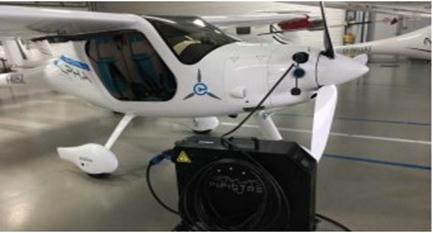
ThePipistrelAlphaElectriciscurrentlya2-seatinstructor witha1.5-hourreserveendurance,itistrue.Withover60 operational aircraft globally, it is the first certified allelectric aircraft. It is more appropriate for use by flight schoolsbecauseitsrunningcostsaverage1Europerhour. [20]
AircraftwithMTOWbetween300and1000kgfallintothe general aviation/recreational airliner category. Typically, they are two-seat electric aircraft. This category consists of certified and built aircraft like the Pipistrel Alpha Electro.
Boththebusinessandregionalaircraftcategoriesboastof improved seat capacities and a nearly 1000 km longer claimed range of travel (nearly ten). A full-scale reproduction of the Variant Alicewasonlyon displayjust atParisAirShow.Withseatingcapacitiesrangingbetween oneandfive,MTOWsbetween450and2200kg,andflying lengths between 16 and 300 km, the VTOL sector has advanced significantly recently. [21] These designs for electric-only airplanes will go into service between 2020 and 2025. Single-aisle, hybrid electric airplanes from Airbus and Boeing with seat capacities ranging from 100 to135 peopleare part of themassivecommercial aircraft programandareexpectedtoenterservicearound2030.
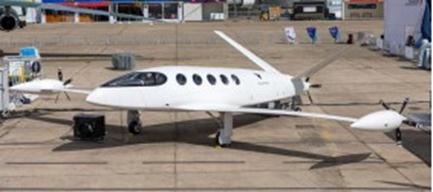
TheEviationAliceisbuiltto goover650kilometersatan airspeedof240knotswith9passengersand2captainson board.Three260kW(350hp)turbochargersproducedby Siemens eAircraft company, who Rolls-Royce just acquired, provide its power. The battery makes up much to60%oftheaircraft'stotaltakeoffweightwithamassof 3,700kg.AccordingtoastatementfromEviation,CapeAir, a local aircraft company in the United States, will buy the Eviation Alice for an estimated $4 million per aircraft. Eviation anticipates certification by the end of 2021, and shipmentswillstartin2022.[22][23]
International Research Journal of Engineering and Technology (IRJET) e-ISSN: 2395-0056
Volume: 09 Issue: 10 | Oct 2022 www.irjet.net p-ISSN: 2395-0072
InordertoaidLH2integrationandacceptance,EnableH2 will also offer a strong safety audit that will describe and reduce risks. The plan will offer a road map for creating inclusive aviation and propulsion systems, as well as essentialenablingtechnologies,toTRL6by2030–2035.
To evaluate a 2MW hybrid-electric rocket engine, Airbus developed the E-Fan X in partnership with Siemens and Rolls-Royce.OneoftheBritishAerospaceRJ100'sfourgas turbineswillbereplacedwitha2MWelectricmotor.
InordertoaidLH2integrationandacceptance,EnableH2 will also offer a strong safety audit that will describe and reduce risks. [24]The plan will offer a road map for creatinginclusiveaviationandpropulsionsystems,aswell as essential enabling technologies, to TRL 6 by 2030–2035.
To evaluate a 2MW hybrid-electric rocket engine, Airbus developed the E-Fan X in partnership with Siemens and Rolls-Royce.OneoftheBritishAerospaceRJ100'sfourgas turbineswillbereplacedwitha2MWelectricmotor.
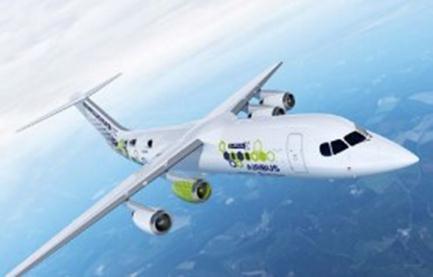
In2020,flighttestingisexpectedtostart.TheE-FanXwill be used by Airbus to set requirements for electricoperatedaircraftaswellasconductresearchintothermal stresses,electricalthrustcontrol,heightanditsimpacton electric systems, and electromagnetic compatibility difficulties.In2020,flighttestingisexpectedtostart. [25] TheE-FanXwillbeusedbyAirbustosetrequirementsfor electric-operated aircraft as well as conduct research into thermal stresses, electrical thrust control, height and its impact on electric systems, and electromagnetic compatibilitydifficulties.
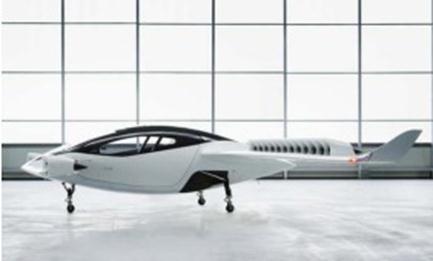
The tilt-jet Lithium Jet comprises 36 motors mounted on its wings. It will be capable of carrying a pilot plus four passengers and reach a top speed of 300 kilometers per hour. When compared to traditional helicopter designs, the ducted engine architecture is anticipated to reduce noise.InMay2019,theLiliumJetcompleteditsfirstflight; before2025,itisanticipatedtoreallybefullyfunctionalin allmajorcities.[26][27]
The shift to more environmentally friendly and energyefficient aircraft is unmistakably linked to an increase of technological solutions capable of resolving the environmental issues that the aviation industry is now facing.Therearetechnologicaldevelopments,especiallyin theareaofalternativepowertrains.Jetenginesthatrunon fossilkerosenearebeingproposedasareplacement,while alternativesincludebatteryandhydrogenfueljetengines, e-fuels, and biofuels. These technologies may lower aviation emissions, but they could also create new environmental and social problems. The framework for estimating and evaluating the sustainability of potential
International Research Journal of Engineering and Technology (IRJET) e-ISSN: 2395-0056
Volume: 09 Issue: 10 | Oct 2022 www.irjet.net p-ISSN: 2395-0072
future advances for even more environmentally friendly butalsopowerfulaviationisintroducedinthispaper.The components of the framework that have already been extensively discussed in the research journals as well as the requirement for more research were determined by a comprehensiveliteraturereview.Studiesondatatypesfor creating foreground and background systems are widely available.
An excellent basis for the simulation of product design is provided by models like CPACS. However, there is currently a lack of a direct connection to sustainability evaluation, especially to well-known sustainable assessment techniques like LCA, LCC, SLCA, or LCSA. For system analysis as well as product lifecycle modeling, therehasalreadybeenasignificantamountofstudy,with alternativefuelspredominating.
It has been emphasized that additional study is necessary to evaluate batteries and hydrogen fuel in terms of socioeconomic and environmental concerns. To comprehend the consequences of prospective aviation technology further than the use stage, models are required. We still don't know how the extraction of necessary raw materials and challenges in the EoL stages willbeaffected.Itisadvisedtocarryoutmorestudiesthat go beyond employing new technologies to reduce GHG emissions, like examining how altering flight height influences the amount of impact aircraft contrails are having on the environment. Furthermore, not only socioeconomic studies must be incorporated into the LCA, as well as the relevant signals must be cautiously identified in the given environment in order to provide a coherent and thorough assessment of sustainability for future aviation development. Further research is needed to determine the conditions under which battery-powered aircraft were significantly more environmentally benign than hydrogen-powered aircraft. The approach described here, which would be based on the idea of enhancing learning LCE, makes it simpler to model a wide range of technologies or mechanisms while dealing with high data ambiguity and variable fluctuation. Future aviation techniques can be made more environmentally and power-efficient by merging multi-scale physical, environmental,andsocio-economicmodelsandlookingat the circumstances in which a particular technology might be more so as a result, this strategy can help engineers createandrunmoreenvironmentallyfriendlyaircraftand increase the functionality of the suggested tools and procedures in aviation. The development of new and inventive technologies and airplane energy sources is accelerating. The possible effects of these changes on the ICAOSustainabilityGoalsarebeingattentivelywatchedby ICAO. To maintain pace with timely environmental approval of these technical advancements, if necessary, ICAOwillneedtoputinasignificantamountofwork.
1. Sims, R.; Schaeffer, F.R.; Creutzig, X.; Cruz-Núñez, M.; D’Agosto, D.; Dimitriu, M.J.; Figueroa Meza, L.; Fulton, S.; Kobayashi, O.; Lah, A.; et al. 2014: Transport. In Climate Change 2014: Mitigation of Climate Change: Contribution of Working Group III to the Fifth AssessmentReportoftheIntergovernmentalPanelon ClimateChange;Cambridge University Press: Cambridge,UK;NewYork,NY,USA,2014.
2. Lee,D.S.;Fahey,D.W.;Forster,P.M.;Newton,P.J.;Wit, R.C.N.; Lim, L.L.; Owen, B.; Sausen, R. Aviation and global climate change in the 21st century. Atmos. Environ.2009,43,3520–3537.[CrossRef][PubMed]
3. Airbus. Cities, Airports & Aircraft: Global Market Forecast 2019–2038. Available online: https://gmf.airbus.com/(accessedon 25 September 2019).
4. Boeing. Commercial Market Outlook 2019–2038. Available online: https://www.boeing.com/commercial/ market/commercial-market-outlook/ (accessed on 25September2019).
5. International Civil Aviation Organization (ICAO) On Board: A SustainableFuture 2016 Environmental Report.Available online: https://www.icao.int/environmental-protection/ Pages/env2016.aspx (accessed on 25 September2019).
6. Gnadt, A.R.; Speth, R.L.; Sabnis, J.S.; Barrett, S.R.H. Technical and environmental assessment of allelectric 180-passenger commercial aircraft. Prog Aerosp.Sci.2019,105,1–30.[CrossRef]
7. Gössling,S.; Upham, P.ClimateChangeandAviation: Issues, Challenges and Solutions; Earthscan: London, UK;Sterling,VA,USA,2009.
8. Ploetner, K.O.; Miltner, L.; Jochem, P.; Kuhn, H.; Hornung, M. Environmental life cycle assessment of universally-electric powered transport aircraft. In Proceedings of the Deutscher Luft- Und Raumfahrt Kongress, Braunschweig, Germany, 14 September 2016.
9. Timmis,A.J.;Hodzic,A.;Koh,L.;Bonner,M.;Soutis,C.; Schäfer, A.W.; Dray, L. Environmental impact assessment of aviation emission reduction through theimplementationofcompositematerials.Int.J.Life CycleAssess.2015,20,233–243.[CrossRef]
10. Toyota Motor Corporation. The MIRAI: Life Cycle Assessment for Communication. 2015, pp. 1–31. Available online: https://global.toyota/en/sustainability/esg/chall
International Research Journal of Engineering and Technology (IRJET) e-ISSN: 2395-0056
Volume: 09 Issue: 10 | Oct 2022 www.irjet.net p-ISSN: 2395-0072
enge2050/challenge2/lca-and-eco-actions/ (accessedon10November2019).
11. Thies, C.; Kieckhäfer, K.; Spengler, T.S.; Sodhi, M.S. Assessment of social sustainability hotspots in the supply chain of lithium-ion batteries. Procedia CIRP 2019,80,292–297.[CrossRef]
12. Wang, Z.; Osseweijer, P.; Duque, J.P. Assessing Social Sustainability for Biofuel Supply Chains: The Case of Aviation Biofuel in Brazil. In Proceedings of the IEEE Conference on Technologies for Sustainability (SusTech), Phoenix, AZ, USA, 12–14 November2017;pp.1–5.
13. Hauschild, M.Z.; Herrmann, C.; Kara, S. An Integrated FrameworkforLifeCycleEngineering.ProcediaCIRP 2017,61,2–9.[CrossRef]
14. Wheatcraft, L.; Ryan, M. Integrated Data as a Foundation of Systems Engineering: Whitepaper by the Requirements Working Group; International CouncilonSystemsEngineering(INCOSE):SanDiego, CA,USA,2018.
15. Titscher, P.; Schön, P.; Horst, M.; Krewer, U.; Kwade, A. Increasing Energy Densities of Sulfur Cathodes using Dispersing and Calendering Processes for Lithium-Sulfur Batteries. Energy Technol. 2018, 6, 1139–1147.[CrossRef]
16. Cerdas, F.; Thiede, S.; Herrmann, C. Integrated Computational Life Cycle Engineering Application to the case of electric vehicles. CIRP Ann. 2018, 67, 25–28.[CrossRef]
17. UNEP/SETAC Life Cycle Initiative. Towards a Life Cycle Sustainability Assessment: Making Informed Choices on Products. 2011. Available online: http://hdl.handle.net/20.500.11822/8001 (accessed on10November2019).
18. Costa,D.;Quinteiro,P.;Dias,A.C.Asystematicreview of life cycle sustainability assessment: Current state, methodological challenges, and implementation issues. Sci. Total Environ. 2019, 686, 774–787. [CrossRef][PubMed]
19. Hauschild,M.Z.;Rosenbaum,R.K.;Olsen,S.I.LifeCycle Assessment; Springer: Cham, Germany, 2018; ISBN 978-3-319-56474-6.
20. Finkbeiner, M.; Schau, E.M.; Lehmann,A.; Traverso, M. Towards Life Cycle Sustainability Assessment. Sustainability 2010,2,3309–3322.[CrossRef]
21. Swarr,T.E.;Hunkeler,D.;Klöpffer,W.;Pesonen,H.-L.; Ciroth, A.; Brent, A.C.; Pagan, R. Environmental lifecycle costing: A code of practice. Int. J. Life Cycle Assess.2011,16,389–391.[CrossRef]
22. Kicherer, A.; Schaltegger, S.; Tschochohei, H.; Pozo, B.F. Eco-efficiency. Int. J. Life Cycle Assess. 2007, 12, 537–543.[CrossRef]
23. Müller-Langer,F.;Tzimas,E.;Kaltschmitt,M.;Peteves, S. Techno-economic assessment of hydrogen production processes for the hydrogen economy for the short and medium term. Int. J. Hydrogen Energy 2007,32,3797–3810.[CrossRef]
24. Leontief, W. Environmental Repercussions and the Economic Structure: AnInput-OutputApproach.Rev. Econ.Stat.1970,52,262–271.[CrossRef]
25. UNEP/SETAC Life Cycle Initiative. Guidelines for Social Life Cycle Assessment of Products. 2009. Available online: https://www.oeko.de/oekodoc/908/2009-023-e n.pdf(accessedon10November2019).
26. Harzing, A.-W.; Alakangas, S. Google Scholar, Scopus and the Web of Science: A longitudinal and crossdisciplinary comparison. Scientometrics 2016, 106, 787–804.[CrossRef]
27. Moed,H.F.;Bar-Ilan,J.;Halevi,G.Anewmethodology for comparing Google Scholar and Scopus. J. Informetr.2016,10,533–551.[CrossRef]
2022, IRJET | Impact Factor value: 7.529 | ISO 9001:2008 Certified Journal | Page314