International Research Journal of Engineering and Technology (IRJET) e-ISSN: 2395-0056

Volume: 09 Issue: 10 | Oct 2022 www.irjet.net p-ISSN: 2395-0072
International Research Journal of Engineering and Technology (IRJET) e-ISSN: 2395-0056
Volume: 09 Issue: 10 | Oct 2022 www.irjet.net p-ISSN: 2395-0072
Ar. Shweta Ghonge1 , Prof. Sandeep G. Dige2 , Prof. Anjali S. Jadhav3 , Prof. Rakhi Begampure4
1Post Graduate Student, S.P.S.M.B.H S College of Architecture, Kolhapur, Maharashtra
2Principal, S.P.S.M.B.H S College of Architecture, Kolhapur, Maharashtra
3Professor, Dept. of Architecture and Construction Project Management, S.P.S.M.B.H S College of Architecture, Kolhapur, Maharashtra, INDIA. ***
Abstract - The increasing number of natural disasters has focusedemphasisonthenecessitytoSheltertothepopulation. The field research of flood-stricken villages in India's tembhipada reveals a need for emergency shelters that are comfortable, durable, and inexpensive to the affected community.Thispaperoutlinesthedesignprocessofcreating an emergency shelter for displaced individuals in the tembhipada nagar post-flood settlements. The Mithi River's morphologicalrecordsmakeitauniquegeographicallocation that floods annually. We conducted an exploratory inquiry to examine several factors of shelter creation. A limited study of flood-affectedtownswasconductedtobetterunderstandtheir lifestyle and constructed culture. A community engagement meetingandactivity wereplannedandimplementedinorder to arrive at a spatial design brief that adhered to humanitarianprinciples.Weinvestigatedaniterativemethod to developing a Shelter, with continual community consultation.Thefull-scaleprototypeisthengiventoafamily to see howeasy it is to assemble andinstall. The experience of using the shelter kit provides guidance for future modifications. The shelter was found to be suitable for usage in the aftermath of a flood. Because of the community's involvement at every stage of the design process, it is culturally suitable and socially relevant. Furthermore, the study's conclusions include efforts to make it transportable and material durable
Key Words: Disaster, Temporary shelter, Emergency, Flood,andShelter.
Humanitarian needs are rapidly increasing; millions of peoplearedisplacedeachyearasaresultofnaturaldisasters. TheWorldDisastersReport2016predictsthatthenumberof refugeeswillcontinuetoclimboverthenextdecade(1)
Humanitarian shelter assistance is critical in assisting displacedcommunities.Thisarticleaimstocontributetothe implementationanddevelopmentofamoreeffectiverelief and reconstruction procedure. This study focuses on a temporaryshelter,whichservesasanintermediateshelterin the humanitarian shelter relief process. Multiple actors, includingaffectedpeople,community-basedorganizations,
local and central government, non-governmental organizations (NGOs), and international organizations, as wellasdesigners(whomaybearchitectsorengineers)and builders, contribute to the successful implementation of emergency shelters. Two parts of shelter coordination, in particular,arecriticaltogettingtheintendedresults: Implementingastructuredorganizationaldesignand Selecting an acceptable procurement strategy at the rebuildinglevel.
This paper describes a community-based strategy, including programme participants and the system of resources and goods required for effective recovery operations.
Organizingareconstructiondesignprojectnecessitatesa systems approach to establishing the project's mandate. Questionssuchaswhoshouldbeconsideredforparticipation andonwhatbasis,aswellaswhodecidesonparticipation, must be addressed. The challenge is to identify the participantswhilesimultaneouslyguidingtherelationships betweenthem.Thesortofreconstruction,whetheritshould bebuiltand,ifso,whereitshouldbebuilt,andhowtobegin theprojectarethenextissuestobeaddressed(2)
Aconstructionprojectinvolvesawiderangeofplayers, fromprofessionalstobusinessesandartisansfromaspecific context of the building industryinsidea specified national area.Asaresult,theselectedprojectparticipantsarereferred to as a project team, which works together to plan and executetheproject(3)
The annual flooding of the tembhipada displaces approximately a million people, damaging or partially demolishing their homes. Displaced people seek refuge in
© 2022, IRJET | Impact Factor value: 7.529 | ISO 9001:2008 Certified Journal | Page181
International Research Journal of Engineering and Technology (IRJET) e-ISSN: 2395-0056
Volume: 09 Issue: 10 | Oct 2022 www.irjet.net p-ISSN: 2395-0072
government institutions such as schools and other educationalinstitutions.Becausetheannualfloodingoccurs duringthehottestandmosthumidmonthsoftheyear,itwas necessary to investigate a design solution for comfortable living over the lodging supplied surrounding government facilities in the form of tarpaulin/plastic sheet tents. Accordingtothefindingsofastudyofacompletelyeroded hamlet, displaced individuals were forced to live in a decayingcommunityhall,whereladieswereforcedtosleep insidethehallatnightandmenwereforcedtosleepoutdoors in theopen. The sense offamilyand privacy were entirely ignoredinsuchaccommodations,wheredisplacedpersons stayedformorethanfivemonthsorlongeruntiltheycould rebuildtheirhomes.
To comprehend the afflicted community's constructed environment. With community input, an early shelter prototype was created. The prototype goes through an iterativephaseinwhichtheuserassemblyandcommunity participationareassessedforadditionalrecommendations.
The design parameters for humanitarian temporary housinghelpareclassifiedintothreemajorcategories:
collective capabilities ofvulnerable communities iscritical (6).Itisvitaltobefamiliarwiththecultureofthesettlement when dealing with communities. The Co-Design Approach was examined for investigating the design of emergency housinginflood-proneparts.
Table -1: ListofDesignCriteriabasedontheessential qualitiesofhumannecessities
Sr. No Design Criteria Objectives Source 1 Security
2 Permane nce
Feelingofsafetyandsecurity
Ensuringprotectionforthe inhabitantsandtheir belongings.
Protectionfromnatureand otherexternalanti-social factors.
Experienceofcontinuitythat characterisesthehome environment. senseofbelongingand connectionwiththeplace
(IFRC, 2011)
(Haywa rd, 1977)
Basichumanneedssuchasthenecessaryelements ofahomeanditsspaces,thesocialenvironment,andits functions.
The aid organization's settlement standards are exactdrainage,layout,security,water,andsanitation.
Technical standards for standard physical and mechanicalshelterandsettlementproperties.
Intraditionalsocieties,theprocessofhousingisthemost fundamentalcomponentofliving.Individualsandhouseholds wereendowedwiththeknowledgeandsuppliesneededto coexistwiththeecologyoftheareabyprimitivecultures.The household resulted in the creation of the individual's and household's "place" in society (4). Maslow's hierarchy of humanneedsanalysispresentsabriefreflectiononhuman wantsasasourceofmotivationinlife.Athoughtfulshelter designaimedatcreatingafriendlyandfamiliarenvironment couldaidintheusers'recoveryprocessthroughitsuse.We discoveredthatwhenpeoplehavecontrolovertheirliving areaandtheirprivacydemandsareaddressed,theymight experience sensations of comfort and independence. This flexibility allows for relaxation and personal development (5). In this regard, Nobel Laureate Amartya Sen's capacity approachproposesatheoreticalwayforassessingqualityof life and social well-being in humanitarian design. The capability approach is centered on people and their capacities. Because individuals live in groups, families, neighborhoods, and communities, understanding the
3 Personali zation
exclusivecontrolanduseof theenvironment
self-expressionandscopefor customisation
controlofspaceindenseand crowdedenvironments
(Sebba & Church man, 1986; Pennart z,1986) 4 Privacy
soundinsulation
internalpartitions
relationshipswithfamily
(IFRC, 2011) 5 Social Relations hips
communitymeetingplaces
sharedspacesforcooking, washing,cleaningetc.
visualperception
(Smith, 1994) 6 Complexi ty
scopeforcustomised assemblytoavoidconfusion duetorepetition
perceptionofphysiological, environmentalandcultural factors
(UNHC R, 2011)
(Stamp s,2005) 7 Identity (Form, Color, Light)
Space is a fundamental constraint in the post-disaster reconstruction of shelter and settlements. A single unit is typically utilized to execute numerous tasks. Table 2 highlights the design criteria that we considered when arrangingthespace.
© 2022, IRJET | Impact Factor value: 7.529 | ISO 9001:2008 Certified Journal |
International Research Journal of Engineering and Technology (IRJET) e-ISSN: 2395-0056
Volume: 09 Issue: 10 | Oct 2022 www.irjet.net p-ISSN: 2395-0072
LoadBearing
ThermalComfort
Sr. No Design
WaterResistance
Vectorcontrol
FireResistance
Environmentalimpact
ThesettingforthispaperisMaharashtra,astateinIndia. It is vulnerable to natural calamities such as floods, landslides,andearthquakesduetoitslocationinaseismic zone.Floodinghappensintheregionowingtoa varietyof causes,including
HeavyRainfallinshortspaceoftime
• Semicoveredspaces
Objectives 1 SleepingAreas • indoorareawiththeoptimum sizeforsleeping 2 Healthand Hygiene • onelatrineper20individuals tobeconsidered 3 Culinaryactivities • covered space preferably sharedcleananddry 4 Storage • storage of belongings and otherreliefmaterials 5 Washingand cleaning • externally provided facilities ofWASHtobeconsidered 6 Studying • Communityspaceamong sheltersonein100shelters 7 Outdoor playing /playing/ working/meeting
Overtheprevious10years,aidagencieshaveestablished somegeneralguidelinesthathavebeensummarizedinmany instruction booklets. Among the most well-known is The Sphere Handbook (7), which was first produced in 2000 collaborativelybytheIFRCandmanyhumanitarianNGOs.It has a section on the minimum criteria for shelters, settlements, and non-food products. Table 3 contains the criteriaprovidedbyhelporganizations.
Dimensio ns Trans port Cost Appropri ateness Assemb ly Durabilit yand Afterlife
Shelter for 5 Local availa bility of materi al
Per fami ly 150 doll ars
Culturall y and Socially relevant
Prefera bly made bythe user commu nity
Contribut eto reconstru ction
Storm
AggravationofRiverbed
Encroachmentinthefloodplains
Degradation of the catchment area in the form of deforestation
LackofProperControlofLanduse
Tosatisfythepost-disasterreconstructionneed,thecodesign approach, a type of community participation, was used. We conducted a community involvement design exercise with displaced population representatives. The community expressed a desire for collaborative design assistance.Toengagetheparticipantsinthedesignprocess, an intensive technique of sketching talks, prototype, and modellingwasusedtofacilitatearchitecturalfacilitation.We documented the process in order to create a co-design approach.Theactofallowingallmembersofthereliefteam: youngpeopleandadults,menandwomen,authoritiesand contractors,toparticipateinthedesignconversationisthe keytoreducingreliefsituationalienation.
TakingintoaccounttheSPHEREHumanitariancriteria, Shelters were created in collaboration with selected membersoftheaffectedcommunitytosatisfytheneedsof thecommunityandtobe delivered withtheavailabilityof landandotherresources.
The structural and technical requirements of shelter designaretypicallygivenbyaidgroups,andweexaminedthe followingparameters.Theengineeringcalculationsarenot coveredinthispaper.Wedid,however,approachtoverify withpertinentsources.
Tounderstandhowsuchsheltershavebeendevelopedin the past, what types of shelters were involved in specific catastrophes, as well as the disaster's environmental,
© 2022, IRJET | Impact Factor value: 7.529 | ISO 9001:2008 Certified Journal | Page183
International Research Journal of Engineering and Technology (IRJET) e-ISSN: 2395-0056
Volume: 09 Issue: 10 | Oct 2022 www.irjet.net p-ISSN: 2395-0072
economic,technological,andsocioculturalperspectives,were examined.
Design elements determine how well shelters perform and should be developed in collaboration with disaster survivors, government agencies, private industry, and any other parties involved in disaster recovery, such as volunteersandinsurancecompanies,inordertopreventthe environmental,economic,technical,andsocioculturalissues listedbelow,whichiswhatthisresearchaimstodoinorder tomeetthisneed.
Incommunityconsultation,apreliminaryassessmentof the displacement pattern and rehabilitation of a displaced communitywasmade.Auserinterviewwasdonetobetter understandtheimpactofthedisplacementondailyliving.In conjunction with the community, a variety of possible relocation options were investigated. As an emergency refuge,theentirecommunityof75familieslivedina180m2 community hall. Because of the inefficient spatial arrangement, the improvised camp in the community hall lacked essential human shelter. Reading and stitching requiredinadequateventilation,cleanliness,andlighting.The presenceofwomenandchildreninthehallhadanimpacton the family's comfort and mutual support. The community lacksknowledgeonshelterrightsandhumanitarianaid.In conjunctionwithcommunityshelter,theassessmentprocess resultedintheestablishmentofunitshelterinacluster.
In this context, the contemporary DIY, "do it yourself" culture, ethic, process, and suggestions, as well as their creativeapplicationinacademicexperiencesofarchitectural self-construction, appeared fitting. CASA Adaptable ArchitectureandAIDA Collaborative StrategiesAnalysisof the interconnected design area and design approach were investigatedinordertoproducenumerousoptions.Figure5 depicts the layout creation process and viable design possibilities. One of the layout concepts was further developedforuserassemblyprototypedevelopmentofthe temporaryshelterkit.
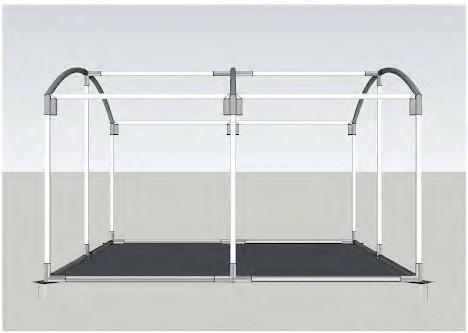
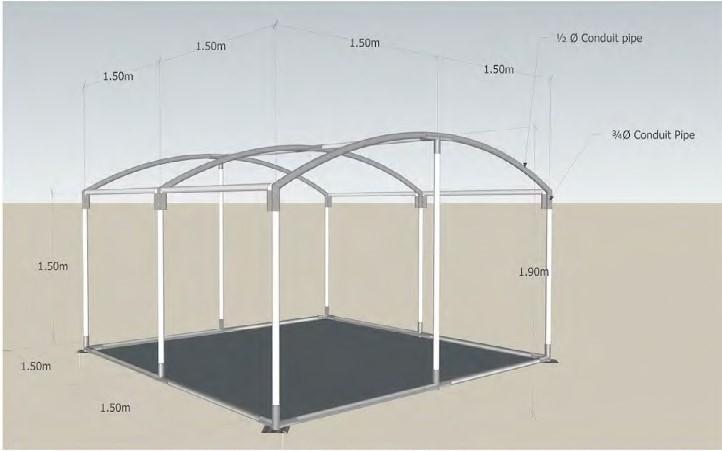
Thespatial,functional,humanitarianandtechnicalaspect oftheshelterkit
9m2perunitshelter. Maintaining the privacy of the family unit by perforatedwallingoveropenings.
Openingoftheshelterintotheaccesspathway.
Communitycookingcornerwithcleaningfacilityis consideredinthecommonplace.
Asharedtoilet&washingfacilitiespereveryeight units.
Thelowestpositionoftheroofinsidetheshelterunit consideredtobeaminimumof1.8m.
Acompressedroofinglayerdevelopsasandwiched roofwithHDPESheet.
A15cmperforatedlatticebamboobetweentheroof &thetopofthewallcladdingactasventilationto enablethereleaseofhotair.
Allresidentswereinvolvedinsettinguptheshelter kit.
Userassemblythusgivingscopeforcustomization andsenseofownership.
The affected community were involved in the process of designing. They had the skills and experienceofutilizingthelocalresourcesandwhich makestheprocessfast.
Fig -1: PerspectiveofTemporaryframing
Fig -2: Framingsystem
© 2022, IRJET | Impact Factor value: 7.529 | ISO 9001:2008 Certified Journal | Page184
International Research Journal of Engineering and Technology (IRJET) e-ISSN: 2395-0056
Volume: 09 Issue: 10 | Oct 2022 www.irjet.net p-ISSN: 2395-0072
Accordingtotheconclusionsofthecommunity-leddesign exercise, the design discussions should be available to all personswhomaybeaffectedbypost-disasterdisplacement. Aspirations from the community are architecturally transformedintovisionsofagreementthatareusefulinpostdisaster settings. Furthermore, we iterated the shelterbuildingproceduretocreateaShelterKitthatcanbemade availablefortheregion'sreoccurringfloodcrisiseveryyear.
Wecanconcludefromtheshelter'suserexperiencethat the:
Shelterprovidesthestructuralstabilitythattheuser desires.
Disasters (pp. 88-109). Auckland, New Zealand: Routledge.
[3] Ehn, P. (2008). Participation in Design Things. Proceedings of the Tenth Anniversary Conference on Participatory Design 2008 (pp. 92-101). Indiana: IndianaUniversity.
[4] Hayward,D.G.(1977).Psychologicalconceptsof‘home’, HUDChallenge.10-13.
[5] IFRC (2011). Transitional shelters, eight designs. Geneva:InternationalFederationofRedCrossandRed CrescentSocieties.
[6] IFRC, UN-Habitat & UNHCR (2008). Shelter Projects 2008
Userswerepleasedwiththeshelter'scomfort.
We were successful in meeting the financial cost criteria.
Thebareminimumofhumanitariancriteriahasbeen reached.
[7] Sphere Project, the (2011). Minimum Standards in Shelter, Settlement and Non-Food Items. The Sphere Handbook.3rded.PracticalActionPublishing.
AssemblytimeoftheKitis1HR.15MNTSbyfour people
WeightofeachshelterKitisanaverageof75to80 kg.
Thereisanabundanceoflocalresourcespreciselyto delivertherequiredquantities
The topic of post-disaster housing is very multidisciplinary, combining social, environmental, and technological sustainability principles with economics, logistics,andpolitics.Accordingtothefindingsofthestudy, engaging with the community is a beneficial technique in afflicted areas where victims frequently seek external support.Asadevelopingcountrywithlimitedresources,we mustendeavortowork withwhatwehaveandcorrectits inadequacies. Urged to be used in the designed shelter kit because it has a minimal carbon footprint, is socially meaningful,andiscosteffectiveinthesetting.However,the concern of termite infestation due to non-treatment, ecological harvesting followed by wall waterproofing providesscopeforfurtherresearchofexploringthematerial andlearningtraditionaltreatmentpracticesthatcannotonly contributetothelongevityoftheshelterkitbutalsogivean aestheticvisualcharacterduetothestainsoftheuseofplantbasedinsecticides.
[1] (2016).WorldDisastersReport
[2] Davidson, C. (2010). Multi-actor arrangements and projectmanagement.InC.J.Davidson,RebuildingAfter
© 2022, IRJET | Impact Factor value: 7.529 | ISO 9001:2008 Certified Journal | Page185