International Research Journal of Engineering and Technology (IRJET) e-ISSN:2395-0056

Volume: 09 Issue: 10 | Oct 2022 www.irjet.net p-ISSN:2395-0072
International Research Journal of Engineering and Technology (IRJET) e-ISSN:2395-0056
Volume: 09 Issue: 10 | Oct 2022 www.irjet.net p-ISSN:2395-0072
1Keshaw Ram, 2B. Chiranjeev Rao, 3Raina Jain
1PG, scholar, Dept. of Electrical and Electronics Engineering, SSGI, Bhilai, India.
2Assistant Professor, Dept. of Electrical and Electronics Engineering, SSGI, Bhilai, India.
3Assistant Professor, Dept. of Electrical and Electronics Engineering, CEC, Bilaspur, India. ***
Abstract- One of the most crucial demands for those in the display are power. Solar energy conversion not only promotes the electric age but also lessens pollution from fossil fuels. The generation of PV control has proven to have a crucial potential for supplying the energy need. The PV module's efficiency and lifespan are increased by the MPPT. This document provides a thorough discussion of the PV system as well as several intelligence techniques. There is also a summary of how artificial intelligence methods and PV systems are combined and applied in a much more effective way.
Key words: Artificialneuralnetwork,fuzzylogic,GeneticcalculationsMaximumpowerpointtracking,Photovoltaic
Power is one of the most important needs for people in the display. The conversion of solar energy into powernotonlyadvancesthepowerera,butitalsoreduces pollution caused by fossil fuels. [1] The continuous rise in thelevelofnurserygasoutflowsandfuelcostsisthemost compelling reason for the Endeavour to use various sources of renewable vitality. Among various sustainable energy sources, solar energy may be an appropriate one because it is clean, free of emanation, and simple to convert specifically to power using a photovoltaic (PV) framework. The generation of PV control has demonstrated a critical potential in meeting the demand for energy. [2] However, widespread use of a PV framework is uncommon because of its high initial cost. Again, there is no proof that the vitality conveyed by PV exhibits consistent yield because it is entirely dependent on the sun's irradiance and the surrounding temperature of the PV modules, cell locale, and stack. An appropriate instrument is required for achieving maximum control fromthePVcellunderfavorableclimaticconditions,which is referred to as maximum control point tracking (MPPT) in the writing. The MPPT improves the efficiency and lifespan of the PV module. Sun-oriented irradiance, temperature, and stack impedance all affect how much a sun-based board will yield. In order to advance the operation of the sun-based board, a dc-dc converter is used because the stack impedance varies on the application.Thetemperatureandirradiancedependenton the sun are dynamic. [1] Since each existing MPPT approachhasdistinctkeyfocusesanddownsides,choosing
a specific MPPT system from among them might be a confusingtask.[2]
The mechanical following device can be used with MPPT, however the control system modifies the electrical working point of the PV modules to provide optimal efficiency and, consequently, optimal yield. MPPT calculations are used to infer the whole control from the sun-based cluster based on contrasts in temperature and illumination. The voltage at which a PV module can produce the best control is its highest control point. The charge controller was used to accommodate the changing voltage and current. The charge controller continues because it is continually modifying the stack when it isn't, removing control from the PV module. The MPPT calculates the best operating point for supplying the most extremesumofcontroltothestackandregulatestheyield voltage and current of the solar-powered panel. The efficiencyofthesun-orientedcellwillincreaseiftheMPPT adaptation can precisely regulate the continuously changing operating point where the greatest amount of controlisavailable.
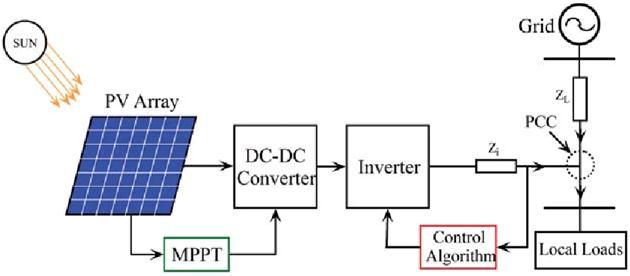
It was suggested that a typical grid-connected PV framework consist essentially of the boost converter, inverter,andPVmoduleFigure1depictstheconfiguration ofthePVframeworkwithalattice-relatedboostconverter, aDC-ACinverter,andanetworkinterfaceforthePVboard. Insuchaframework,thevoltageandcurrentfromthesunorientedboardaresentintotheboostconverterandMPPT controller; the main goal is to force the PV board to get a
International Research Journal
Engineering
Technology (IRJET) e-ISSN:2395-0056
Volume: 09 Issue: 10 | Oct 2022 www.irjet.net p-ISSN:2395-0072
desired voltage that ensures the largest control yield, knownasMPPvoltage.Accordingtotheelectricaldiagram, the DC-DC converter and PV board can be viewed as a single unit that needs to be managed to eliminate unpleasantfactorslikestackandirradiance.Overtime,the control is reduced, with lower temperatures offering the mostcontrol.Furthermore,itshouldbenotedthatwhena PV module is explicitly linked to a stack, the stack impedance determines the PV module's operational state and,inanidealstack,enablesthePVmoduletoobtainthe mostcontrol.[3]
��ℎ =( )[���� +(�−��)] (2)
Theexpressionofthesaturationcurrentisgivenby �� =��� [ ]3 exp[ ( − )] (3)
Where
Id:saturationcurrent(A) T:celltemperature(K) Tr:referencetemperature(K) �rr :saturationcurrentat��
Figure-1-Blockdiagramofphotovoltaic
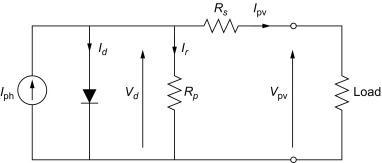
The corresponding solar cell circuit is shown in Figure-2 withtheintrinsicshuntandseriesresistancesrepresented by Rsh and Rs, respectively, and the output current and voltage of the solar array, Ipv and Vpv, respectively. By using Rsh and Rs, which are very huge and very little, the electrical modelismadesimpler.
G:solarirradiance(W/�2) Gn:referenceirradiation(W/�2) ����:short-circuitcurrentatreferencecondition ki:short-circuittemperaturecoefficient kb:��������′�constant q:electron’scharge
A:idealityfactor
2.1.2DC-DCconverter
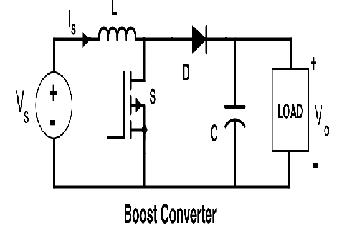
Asa DC-DCpowerconverter,weusea boostconverter. In Fig. 3, its circuit topology is displayed. where iL is the inductor current, Vpv is the input voltage, and Vs is the output voltage We assume that the PV current and inductor current are equivalent. Convertor load, inductor, inputcapacitor,andoutputcapacitor,respectively,arethe passivecomponentsR,L.
Figure-2SimplifiedequivalentcircuitofPVcell
Theoutputcurrent��� is ��� =��ℎ −�� [exp( )−1] (1)
Thephoto-currentcanbeexpressedby
Figure3-Boostconverter
International Research Journal of Engineering and Technology (IRJET) e-ISSN:2395-0056
Volume: 09 Issue: 10 | Oct 2022 www.irjet.net p-ISSN:2395-0072
The power output’s characteristic of the PV system is nonlinearandcruciallyinfluencedbysolarirradiationand temperature. Therefore, the PV systems operating point mustchangesothattheproducedenergyismaximized.
This algorithm is based on the relation between the maximum power point voltage ���� and the open circuit voltage ���. The maximum power point voltage ���� is always a constant fraction of the open circuit voltage ��� asitisgivenbyEq.4.
���� =�� ���
(4)
The constant fraction �� is between 0.7 and 0.8. ��� is measured and used as in input to the controller. FOCV needs measurements of ���. So, it is necessary to introduce a static switch into the PV array. The switch must be connected in series to open the circuit. In this method,���isneededforthePIregulator
The Fractional Short-Circuit Current (FSCC) method is based on the proportionality between the optimum operating current ���� and the short circuit current ���. Eq.(5)showsthat���� canbedeterminedinstantaneously bydetecting ���.���� =��.��� (5)
where�� istheconstantfactor.
Thistechniquerequiresmeasurementsoftheshortcircuit current ���. It is essential to introduce a static switch in parallelwiththePVarraytogetthismeasurementsothat the shortcircuit’s condition is generated. When ��� = 0, there is no supplied power by the PV system. As a result, no energy is generated. As mentioned in the previous technique, the PV voltage measurement’s is required for thePIregulator.
The application of Perturb and Observe (P&O) algorithm has been widely used since it is an easy one to be implemented. This algorithm perturbs the operating voltagetoensuremaximumpower.Thebasicflowchartof P&OalgorithmisshowninFig.4.
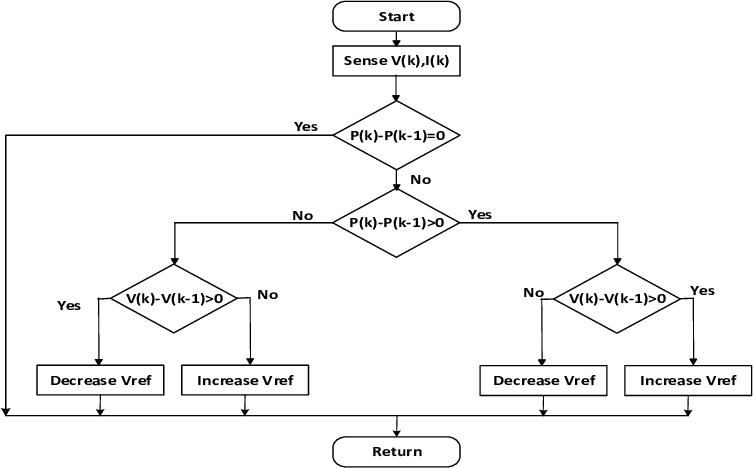
The P&O technique compares the power of the previous stepandthenewstepsothatitincreasesordecreasesthe voltage or current. Operating on the left of the MPP, it is noticeable that incrementing (decrementing) the voltage allows to increase (decrease) the power and decrease (increase) the power when on the right of the MPP. The perturbationiskeptthesametoreachtheMPPwhenthere is an increase in power and vice-versa. P&O has a good behavior when the irradiance does not change quickly with time. However, the power oscillates around the MPP in steady state operation and it fails with variations of temperatureandirradiance.
TheIncrementalConductance(IC)algorithm,explainedby the flow chart given by Fig.5, compares the incremental and instantaneous array conductance ( and respectively) in a PV system. Depending on the result, it increasesordecreasesthevoltageuntilMPPisreached.
International
e-ISSN:2395-0056
Volume: 09 Issue: 10 | Oct 2022 www.irjet.net p-ISSN:2395-0072
Figure5-BasicIncrementalConductanceAlgorithm
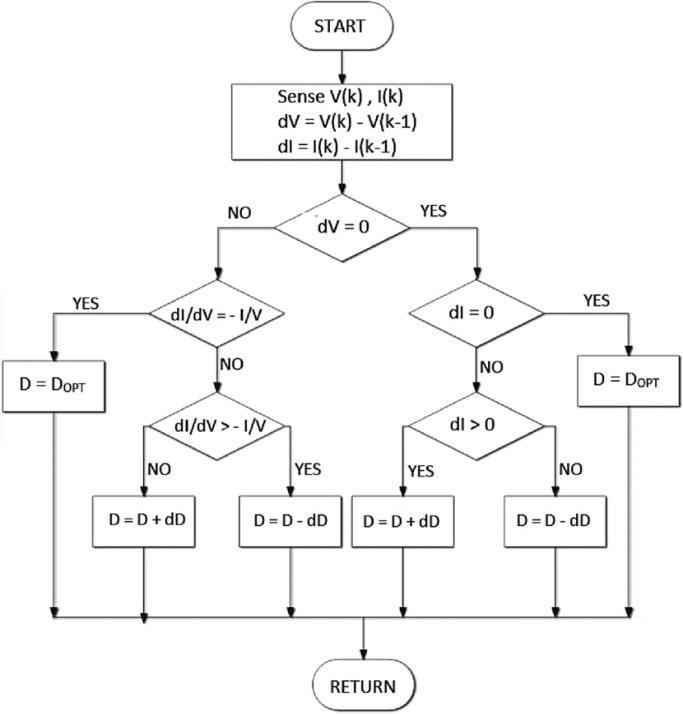
when < 0 ( < ) , decreasing the reference voltageforces∂�∂�toapproachzero; when > 0 ( > ) , increasing the reference voltageforces∂�∂�toapproachzero; when = 0 ( = ) , reference voltage does not needanychange.
ContrarytoP&O,thePVvoltageremainsconstantoncethe MPP is reached. This technique decreases the oscillations problemanditiseasytobeimplemented.
Sliding mode control (SMC) is known as a robust control technique and it is appropriate for controlling switched systems.ForPVsystem,theswitchingsurfaceischosenas [4] (�,�)= + (6)
The science behind brain organization, which plays a crucial role in the human body, is essentially where the
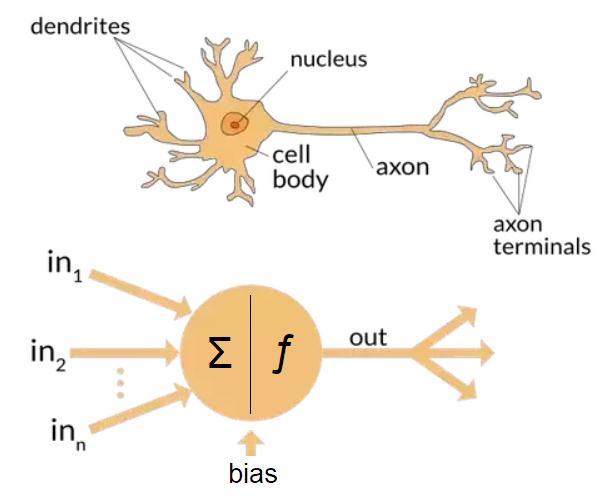
idea of an artificial neural network (ANN) is given. The neural network of the human body is used to carry out work. A neural network is essentially a web of millions of neurons that are connected to one another. With the help of these connected neurons, all parallel processing wears outthehumanbody,makingitthebestexampleofparallel processing. A neuron is a rare organic cell that transmits information from one neuron to another with the help of some electrical and chemical changes. It consists of a cell body, or soma, and the axon and dendrites, two different types of outgrowths that resemble tree branches. The cell body is made up of a core that carries information about innate traits and plasma that houses the atomic materials or building blocks needed by the neurons A neuron receives signals from other neuron through dendrites, which is one method in which the entire process of acceptinganddeliveringsignalsisorganized.Theaxonisa long, slender structure that the neuron uses to transfer electrical messages through neural connections to other neuronswhenitmakeselectricalspikes.[5] Figure6-BiologicalstructureofANN
GeneticAlgorithm(GA),firstproposedbyJ.Hollandinthe 1970sanddrivenbytheorganicevolutionoflivingthings, aresearchcalculationsbasedonthestandardsofcommon preference and hereditary traits. Hereditary calculations isolate the problem domain as a population of individuals and make an iterative attempt to investigate the fittest individual. GA transforms a group of low quality people into a group of high quality people, where each person speakstoa differentaspect oftheproblemtoberesolved. Awellnessworkservesasaquantitativerepresentationof each rule's adaptation to a certain environment and is used to assess the quality of each run of the performance. The tactic starts with a starting populace of randomly generated individuals. Three key hereditary administrators determination, hybrid, and
e-ISSN:2395-0056
Volume: 09 Issue: 10 | Oct 2022 www.irjet.net p-ISSN:2395-0072
transformation are successively connected to each personwithvaryingprobabilitiesduringeachera.TheGAs is computer software that replicates the evolution and heredity of live organisms. Given that GAs are multi-point look strategies, an optimum arrangement is definitely possible for multi-modular objective capabilities using GAs. GAs is also relevant to problems with discrete look space.Inthisway,GAisnotonlyincrediblyeasytousebut also a very effective optimization tool. In GA, the look space is made up of strings known as chromosomes that individually speak to a potential solution to the problem. Each chromosome's wellness value is its objective work worth. A population may be a collection of chromosomes along with their associated health. Populations are producedineraswithanemphasisontheGA[6].
A way of thinking that is based on how people think is calledfuzzylogic(FL).Withallswitchingactionsrestricted to better YES and NO attributes, the FL methodology mirrorsthehumandynamicsapproach.
Atypicallogicblockthatacomputercancomprehendwill use the correct data and perform work that is obviously TRUEorFALSE,similartoahumanYESorNO.
The inventor of fuzzy logic Lotfi Zadeh found that, in contrast to computers, human dynamics incorporate a number of potential outcomes between YES and NO, for example:
find the best solution. PSO has two methodologies: the cognitive methodology and the social methodology. The algorithmmovestowardtheglobaloptimumlikeaparticle travelling through the search space. When defining a particle in PSO, D stands for dimensions and R stands for real numbers Every particle has a unique beginning velocity and position that are chosen at random. Each particlemustretainitspbest,alsoknownasthelocal best position, and the Gbest, also known as the overall best position. The following equations are used to update the particle's position and speed. Where, are two random values ranges [0, 1] and & are the leaning factors, is the velocity,isthelocation,isthepersonalbestpositionofthe particle,andistheglobalbestpositionforthePSO.[8]
In unstable environmental conditions of sun-oriented illumination and temperature, maximum power point tracking (MPPT) may be a widely used method to construct an effective solar system. Here, the challenge is to improve a solar generator's performance using an artificialneuralnetwork-basedMPPTplot.Themajorityof the time, PV modules exhibitnonlinear I–Vcharacteristics with different MPPs based on the temperature and sunpoweredlight.ItmustrunatitsMPPinordertoenablethe largest control exchange to the load from the GPV. This is frequentlyachievedbybalancingthedutycycleofaDC-DC boost converter, whose obligation cycle is balanced by artificial neural networks, between the PV board and the stack. According to the obtained recreation results, the investigatedANN-basedtechniqueismoreproductiveand motions around the MPP are substantially decreased as compared to the well-known perturb and observe MPPT. Following execution, both methods seem wonderful when using Matlab/Simulink. On the other side, the ANN-MPPT approach produces negligible motions around the MPP, whichboostsproductivity.[9]
PSO is a Mehta heuristic algorithm that Kennedy and Eberhartfirstdevised.Theprogrammemimicshowaflock of birdswould migrateand separatethemselves from one another as they searched for an ideal location in a multidimensional world. PSO is a genetic algorithm-like evolutionary computing technique (GA). Particles are swarmsthatstartoffrandomlyandupdategenerations to
In this paper, a sun-oriented PV framework with an artificial neural network-based MPPT controller has been proposed. The controller consists of two components, one of which uses MPPT calculations without neural organisation and the other of which uses MPPT calculations with neural organisation. For analysing the relative execution for following MPPT, two distinct parts are used. According to the resultsof recreation, the MPPT calculation using ANN forecasts temperature and irradiancevariationswithgreateraccuracythantheMPPT calculation without ANN. The differences between yield voltage and yield control can be seen in the direct relationshipbetweenthetwo.Eventhoughthebendhasa few nonlinear parcels, the control changes directly with theyieldvoltage.[10]
e-ISSN:2395-0056
Volume: 09 Issue: 10 | Oct 2022 www.irjet.net p-ISSN:2395-0072
We provide an MPPT computation in this paper that is based on the single-layer neural network display of the photovoltaicboard.Itappearsthattheneuralnetworkcan beusedtocorrectlyillustratehowthephotovoltaicboard's current, voltage, solar-based irradiance, and temperature relate to one another. Contrary to the similar circuit demonstration,theneuralarrangementdemonstrationcan be used to determine the slope of the P-V bend, enabling the design of the fundamental MPPT technique, which relies on the steepest ascending approach. The focus of long-term effort will be on developing an irradiance estimator plan and a crossover calculation plan that is robust to errors in irradiance estimation Additionally, the proposed method will be validated using accurate photovoltaicestimates.[11]
The most effective control point of solar-powered cells is when artificial neural systems are put into action. The execution was successfully completed, and the outcomes approved the accuracy with which the MPP was followed in varying weather circumstances. The low photovoltaic voltage was increased by the DC-DC boost converter to a higherlevel,andtheH-bridgeinverterwasusedtoconvert theDCvoltagetoAC.Usinganeuralnetworkarchitecture, thecircuit'smutilationscausedbyvariouscomponentsare corrected.Afterreversal,theACvoltagecanbesteppedup and transferred to the network for household uses. The ANN-based MPPT strategy reveals that it is the swiftest and most tenacious method of implementing MPP, and it allows us to transfer control to the lattice using transformer[12]
This research examines the use of artificial neural networks (ANN) for tracking the biggest control point. A mistakebackengenderingapproachisusedtopreparethe neural network. The focus of neural organisation is on properly and quickly following the most extreme control point. In this technique, a neural network is used to show the reference voltage of the most extreme control point under various climatic circumstances. The most severe control point can be followed by properly controlling the dc-dc boost converter. Utilizing MATLAB/SIMULINK, reenactmentresultsare obtained toconfirmtheresultsof thehypothesisinquiry.[13]
When the boards are connected to the boost converter under various changeable stack situations, BPNN-DL in thispaperobtainsthebestcontrol pointandamplifiesthe yieldcontrolfromthesunbasednetworks.Byenablingthe forecast of reference voltage under various climatic conditions, BPNN-DL enables the separation of various yield controls and ensures the best yield control with constant yield voltage. In contrast to current techniques,
theproposedBPNN-DLappearstobecapableofachieving thelargestyieldcontrol(98%exactness) fromeachboard under specific conditions. In the future, receiving the machine learning modules could be the focal point of a reductioninexecutioncosts.[14]
The non-direct feature of sun-based PV systems necessitates an expert Greatest Control Point Following (MPPT) computation to control the yield control, which has a significant impact on the efficiency of the sun-based PV systems in order to extract the maximum amount of energy. The suggested computation is based on the obligation proportion that Neural Organize anticipates (NN). After the plan was developed using 625 tests and was approved, it ensures quick yield management, no overshoot, no excessive wobbling, and greater stability compared to traditional algorithms. By closely observing the Most Extreme Control Point, the recreation is able to confirm the acceptability of the NN computation under completely diverse environmental conditions (MPP). Additionally, the minor Cruel Squared Error (MSE) obtained fromtheNN validatestheprecisionandstability of the obligation cycle. Also, the accuracy and stability of thedutycyclearejustifiedbythelowMeanSquaredError (MSE)acquiredfromtheNN[15]
This research highlights the design of the neural arrange controller for the single stage acceptance engine (1 HP) speed control, controlled by the sun directed vitality framework.Using the incremental conductance technique, the crest control from the solar-powered board is freed. The single stage inverter that supports the solar-powered boardyieldvoltageandcurrentissupportedbytheSEPIC converter, which powers the acceptance engine. In order to increase the voltage obtained from the solar-powered board, the beats from the specific controller and Incremental Conductance computation based MPPT Controller are combined and then delivered to the SEPIC converter. The controller receives criticism for the acceptance engine's speed. The neural organise controller recreation has been completed. The recreation for the neuralorganizecontrollerhasbeencarriedout.Recreation comes about gotten appears that Neural Organize controller performs superior for speed control of acceptanceengine.[16]
ThisstudycomparesfourMPPTprogrammesbuiltonFLC. Based on the examination of the plan handle and subsequent impacts, it can be stated that the determination of input components determines the difficulty of the ultimate control impacts. Recreational results and try evaluations show that the hypothetical investigation is correct. In any event, the MPPT
e-ISSN:2395-0056
Volume: 09 Issue: 10 | Oct 2022 www.irjet.net p-ISSN:2395-0072
advancements, which integrate FLC with other advancements,arenotdetailedinthiswork.[17]
Because it expands the yield control that the solarpoweredPVmoduleconveys,theMPPTcontrollerconcept is seen as being crucial. Based on the type of calculation used, the 50 techniques that were studied in this survey work are divided into eight categories. The MPPT strategies are discussed in this essay together with their advantagesanddisadvantages,indicatingthatthechoiceof the MPPT approach should be based on the utility's individual application and requirement. At the conclusion of each category, an unthinkable comparison is also provided. This comparison can be a powerful tool for selecting the most effective MPPT to meet the needs of both administrators and clients. This information may discover an charming source to assist the engineers in settingwiththeoverwhelmingmechanicalsituation.[2]
Integrationofrenewableenergywiththecontrolsystemis becomingmoreandmorenecessary.Forbatterycharging, applicationsthatareconnectedtoaframework,etc.,solarpowered PV technology is essential. It is essential to determine the most conceivable energy gather from photovoltaic board in order to improve yield control of a solar-powered photovoltaic method. The most stringent Control Point Following (MPPT) controller for a solarbasedphotovoltaicsystemisdevelopedinthisresearchby employing a synthetic neural network (ANN). A comparison is also made between the operation of an ANN-based MPPT controller and conventional MPPT techniques. In particular, incremental conductance, fragmented open circuit voltage, and slope increasing (annoy and watch). By using MATLAB/SIMULINK to examineoutcomes,recreationsarecarriedout.[18]
When using an ANN-based MPPT controller, the yield voltage is smoother and has less movements. The controllerismorephysicallypowerfulandrapid.Although 16 information sets were used in this paper, a larger number of information sets may be used to prepare the structure, which would allow for the creation of an even morepowerfulandprecisecontroller.[19]
Inordertoobtainthemost extremecontrol possiblefrom the sun-oriented cell of a photovoltaic (PV) module, the electrical working point is shifted using the commonly used control approach known as Maximum Power Point Tracking (MPPT) computation. Incredibly unfortunate control events also occur as a result of source and stack errors. Therefore, an MPPT must be designed in order to extract the maximum amount of control from a solarpoweredpanel.Thegoalofthepaperistopresentanovel,
feasible, and efficient microcontroller-based MPPT framework for solar-oriented photovoltaic systems in order to ensure quick greatest control point operation under all rapidly changing environmental conditions. The suggested controller system employs PWM techniques to direct boost converter output control at its maximum practicablevaluewhileconcurrentlymanagingthebattery charging system. Using a MATLAB/Simulink demonstration, parameter extraction, demonstrative evaluation,andboostconverterinquiryaredemonstrated. [20]
Powerisoneofthemostimportantrequirementsforthose in the display. The use of solar energy not only advances theelectronicerabutalsoreducesthepollutioncausedby fossilfuels.TheMPPTextendsthelifeandefficiencyofthe PVmodule.ThePVsystemandotherintelligencemethods are covered in-depth in this document. There is also an overview of how PV systems and artificial intelligence techniques can be deployed together much more successfully.
1. Kumaresh.V, “Literature Review on Solar MPPT Systems”, Department of Electrical and Electronics Engineering, Amrita University, Amritanagar, Coimbatore, Advance in Electronic and Electric Engineering. ISSN 2231-1297, Volume 4, Number 3 (2014),pp.285-296©ResearchIndia
2. Podder,MPPTMethodsforSolarPVSystems:ACritical Review Based on Tracking Nature. IET Renewable Power Generation. 2019. 13. 10.1049/ietrpg.2018.5946.
3. Zakaria Mohamed SalemElbarbary ,“Review of maximum power point tracking algorithms of PV system”ISSN:2634-2499,6July2021.
4. A. Kchaou, "Comparative study of different MPPT techniques for a stand-alone PV system," 2016 17th International Conference on Sciences and Techniques ofAutomaticControlandComputerEngineering(STA), 2016,pp.629-634,doi:10.1109/STA.2016.7952092.
5. Manish Mishra, “A View of Artificial Neural Network”, IEEE International Conference on Advances in Engineering & Technology Research (ICAETR - 2014), August 01-02, 2014, Dr. Virendra Swarup Group of Institutions,Unnao,India
International Research Journal of Engineering and Technology (IRJET) e-ISSN:2395-0056
Volume: 09 Issue: 10 | Oct 2022 www.irjet.net p-ISSN:2395-0072
6. Lingaraj, Haldurai, “ A Study on Genetic Algorithm and its Applications” International Journal of Computer SciencesandEngineering.20194.139-143.
7. Mohd Najib Mohd Salleh,Noureen Talpur,Kashif Hussain “Adaptive Neuro-Fuzzy Inference System: Overview, Strengths, Limitations, and Solutions” Data Mining and Big Data, 2017, Volume 10387 ISBN : 9783-319-61844-9
8. Eberhart, & Shi, Yuhui, “ Particle swarm optimization: Development, applications and resources” 2001, Proceedings of the IEEE Conference on Evolutionary Computation, ICEC. 1. 81 - 86 vol. 1. 10.1109/CEC.2001.934374.
9. F.Berrezzek,"EfficientMPPTschemeforaphotovoltaic generator using neural network," 2020 1st International Conference on Communications, Control Systemsand Signal Processing(CCSSP),2020, pp.503507.
10. R. B. Roy, J. Cros, A. Nandi and T. Ahmed, "Maximum Power Tracking by Neural Network," 2020 8th International Conference on Reliability, Infocom Technologies and Optimization (Trends and Future Directions)(ICRITO),2020,pp.89-93.
11. M. Rolevski and Ž. Zečević, "MPPT controller based on the neural network model of the photovoltaic panel," 2020 24th International Conference on Information Technology(IT),2020,pp.1-4.
12. L. P. N. Jyothy, "An Artificial Neural Network based MPPT Algorithm For Solar PV System," 2018 4th International Conference on Electrical Energy Systems (ICEES),2018,pp.375-380.
13. Agwa, Ahmed & Mahmoud, I.. (2017). Photovoltaic Maximum Power Point Tracking by Artificial Neural Networks.
14. Ahmed, K. & Sayeed, Farrukh & Logavani, K. & Catherine, T. & Ralhan, Shimpy & Singh, Dr & Prabu, Thandaiah & Subramanian, B. & Kassa, Adane. (2022). Maximum Power Point Tracking of PV Grids Using Deep Learning. International Journal of Photoenergy. 2022.1-7.10.1155/2022/1123251.
15. E. Abderrahmane, "Development of a Photovoltaic MPPT Control based on Neural Network," 2021 Innovations in Energy Management and Renewable Resources(52042),2021,pp.1-6.
16. T.Shanthi, S.U.Prabha , “Neural Network Based MPPT ControllerforSolarPVSystem”InternationalJournalof Innovative Technology and Exploring Engineering (IJITEE) ISSN: 2278-3075, Volume-8 Issue-2S2 December,2018
17. Zhu Tongsen, “A Comprehensive Study on Maximum PowerPointTrackingTechniquesBasedonFuzzyLogic Control for Solar Photovoltaic Systems” Frontiers in EnergyResearch VOLUME9,2021,ISSN=2296-598X
18. L. P. N. Jyothy and M. R. Sindhu, "An Artificial Neural Network based MPPT Algorithm For Solar PV System," 20184thInternationalConferenceonElectricalEnergy Systems(ICEES),2018,pp.375-380.
19. Duwadi, Kapil, “Design of ANN based MPPT for Solar Panel”2015,10.13140/RG.2.1.3687.7925.
20. B. R. S. Reddy, P. B. Narayana, P. Jambholkar and K. S. Reddy, "MPPT algorithm implementation for solar photovoltaic module using microcontroller," 2011 AnnualIEEEIndiaConference,2011,pp.1-3.
Keshaw Ram is a student of Mtech (Power system) in electrical and electronics engineering of final year. Heis perusing Mtech degree from Shri Shankaracharya Group of Institution affiliated with Chhattisgarh swami Vivekananda Technical University. His interest is in power system, artificial intelligence and renewableenergy.
B. Chiranjeev Rao has received his Bachelor of Engineering Degree in Electrical Engineering from Bhilai institute of technology, Chhattisgarh Swami Vivekanand Technical University, Bhilai in 2005.Master’s Degree in Power System Engineering from SSTC, SSGI, Bhilai, Chhattisgarh Swami VivekanandTechnical University, Bhilai. He is current pursuing from PhD Chhattisgarh Swami Vivekanand Technical University, Bhilai in Power System Engineering. He is currently working as an Assistant Professor at theDepartmentofElectricalAndElectronics Engineering, SSTC, SSGI,Bhilai. His area of interests includes Power Quality, Optimization in power system, Microgrid and electrical drives. He is a member of the Institution of Engineers(India)(IE(I)).


e-ISSN:2395-0056
Volume: 09 Issue: 10 | Oct 2022 www.irjet.net p-ISSN:2395-0072
Raina Jain has received her Bachelor of Engineering Degree in Electrical Engineering from lakhmi chand institute of technology, Bilaspur in 2017. Master’s Degree in Power System Engineering from SSTC, SSGI, Bhilai, in 2021 affiliated with Chhattisgarh Swami Vivekanand Technical University, Bhilai.
Sheiscurrently working as an Assistant Professor at the Department of Electrical And Electronics Engineering, in Chouksey Engineering College, Bilaspur. Her area of intrest is in power system, artificial intelligence,controlsystem,andrenewable energy.