A Comparative Analysis on Parameters of Different Adder Topologies

Page 1

International Research Journal of Engineering and Technology (IRJET) Volume: 09 Issue: 10 | Oct 2022

www.irjet.net

e-ISSN: 2395-0056 p-ISSN: 2395-0072

A Comparative Analysis on Parameters of Different Adder Topologies Deepa Suranam Lamani1, Dr. Kiran V2 1MTECH

1st year, Dept. of ECE, RV college of Engineering, Karnataka, India Professor, Dept. of ECE, RV college of Engineering, Karnataka, India ---------------------------------------------------------------------***--------------------------------------------------------------------1.1 Ripple carry adder Abstract - Due to their widespread use in the effective 2Associate

implementation of fundamental binary arithmetic, adders are an essential component in digital integrated design. A basic adder topology unquestionably requires higher working speeds, tolerable power consumption, and significantly less chip area. An extensive comparative examination of many modern adder topologies is provided in the current paper. The in-depth analysis of the adder that is described in this paper aims to make it easier to choose an adder topology for any digital design while balancing the trade-offs between area, propagation delay, and power dissipation. In this paper, a thorough comparison of four distinct adder topologies—the Ripple Carry Adder, Carry Save Adder, Carry Skip Adder, and Carry Select Adder—is made on basis of a number of design metrics and performance factors.

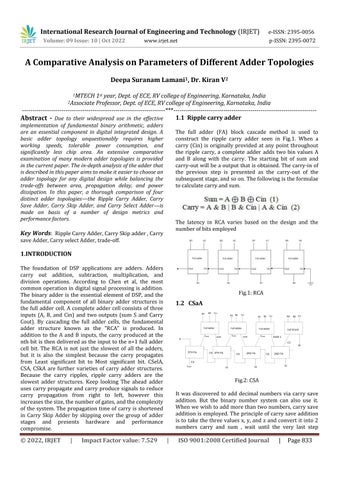
The full adder (FA) block cascade method is used to construct the ripple carry adder seen in Fig.1. When a carry (Cin) is originally provided at any point throughout the ripple carry, a complete adder adds two bin values A and B along with the carry. The starting bit of sum and carry-out will be a output that is obtained. The carry-in of the previous step is presented as the carry-out of the subsequent stage, and so on. The following is the formulae to calculate carry and sum.

The latency in RCA varies based on the design and the number of bits employed

Key Words: Ripple Carry Adder, Carry Skip adder , Carry save Adder, Carry select Adder, trade-off.

1.INTRODUCTION The foundation of DSP applications are adders. Adders carry out addition, subtraction, multiplication, and division operations. According to Chen et al, the most common operation in digital signal processing is addition. The binary adder is the essential element of DSP, and the fundamental component of all binary adder structures is the full adder cell. A complete adder cell consists of three inputs (A, B, and Cin) and two outputs (sum S and Carry Cout). By cascading the full adder cells, the fundamental adder structure known as the "RCA" is produced. In addition to the A and B inputs, the carry produced at the nth bit is then delivered as the input to the n+1 full adder cell bit. The RCA is not just the slowest of all the adders, but it is also the simplest because the carry propagates from Least significant bit to Most significant bit. CSelA, CSA, CSkA are further varieties of carry adder structures. Because the carry ripples, ripple carry adders are the slowest adder structures. Keep looking The ahead adder uses carry propagate and carry produce signals to reduce carry propagation from right to left, however this increases the size, the number of gates, and the complexity of the system. The propagation time of carry is shortened in Carry Skip Adder by skipping over the group of adder stages and presents hardware and performance compromise.

© 2022, IRJET

|

Impact Factor value: 7.529

Fig.1: RCA

1.2 CSaA

Fig.2: CSA It was discovered to add decimal numbers via carry save addition. But the binary number system can also use it. When we wish to add more than two numbers, carry save addition is employed. The principle of carry save addition is to take the three values x, y, and z and convert it into 2 numbers carry and sum , wait until the very last step

|

ISO 9001:2008 Certified Journal

|

Page 833


Turn static files into dynamic content formats.
Create a flipbook