International Research Journal of Engineering and Technology (IRJET)
e-ISSN: 2395-0056
Volume: 08 Issue: 07 | July 2021
p-ISSN: 2395-0072
www.irjet.net
OBJECT RECOGNITION FOR BLIND AID MEDIUM USING ANDROID Mrs. Sheela S K1, Hruthik K M2, Sachin Gowda H M3, Yashwanth N R4, Shashank K R5 1Assistant professor, Dept. of Information science Engineering, BGS Institute of Technology, Karnataka, India 2-5Student, Dept. of Information science Engineering, BGS Institute of Technology, Karnataka, India
---------------------------------------------------------------------***---------------------------------------------------------------------
Abstract - Among all of the human senses, vision is one of the most important, and it plays a critical role in comprehending the surroundings around you Visually challenged people find it challenging to go about outside without assistance. As a result, this research is an attempt to develop a low vision object detection system. As a result, the following is required: It requires, among other things, a camera, an application, and an audio device. We developed and deployed an Android app that makes use of the phone's camera A vision-impaired person uses a camera to detect objects in their environment. In addition, the Application will inform the user of the object's direction as well as their distance from it. The programme will use an audio device such as headphones or the phone's speaker to give the visually impaired user the name, direction, and distance of the object. Visually challenged persons will be able to converse with each other using this way. This technology will allow visually impaired persons to travel around independently by educating them about the many items around them.
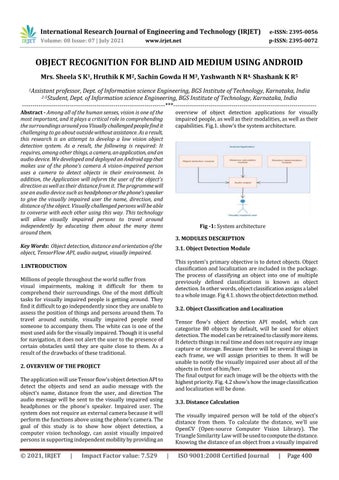
overview of object detection applications for visually impaired people, as well as their modalities, as well as their capabilities. Fig.1. show’s the system architecture.
Key Words: Object detection, distance and orientation of the object, TensorFlow API, audio output, visually impaired.
3.1. Object Detection Module
Fig -1: System architecture 3. MODULES DESCRIPTION
This system's primary objective is to detect objects. Object classification and localization are included in the package. The process of classifying an object into one of multiple previously defined classifications is known as object detection. In other words, object classification assigns a label to a whole image. Fig 4.1. shows the object detection method.
1.INTRODUCTION Millions of people throughout the world suffer from visual impairments, making it difficult for them to comprehend their surroundings. One of the most difficult tasks for visually impaired people is getting around. They find it difficult to go independently since they are unable to assess the position of things and persons around them. To travel around outside, visually impaired people need someone to accompany them. The white can is one of the most used aids for the visually impaired. Though it is useful for navigation, it does not alert the user to the presence of certain obstacles until they are quite close to them. As a result of the drawbacks of these traditional.
3.2. Object Classification and Localization Tensor flow's object detection API model, which can categorize 80 objects by default, will be used for object detection. The model can be retrained to classify more items. It detects things in real time and does not require any image capture or storage. Because there will be several things in each frame, we will assign priorities to them. It will be unable to notify the visually impaired user about all of the objects in front of him/her. The final output for each image will be the objects with the highest priority. Fig. 4.2 show’s how the image classification and localization will be done.
2. OVERVIEW OF THE PROJECT The application will use Tensor flow's object detection API to detect the objects and send an audio message with the object's name, distance from the user, and direction The audio message will be sent to the visually impaired using headphones or the phone's speaker. Impaired user. The system does not require an external camera because it will perform the functions above using the phone's camera. The goal of this study is to show how object detection, a computer vision technology, can assist visually impaired persons in supporting independent mobility by providing an
© 2021, IRJET
|
Impact Factor value: 7.529
3.3. Distance Calculation The visually impaired person will be told of the object's distance from them. To calculate the distance, we'll use OpenCV (Open-source Computer Vision Library). The Triangle Similarity Law will be used to compute the distance. Knowing the distance of an object from a visually impaired
|
ISO 9001:2008 Certified Journal
|
Page 400
International Research Journal of Engineering and Technology (IRJET)
e-ISSN: 2395-0056
Volume: 08 Issue: 07 | July 2021
p-ISSN: 2395-0072
www.irjet.net
user is more advantageous because it gives the user a notion of the thing's size, more than just knowing the thing's name, he has to know the relative space surrounding him and how distant the object is from him. To determine the distance, the device's camera must first be calibrated; consequently, the calibration module must be executed every time the programme is started for the first time. The basic goal of calibration is to figure out what the focal length of the camera lens is, which will be used in subsequent. Fig.4.3 show’s how to calculate the distance between the object and user.
4.3. Distance Calculation
4. SCREENSHOTS 4.1. Object Detection
Fig -4.3: Distance Calculation 5. CONCLUSIONS In recent years, many solutions have been created to assist visually impaired people in navigating their surroundings and recognizing objects. However, most of these technologies are too expensive for visually impaired persons to use in their daily lives. The expense of the infrastructure required to put things in place systems.
Fig -4.1: Object Detection 4.2. Object Classification and Localization:
Our goal is to create a system that can assist visually impaired people in recognizing and navigating around objects both indoors and outdoors. The visually challenged user must perform the following in order to use our system: There is no requirement to learn any certain skill. Furthermore, the price of the, the proposed solution is minimal, as it simply requires a smartphone.to put it into action Unlike other proposed systems, our object detection technique eliminates the requirement for hardware such as sensors, cutting the system's overall cost. 6. FUTURE ENHANCEMENTS Future improvements are planned the system can contain a text-to-speech capability that recognizes the text in front of the visually impaired user and produces an audio output. The user will be able to comprehend the written text around him as a result of this. A more advanced version of such a technology could allow a visually impaired person to read a conventional book without purchasing an audiobook; It can also assist the user in independently identifying various drugs. As a result, a Text to Speech capability in our system can vastly improve its usefulness.
Fig -4.2: Object Classification and Localization
© 2021, IRJET
|
Impact Factor value: 7.529
|
ISO 9001:2008 Certified Journal
|
Page 401
International Research Journal of Engineering and Technology (IRJET)
e-ISSN: 2395-0056
Volume: 08 Issue: 07 | July 2021
p-ISSN: 2395-0072
www.irjet.net
The model can be taught to recognize a variety of cuisines and dishes. When a visually challenged person is at a buffet, food detection can be advantageous. REFERENCES [1]
[2]
[3]
[4]
[5]
Rabia Jafri, Syed Ali, Hamid Arabnia, and Shameem Fati ma (2013). A survey of computer vision-based item recognition for visually challenged people in an indoor environment. 10.1007/s00371-013-0886-1. The Visual Computer. 30. RFAIDEA navigation and object recognition aid for visually impaired people based on RFID technology. Murad, M., Rehman, A., Shah, A.A., Ullah, S., Fahad, M., Yahya, K.M. 7th International Conference on Emerging Technologies (ICET), Pakistan, pp. 14. (2011). A. Nishajith, J. Nivedha, S.S. Nairand J. Mohammed Shaffi, “Smart Cap Wearable Visual Guidance System for Blind," Coimbatore, 2018, pp. 275-278. S. Anand, A. Kumar, M. Tripathi, and M.S. Gaur. Human Face Detection Enabled Smart Stick for Visually Impaired people. R. Sheth, S. Rajandekar, S. Laddha, R. Chaudhari, R. Chaudhari, (2014). "A smart white cane is a beautiful an d cost-effective walking aid." 3(10), 84-89, American Journal of Engineering Research.
© 2021, IRJET
|
Impact Factor value: 7.529
|
ISO 9001:2008 Certified Journal
|
Page 402