International Research Journal of Engineering and Technology (IRJET)
e-ISSN: 2395-0056
Volume: 07 Issue: 09 | Sep 2020
p-ISSN: 2395-0072
www.irjet.net
PLANNING AND DESIGNING OF INTERSECTION UNDER MIXED TRAFFIC FLOW CONDITION Dr. Prof. B. S. Shete1, Prof. A. R. Bijwe2, Navin A. Shirole3 1HOD, Dept. of Civil Engineering, Dr. Sau. Kamlatai Gawai Institute of Engineering and Technology, Amravati, 2Assistant Professor, Dept. of Civil Engineering, Dr. Rajendra Gode Institute Technology & Research, Amravati,
Student, Dept. of Civil Engineering, Dr. R.G.I.T&R, Amravati ---------------------------------------------------------------------***---------------------------------------------------------------------3
Abstract - The developing cities are having a lot of traffic
about 3000 vehicles per hour can be considered as the upper limiting case and a volume of 500 vehicles per hour is the lower limit.
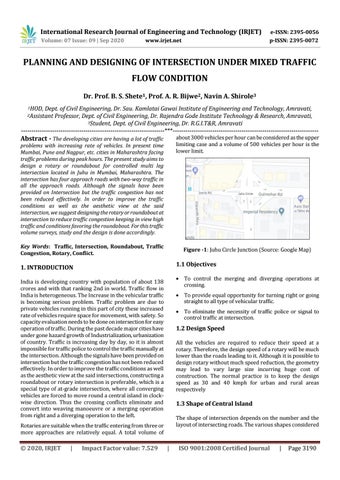
problems with increasing rate of vehicles. In present time Mumbai, Pune and Nagpur, etc. cities in Maharashtra facing traffic problems during peak hours. The present study aims to design a rotary or roundabout for controlled multi leg intersection located in Juhu in Mumbai, Maharashtra. The intersection has four approach roads with two-way traffic in all the approach roads. Although the signals have been provided on Intersection but the traffic congestion has not been reduced effectively. In order to improve the traffic conditions as well as the aesthetic view at the said intersection, we suggest designing the rotary or roundabout at intersection to reduce traffic congestion keeping in view high traffic and conditions favoring the roundabout. For this traffic volume surveys, study and the design is done accordingly. Key Words: Traffic, Intersection, Roundabout, Traffic Congestion, Rotary, Conflict.
Figure -1: Juhu Circle Junction (Source: Google Map)
1.1 Objectives
1. INTRODUCTION
To control the merging and diverging operations at crossing.
India is developing country with population of about 138 crores and with that ranking 2nd in world. Traffic flow in India is heterogeneous. The Increase in the vehicular traffic is becoming serious problem. Traffic problem are due to private vehicles running in this part of city these increased rate of vehicles require space for movement, with safety. So capacity evaluation needs to be done on intersection for easy operation of traffic. During the past decade major cities have under gone hazard growth of Industrialization, urbanization of country. Traffic is increasing day by day, so it is almost impossible for traffic police to control the traffic manually at the intersection. Although the signals have been provided on intersection but the traffic congestion has not been reduced effectively. In order to improve the traffic conditions as well as the aesthetic view at the said intersections, constructing a roundabout or rotary intersection is preferable, which is a special type of at-grade intersection, where all converging vehicles are forced to move round a central island in clockwise direction. Thus the crossing conflicts eliminate and convert into weaving manoeuvre or a merging operation from right and a diverging operation to the left.
To provide equal opportunity for turning right or going straight to all type of vehicular traffic. To eliminate the necessity of traffic police or signal to control traffic at intersection.
1.2 Design Speed All the vehicles are required to reduce their speed at a rotary. Therefore, the design speed of a rotary will be much lower than the roads leading to it. Although it is possible to design rotary without much speed reduction, the geometry may lead to vary large size incurring huge cost of construction. The normal practice is to keep the design speed as 30 and 40 kmph for urban and rural areas respectively
1.3 Shape of Central Island The shape of intersection depends on the number and the layout of intersecting roads. The various shapes considered
Rotaries are suitable when the traffic entering from three or more approaches are relatively equal. A total volume of
© 2020, IRJET
|
Impact Factor value: 7.529
|
ISO 9001:2008 Certified Journal
|
Page 3190
International Research Journal of Engineering and Technology (IRJET)
e-ISSN: 2395-0056
Volume: 07 Issue: 09 | Sep 2020
p-ISSN: 2395-0072
www.irjet.net
to suit different conditions are circular, elliptical, turbine, tangent, each having its own advantages and limitations.
ratio 4:1 is regarded as minimum. The minimum values of weaving lengths as recommended by IRC are given below:
1.4 Entry, Exit and Island Radius
Table -1: Design Speed and Weaving Width
The radius at the entry depends on various factors like design speed, super-elevation, and co efficient of friction. The entry to the rotary is not straight, but a small curvature is introduced. This will force the driver to reduce the speed. The entry radius of about 20 and 25 metres is ideal for urban and rural design respectively. The exit radius should be higher than the entry radius and the radius of the rotary island so that the vehicles will discharge from the rotary at a higher rate. A general practice to keep the exit radius is 1.5 to 2 times the entry radius. However, if pedestrian movement is higher at the exit approach, then the exit radius could be set as same as that of the entry radius. The radius of the central island is governed by the design speed, and radius of the entry curve. The radius of the central island, in practice, is given a slightly higher radius so that the movement of the traffic already in the rotary will have priority. The radius of the central island which is about 1.3 times that of the entry curve is adequate for all practical purposes.
Design Speed (Kmph) 40 30
1.7 Capacity The capacity of rotary is determine by the capacity of each weaving section. Transportation road research lab (TRL) proposed the following empirical formula to find the capacity of the weaving section. Qp=
The entry width and exit width of the rotary is governed by the traffic entering and leaving the intersection and the width of the approaching road. The width of the carriageway at entry and exit will be lower than the width of the carriageway at the approaches to enable reduction of speed. IRC suggests that a two lane road of 7 m width should be kept as 7 m for urban roads and 6.5 m for rural roads. Further, a three lane road of 10.5 m is to be reduced to 7 m and 7.5 m respectively for urban and rural roads. Weaving width is given as (e1 + e2 ) 2
280w(1+e/w)*(1-p/3) (1+w/l)
Where, e is the average entry and exit width, w is the weaving width, l is the length of weaving, p is the proportion of weaving traffic to the non–weaving traffic where a and d are the non-weaving traffic and b and c are the weaving traffic. Therefore,
1.5 Width of Rotary
wweaving =
Minimum weaving length(m) 45 30
p=
b+c a+b+c+d
2. TRAFFIC SURVEY AND DATA COLLECTION The traffic data is collected video graphic method by counting the number of different types of vehicle approaching to the intersection from all the four directions and then converting the values in to the common factor called Passenger Car Unit (PCU).
+ 3.5m
e1 is the width of the carriageway at the entry e2 is the carriageway width at exit. Weaving length determines how smoothly the traffic can merge and diverge
1.6 Weaving Length The weaving length determines the ease with which the vehicle can maneuver through the weaving section and thus determines the capacity of the rotary. The weaving length is decided on the basis of the factors, such as, the width of weaving section, average width of entry, total traffic and proportion of weaving traffic in it. It is desirable to prevent direct traffic cuts and this can be achieved by making the ratio of weaving length to weaving width large enough. A
© 2020, IRJET
|
Impact Factor value: 7.529
Figure -2: Hourly Variation Junction Volume Traffic
|
ISO 9001:2008 Certified Journal
|
Page 3191
International Research Journal of Engineering and Technology (IRJET)
e-ISSN: 2395-0056
Volume: 07 Issue: 09 | Sep 2020
p-ISSN: 2395-0072
www.irjet.net
Table -2: Traffic Volume in PCU/hour Direction (Approach)
Left Turning
Straight
Right Turning
North (Andheri-Versova)
245
248
160
South (Guru-Nanak Road)
152
290
199
East (Gulmohar Road
221
163
239
West (Devle Road)
163
200
164
Weaving traffic from East to South i.e. from Gulmohar Road to Guru-Nanak Road a= 160 PCU/hr. b= (164+248) = 412 PCU/hr. c= (163+239) = 402 PCU/hr. d= 221 PCU/hr. b+c p= a+b+c+d
p(E-S) =
2.1 Parameters for Calculation
412+402 160+412+402+221
=0.68
Since intersection legs carry nearly equal traffic, a circular centre island will be adopted.
Hence mathematical formula for capacity of roundabout, from IRC 65-1967 280w(1+e/w)*(1-p/3) Qp(E-S)= (1+w/l)
A radius of 25m of entry, 40m at exit and Diameter of 50m for Central Island is adopted.
Qp(E-S)=
For rotary in urban areas, design speed =30kmph
Weaving width of 14m and Weaving length as 56m is adopted.
280*14*(1+10.5/14)*(1-0.68/3) (1+14/56)
= 4244.05 PCU /hr.
Similarly, Proportion of weaving traffic to non-weaving traffic for other directions are given below,
p(S-W) =
p(W-N) =
p(N-E) =
Figure -3: Traffic approach of The Rotary
3. Capacity of Rotary
323+489 239+323+489+152 529+364 199+529+364+163 399+408 164+399+408+245
= 0.67
= 0.71
= 0.66
The proportion of weaving traffic to non-weaving traffic is highest in the West-North direction. Thus capacity of roundabout in West-North direction is given as, Qp(W-N)=
280*14*(1+10.5/14)*(1-0.71/3) (1+14/56)
= 4189.17 PCU /hr.
Similarly proportion of weaving traffic to non-weaving traffic is lowest in the North-East direction. Thus capacity of roundabout in North-East direction is given as, Qp(N-E)=
Figure -4: Traffic Negotiating a Rotary (PCU/hour)
© 2020, IRJET
|
Impact Factor value: 7.529
|
280*14*(1+10.5/14)*(1-0.66/3) (1+14/56)
ISO 9001:2008 Certified Journal
|
= 4280.64 PCU /hr.
Page 3192
International Research Journal of Engineering and Technology (IRJET)
e-ISSN: 2395-0056
Volume: 07 Issue: 09 | Sep 2020
p-ISSN: 2395-0072
www.irjet.net
[11] IRC: 65 (2017).Guidelines for the Planning and Design of
The capacity of intersection is the minimum of the capacity of all the weaving section. Hence capacity of designed roundabout is Qp (W-N) i.e. 4189.17 PCU/hr. According to IRC, rotary can handle the traffic upto 3000 PCU/hr efficiently.
Roundabout.
4. CONCLUSIONS In our study we performed surveys and accumulate traffic data which was required for designing roundabout, and after studying all necessary requirements and calculation we found that minimum capacity of designed roundabout is 4189.17 PCU/hr. whereas maximum required capacity for concerned intersection is 4280.64 PCU/hr. hence we can conclude that designed roundabout can efficiently handle present traffic flow as well as if in near future if there is slightly increase in rate of traffic flow, designed roundabout is capable for managing the traffic. There are few areas still required to reduce congestion at junction, for betterment of the intersection are: Provide the road crossing near the intersection. Provide Odd- even parking. Expanding the area for better approach
REFERENCES Khanna, S.K., and Justo, C.E.G., (2018), “Highway Engineering”, New Chand and Bros, 10th Edition, New Delhi.M. Young, The Technical Writer’s Handbook. Mill Valley, CA: University Science, 1989. [2] Dr. L.R. Kadiyali, “Traffic Engineering and transport planning ”, 10th edition , New Delhi. [3] Surender Kadyan and V K Ahuja, “A Study of Rotary Intersection at Panipat”, IJERST&E, ISSN: 2319-7463, Vol. 5 Issue 7, July-2016 [4] Krutika M. Gamit, Aney K. Patel, Ankit S. Vasava, Viral N. Patel, Rutvij J. Maheta, “Traffic Congestion Overcome By Rotary Design” | International Research Journal of Engineering and Technology (IRJET), Vol.6, Issue .4 (April-19). [5] IRC: 65 (1976) – Recommended Practice for Traffic Rotaries. [6] Indian Roads Congress (IRC). (1994). “Guidelines for design of at grade intersections in rural and urban areas.” IRC Special Publication, No. 41, Indian Roads Congress, New Delhi, India. [7] Analysis and Solutions to improve traffic flow at intersections of Bhopal: Major Project Report (2015), University Institute of Technology, RGPV, Bhopal. [8] Indian Road Congress- IRC SP 41 (Special Publication). [9] S K. Mahajan, Anshul Umadekar, Kruti Jethwa “New concept of traffic rotary deign at road intersection, 2013” International Conference of Transportation Professionals. [10] IRC: 92 (1985).Guidelines for the Design of Interchanges in Urban Areas. [1]
© 2020, IRJET
|
Impact Factor value: 7.529
|
ISO 9001:2008 Certified Journal
|
Page 3193