International Research Journal of Engineering and Technology (IRJET)
e-ISSN: 2395-0056
Volume: 07 Issue: 03 | Mar 2020
p-ISSN: 2395-0072
www.irjet.net
AN EXPERIMENTAL AND ANALYTICAL STUDY OF SLOPE STABILITY BY SOIL NAILING V. Prahatheswaran1, P. Ashika2 1Assistant Professor, Department of Civil Engineering, Karur College of Engineering, Tamil Nadu, India 2PG Student, Department of Civil Engineering, Karur College of Engineering, Tamil Nadu, India
---------------------------------------------------------------------***----------------------------------------------------------------------
Abstract - Soil nailing is a widely accepted method for the
improvement of natural and artificial slope as well as used for temporary and permanent earth support, slope stabilization purpose and retaining walls on many projects in the universe. In this paper, an experimental and analytical test carried out for the unreinforced and reinforced soil slope by applying a gradual increasing surcharge load. However, the experimental analysis is done by model testing and the analytical analysis is done with finite element software Plaxsis 3D. Hence the soil slopes are constructed by using sand size soil with two different soil slope angles of 45° and 60° with the horizontal. Then with these soil slopes angles nails are injected at three different nail inclinations of 0°, 15° and 30°. During the testing program, the behaviour of reinforced and unreinforced soil slopes under the increasing surcharge loading the failure slip surface, maximum load carrying capacity of the slope and the settlement are observed. Moreover various slopes are analysed by FES-Plaxsis 3D and a comparable study is carried out with experimental data. Key Words: unreinforced, reinforced model testing, finite element, failure pattern, soil nail inclination, surcharge load, settlement, load carrying capacity
slip surface and the load carrying capacity of the nailed slopes are observed during the testing program. The unreinforced and reinforced slopes are also analysed by using a Finite Element package PLAXIS 3D with same respective slope angles and nail inclinations. The results obtained from the model testing are comparable with the analytical results from Finite Element Method.
1.1 OBJECTIVE OF THE STUDY •To study the properties of nature of the soil and reinforced material (soil nails). •To study the response of the unreinforced soil slope and soil nailed slope by applying gradual increasing of surcharge load which is carried out by both experimentally (Model testing) and analytically (Finite element software PLAXIS 3D) . •To observe the load bearing capacity vs. settlement and failure pattern of the slope angles of 45° and 60° without reinforcement and with reinforced by installing soil nails at three different inclination of 0°, 15° and 30°. •Finally to find the soil nailed slope angle, inclination of soil nails, failure pattern, maximum bearing capacity and settlement of the reinforced soil (soil nailing) slope model.
1. INTRODUCTION In recent years, soil nailing has been widely used by civil engineers and geotechnical engineers for stabilizing the steep slopes or carryout ground improvement. Researchers have employed model testing programmes and numerical modelling methods to find out the most critical failure surface, maximum load carrying capacity and settlement. However the verification of these parameters is only made by carrying out a comparable study between the model testing and analytical testing results. With the recent advances the validation of soil nail models can be done using Finite Element software packages like PLAXIS 3D, ABACUS, GEO5 etc.
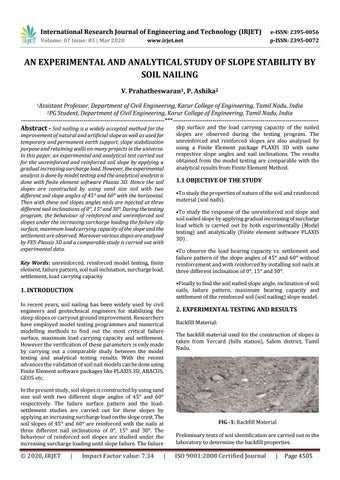
2. EXPERIMENTAL TESTING AND RESULTS Backfill Material: The backfill material used for the construction of slopes is taken from Yercard (hills station), Salem district, Tamil Nadu.
In the present study, soil slopes is constructed by using sand size soil with two different slope angles of 45° and 60° respectively. The failure surface pattern and the loadsettlement studies are carried out for these slopes by applying an increasing surcharge load on the slope crest. The soil slopes of 45° and 60° are reinforced with the nails at three different nail inclinations of 0°, 15° and 30°. The behaviour of reinforced soil slopes are studied under the increasing surcharge loading until slope failure. The failure
Preliminary tests of soil identification are carried out in the laboratory to determine the backfill properties.
© 2020, IRJET
ISO 9001:2008 Certified Journal
|
Impact Factor value: 7.34
|
FIG -1: Backfill Material
|
Page 4505
International Research Journal of Engineering and Technology (IRJET)
e-ISSN: 2395-0056
Volume: 07 Issue: 03 | Mar 2020
p-ISSN: 2395-0072
www.irjet.net
Table -4: EXPERIMENTAL RESULTS FOR REINFORCED SOIL SLOPES
Table-1: Properties of the backfill material Properties Result Index properties Material Sand Grain size distribution Specific gravity (G)
Well graded sand SW 2.58
Liquid limit (WL) 15.4 % Plastic limit (WP) 13.20 % Engineering properties Maximum dry density ( ) 2.02 g/cm3 Optimum moisture content 10 % (w) Value of Cohesion (c) 1.8 kg/cm2 Angle of internal friction (ϕ) 26°
Slope angles
Nail inclination
45°
0° 15° 30° 0° 15° 30°
60°
Reinforced Load (N) Settlement (mm) 21100 6.2 18826 6.9 14350 8.4 16452 10.3 15610 11.2 12437 11.7
The failure pattern of unreinforced and reinforced soil slopes which undergo a circular slip failure for both 45° and 60° slope angle. 3. ANALYTICAL ANALYSIS BY USING FINITE
Nails:
ELEMENT PACKAGE PLAXIS 3D AND RESULTS
Hollow Aluminium pipes are used as nails for the soil slopes.
Modeling of the slope: Analytical set up by using finite element package PLAXIS 3DFoundation v1.5 Table -5: MATERIAL PROPERTIES OF SOIL SLOPE AND NAILS Property Material model Type of material behavior Unit weight of soil above phreatic line (γunsat) Unit weight of soil below phreatic line (γsat) Young’s modulus of soil (constant) (E) Poisson’s ratio (constant) (υ) Cohesion (c) Friction angle (constant) (φ) Length of Soil Nail (L) Young’s Modulus of Elasticity of Soil Nail (Enail)
FIG -2: Nailing Material Table -2: Properties of the nail Property
Value
Material
Aluminium (Hollow pipes)
Length of the nail L Cross-section area, A
150mm 78.5 mm2
Modulus of elasticity of nail ENail
69 GPa
45° 60°
Unreinforced Load (N) 14100 10300
© 2020, IRJET
|
Slope angles
Settlement (mm) 7.6 12.3
Impact Factor value: 7.34
20.14 kN/m3 50000 kN/m2 0.3 1.8 kN/m2 26° 150 mm 69 GPa
Table -6: FINITE ELEMENT ANALYSIS RESULTS FOR UNREINFORCED SOIL SLOPES
Table -3: EXPERIMENTAL RESULTS FOR UNREINFORCED SOIL SLOPES Slope angles
Value Mohr-Coulomb Drained 15.27 kN/m3
45° 60°
|
Unreinforced Load (N) Settlement (mm) 17892.56 1.4 11485.21 1.9
ISO 9001:2008 Certified Journal
|
Page 4506
International Research Journal of Engineering and Technology (IRJET)
e-ISSN: 2395-0056
Volume: 07 Issue: 03 | Mar 2020
p-ISSN: 2395-0072
www.irjet.net
Table -7: FINITE ELEMENT ANALYSIS RESULTS FOR REINFORCED SOIL SLOPES Slope angles 45°
60°
Nail inclination 0° 15° 30° 0° 15° 30°
Reinforced Load (N) Settlement (mm) 28327.52 2.5 25320.17 2.7 21230.85 2.1 22825.14 3.8 20362.31 4.1 19429.20 4.5
The failure pattern of unreinforced and reinforced slopes have circular slip surface failure for both 45° and 60° slope angle.
4. CONCLUSIONS From the present study it can be analysed by both experimental and analytical that soil nailed slopes leads to increase the stability of slopes. 1) The failure pattern of unreinforced and reinforced soil slopes of both 45° and 60° slope angle undergone a circular slip failure, it can be concluded that nailed soil slopes tends to rotational failure. 2) Load carrying capacity of unreinforced and reinforced soil slope of angle 45° is found to be increased than the unreinforced and reinforced soil slope of angle 60°, it can be concluded that slope angle of 45° is more effective. 3) Reinforced soil slope of angle 45° at an inclination of 0° tends to increase the load carrying capacity compared to the other inclination of 15° and 30°. 4) However, a small settlement is occurred in the slope crest of both unreinforced and reinforced soil slope of various angles at various inclinations which can be acceptable according to the boundary conditions. 5) It can be concluded that reinforced soil slope of angle 45° at an inclination of 0° having rotational failure, maximum load bearing capacity and settlement within the limit compared to other soil slope in model testing and analytical testing.
REFERENCES Arindam Dey (2015). “Issues and aspects of soil nailing.” QIP-STC on Challenges and Recent Advances in Geotechnical Engineering Research and Practices IIT Guwahati. [2] G.B. Baecher (2005). “Reinforcement with Soil Nails.” Geo-slope international ltd. [3] Chih-Chung Chung et al. (2016). “Laboratory evaluation of soil-nailing quality inspection by an improved TDR method.” Journal of Geo Engineering, Vol. 11, No. 3, pp. 143-149. [1]
© 2020, IRJET
|
Impact Factor value: 7.34
Dey R et al. (2013). “Progressive failure of slopes with sensitive clay layers.” Proceedings of the 18th International Conference on Soil Mechanics and Geotechnical Engineering. Technical Committee 208. [5] Emmanuel Baah‑ Frempong and Sanjay Kumar Shukla (2018). “Stability analysis and design charts for a sandy soil slope supporting an embedded strip footing.” International journals of Geo-Engineering 9:13, 10.1186/s40703‑ 018‑ 0082‑ 2. [6] Farzi M and Khodadadi R August (2017). “The effect of nail inclination angle on improving the performance of nailing system in vertical excavation.” Civil engineering research journal. Research Article-Volume-1, Issue-3, DOI: 10.19080 CERJ-01.555561. [7] K.S. Gill et al. December (2011). “Load bearing capacity of footing resting on a multilayer reinforced fly ash slope.” Proceedings of Indian Geotechnical Conference. 15-17, Kochi (Paper No. N-055). [8] Hui Hu and Peiyuan Lin (2019). “Model uncertainty in predicting facing tensile forces of soil nail walls using bayesian approach.” Hindawi Mathematical Problems in Engineering. Research Article- Volume 19, Article ID 5076438. [9] Jadeja Rajveer et al. (2017). A review of soil nailing. “International Journal of Advance Engineering and Research Development.” Scientific Journal of Impact Factor (SJIF): 4.72, e-ISSN: 2348-4470, p-ISSN : 23486406. [10] A.Karthikeyan and S. Amuthan December (2017). “A case study on soil-nailed retaining wall in hilly area.” Indian Geotechnical Conference, Geo-NEst 14-16 , IIT Guwahati, India. [11] S. Loghu Prasath Mar (2019). “Study on the behaviour of slope using soil nailing and shotcreting.” International Research Journal of Engineering and Technology (IRJET), e-ISSN: 2395-0056, Volume: 06, Issue: 03 pISSN: 2395-0072. [12] More Abhijit Ashok (2015), “A seminar report on soil nailing.” Seminar Report, Sinhgad Academy of Engineering, 150709091856-lva1-app6891. [13] Marek Kulczykowski et al. (2017). “Application of soil nailing technique for protection and preservation historical buildings.” IOP Conference Series: Materials Science and Engineering 245-022055 DOI:10.1088/1757-899X/245/2/022055. [14] Naresh Gurpersaud, Sai K. Vanapalli & Siva Sivathayalan December (2010). “Pull-out capacity of soil nails in unsaturated soils.” Indian Geotechnical Conference IGC 15-17, IIT Madras, Chennai, India. [4]
|
ISO 9001:2008 Certified Journal
|
Page 4507