International Research Journal of Engineering and Technology (IRJET)
e-ISSN: 2395-0056
Volume: 07 Issue: 01 | Jan 2020
p-ISSN: 2395-0072
www.irjet.net
Laboratory Studies on Stone Matrix Asphalt mix prepared using Lime and cement as Filler material and Cellulose Arbocel Fibre Santoshkumar1, Nagesh S2, Ramesh B3, Bharath K4 1,2,3,4Assistant Professor, Department of Civil Engineering, Navodaya Institute of Technology Raichur,
Karnataka, India ---------------------------------------------------------------------***----------------------------------------------------------------------
Abstract - The Stone Matrix Asphalt (SMA) mixture is a hot blend asphalt, developed in Germany in the mid-1960. It is a gap graded asphalt mixture which is intended with expanding deformity (rutting) resistance and durability by using the structural premise of stone-on-stone contact. Also which is characterized by high coarse aggregates and fine particles, high binder content and fiber additives as stabilizers. It has low air voids with a higher level of macro texture laid resulting in waterproofing with good drainage surface. The present work focuses on assessing the properties of Stone Matrix Asphalt Mix and also the effect of the addition of fibers. The objectives of the study to obtain a desired gradation as per s. pecification given by IRC: SP: 79: 2008 by using locally available aggregates and other materials, to determine the optimum binder content and optimum fibre content by varying binder content 5.8%, 6%, 6.2%, 6.4% and 6.6% , fibre content 0.30% by total weight of aggregates. In this study, VG 10 grade is used as the binder and hydrated lime is used as filler and Arbocel as fiber. From the Marshall Stability test results, it is observed that the 0.30% of addition fiber optimum dosage. The results showed that the SMA Mix has better resistance with 0.3% of fiber , max 3% of lime and cement .
1.1 DESIRABLE ASPHALT
MATRIX
a.
Sufficient bitumen to ensure a durable pavement.
b.
Sufficient void in total compaction mix to allow for a slight amount of additional compaction and traffic loading without flushing and bleeding.
c.
Sufficient workability to permit sufficient placement of the mix without segregation.
d.
Sufficient flexibility to meet traffic loads, especially in cold season.
e.
Sufficient amount of fibers to control draining of bitumen.
f.
The mix should be an economical for the designed period.
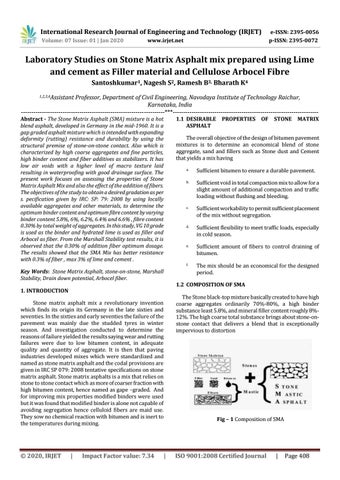
The Stone black-top mixture basically created to have high coarse aggregates ordinarily 70%-80%, a high binder substance least 5.8%, and mineral filler content roughly 8%12%. The high coarse total substance brings about stone-onstone contact that delivers a blend that is exceptionally impervious to distortion
Stone matrix asphalt mix a revolutionary invention which finds its origin its Germany in the late sixties and seventies. In the sixties and early seventies the failure of the pavement was mainly due the studded tyres in winter season. And investigation conducted to determine the reasons of failure yielded the results saying wear and rutting failures were due to low bitumen content, in adequate quality and quantity of aggregate. It is then that paving industries developed mixes which were standardized and named as stone matrix asphalt and the codal provisions are given in IRC SP 079: 2008 tentative specifications on stone matrix asphalt. Stone matrix asphalts is a mix that relies on stone to stone contact which as more of coarser fraction with high bitumen content, hence named as gape –graded. And for improving mix properties modified binders were used but it was found that modified binder is alone not capable of avoiding segregation hence celluloid fibers are maid use. They sow no chemical reaction with bitumen and is inert to the temperatures during mixing.
Impact Factor value: 7.34
STONE
1.2 COMPOSITION OF SMA
1. INTRODUCTION
|
OF
The overall objective of the design of bitumen pavement mixtures is to determine an economical blend of stone aggregate, sand and fillers such as Stone dust and Cement that yields a mix having
Key Words: Stone Matrix Asphalt, stone-on-stone, Marshall Stability, Drain down potential, Arbocel fiber.
© 2020, IRJET
PROPERTIES
Fig – 1 Composition of SMA
|
ISO 9001:2008 Certified Journal
|
Page 408
International Research Journal of Engineering and Technology (IRJET)
e-ISSN: 2395-0056
Volume: 07 Issue: 01 | Jan 2020
p-ISSN: 2395-0072
www.irjet.net
1.3 NEED FOR STUDY
2.2 Binder
Road transportation is one of the common modes of transport which was used in the pre-notable Circumstance .from that point forward many examinations is pavement material were carried out providing safe and comfortable ride to the road users .In the present day scenario it is noticed that vehicular volume ,frequency and loading intensity by manifolds the road laid with conventional bituminous mixes is unable to cope up with the above variables resulting in early failure .many Researchers have contributed for the use of waste materials ,for improvement in pavement service Life. Stone matrix asphalt mix is suitable for heavy vehicle traffic and offers good resistance for rutting characteristics .keeping in mind the end goal to build the quality and resistance of SMA mixture Arbocel Fibers is added at regular intervals.
The proper selection of binder content is an important element supporting the stone skeleton performance. In this study VG-10 Grade bitumen used. To find the physical properties of the binder content the various test are carried out as per IRC: SP: 53:2010 and MoRTH 500-36 Section. 2.3 Filler Material Hydrated lime has been used as the mineral filler in the stone matrix asphalt mixture, with the replacement for stone dust in the percent of 2%. It was procured from, Vijay laxmi enterprises, timerpet road, Raichur. The grading requirement is carried out as per IRC: SP: 79: 2008 and MORTH 500-36 Section. 2.4 Stabilizer Additive
1.4 SCOPE AND OBJECTIVES OF SMA
Fibres are used as stabilizer in SMA mixture. It helps to increase the strength and stability also decrease the drain down in SMA Mix. In the present study, the fiber used is ARBOCEL® ZZ 8/1G. It was procured from Strategic Marketing and Research Team, Bangalore. Arbocel is natural cellulose fibre produced from cellulose and it is a powdery to fibrous cellulose additive for use in construction chemicals products. The characteristics of Arbocel fibre are as shown in Table No – 01.
The extent of present work includes the assurance of different properties of the binder and aggregate utilized for SMA mixture. SMA sample were set up by fluctuating the bitumen substance and fiber content by conducting marshal stability Test to decide the ideal bitumen substance and ideal fiber substance. Further the Drain-down Test was led to check for the cover seepage. The laboratory performance of the SMA blends is checked for the moisture susceptibility and Rutting Test. The objectives of the present dissertation work are given below. i.
To assess the properties of aggregates and bitumen by conducting the test in the laboratory as per MORT& H specification and IS SP: 2010 respectively.
ii.
To determine the optimum binder content with addition of 0.3% of fiber and optimum fibre content by varying their percentage by conducting Marshall Stability Test.
iii.
To conduct Marshall Stability test on stone matrix asphalt mix prepared using stone dust (1% and 2%), Cement (1% and 2%) as mineral filler and cellulose fibre as a stabilizing additive at 25⁰c.
iv.
Table No – 01 Sl No
Characteristics
1 2
Physical appearance Cellulose content
Values from Testing Certificate Long fibre, Grey 80±5 %
3 4 5
Average fibre length Average fibre thickness Bulk density
1100 µm 45 µm 200 g/l – 280 g/l
6
Temperature resistance (℃) pH value
Up to 200℃
7
7.5±1
To study the property of SMA Mix addition of fiber by performing Marshall Stability test.
2. MATERIALS USED 2.1 Aggregates Aggregates used are mainly divided into coarse and fine aggregate based on their size. The aggregates selected for the Stone Matrix Asphalt are subjected to various aggregate tests as specified by IRC: SP: 79: 2008 and MoRTH section 500, confirming to the table 500-36. Fig No – 02 Arbocel Fiber
© 2020, IRJET
|
Impact Factor value: 7.34
|
ISO 9001:2008 Certified Journal
|
Page 409
International Research Journal of Engineering and Technology (IRJET)
e-ISSN: 2395-0056
Volume: 07 Issue: 01 | Jan 2020
p-ISSN: 2395-0072
www.irjet.net
3. TESTS AND SMA MIX DESIGN
3
Flash Point ( ℃)
4
Specific Gravity
3.1 Aggregates Properties The aggregates were evaluated for various physical properties in accordance with the Indian Standard specifications and The following Table No 2 presents the test results of physical characteristics of aggregates used in the present work.
S Aggregate l Test N o
Method
Result
Requirement as per IRC:SP:79:2008
1
Aggregate Impact Value (%)
IS : 2386 ( Part-IV)
14.87 %
< 18 %
2
Aggregate crushing value (%)
IS : 2386 ( Part-IV)
16.45%
< 25 %
3
Combined Flakiness &Elongatio n Index (%)
IS : 2386 (Part-I)
26.78%
< 30 %
4
Angularity number
IS : 2386 (Part-I)
9
< 11
5
Water absorption
IS : 2386 ( Part-III)
1.8
<2
6
Specific gravity of coarse aggregates
IS : 2386 ( Part-III)
2.058
>2
Aggregate gradation is one of the most basic laboratory test done which aims to determine the percentages of different size of aggregates to be used in the mix. After the basic tests, the aggregates are further used in the determination of the proper blend to give a good mix consisting of different size of aggregates. The different size of aggregates used to obtain proper blend are 19mm down size, 10mm down size, 6mm down size and stone dust. 4000gm of aggregates were taken for sieve analysis. The aggregate gradation is done by using Rothfuch’s Method to find the individual percentages of different sized aggregates to be used confirming to the upper and lower limits specified as per MoRTH table 500-37 and IRC: SP: 79: 2008.
3.4 SMA Mix Design The mix design is done by using Marshall Stability Test to find the optimum binder content bearing a maximum stability value and also confirming the other Marshall parameters. The design mix shall meet the requirements as per MORTH table 500-38: SMA Mix requirements. The requirements for SMA Mix are shown in Table 4.The combined grading of the coarse aggregates, fine aggregates and mineral filler shall be within the limits shown in Table 5.
Bitumen grade (VG -10) was used as he binder in the mixture design of Stone Matrix Asphalt Mix throughout the work. The test results are tabulated in Table No 3. Table No 3 Bitumen Test Result
2
>0.99
Chart No 1: Aggregate Gradation
3.2 Binder
1
Min 220
3.3 Aggregate Gradation
Table No 2 Physical Characteristics of Aggregates- Test Results
Sl No
IS – 154622004 260°C IS – 1.00 154622004
Test
Penetration at 25℃ (mm) Softening Point (℃)
© 2020, IRJET
Method
Results
IS – 40 154622004 IS – 154622004 64°C
|
Requirement as per IRC: SP: 53: 2010 30-50
Table No 4 SMA Mix Requirements
Min 60
Impact Factor value: 7.34
|
SI no
Mix design parameters
1 2
Air void content % Bitumen content %
Requirements per MORTH table 500-38 4.0% Minimum 5.8%
ISO 9001:2008 Certified Journal
|
Page 410
as
International Research Journal of Engineering and Technology (IRJET)
e-ISSN: 2395-0056
Volume: 07 Issue: 01 | Jan 2020
p-ISSN: 2395-0072
3
Fibre %
4
Voids in mineral aggregates % Asphalt drain down % Tensile strength ratio %
5 6
www.irjet.net
temperature of around 165℃-185℃. The mix is now transferred to the preheated mould and compacted with 50 blows on each side of specimen at a temperature of around 130℃-150℃. Once the mix is compacted the specimen is allowed to cool down for 24hrs and de-mould the specimen. The de-moulded specimen is kept in water bath for 30 minutes maintained at a 60℃ temperature. The specimen is placed in the Marshall Test setup, the load is applied at the constant deformation rate of 51mm per minute and load deformation readings are closely observed. The maximum load reading corresponding deformation of the specimen at failure load are noted. The maximum load value expressed in kg is recorded as the ‘Marshall Stability’ value of the specimen. The vertical deformation of the test specimen corresponding to the maximum load, expressed in mm units is recorded as the ‘Flow Value’. The specimen is removed from the test head and test is repeated on other specimen. Three specimens were casted for each binder content and average value is considered.
0.30% by mass of total mix Minimum 17 Maximum 0.30% Minimum 85
Table No 5 Composition of Stone Matrix Asphalt
SI NO
SMA Designation
13mm SMA
1
Course where used
Wearing course
2
Nominal aggregate size
13mm
3
Nominal layer thickness
40-50 mm
4
IS Sieve (mm)
Cumulative % by weight of total aggregate passing
5
26.5
-
6
19
100
7
13.2
90-100
8
9.56
50-75
9
4.75
20-28
4. TEST RESULTS OF SMA MIX
10
2.36
16-24
4.1 SMA Mixture
11
1.18
13-21
12
0.600
12-18
13
0.300
10-20
14
0.075
8-12
Fig No 03 Marshall Moulds and Test Set up
For SMA Conventional mixture to know the optimum binder content and stability by conducting the Marshall Stability test in the laboratory. Varying the percentage of binder content with increment of 0.2% i.e. 5.8%, 6%, 6.2%, 6.4%, 6.6% and addition of filler material 2% in to the mix. The test results and Marshall Parameters are shown in chart no 02. The volumetric property with binder content (%) for conventional mix are within limits as per IRC: SP: 79: 2008 Specifications for Stone Matrix Asphalt.
3.5 Marshall Stability Test This test is conducted to determining the optimum bitumen substance bearing a maximum stability and other Marshall parameters.
4.2 Relationship between binder content and Marshall Parameters for SMA mixture The graphical representation of binder content versus Marshall Parameters is shown in chart no 2. From graphs individual values of optimum binder contents are obtained considering maximum stability, maximum density, and mid-range of recommended voids content. Considering the different values of optimum binder contents determined as above, a suitable design optimum binder content is selected within the range of optimum values mentioned. The optimum binder content was observed to be 6.2% with bearing maximum stability 1764kg and density 2.30g/cc. The relationship between the binder content and percentage
3.5.1 Specimen Preparation for SMA Mix The various size of aggregates were mixed in proportion obtained from the gradation and Marshall Samples were prepared at varying binder contents of 5.8%, 6%, 6.2%, 6.4%, and 6.6% at increments of 0.2%. Approximately 1200gms aggregates taken in combination of different sizes and filler heated to a temperature of around 170℃ -180℃ for the preparation of specimen. The bitumen is heated up to a flowing state of around 125℃. The aggregates and bitumen are well mixed in the mixer at a
© 2020, IRJET
|
Impact Factor value: 7.34
|
ISO 9001:2008 Certified Journal
|
Page 411
International Research Journal of Engineering and Technology (IRJET)
e-ISSN: 2395-0056
Volume: 07 Issue: 01 | Jan 2020
p-ISSN: 2395-0072
www.irjet.net
air voids is an important parameter in the mix design of the Stone Matrix Asphalt. It is observed that increase in binder content reduces the percentage air-voids of the compacted mix. It is also seen that increase in binder content, there is increase in flow value, voids filled with bitumen and voids filled with mineral aggregates. For the optimum binder content 6.2% VFB, VMA and Flow value was observed to be 77%, 18.15% and 3.2mm respectively. 4.3 SMA Mix with replacement of lime, cement. The reason for adding fibres is to reduce the drain down of binder and making the mix homogeneous, which is very well confirmed by the stability results of SMA mixture before and after addition of fibers. Marshall Stability test on SMA with addition of fibers aims to found out the optimum binder content and optimum fibre content bearing the maximum stability. Here max percentages of binder content 6.2% with 0.3% percentages of fibers are added to the mix. The test results of addition fibers and the Marshall properties with addition of fibers , lime and cement are shown in chart no 3 and 4 respectively. The OFC (optimum fiber content) and OBC (optimum binder content) are observed to further investigations on SMA mixture. The relationship between binder content and Marshall Parameters for SMA mixtures with addition of fiber is discussed in detail below.
Chart No 03: Graphical Representation for Marshall Stability, VFB and Percentage of Air Voids V/S Percentage of Lime Content
Chart No 02: Graphical Representation of Marshall Mix Parameters
Chart No 4: Graphical Representation for Marshall Stability, VFB and Percentage of Air Voids V/S Percentage of Cement Content
© 2020, IRJET
|
Impact Factor value: 7.34
|
ISO 9001:2008 Certified Journal
|
Page 412
International Research Journal of Engineering and Technology (IRJET)
e-ISSN: 2395-0056
Volume: 07 Issue: 01 | Jan 2020
p-ISSN: 2395-0072
www.irjet.net
when compared to the specimens prepared using Cement (3%) filler.
5. RESULTS AND DISCUSSIONS
1.
The Optimum Bitumen Content (OBC = 6.2 %) for Stone Matrix Asphalt mix prepared without using lime, Cement as filler material and with fiber (0.3%) as stabilizing additive are 11.42 Kg .
2.
It is observed that Optimum Bitumen Content for Stone Matrix Asphalt mix prepared using lime (3%) and cement ( 3%) as filler material and fiber (0.3%) as stabilizing additive are 13.76 Kg and 9.19 kg.
3.
4.
The Marshall stability for Stone Matrix Asphalt mix prepared at OBC using lime (3%) and Cement (3%) as filler material and fiber (0.3%) as stabilizing additive are 1379.1kg and 919.0kg respectively. The Marshall stability for Stone Matrix Asphalt mix prepared at OBC without using lime (3%) and Cement (3%) as filler material and fiber (0.3%) as stabilizing additive are 1376.0kg respectively
5.
The Total air voids for Stone Matrix Asphalt mix prepared at OBC using lime (3%), Cement (3%) as filler material and fiber (0.3%) as additive is 4.03% and 4.02% respectively.
6.
The Total air voids for Stone Matrix Asphalt mix prepared at OBC without using lime (3%) and Cement (3%) as filler material and fiber (0.3%) as stabilizing additive are 4.04 respectively .
7.
The VFB for Stone Matrix Asphalt mix prepared at OBC using lime (3%), Cement (3%) as filler material and fiber (0.3%) as additive are 78.472% and 74.473% respectively.
8.
The VMA for Stone Matrix Asphalt mix prepared at OBC without using lime (3%) and Cement (3%) as filler material and fibre (0.3%) as stabilizing additive are 78.100 % respectively .
4.
Marginal increase in Bulk density for Stone Matrix Asphalt mix prepared at OBC using fiber(0.3%) as stabilizing additive and lime (3%) as filler when compared to the specimens prepared using Cement (3%) filler.
5.
Substantial decrease in Flow value for Stone Matrix Asphalt mix prepared at OBC using fiber (0.3%) as stabilizing additive and lime (3%) as filler when compared to the specimens prepared using Cement (3%) filler.
6.
Marginal decrease in Total air voids for Stone Matrix Asphalt mix prepared at OBC using fiber (0.3%) as stabilizing additive and lime (3%) as filler when compared to the specimens prepared using Cement (3%) filler.
7.
Marginal decrease in VMA for Stone Matrix Asphalt mix prepared at OBC using fiber (0.3%) as stabilizing additive and lime (3%) as filler when compared to the specimens prepared using Cement (3%) filler.
8.
Marginal increase in VFB value for Stone Matrix Asphalt mix prepared at OBC using fiber (0.3%) as additive and lime (3%) as when compared to the specimens prepared using Cement (3%).
9.
Based on Marshall properties of Stone Matrix Asphalt mix it is concluded that Stone Matrix Asphalt mix prepared using lime as mineral filler are superior than mix prepared using cement as filler material for stone matrix prepared using fiber as stabilizing additive.
6.2 RECOMMENDATIONS FOR FUTURE SCOPE 1.
Many properties of SMA Mix such as Marshall Properties, drain down potential, moisture susceptibility, and rutting behaviour has been tried in this investigation. However, some other properties such as fatigue resistance and dynamic creep behaviour can be further investigated.
2.
Studies can be carried out further by using natural fibres and waste plastic like low and high density polyethylene as an additive into mix and to know the effect of addition.
3.
Study on rutting analysis is done with room temperature, constant tyre pressure and type of tyre, these constant parameters are varied for further research work on stone matrix asphalt blend and to know the effect of variation in the parameters.
6.0 CONCLUSION AND FUTURE SCOPE OF WORK 6.1 CONCLUSIONS 1.
The test results of aggregates are satisfying the requirements as per Table 500-38 of MORT&H (V Revision) specifications.
2.
The test results of bitumen (VG-10) are satisfying the requirements as per IS 73 2013.
3.
Substantial increase in Marshall Stability for Stone Matrix Asphalt mix prepared at OBC using fiber (0.3%) as stabilizing additive and lime (3%) as filler
© 2020, IRJET
|
Impact Factor value: 7.34
|
ISO 9001:2008 Certified Journal
|
Page 413
4.
International Research Journal of Engineering and Technology (IRJET)
e-ISSN: 2395-0056
Volume: 07 Issue: 01 | Jan 2020
p-ISSN: 2395-0072
www.irjet.net
Use of steel slag as a replacement of aggregates to the normal virgin aggregates can tried for the further work.
11. Muniandy R., Huat B. B. K (2006) “In this study cellulose oil palm fibre as stabilizing additive” 12. Pawan Kumar et al. (2004) “Use from claiming Jute Fibres in stone grid black-top mixtures”.
REFERENCES 1.
2.
Goutham Sarang, Lekha B.M, A.U. Ravi Shankar, “Aggregate And Bitumen Modified With Chemicals For Stone Matrix Asphalt Mixtures” International Conference on Innovations in Civil Engineering, IOSR Journal of Mechanical and Civil Engineering (IOSR-JMCE) e-ISSN: 2278-1684, p-ISSN: 2320-334X PP 14-20
13. S. K. Khanna, C. E. G. Justo, A. Veeraragavan (2014), “Text Book of Highway Engineering (revised 10th edition)”.
Suchismita, M. Panda, U. Chattaraj, L. Gáspár (2011), “Fatigue Characteristics of Stone Matrix Asphalt Mixes In Warm Climate”, Acta Technica Jaurinensis Vol. 4. No. 3.
15. IS 73:2013 “PAVING BITUMEN — SPECIFICATION (Fourth Revision)”.
3.
Rajendra Soren (2012), “Laboratory Investigation On Stone Matrix Asphalt Using Bagasse Fibre”, Department of Civil Engineering National Institute of Technology Rourkela-769008.
4.
Goutham Sarang, Mehnaz E and A.U. Ravi Shankar (2014), “Comparison Of Stone Matrix Asphalt Mixtures Prepared In Marshall Compaction And Gyratory Compactor”, International Journal of Civil Engineering Research. ISSN 2278-3652 Volume 5, Number 3 .pp. 233-240.
5.
Bindu C.S, Beena K.S (2014), “Influence Of Additives On The Drain Down Characteristics Of Stone Matrix Asphalt Mixtures” International Journal ofResearch in Engineering and Technology eISSN: 2319-1163 pISSN: 2321-7308 Volume: 03.
6.
Ashish Talati, Vaishakhi Talati (2014), “Study Of Stone Matrix Asphalt For The Flexible Pavement” IJEDR Volume 2, Issue 1 ISSN: 2321-9939
7.
Mahabir Panda, Ujjal Chattaraj, “Resilient Characteristics of Stone Matrix Asphalt Mixes”, Department of Civil Engineering, National Institute ofTechnology, Rourkela, Orissa.
8.
Bindu C.S Reader, Beena. K.S (2014) “Waste Plastic as a Stabilizing Additive In Stone Mastic Asphalt”, Division of Civil Engineering, Cochin University of Science and Technology, CUSAT, Cochin 682022, Kerala.
9.
Bindu C.S (2012), “Influence of Additives on the Characteristics of Stone Matrix Asphalt” Cochin University of Science and Technology Kochi-682 022.
14. S. K. Khanna, C .E .G. Justo, A. Veeraragavan (2013), “Highway Materials and Pavement Testing (revised 5th edition)”. Laboratory Manual.
16. IRC SP78:2008 “Tentative Specifications for Stone Matrix Asphalt”. 17. Indian Roads Congress (2013), Specifications for Road and Bridge Works, “MoRT&H (Fifth revision)” BIOGRAPHIES Mr Santoshkumar Assistant Professor Department of Civil Engineering Navodaya Institute of Technology, Raichur - 584103 Mr Nagesh Sugandhi Assistant Professor Department of Civil Engineering Navodaya Institute of Technology, Raichur – 584103 Mr Ramesh Baragani Assistant Professor Department of Civil Engineering Navodaya Institute of Technology, Raichur - 584103 Mr Bharath Koner Assistant Professor Department of Civil Engineering Navodaya Institute of Technology, Raichur - 584103
10. Vivek B R, Dr Sowmya N J (2015) “Utilization of Fibre as a strength modifier in Stone Matrix Asphalt”.
© 2020, IRJET
|
Impact Factor value: 7.34
|
ISO 9001:2008 Certified Journal
|
Page 414