International Research Journal of Engineering and Technology (IRJET)
e-ISSN: 2395-0056
Volume: 07 Issue: 01 | Jan 2020
p-ISSN: 2395-0072
www.irjet.net
A Study on Face Recognition Based On Local Binary Pattern Ankita Gupta1, Pranay Devghare2, Shouryaraj Batra3, Shubham Mishra4, Prof. Piyush Awthare5 1Ankita Gupta Student & Bhandara 2Pranay Devghare Student & Bhandara
3Shouryaraj Batra Student & Bhandara 4Shubham Mishra Student & Bhandara
5Piyush Awthare: Professor, Dept. of Computer Engineering, Manoharbhai Patel Institute of Engineering and
Technology College, Maharashtra, India ---------------------------------------------------------------------***---------------------------------------------------------------------
Abstract - Image processing and facial analysis has been an
important research field which aims to identify human faces and found its use in various different fields for examples in security. The reasons for this trend are; first it’s the wide range of law enforcement applications and the second availability of feasible technologies after many years of research. Face recognition and detection is still a difficult challenge and there is no unique method that provides an effective solution to all situations face processing may encounter. In this paper a study on face recognition based on different algorithms is presented for extraction of features.
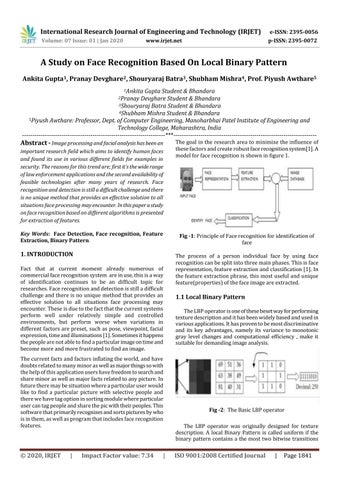
The goal in the research area to minimize the influence of these factors and create robust face recognition system[1]. A model for face recognition is shown in figure 1.
Key Words: Face Detection, Face recognition, Feature Extraction, Binary Pattern.
Fig -1: Principle of Face recognition for identification of face
1. INTRODUCTION
The process of a person individual face by using face recognition can be split into three main phases. This is face representation, feature extraction and classification [1]. In the feature extraction phrase, this most useful and unique feature(properties) of the face image are extracted.
Fact that at current moment already numerous of commercial face recognition system are in use, this is a way of identification continues to be an difficult topic for researches. Face recognition and detection is still a difficult challenge and there is no unique method that provides an effective solution to all situations face processing may encounter. These is due to the fact that the current systems perform well under relatively simple and controlled environments, but perform worse when variations in different factors are preset, such as pose, viewpoint, facial expression, time and illuminations [1]. Sometimes it happens the people are not able to find a particular image on time and become more and more frustrated to find an image. The current facts and factors inflating the world, and have doubts related to many minor as well as major things so with the help of this application users have freedom to search and share minor as well as major facts related to any picture. In future there may be situation where a particular user would like to find a particular picture with selective people and there we have tag option in sorting module where particular user can tag people and share the pic with their peoples. This software that primarily recognizes and sorts pictures by who is in them, as well as program that includes face recognition features.
© 2020, IRJET
|
Impact Factor value: 7.34
|
1.1 Local Binary Pattern The LBP operator is one of these beset way for performing texture description and it has been widely based and used in various applications. It has proven to be most discriminative and its key advantages, namely its variance to monotonic gray level changes and computational efficiency , make it suitable for demanding image analysis.
Fig -2: The Basic LBP operator The LBP operator was originally designed for texture description. A local Binary Pattern is called uniform if the binary pattern contains a the most two bitwise transitions
ISO 9001:2008 Certified Journal
|
Page 1841
International Research Journal of Engineering and Technology (IRJET)
e-ISSN: 2395-0056
Volume: 07 Issue: 01 | Jan 2020
p-ISSN: 2395-0072
www.irjet.net
from 0 to 1 or vice versa when the bit pattern is considered circular[3].
1.2 Facial Description with LBP Some retaining information about relational is important. This reasoning leads to the basic methodology of this work. LBP is a simple and efficient text description operator which labels the pixels of an image by thresholds the neighbourhood of each pixel and which produce the result as a binary number. We can represent the face images with a simple data vector. LBPs compute a local representation of texture. This local representation is constructed by comparing each pixel with the surroundings neighbourhood pixels. The basic histogram can be extended into a spatially enhanced histogram which encodes both the appearance and the spatial relations of facial regions. In the spatially enhanced histogram, we effectively have a description of the face on three different levels of locality.
2. Algorithm for Face Recognition
pixels. It is used to decide the local characteristic in the face and also works by using simple LBP operator. Local Binary Patterns are amongst the recent texture descriptors. The original LBP operator replaces the fee of the pixels of an photograph with decimal numbers, which are known as LBPs or LBP codes that encode the local shape around every pixel. Algorithm The process of face recognition consists of following four main parts: 1. Preprocessing: We begin by applying the tan and Trigg’ illumination and normalization algorithm to compare for illumination variation in the face image. No futher preprocessing such as face alignment is performed. 2. LBP operator applications: In this section LBP are computed for each pixel, making a fine scale textural description of the image. 3. Local feature extraction process: Local features are produced by computing histograms of LBP over local image regions. 4. Classification: Each face image in test set is classified by comparing it against the face images in the training set. The comparison is performed using local features obtained in the previous step in the algorithm. The first steps are shared by all of the algorithm[1]. Face recognition is not a simple problem seeing that an unknown face picture seen within the extraction section is commonly one of a kind from the face photo seen inside the classification section. Although nearby binary features has been extracted from the face image for the picture uses in the database that in comparison with the enter face picture. The face photograph depends on viewing lightning and environmental conditions. In addition the face image adjustments in keeping with the expressions.
Fig -3: Flowchart for LBP process Local Binary Pattern works at the local features of the LBP capabilities that makes use of LBP operator which summarizes the local unique structure of a photo LBP is an ordered set of binary comprises of pixels intensities is completed as consistent with the value of surrounding
© 2020, IRJET
|
Impact Factor value: 7.34
|
Each important pixel is compared with its eight neighbours; the neighbours having smaller price than that of the relevant pixel may have the bit 0, and the other neighbours having fee identical to or greater than that of the relevant pixel will have the bit 1. For every given important pixel, one can generate a binary range that is acquired by using concatenating some of these binary bits in a clockwise manner, which begins from the only of its top-left neighbour. The ensuing decimal cost of the generated binary wide variety replaces the principal pixel cost. The histogram of LBP labels (the frequency of occurrence of every code) calculated over a place or an image can be used as a texture descriptor of that image. The size of the histogram is 2P for the reason that operator LBP(P,r) is capable of generate 2P exceptional binary codes, formed through the P neighbouring pixels. Recently, several LBP versions have been developed if you want to improve the texture description.
ISO 9001:2008 Certified Journal
|
Page 1842
International Research Journal of Engineering and Technology (IRJET)
e-ISSN: 2395-0056
Volume: 07 Issue: 01 | Jan 2020
p-ISSN: 2395-0072
www.irjet.net
It is found that the face recognition algorithm efficacy of the traditional face recognition approaches. PCA and LDA, decreases while facing the face variation on pose, illumination and expressions. In addition, all the algorithms perform better on expressions variation than on illumination condition, which means illumination variation is more challenging for face recognition.
3. CONCLUSION This paper affords a look at approximately the local binary pattern set of rules for face reputation making use of function extraction with nearby binary sample. This facial illustration is primarily based on dividing a facial photograph into small areas and computing a description of each location the use of nearby binary pattern. This look at makes us apprehend approximately face recognition set of rules and extraction of features.
REFERENCES Devendra Gondole, Prof. P.A. Salunkhe, “Face Recognition Based on Local Binary Pattern,” IJSRSET1841145, vol. 4, Feb 2018. [2] T. Ojala, M. Pietikainen, and T. Maenpaa, “Multiresolution gray-scale and rotation invariant texture classification with local binary patterns,” IEEE Transactions on Pattern Analysis and Machine Intelligence, vol. 24, no. 7, pp. 971-987, Jul 2002 [3] Karol Marso, Albert Nannarelli, “Face Recognition using approximate Arithmatic” DTU Compute. DTU Compute Technical reports-2018, vol. 2, Jan 2020 [4] Sandeep Kumar, Sukhwinder Singh, Jagdish Kumar. “A Study on Face Recognition Techniques with Age and Gender Classification” May 2017 [1]
© 2020, IRJET
|
Impact Factor value: 7.34
|
ISO 9001:2008 Certified Journal
|
Page 1843