International Research Journal of Engineering and Technology (IRJET)
e-ISSN: 2395-0056
Volume: 07 Issue: 01 | Jan 2020
p-ISSN: 2395-0072
www.irjet.net
Water Desalination using Renewable Energy Source Prof. Vijay kumar1, A.P. Bhalerao2, B.K. Wagh3, P.I. Bhagat4 1,2,3,4Dept. of Electrical Engg., AVCOE Sangamner, Maharashtra, India
---------------------------------------------------------------------***----------------------------------------------------------------------
Abstract – Water is the basic need of human for cooking, washing and bathing. But 97.5% of the earth’s water is seawater and the remaining 2.5% is freshwater found in glaciers and underground. To satisfy the water requirement for daily needs we are depend on natural freshwater resources like river water, underground water and rainwater. Desalination is a process of removing salts from sea water. In this paper desalination of water is based on water condensation method. In water condensation method, water is heated till it converted into vapors. Then this water vapors are collected and cooled down to convert into liquid form. In this method, impurities and salt in sea water remains at bottom level and water converted into gas. Like this, pure water is obtained from sea water.
In this paper we proposed a prototype of sea water desalination tank. A metal airtight tank is designed for this project. In which water is heated with the help of heater coil. Energy requirement for this purpose is satisfied through solar energy using PV module. A temperature control system with the help of microcontroller and LCD is added to protect system from overheating. This project will help in various forms to use sea water such as drinking, bathing, clothing, irrigation, etc Key Words: Desalination, Condensation, PV module , etc 1. INTRODUCTION: The hybrid inverter we are using or smart grid inverter is a trending generation of inverter for solar and wind applications using nonconventional energy home
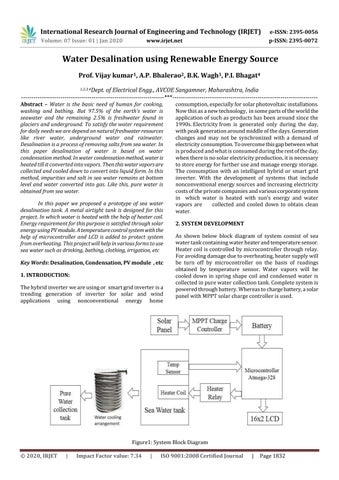
consumption, especially for solar photovoltaic installations. Now this as a new technology, in some parts of the world the application of such as products has been around since the 1990s. Electricity from is generated only during the day, with peak generation around middle of the days. Generation changes and may not be synchronized with a demand of electricity consumption. To overcome this gap between what is produced and what is consumed during the rest of the day, when there is no solar electricity production, it is necessary to store energy for further use and manage energy storage. The consumption with an intelligent hybrid or smart grid inverter. With the development of systems that include nonconventional energy sources and increasing electricity costs of the private companies and various corporate system in which water is heated with sun’s energy and water vapors are collected and cooled down to obtain clean water. 2. SYSTEM DEVELOPMENT As shown below block diagram of system consist of sea water tank containing water heater and temperature sensor. Heater coil is controlled by microcontroller through relay. For avoiding damage due to overheating, heater supply will be turn off by microcontroller on the basis of readings obtained by temperature sensor. Water vapors will be cooled down in spring shape coil and condensed water is collected in pure water collection tank. Complete system is powered through battery. Whereas to charge battery, a solar panel with MPPT solar charge controller is used.
Figure1: System Block Diagram © 2020, IRJET
|
Impact Factor value: 7.34
|
ISO 9001:2008 Certified Journal
|
Page 1832
International Research Journal of Engineering and Technology (IRJET)
e-ISSN: 2395-0056
Volume: 07 Issue: 01 | Jan 2020
p-ISSN: 2395-0072
www.irjet.net
2.1 Circuit Diagram The electrical circuit network of the system is shown in figure. The photovoltaic solar panel is used for generation of electricity using solar energy. This energy is used for charging of small energy system usually battery through MPPT charge controller for maximum tracking of solar energy for stable power supply to the desalination unit. The battery is connected to the heater coil through microcontroller. The microcontroller is used to control the system. Microcontroller is connected to the LCD display, temperature sensor, battery and heater relay. The
temperature sensor is connected in water tank for temperature control during the heating process. Data collected from is sent to the temperature sensor is sent to microcontroller which controls the heater coil through relay for the heating of water. The LCD shows the temperature of the water and water level in the tank. The evaporated water is then collected through cooling arrangements where is gets cool down is collected inside the pure water collection tank. This water collected here is free of salts and any impurities. It makes the system robust, simple in operation, low maintenance, compact in size, easy transportation to any site.
Figure2:circuit diagram In this design the hardware components that we use are:
Solar panel
Microcontroller ATMEGA328
MPPT Charge controllers
Battery
Temperature Sensor
2.2 Solar Panel (12V, 40W)
Figure3: solar panel © 2020, IRJET
|
Impact Factor value: 7.34
|
ISO 9001:2008 Certified Journal
|
Page 1833
International Research Journal of Engineering and Technology (IRJET)
e-ISSN: 2395-0056
Volume: 07 Issue: 01 | Jan 2020
p-ISSN: 2395-0072
www.irjet.net
Specifications:
poly-Crystalline Silicon Maximum Power Watt 40 Production Tolerance ±10% Maximum Power voltage V 18V Maximum Power current A 2.23A Open circuit voltage V 22V Short circuit current A 2.42 Size of panel (wide 225.5Mmm*639mm*6.9mm
and
high)
2.2 Microcontroller ATMEGA328 A microcontroller is a heart of every automation system. It is a small, low cost and self-contained on chip computer. Microcontrollers usually must have low-power requirements since many devices they control are battery-operated. As per our requirements, microcontroller ATMEGA328P matches perfectly.
Figure4: MPPT charge controller
Non isolated buck module
Input voltage:6-36V
28 pin IC with 20 GPIO pins
Out-put voltage:1.25-32V continuously adjustable
Multiple software tool support
Output current Range:.05-5A
Inbuilt 6 channel ADC
Operating temperature: -40 to +85 degree Conversion efficiency: up to 95%
Power Consumption at 1 MHz, 1.8V, 25°c are: Active Mode: 0.2 mA, Power-down Mode: 0.1μA
32 General purpose registers
2kb SRAM, 1kb EEPROM
Low power Sleep mode
Works on 5V
2.3 MPPT Charge Controller MPPT or Maximum Power Point Tracking is algorithm that included in charge controllers used for extracting maximum available power from PV module under certain conditions. The voltage at which PV module can produce maximum power is called maximum power point (or peak power voltage).
2.4 Battery (12V, 7Ahr sealed lead acid) The rechargeable batteries are lead-lead dioxide systems. The dilute sulfuric acid electrolyte is absorbed by separators and plates and thus immobilized. Should the battery be accidentally overcharged producing hydrogen and oxygen, special one way valves allow the gases to escape thus avoiding excessive pressure buildup. Otherwise, the battery is completely sealed and is, therefore, maintenancefree, leak proof and usable in any position. Here we used two such batteries for current requirement of heating coil. Two batteries connected in series then 14 A of current generated and which is used to heat the water inside the tank by giving to heating coil.
Figure5: Battery 12V, 7Ahr sealed lead acid
© 2020, IRJET
|
Impact Factor value: 7.34
|
ISO 9001:2008 Certified Journal
|
Page 1834
International Research Journal of Engineering and Technology (IRJET)
e-ISSN: 2395-0056
Volume: 07 Issue: 01 | Jan 2020
p-ISSN: 2395-0072
www.irjet.net
Features:
REFERENCES
Absorbent Glass Mat (AGM) technology for efficient gas recombination of up to 99% and freedom from electrolyte maintenance or water adding. Can be mounted in any orientation. Computer designed lead, calcium tin alloy grid for high power density. Long service life, float or cyclic Maintenance-free operation. Low self-discharge.
2.5 Temperature Sensor DS18B20 This is a pre-wired and waterproofed version of the DS18B20 sensor. Handy for when you need to measure something far away, or in wet conditions. While the sensor is good up to 125°C the cable is jacketed in PVC so we suggest keeping it under 100°C.It is use to sense the temperature of water inside the tank. Stainless steel encapsulated waterproof and rustproof Original DS18B20 temperature sensor probe used chips 3.0V~5.5power supply. It having an range of 55 ° ~+125 °c
[1] L.F. Greenlee, et al. (2009) Reverse osmosis desalination: Water sources, technology, and today‟s challenges, Water Research, 43(9):2317-2348. [2] A. E. Kabeel, et al. (2013) Water desalination using a humidification dehumidification technique-A detailed review, Natural Resources, (3):286-305. [3] H. Sharon, et al. (2015) A review of solar energy driven desalination technologies, Renewable & Sustainable Energy Reviews, 41:1080-1118. [4] L. Henthorne (2011) The state of desalination, International Desalination Association World Congress on Desalination and Water Reuse. [5] P. Byrne, et al. (2015) A review on the coupling of cooling, desalination and solar photovoltaic systems, Renewable & Sustainable Energy Reviews, 47:703-717. [6] Y.B. Karhe, et al. (2013) A solar desalination system using humidification dehumidification process- A review of recent research, International Journal of Modern Engineering Research, 3(2):962-969. [7] I. Dincer, C. Acar (2015) A review on clean energy solutions for better sustainability, International Journal of Energy Research, 39: 585-606 [8] S.G. Talbert, et al. (1970) Manual on solar distillation of saline water, Research and Development Progress Report No. 546, United States Department of the Interior, Contract No. 14-01-0001-1695
Figure6: Temperature Sensor 2.6 Water Heating Coil Water heating coils runs on 12 V supply having 16A ratings with high quality copper wire heat pipe, oxygen free copper wire. Which is use to heat the water stored inside the tank and supply operation of coil is based on relay which controlled by the microcontroller. 3. CONCLUSION
[9] M.A. Eltawil, et al. (2009) A review of renewable energy technologies integrated with desalination systems, Renewable & Sustainable Energy Reviews, 13(9):2245-2262. [10] D. Dsilva Winfred Rufuss, et al. (2016) Solar stills: A comprehensive review of designs, performance and material advances, Renewable & Sustainable Energy Reviews, 63:464-
The water has become one of the important resources at present and its needs are rapidly increasing .Renewable technologies can be used as solution for this with promise of economic and environmental viability on large scale. In this paper we have designed a standalone desalination unit which uses solar energy it makes the system robust, simple in operation, low maintenance, compact in size, easy transportation to any site. It has many applications at coastal areas, rural areas, during natural calamities and emergency conditions. 4. ACKNOWLEDGEMENT The authors would like to thank the viewers for their constructive comments. We also would like to thank our institution for their support to carry out our project. © 2020, IRJET
|
Impact Factor value: 7.34
|
ISO 9001:2008 Certified Journal
|
Page 1835