International Research Journal of Engineering and Technology (IRJET)
e-ISSN: 2395-0056
Volume: 07 Issue: 01 | Jan 2020
p-ISSN: 2395-0072
www.irjet.net
Extraction of Pure Methane, its Analysis & its Applications Mayuri Dahare, Sakshi Kale, Sanjivanee Rathod, Shital Kakde, Hitesh Tiwari, Sachin Murkute, Shailesh Dhawad Department of Electrical Engineering, Yeshwantrao Chavan College of Engineering, Wanadongri, Nagpur, Maharashtra, India. ---------------------------------------------------------------------***----------------------------------------------------------------------
Abstract: - Biogas is most commonly used form of
renewable energy. Generally biogas is used for cooking purpose. Biogas is composed of gases like CO2, N2, O2, CH4, H2S. The composition of different gases can be obtained by the process of gas chromatography. Out of all these gases the composition of methane obtained is maximum( approx 75%) and its calorific value is nearly same as other fuels like petrol, diesel. So, it can replace other fuels for the generation of electricity. Existing system of Generation of electricity is expensive. So for reducing the cost, Biogas generator can be replaced by gasoline engine coupled with dynamo. And also biogas can be used for lighting purpose by using mantle lamp. Key Words: Biogas, Dynamo, Renewable energy, Mantle Lamp, Biogas Generator, Gasoline Engine.
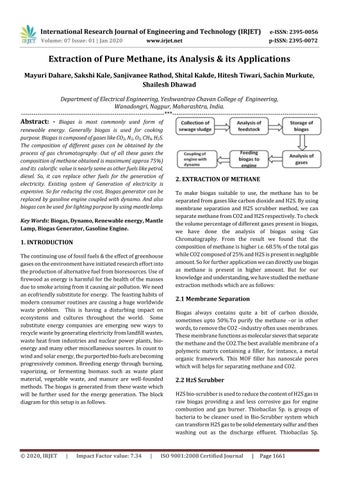
1. INTRODUCTION The continuing use of fossil fuels & the effect of greenhouse gases on the environment have initiated research effort into the production of alternative fuel from bioresources. Use of firewood as energy is harmful for the health of the masses due to smoke arising from it causing air pollution. We need an ecofriendly substitute for energy. The feasting habits of modern consumer routines are causing a huge worldwide waste problem. This is having a disturbing impact on ecosystems and cultures throughout the world. Some substitute energy companies are emerging new ways to recycle waste by generating electricity from landfill wastes, waste heat from industries and nuclear power plants, bioenergy and many other miscellaneous sources. In count to wind and solar energy, the purported bio-fuels are becoming progressively common. Breeding energy through burning, vaporizing, or fermenting biomass such as waste plant material, vegetable waste, and manure are well-founded methods. The biogas is generated from these waste which will be further used for the energy generation. The block diagram for this setup is as follows.
© 2020, IRJET
|
Impact Factor value: 7.34
|
2. EXTRACTION OF METHANE To make biogas suitable to use, the methane has to be separated from gases like carbon dioxide and H2S. By using membrane separation and H2S scrubber method, we can separate methane from CO2 and H2S respectively. To check the volume percentage of different gases present in biogas, we have done the analysis of biogas using Gas Chromatography. From the result we found that the composition of methane is higher i.e. 68.5% of the total gas while CO2 composed of 25% and H2S is present in negligible amount. So for further application we can directly use biogas as methane is present in higher amount. But for our knowledge and understanding, we have studied the methane extraction methods which are as follows:
2.1 Membrane Separation Biogas always contains quite a bit of carbon dioxide, sometimes upto 50%.To purify the methane –or in other words, to remove the CO2 –industry often uses membranes. These membrane functions as molecular sieves that separate the methane and the CO2.The best available membrane of a polymeric matrix containing a filler, for instance, a metal organic framework. This MOF filler has nanoscale pores which will helps for separating methane and CO2.
2.2 H2S Scrubber H2S bio-scrubber is used to reduce the content of H2S gas in raw biogas providing a and less corrosive gas for engine combustion and gas burner. Thiobacilas Sp. is groups of bacteria to be cleaner used in Bio-Scrubber system which can transform H2S gas to be solid elementary sulfur and then washing out as the discharge effluent. Thiobacilas Sp.
ISO 9001:2008 Certified Journal
|
Page 1661
International Research Journal of Engineering and Technology (IRJET)
e-ISSN: 2395-0056
Volume: 07 Issue: 01 | Jan 2020
p-ISSN: 2395-0072
www.irjet.net
microorganisms directly oxidize H2S to sulfur in order to generate energy for cell growth.
3. ANALYSIS OF FEEDSTOCK It starts in the laboratory where the samples are analyzed using an accurate lab balance. The samples can be weighed to determine the weight of the dish and the known volume of sample. Subtracting the dish weight gives the weight of the sample. After drying at 1050C, following evaporation of water, weighing the sample and subtracting the dish weight allows the Total solid to be determined. After combustion in a lab furnace at 5000C the fixed solids percentage of the original dry mass can be determined by weighing the sample, subtracting the dish weight and comparing with the weight of the sample after evaporation .This is expressed as a percentage can be subtracted from 100% to arrive at the volatile solid fraction percent. The samples taken are green waste, dry waste, paper waste, tea powder, outlet slurry and cow dung. The result obtained by analyzing the sample are as follows. Type of feedstock Dry waste Paper waste Green Waste Outlet slurry Cow Dung
Total solid (gm) 8.84 6.5 4.91
Moisture content % 11.6 35 50.9
Fixed solid % 56.05 32.76 30.65
Volatile solid %
0.95
90.9
25.27
74.72
2.07
79.3
12.56
87.43
100 90 80 70 60 50 40 30 20 10 0
43.95 67.24 69.35
4.1 What is Gas Chromatography? Gas chromatography (GC) is a common type of chromatography used in analytical chemistry for separating and analyzing compounds that can be vaporized without decomposition. It uses for testing the purity of a particular substance, or separating the different components of a mixture (the relative amounts of such components can also be determined). In some situations, GC may help in identifying a compound. In gas chromatography, the mobile phase (or "moving phase") is a carrier gas, usually an inert gas such as helium or an unreactive gas such as nitrogen. Helium remains the most commonly used carrier gas in about 90% of instruments although hydrogen is preferred for improved separations. The stationary phase is a microscopic layer of liquid or polymer on an inert solid support, inside a piece of glass or metal tubing called a column (an homage to the fractionating column used in distillation). The instrument used to perform gas chromatography is called a gas chromatograph. The gaseous compounds being analyzed interact with the walls of the column, which is coated with a stationary phase. This causes each compound to elute at a different time, known as the retention time of the compound. The comparison of retention times is what gives GC its analytical usefulness.
moisture content
pa p
dr y
w as
te er w a gr ee ste n w as ou tle te ts lu co rry w du ng
volatile solid
4. ANALYSIS OF BIOGAS The produced biogas is taken out in tedler bag with the help of suction pump. This stored gas is carried out in the Chemical Lab of VNIT Nagpur to analyse the percentage of various gases contained in the biogas with the help of Gas chromatography test. © 2020, IRJET
|
Impact Factor value: 7.34
|
4.2 GC Analysis A gas chromatograph is a chemical analysis instrument for separating chemicals in a complex sample. A gas chromatograph uses a flow-through narrow tube known as
ISO 9001:2008 Certified Journal
|
Page 1662
International Research Journal of Engineering and Technology (IRJET)
e-ISSN: 2395-0056
Volume: 07 Issue: 01 | Jan 2020
p-ISSN: 2395-0072
www.irjet.net
the column, through which different chemical constituents of a sample pass in a gas stream (carrier gas, mobile phase) at different rates depending on their various chemical and physical properties and their interaction with a specific column filling, called the stationary phase. The function of the stationary phase in the column is to separate different components, causing each one to exit the column at a different time (retention time). Other parameters that can be used to alter the order or time of retention are the carrier gas flow rate, column length and the temperature.In a GC analysis, a known volume of gaseous or liquid analyze is injected into the "entrance" (head) of the column. As the carrier gas sweeps the analyze molecules through the
CH4 CO2 O2 N2 H2
5. APPLICATIONS 5.1 Generation of Electricity:
column, this motion is inhibited by the adsorption of the analyze molecules either onto the column walls or onto packing materials in the column. The rate at which the molecules progress along the column depends on the strength of adsorption, which in turn depends on the type of molecule and on the stationary phase materials. Since each type of molecule has a different rate of progression, the various components of the analyze mixture are separated as they progress along the column and reach the end of the column at different times (retention time). Thus, the time at which each component reaches the outlet and the amount of that component can be determined.
4.3 Results obtained from GC
Biogas can be used in similar ways as natural gas in gas stoves, lamps or as a fuel for engines. The energy content of the gas mainly depends on its methane content. Theoretically biogas can be converted directly into electricity by using the fuel cell. However, this process requires very clean gas and expensive fuel cells. Therefore this option is still a matter for research and is not currently a practical option. The conversion of biogas to electric power by a generator set is much more practical. In contrast to natural gas, biogas is characterized by a high knock resistance and hence can be used in combustion motors with high compression rates. The biogas from gas storage tank is forcefully fed to the modified two stroke engine. The engine is designed with two inlets, for biogas and another for air required for proper combustion. Engine utilizes this chemical energy to convert into mechanical energy. When the engine is coupled with the dynamo, mechanical energy can be converted into electrical energy. This is the basic principle of generating electricity from biogas.
Peak Table
Ret. Time
Area
Height
5.2 Mantle Lamp
CO2 N2 CH4 Total
1.749 2.331 3.607
21687 130615 1614266 1766569
2161 5954 32535 40649
Mantle lamp produces incandescent lights. They burn a fuel like methane, propane, white gas or kerosene to produce heat, and the heat causes the mantles to produce light.
GASES Methane Carbon Dioxide Oxygen Nitrogen Hydrogen
© 2020, IRJET
|
The mantles are a ceramic mesh that encase the flame produced by the lantern. Mantles start out as silk fabric sacks impregnated with different oxides.
VOL% 68.214 25.171 0.914 4.857 0.087
Impact Factor value: 7.34
|
ISO 9001:2008 Certified Journal
|
Page 1663
International Research Journal of Engineering and Technology (IRJET)
e-ISSN: 2395-0056
Volume: 07 Issue: 01 | Jan 2020
p-ISSN: 2395-0072
www.irjet.net
CONCLUSIONS
From the analysis of feedstock ,it is concluded that the volatile solid(transform solid phase into gases phase) percentage is more in case of cow dung . And hence by using cow dung as a feedstock the gas production can be increased. From the result of Gas chromatography it is concluded that the retention time for methane is higher. Hence the volume of methane is higher. The volume of methane obtained is 68.21%.
ACKNOWLEDGEMENT It is with deep sense of gratitude that we wish to place on record sincere thanks to our guide Dr. Mrs. S. P. Adhau this work has been made possible by her continuous encouragement, expert guidance and exemplary perseverance. We have learnt from her the meaning of purposefulness and skill of innovation, throughout the period of this work. She maintained strict objectivity and exhorted us to strive for perfection. Also, we are in debated to her for providing us an ideal experimental setup. We obligated to her for keen interest in this work and skill which we have acquired during the course of this study.
REFERENCES [1] N.H.S.Ray, M.K.Mohanty and R.C. Mohanty, “Anaerobic Digestion Kitchen Waste: Biogas Production, Purification and Application in I.C. Engines”, Dept. of Mech Engg. CEB, BBSR, Odisha, India, Jan 2014 [2] Patil V.S. and Deshmukh H.V, “A review on codigestion of vegetable waste with organic wastes for energy generation.” International Research Journal Biological Sciences, 4(6), 83-86,(2015) [3] Anuradha Tomar and Anushree Shrivastav, “Electricity from waste –Bibliographic survey”, Dept. of Electrical and Electronics Engineering,Northern India Engineering College,New Delhi, India, May 2014 [4] Renewable Energy and Environmental Information Network (REEIN)-http://www.reein.org
© 2020, IRJET
|
Impact Factor value: 7.34
|
ISO 9001:2008 Certified Journal
|
Page 1664