International Research Journal of Engineering and Technology (IRJET)
e-ISSN: 2395-0056
Volume: 07 Issue: 01 | Jan 2020
p-ISSN: 2395-0072
www.irjet.net
Shopping Mall Experience using Beacon Technology Musaib Baug1, Arbaz Nagaria2, Sejal Shelar3, Prof. Vijaya Sagvekar4 1Musaib Baug Mumbai University 2Arbaz Nagaria Mumbai University 3Sejal Shelar Mumbai University
4Professor Vijaya Sagvekar, Dept. of Information Technology, PVPPCOE, Maharashtra, India
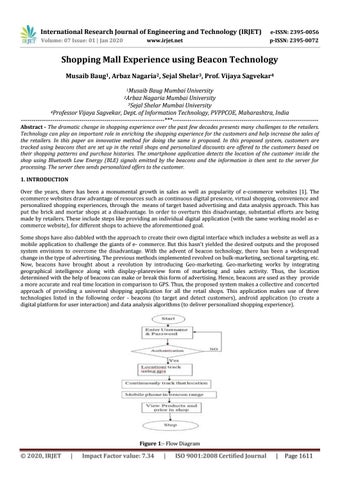
---------------------------------------------------------------------***---------------------------------------------------------------------Abstract - The dramatic change in shopping experience over the past few decades presents many challenges to the retailers. Technology can play an important role in enriching the shopping experience for the customers and help increase the sales of the retailers. In this paper an innovative method for doing the same is proposed. In this proposed system, customers are tracked using beacons that are set up in the retail shops and personalized discounts are offered to the customers based on their shopping patterns and purchase histories. The smartphone application detects the location of the customer inside the shop using Bluetooth Low Energy (BLE) signals emitted by the beacons and the information is then sent to the server for processing. The server then sends personalized offers to the customer. 1. INTRODUCTION Over the years, there has been a monumental growth in sales as well as popularity of e-commerce websites [1]. The ecommerce websites draw advantage of resources such as continuous digital presence, virtual shopping, convenience and personalized shopping experiences, through the means of target based advertising and data analysis approach. This has put the brick and mortar shops at a disadvantage. In order to overturn this disadvantage, substantial efforts are being made by retailers. These include steps like providing an individual digital application (with the same working model as ecommerce website), for different shops to achieve the aforementioned goal. Some shops have also dabbled with the approach to create their own digital interface which includes a website as well as a mobile application to challenge the giants of e- commerce. But this hasn't yielded the desired outputs and the proposed system envisions to overcome the disadvantage. With the advent of beacon technology, there has been a widespread change in the type of advertising. The previous methods implemented revolved on bulk-marketing, sectional targeting, etc. Now, beacons have brought about a revolution by introducing Geo-marketing. Geo-marketing works by integrating geographical intelligence along with display-planreview form of marketing and sales activity. Thus, the location determined with the help of beacons can make or break this form of advertising. Hence, beacons are used as they provide a more accurate and real time location in comparison to GPS. Thus, the proposed system makes a collective and concerted approach of providing a universal shopping application for all the retail shops. This application makes use of three technologies listed in the following order - beacons (to target and detect customers), android application (to create a digital platform for user interaction) and data analysis algorithms (to deliver personalized shopping experience).
Figure 1:- Flow Diagram
© 2020, IRJET
|
Impact Factor value: 7.34
|
ISO 9001:2008 Certified Journal
|
Page 1611
International Research Journal of Engineering and Technology (IRJET)
e-ISSN: 2395-0056
Volume: 07 Issue: 01 | Jan 2020
p-ISSN: 2395-0072
www.irjet.net
2. METHODS & MATERIALS 2.1 EXISTING SYSTEM In the existing system with the prevalence of service computing and cloud computing, more and more services are deployed in cloud infrastructures to provide rich functionalities. Service users have nowadays encounter unprecedented difficulties in finding ideal ones from the overwhelming services. Recommender systems (RSs) are techniques and intelligent applications to assist users in a decision-making process where they want to choose some items among a potentially overwhelming set of alternative products or services. Collaborative filtering (CF) such as item- and user-based methods are the dominant techniques applied in RSs. The most fundamental challenge for the huge amount of Data applications is to explore the large volumes of data and extract useful information or knowledge for future actions. The basic assumption of user-based CF is that people who agree in the past tend to agree again in the future. Different with user-based CF, the item-based CF algorithm recommends a user the items that are similar to what he/she has preferred before in traditional CF algorithms, to compute similarity between every pair of users or services may take too much time, even exceed the processing capability of current RSs. Consequently, service recommendation based on the similar users or similar services would either lose its timeliness or could not be done at all. 2.2 PROPOSED SYSTEM Targeted Advertising Using Behavioral Data and Social Data Mining In this paper author proposed, a model combining the idea of social and spatial data to provide targeted advertisements. Social data is acquired through users. Facebook profile and location of the user is found with the help of Beacons. B. A Review of the Role of Sensors in Mobile Context- Aware Recommendation Systems In this paper, author proposed, the importance of considering the context of the situation in which the recommendation process takes place, in order to offer more relevant & precise recommendation. Recent approaches also have highlighted the importance of considering the context of the situation in which the recommendation process takes place, in order to offer more relevant & precise recommendation. GPS: Which Indoor Location Technology will your Business Benefit from In this paper, author proposed, When a BLEenabled device (like a smart phone), comes in the range of the beacon signal, an action can be triggered in the device or some contextually relevant message can be sent or notifications can be triggered, provided the device has its 'Bluetooth' service operational. BLE devices are gaining popularity due to their cost efficient and energy saving model. Beacon is the best available option when it comes to indoor location positioning, communication and analytics. This technology easily edges out Wi-Fi and NFC with its combination of flexibility, accuracy and a low-cost infrastructure. Gateway to the Internet of Things In this paper, author proposed, to provide relevant advertisements to consumers, systems have to consider their location as well. The consumers will be highly contented if the offers shown to them are easily accessible in nearby areas. There are several devices in use today for providing the location of a person. In this paper, we present the idea of using a 'beacon' or a 'Bluetooth Low Energy Device' for accessing the location of user. The beacon devices are an indoor proximity system which transmit a signal using Bluetooth Low Energy, or BLE for short – the signal contains a unique identifier for that beacon. Personalized Recommendations Based on Users’ Information-Centered Social Networks In this paper, author proposed the widely available and diversified assortment of online social networks, most recent social network-based recommendations have concentrated on limited kinds of online sociality. There does not exist any model that combine the idea of social and spatial data to provide effective results. Some systems do not consider user preferences, others do not take into account the location. In this model, we discuss the idea of combining both to recommend best offers to customers. Context-Aware Recommender Systems for Learning: a Survey and Future Challenges In this paper, author proposed, there are not many systems in use currently which employ the combination of spatial and social data to provide recommendations to user. Many paradigms have been proposed to incorporate contextual information in the recommendation process. A first recommendation via context-driven querying and search approach uses contextual information to query or search a certain repository of resources (e.g., restaurants) and presents the best matching resources (e.g., nearby restaurants that are currently open) to the user. A second contextual preference elicitation and estimation approach is a more recent trend in context-aware recommender system research. This approach attempts to model and learn contextual user preferences. Social Tagging for Personalized Location-Based Services In this paper, author proposed a data mining framework that utilizes the concept of social network for the targeted advertising of products by observing cohesive subgroups from the user's social network account and based on that infer the probability of liking a particular product category from transaction records.
© 2020, IRJET
|
Impact Factor value: 7.34
|
ISO 9001:2008 Certified Journal
|
Page 1612
International Research Journal of Engineering and Technology (IRJET)
e-ISSN: 2395-0056
Volume: 07 Issue: 01 | Jan 2020
p-ISSN: 2395-0072
www.irjet.net
Automatic Keyword Extraction from Individual Documents In this paper, author proposed, how the current generation of location-based services (LBSs) fail to provide personalized recommendations and only suggest the nearby the point of interests (POIs). To overcome such a limitation, they realized a social recommender system able to identify user preferences and information needs, thus suggesting personalized recommendations related to possible POIs in the surroundings. Seth and Zhang discussed a social network-based approach to personalized recommendation of participatory media content, such as blogs and proposed and evaluated such a system based on a Bayesian user model. A Social Network Based Approach to Personalized Recommendation of Participatory Media Content In this paper, author proposed, how the current generation of location-based services (LBSs) fail to provide personalized recommendations and only suggest the nearby the point of interests (POIs). To overcome such a limitation, they realized a social recommender system able to identify user preferences and information needs, thus suggesting personalized recommendations related to possible POIs in the surroundings.
Figure 2:- Data Flow Architecture 3. CONCLUSION A novel idea for the targeted advertising of products. Personalization process is completed using the information obtained from the user's social network. Spatial information is obtained using Bluetooth Low Energy devices. The systems for targeted advertising existing today provide suggestions considering only user's interests. To solve this problem, we have proposed a model which uses combination of social and spatial data. Such models are capable of obtaining user's preferences and based on their current location, they provide more appropriate advertisements model or a similar stack can be used in providing the information for better medical services available in user's vicinity according to his/her needs and in the case of ticket counters at airports to provide the best deal available. REFERENCES [1] w. Kim, "Cloud Computing: Today and Tomorrow." Journal of object technology, vol. 8, no. 1, pp. 65-72, 2009 [2] H. Takabi, 1. B. Joshi, and G.-J. Abn, "Security and Privacy Challenges in Cloud Computing Environments;' IEEE Security & Privacy, no. 6, pp. 24-31, IEEE, 2010. [3] S. Marston, Z. Li, S. Bandyopadhyay, J. Zhang, and A. Ghalsasi, "Cloud Computing-the Business Perspective," Decision support systems, vol. 51, no. 1, pp. 176-189, Elsevier, 2011.. [4] D. Agrawal, S. Das, and A. EI Abbadi, "Big data and cloud computing: current state and future opportunities," in 14th International Conference on Extending Database Technology, pp. 530-533, Uppsala, Sweden, March 2011. [5] D. Zissis and D. Lekkas, "Addressing Cloud Computing Security Issues," Future Generation computer systems, vol. 28, no. 3, pp. 583- 592, Elsevier, 2012.
© 2020, IRJET
|
Impact Factor value: 7.34
|
ISO 9001:2008 Certified Journal
|
Page 1613