International Research Journal of Engineering and Technology (IRJET)
e-ISSN: 2395-0056
Volume: 07 Issue: 11 | Nov 2020
p-ISSN: 2395-0072
www.irjet.net
NEAREST KEYWORD SET SEARCH INMULTI-DIMENSIONAL DATASETS JAWALAKAR KESHAV1, S NAGARAJU2, N. UPENDRA BABU3
---------------------------------------------------------------------------***-------------------------------------------------------------------ABSTRACT: In computer Data set analysis, hundreds of files are usually examined. Much of the data in those files consists of unstructured text, whose analysis by computer examiners is difficult to be performed. In this context, automated methods of analysis are of great interest. In particular, algorithms for clustering documents can facilitate the discovery of new and useful knowledge from the documents under analysis we present an approach that applies document clustering algorithms to forensic analysis of computers seized in police investigation. We illustrate the proposed approach and get the lines and clustering word matching lines. We also present and discuss several practical results that can be useful for researchers and practitioners of Data set. Keywords—Clustring, Indexing, Hashing.
Filtering,
Multi-dimensional
data,
1. INTRODUCTION TO DATA MINING:
1.1 WORKING OF DATA MINING: While huge scale data advancement has been propelling separate trade and insightful systems, data mining gives the association between the two. Data mining programming dismembers associations and precedents in set away trade data in perspective on open-completed customer request. A couple of sorts of logical programming are open: quantifiable, machine learning, and neural systems. 1.2 MAJOR ELEMENTS IN DATA MINING: 1) Extract, change, and burden exchange information onto the information stockroom system. 2) Store and deal with the information in a multidimensional database system. 3) Provide information access to business investigators and data innovation experts. 4) Analyze the information by application programming. 5) Present the information in a helpful arrangement, for example, a diagram or table. 1.3 DIFFERENT LEVELS OF ANALYSIS
Artificial neural networks: Non-linear predictive models that learn through training and resemble biological neural networks in structure.
Genetic algorithms: Optimization techniques that use process such as genetic combination, mutation, and natural selection in a design based on the concepts of natural evolution.
Decision trees: Tree-framed structures that address sets of decisions. These decisions make rules for the gathering of a dataset. Specific decision tree systems fuse Classification and Regression Trees (CART) and Chi Square Automatic Interaction Detection (CHAID). Truck and CHAID are decision tree systems used for portrayal of a dataset. They give a course of action of fundamentals that you can apply to another (unclassified) dataset to envision which records will have a given outcome. Truck divides a dataset by making 2-way parts while CHAID pieces using chi square tests to make multi-way parts. Truck typically requires less data arranging than CHAID.
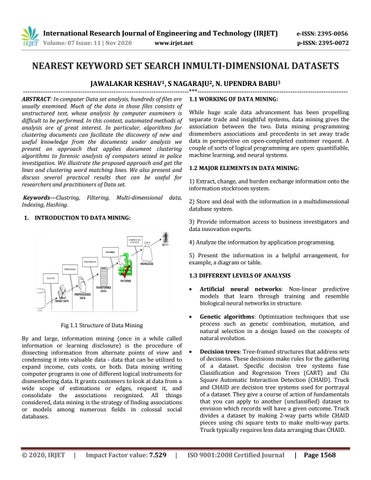
Fig 1.1 Structure of Data Mining By and large, information mining (once in a while called information or learning disclosure) is the procedure of dissecting information from alternate points of view and condensing it into valuable data - data that can be utilized to expand income, cuts costs, or both. Data mining writing computer programs is one of different logical instruments for dismembering data. It grants customers to look at data from a wide scope of estimations or edges, request it, and consolidate the associations recognized. All things considered, data mining is the strategy of finding associations or models among numerous fields in colossal social databases.
© 2020, IRJET
|
Impact Factor value: 7.529
|
ISO 9001:2008 Certified Journal
|
Page 1568
International Research Journal of Engineering and Technology (IRJET)
e-ISSN: 2395-0056
Volume: 07 Issue: 11 | Nov 2020
p-ISSN: 2395-0072
www.irjet.net
Nearest neighbor method: A system that characterizes each record in a dataset dependent on a blend of the classes of the k record(s) most like it in a chronicled dataset (where k=1). Some of the time called the k-closest neighbor method.
2. EXISTING SYSTEM
Location-unique keyword inquiries on the web and within the GIS systems had been in advance reacted utilizing a total of R-Tree and modified record. Felipe et al. Advanced IR2-Tree to rank things from spatial datasets based on a combination in their distances to the inquiry locations and the relevance of their content descriptions to the question key phrases. Cong et al. Included R-tree and rearranged record to address a question much like Felipe et al. The utilization of a unique positioning element.
2.1 DISADVANTAGES OF EXISTING SYSTEM:
These techniques do now not offer concrete hints while in transit to allow green processing for the sort of inquiries where question coordinates are absent. In multi-dimensional territories, it's miles tough for customers to offer significant coordinates, and our work manages some other kind of inquiries where customers can just give key phrases as enter. Without question coordinates, it is difficult to adjust present procedures to our inconvenience. Note that a simple reduction that treats the coordinates of each statistics point as plausible inquiry coordinates endures negative scalability.
Although existing techniques utilizing tree-based records [2], [7], [8], [9] recommend potential answers for NKS inquiries on multidimensional atasets, the performance of these algorithms weakens sharply with the increase of size or dimensionality in datasets. Our empirical results show that these algorithms may take hours to end for a multidimensional dataset of a large number of focuses. Therefore, there is a requirement for an efficient algorithm that scales with dataset measurement, and yields practical inquiry efficiency on huge datasets Objects (e.g., images, chemical compounds, documents, or specialists in collaborative systems) are frequently characterized by a collection of significant highlights, and are commonly spoken to as focuses in a multi-dimensional component space. For instance, images are spoken to utilizing color include vectors, and typically have descriptive content data (e.g., labels or keywords) associated with them. The presence of keywords in highlight space takes into account the improvement of new devices to question and investigate these multi-dimensional datasets.
© 2020, IRJET
|
Impact Factor value: 7.529
|
3. PROPOSED SYSTEM In this paper, we recollect multi-dimensional datasets where each statistics point has a lot of key phrases. The presence of keywords in highlight territory lets in for the improvement of new apparatus to question and discover those multi-dimensional datasets. In this project, we have a gander at closest keyword set (called NKS) inquiries on literary content-rich multidimensional datasets. A NKS inquiry is a lot of consumersupplied keywords, and the final product of the question can likewise consist of alright arrangements of records focuses each of which incorporates all the question key phrases and administrative work one of the top-alright tightest cluster inside the multi-dimensional territory. In this project, we prompt ProMiSH (brief for Projection and Multi-Scale Hashing) to allow quick processing for NKS inquiries. In unique, we widen an authentic ProMiSH (alluded to as ProMiSH-E) that continually recovers the superior top-k consequences, and a surmised ProMiSH (known as ProMiSH-A) this is progressively efficient in phrases of time and zone, and is capable of gain close to-extreme results in practice. 4. ADVANTAGES OF PROPOSED SYSTEM:
Better reality efficiency. A tale multi-scale file for exact and estimated NKS inquiry processing. It's an efficient look for algorithms that work with the multi-scale files for quick question processing. We behavior gigantic experimental research to exhibit the general performance of the proposed methodologies.
5. SYSTEM REQUIREMENTS: •
Operating system : Windows XP/7.
•
Coding Language : JAVA/J2EE
•
Data Base : MYSQL
HARDWARE REQUIREMENTS: •
System : Pentium IV 2.4 GHz.
•
Hard Disk : 40 GB.
•
Monitor : 15 VGA Colour.
•
Ram : 512 Mb.
ISO 9001:2008 Certified Journal
|
Page 1569
International Research Journal of Engineering and Technology (IRJET)
e-ISSN: 2395-0056
Volume: 07 Issue: 11 | Nov 2020
p-ISSN: 2395-0072
www.irjet.net
5.1 RESULT ANALYSIS:
© 2020, IRJET
|
Impact Factor value: 7.529
|
ISO 9001:2008 Certified Journal
|
Page 1570
International Research Journal of Engineering and Technology (IRJET)
e-ISSN: 2395-0056
Volume: 07 Issue: 11 | Nov 2020
p-ISSN: 2395-0072
© 2020, IRJET
|
www.irjet.net
Impact Factor value: 7.529
|
ISO 9001:2008 Certified Journal
|
Page 1571
International Research Journal of Engineering and Technology (IRJET)
e-ISSN: 2395-0056
Volume: 07 Issue: 11 | Nov 2020
p-ISSN: 2395-0072
© 2020, IRJET
|
www.irjet.net
Impact Factor value: 7.529
|
ISO 9001:2008 Certified Journal
|
Page 1572
International Research Journal of Engineering and Technology (IRJET)
e-ISSN: 2395-0056
Volume: 07 Issue: 11 | Nov 2020
p-ISSN: 2395-0072
www.irjet.net
weights of key expressions. Furthermore, the criteria of an outcome containing all the key expressions can be comfortable to produce results having best a subset of the inquiry keywords. REFERENCES [1] W. Li and C. X. Chen, “Efficient data modeling and querying system for multi-dimensional spatial data,” in Proc. 16th ACM SIGSPATIAL Int. Conf. Adv. Geographic Inf. Syst., 2008, pp. 58:1– 58:4. [2] D. Zhang, B. C. Ooi, and A. K. H. Tung, “Locating mapped resources in web 2.0,” in Proc. IEEE 26th Int. Conf. Data Eng., 2010, pp. 521–532. [3] V. Singh, S. Venkatesha, and A. K. Singh, “Geo-clustering of images with missing geotags,” in Proc. IEEE Int. Conf. Granular Comput., 2010, pp. 420–425. [4] V. Singh, A. Bhattacharya, and A. K. Singh, “Querying spatial patterns,” in Proc. 13th Int. Conf. Extending Database Technol.: Adv. Database Technol., 2010, pp. 418–429. [5] J. Bourgain, “On lipschitz embedding of finite metric spaces in hilbert space,” Israel J. Math., vol. 52, pp. 46–52, 1985. AUTHORS 1. JAWALAKAR KESHAV M.Tech Scholar Dept. of Computer Science, SSSISE, VADIYAMPET Anantapur. CONCLUSION In this paper, an answers for the inconvenience of top-k closest watchword set look for in multi-dimensional datasets and a unique file alluded to as ProMiSH based on random projections and hashing is proposed. Based on this file, progressed ProMiSH-E that uncovers a most proficient subset of focuses and ProMiSH-A that searches close most fitting outcomes with better productivity. Our empirical outcomes show that ProMiSH is speedier than contemporary tree-based procedures, with a couple of requests of importance performance development. Moreover, the strategies scale well with every genuine and engineered datasets. Positioning abilities. In the predetermination, planed to investigate other scoring schemes for rating the final product units. In one scheme, it can likewise allocate weights to the key expressions of a point by the use of strategies like tf-idf. At that point, every association of focuses may be scored based on separation among focuses and
© 2020, IRJET
|
Impact Factor value: 7.529
|
2. SIDDAPU NAGARAJU Assistant Professor, Dept. of Computer Science, SSSISE, VADIYAMPET Anantapur. 3. N. UPENDRA BABU Assistant Professor, Dept. of Computer Science, Anantapur.
ISO 9001:2008 Certified Journal
|
Page 1573