
International Research Journal of Engineering and Technology (IRJET) e-ISSN: 2395-0056
Volume: 13 Issue: 01 | JAN 2026 www.irjet.net p-ISSN: 2395-0072
International Research Journal of Engineering and Technology (IRJET) e-ISSN: 2395-0056
Volume: 13 Issue: 01 | JAN 2026 www.irjet.net p-ISSN: 2395-0072
Srushti Jagnade , Vinisha Gavade, Rushi Burhan, Vinay Misal , Mr. S.A.Ingole
Diploma students of JSPM’s Rajarshi Shahu of college of Engineering, Polytechnic, Pune, India
Abstract - In today’s competitive world, many individuals possessvaluableskillsbutlackproperplatformstoshowcase, exchange, or enhance them. At the same time, learners often struggle to find affordable and reliable skill providers. To address this gap, this paper presents Skill Trade, a mobile application designed for skill exchange and peer-to-peer learning. The Skill Trade app allows users to offer their skills and learn new skills in return, promoting collaborative and cost-effectivelearning.Theapplicationprovidesfeaturessuch as user registration, skill listing, skill searching, communicationbetweenusers,andfeedbackmechanisms.By enabling direct interaction between skill seekers and skill providers, the platform reduces dependency on expensive courses and encourages practical knowledge sharing. The system is designed using modern mobile application technologiestoensureusability,security,andscalability.Skill Trade aims to empower students, freelancers, and professionals by creatinga digital ecosystem where skills are valued as currency. The proposed application not only enhances skill development but also supports career growth and community learning. This paper discusses the design, implementation, and potential impact of the Skill Trade application in bridging the skill gap in society.
Key Words: Skill Trade, Skill Exchange, Mobile Application, Skill Development, Peer Learning
Inthemoderndigitalera,skilldevelopmentplaysacrucial role in personal growth, employability, and economic progress. However, access to quality skill training is often limitedduetohighcosts,lackofawareness,andinsufficient platforms that connect learners with skilled individuals. Manypeoplepossessvaluablepracticalskillsbutdonothave effective opportunities to share or monetize them, while othersstruggletofindaffordablewaystolearnnewskills. With the rapid growth of mobile technology, applications have become powerful tools for knowledge sharing and learning. Mobile-based platforms enable users to connect easily, communicate efficiently, and access learning resourcesanytimeandanywhere.Despitetheavailabilityof online courses and training programs, there is a lack of platforms that promote direct skill exchange and peer-topeerlearning.Toovercomethesechallenges,SkillTradeis proposed as a mobile application that facilitates skill exchangebetweenindividuals.Theapplicationallowsusers tooffertheirskillsandlearnnewskillsinreturn,creatinga mutually beneficial learning environment. Skill Trade
encouragescollaborativelearningbytreatingskillsasaform ofvalueratherthanfocusingonlyonmonetarytransactions. The Skill Trade application aims to support students, freelancers,andprofessionalsbyprovidingadigitalplatform for skill sharing, communication, and feedback. By promoting community-based learning and practical knowledge exchange,theapplicationhelps bridge thegap between skill seekers and skill providers. This paper presentsthedesign,development,andfunctionalityofthe Skill Trade app along with its potential impact on skill developmentandcareergrowth.
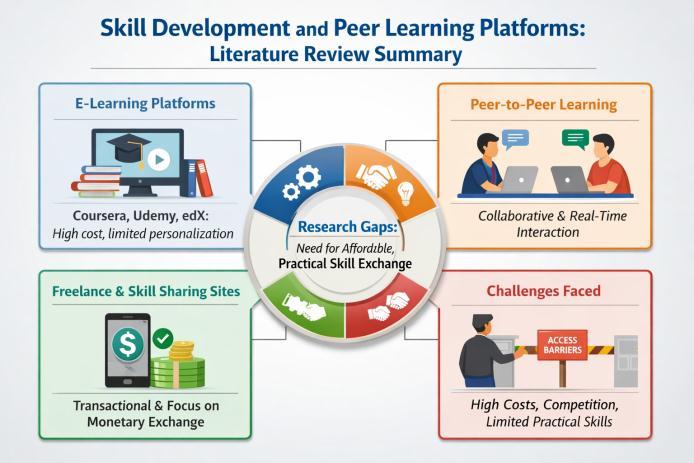
Skill development and knowledge sharing have gained significant importance with the advancement of digital technologies. Several studies and applications have been proposedtosupportonlinelearning,skillenhancement,and peer-to-peer interaction. Traditional e-learning platforms such as Coursera, Udemy, and edX provide structured courses but often involve high costs and limited personalization. Research indicates that while these platformsareeffectivefortheoreticallearning,theymaylack real-timeinteractionandpracticalskillexchange.Peer-topeer learning models have been widely studied as an effectiveapproachforcollaborativeeducation.Accordingto existing literature, peer learning improves engagement, communication skills, and practical understanding. Platforms that encourage direct interaction between learnersandskilledindividualshelpcreateamoreflexible and learner-centred environment. However, most peerlearningsystemsarelimitedtoacademictutoringanddonot supporta broader exchange ofdiverseskills.Skill-sharing platforms such as freelancing websites and community forumsallowuserstoofferservicesorknowledge,butthey are mainly transaction-based and focus on monetary exchange.Studiesshowthat beginnersandstudentsoften facebarriersinaccessingsuchplatformsduetoexperience requirementsandcompetition.Additionally,theseplatforms donotemphasizereciprocallearning,whereuserscanboth teachandlearn.Recentresearchhighlightstheroleofmobile applicationsinbridgingskillgapsbyprovidingaccessibility andeaseofuse.Mobile-basedlearningsystemsenableusers tolearnanytimeandanywhere,increasingparticipationand continuity. However, there is limited research on applicationsthattreatskillsasaformofvalueandpromote non-monetaryskillexchange.Basedonthereviewofexisting systemsandstudies,itisobservedthatthereisaneedfora platform that combines mobile accessibility, peer-to-peer
2395-0056
Volume: 13 Issue: 01 | JAN 2026 www.irjet.net p-ISSN: 2395-0072
interaction, and skill exchange in a collaborative manner. TheproposedSkillTradeapplicationaddressesthesegaps byenablinguserstoexchangeskills,communicatedirectly, and provide feedback, thereby creating a practical and inclusivelearningecosystem.
The review of existing literature and platforms reveals severallimitationsincurrentskilldevelopmentandlearning systems.Althoughnumerousonlinelearningplatformsand skill-sharingwebsitesareavailable,theyprimarilyfocuson paid courses, service-based transactions, or academic tutoring.Thesesystemsoftenlackflexibility,affordability, and opportunities for reciprocal learning. Most existing platforms do not support skill exchange, where users can both offer and learn skills without monetary dependency. Peer-to-peer learning models are available, but they are usually restricted to specific domains and do not cover a wide range of practical, vocational, and creative skills. Additionally, many platforms fail to provide personalized interaction, real-time communication, and trust-building mechanisms such as feedback and ratings. Mobile-based learningapplicationsimproveaccessibilitybutoftenoperate asone-directionallearningsystemsratherthancollaborative ecosystems.Thereislimitedresearchonmobileapplications that treat skills as a form of value and encourage community-drivenlearning.Furthermore,existingsystems donotadequatelyaddresstheneedsofstudents,beginners, andindividualsfromeconomicallyweakersectionswhoseek cost-effective skill development opportunities. Therefore, thereexistsaresearchgapindesigningandimplementinga mobile-basedskillexchangeplatformthatintegratespeerto-peer interaction, non-monetary skill trading, usability, andscalability.TheproposedSkillTradeapplicationaimsto bridgethisgapbyenablingcollaborativelearningthrough skillexchange,directcommunication,andfeedback-driven trust, thereby contributing to inclusive and practical skill development.
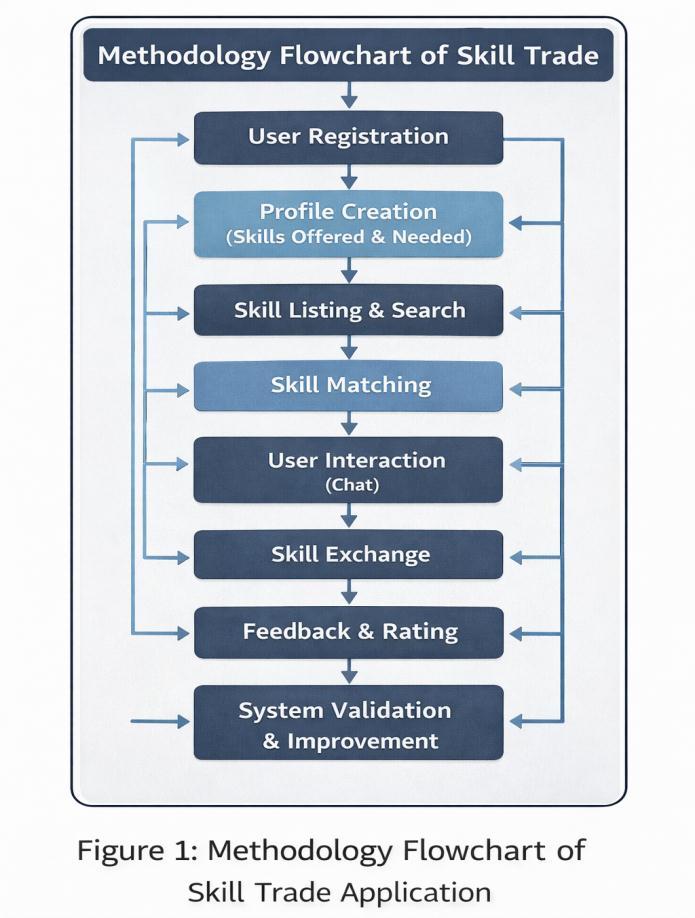
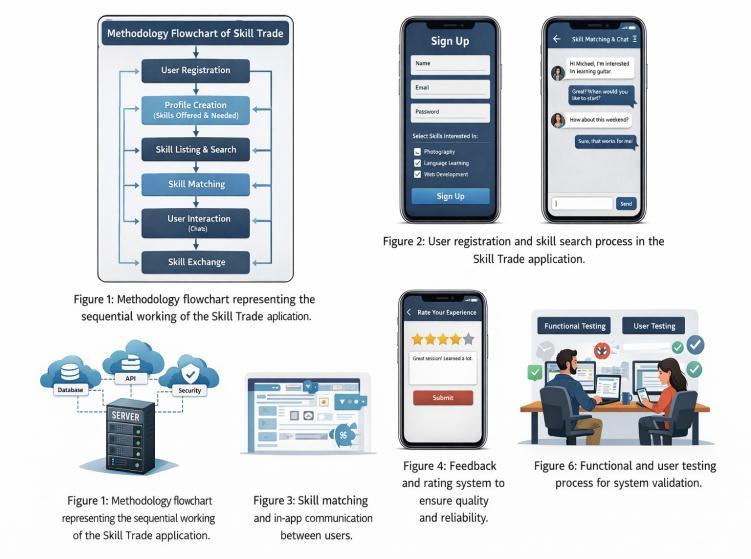
ThemethodologyoftheSkillTradeapplicationfocusesonthe systematic design, development, and implementation of a mobile-basedskillexchangeplatform.Theapproachfollowed ensures usability, scalability, and effective peer-to-peer interaction. SystemDesignThesystemisdesignedusinga modular architecture to separate different functional components such as user management, skill management, communication, and feedback. This approach improves maintainability and allows future enhancements. User interfacedesignemphasizessimplicityandeaseofnavigation toensureasmoothuserexperience. UserRegistrationand AuthenticationUsersregisterontheapplicationbyproviding basic details such as name, email ID, and skill interests. Authenticationensuressecureaccessandprotectsuserdata. Eachusercancreateaprofileshowcasingtheskillstheycan offer and the skills they want to learn. Skill Listing and Search Users can list their skills with descriptions and proficiencylevels.Thesystemallowsuserstosearchforskills basedoncategories,keywords,oruserprofiles.Thisfeature helpsskillseekerseasilyfindsuitableskillproviders. Skill MatchingandInteractionOnceasuitableskillisfound,users can initiate interaction through in-app communication features. The application supports direct messaging to discusslearningrequirements,availability,andskillexchange terms.Thispromotestransparentandeffectivecollaboration. Feedback and Rating System After completing a skill exchange, users can provide feedback and ratings. This mechanism builds trust within the community and helps maintainqualitybyencouragingresponsibleparticipation. Technology Implementation The Skill Trade application is developed using modern mobile application development toolsandbackendservices.Acentralizeddatabaseisusedto store user profiles, skill details, messages, and feedback. Secure data handling techniques are applied to ensure privacyand reliability. Testing and ValidationThesystem undergoesfunctionaltestingtoverifyeachmodule,including registration,skillsearch,communication,andfeedback.User testingisconductedtoevaluateusabilityandperformance. Identifiedissuesareresolvedtoensurestableandefficient systemoperation.
International Research Journal of Engineering and Technology (IRJET) e-ISSN: 2395-0056
Volume: 13 Issue: 01 | JAN 2026 www.irjet.net p-ISSN: 2395-0072
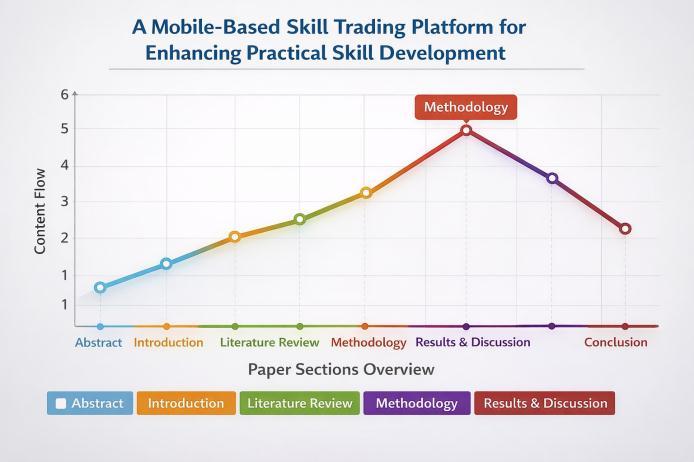
The Skill Trade application wassuccessfullydesignedand implementedasamobile-basedplatformforskillexchange and peer-to-peer learning. The system was tested with multiple users to evaluate its functionality, usability, and overall performance. The results demonstrate that the applicationeffectivelymeetsitsobjectivesofconnectingskill seekersandskillprovidersinacollaborativeenvironment. System Functionality Results The user registration and authentication module functioned accurately, allowing secureaccesstotheapplication.Userswereabletocreate profiles, list skills, and search for desired skills without errors. The skill search and matching features provided relevant results based on user inputs, reducing the time required to find suitable skill providers. User Interaction and Engagement In-app communication enabled smooth interactionbetweenusers.Participantswereabletodiscuss skill exchange requirements clearly, leading to better understanding and coordination. The feedback and rating systemencouragedresponsiblebehaviourandhelpedusers identify trustworthy skill partners. User engagement increasedasparticipantscouldbothlearnandshareskillson thesame platform. PerformanceAnalysisTheapplication demonstratedstableperformanceduringtesting,withquick responsetimesforskillsearchesandmessagedelivery.The modular design helped maintain system efficiency and supportedsmoothdatahandling.Nomajorsystemfailures
wereobservedduringthetestingphase,indicatingreliability of the proposed solution. Discussion The results indicate that Skill Trade successfully addresses the limitations of existing learning and skill-sharing platforms. Unlike traditionalpaidlearningsystems,theapplicationpromotes non-monetary skill exchange, making skill development more accessible and inclusive. The peer-to-peer learning approach enhances practical knowledge sharing and communityengagement.Thefeedbackmechanismplaysa vital role in building trust among users, which is often missingininformalskill-sharingplatforms.Overall,theSkill Trade application proves to be an effective solution for collaborativeskilldevelopmentanddemonstratespotential for future enhancements such as advanced matching algorithms, certification features, and integration with professionalnetworks.
ThispaperpresentedthedesignandimplementationofSkill Trade, a mobile application developed to support skill exchangeandpeer-to-peerlearning.Theproposedsystem addressesthelimitationsoftraditionallearningplatformsby providing a collaborative and cost-effective environment whereuserscanbothofferandacquireskillswithoutrelying solely on monetary transactions. The results demonstrate that the Skill Trade application effectively connects skill seekers and skill providers through features such as skill listing, search, communication, and feedback. The system promotes practical knowledge sharing, enhances user engagement,andbuildstrustwithinthelearningcommunity. Its mobile-based approach ensures accessibility, usability, and flexibility for users from diverse backgrounds. Skill Trade contributes to inclusive skill development by empoweringstudents,freelancers,andprofessionalstolearn from one another. The application has the potential to reduce skill gaps and encourage continuous learning in a community-driven manner. Overall, the proposed system proves to be a practical and scalable solution for modern skilldevelopmentneeds.
International Research Journal of Engineering and Technology (IRJET) e-ISSN: 2395-0056
Volume: 13 Issue: 01 | JAN 2026 www.irjet.net p-ISSN: 2395-0072
Iwouldliketoexpressmysinceregratitudetomyproject guide for their valuable guidance, constant support, and encouragementthroughoutthedevelopmentofthisproject. Theirsuggestionsand insights playeda crucial roleinthe successfulcompletionofthiswork.Iamalsothankfultothe facultymembersofmyinstituteforprovidingthenecessary resources and academic support during the course of this project.Iextendmyheartfeltthankstothemanagementfor creatingaconducivelearningenvironment.Iwouldliketo acknowledge my friends and classmates for their cooperation,motivation,andconstructivefeedbackduring the project development. Finally, I express my deep gratitude to my parents for their continuous support and encouragement, which motivated me to complete this projectsuccessfully.
[1]A.S.MalikandR.Kumar,“Peer-to-PeerLearningSystems and Their Impact on Skill Development,” International JournalofComputerApplications,vol.175,no.12,pp.15–20, 2020.
[2] S. Patel and N. Shah, “Mobile Learning Applications: Design,ChallengesandOpportunities,”InternationalJournal ofEngineeringResearchandTechnology(IJERT),vol.9,no. 6,pp.450–455,2020.
[3] M. Brown, J. Smith, and L. Williams, “Collaborative LearningThroughDigitalPlatforms,”InternationalJournalof AdvancedResearchinComputerScience,vol.10,no.3,pp. 25–30,2019.
[4]P.GuptaandA.Verma,“DesignandImplementationof AndroidBasedLearningApplications,”InternationalJournal ofScientificResearchinComputerScience,Engineeringand InformationTechnology,vol.6,no.2,pp.120–125,2020.
[5]N.KaurandR.Singh,“Skill DevelopmentUsing Mobile Technology,” International Journal of Engineering and Advanced Technology (IJEAT), vol. 8, no. 5, pp. 105–110, 2019.
[6]GoogleDevelopers,“AndroidApplicationDevelopment Guide,”Available:https://developer.android.com
[7] Firebase Documentation, “Firebase for Mobile App Development,”Available:https://firebase.google.com/docs
BIOGRAPHIES :



SamitArunIngoleProfessor, JSPM’s Rajarshi Shahu College of Engineering,Polytechnic,Pune.
SrushtiJagnadeDiplomaStudent, JSPM’s Rajarshi Shahu College of Engineering,Polytechnic,Pune.
RushiBurhanDiplomaStudent, JSPM’s Rajarshi Shahu College of Engineering,Polytechnic,Pune.
International Research Journal of Engineering and Technology (IRJET) e-ISSN: 2395-0056
Volume: 13 Issue: 01 | JAN 2026 www.irjet.net p-ISSN: 2395-0072


VinishaGavadeDiplomaStudent, JSPM’sRajarshiShahuCollegeof Engineering,Polytechnic,Pune.
VinayMisalDiplomaStudent, JSPM’s Rajarshi Shahu College of Engineering,Polytechnic,Pune.