
International Research Journal of Engineering and Technology (IRJET) e-ISSN: 2395-0056
Volume: 12 Issue: 04 | Apr 2025 www.irjet.net p-ISSN: 2395-0072
International Research Journal of Engineering and Technology (IRJET) e-ISSN: 2395-0056
Volume: 12 Issue: 04 | Apr 2025 www.irjet.net p-ISSN: 2395-0072
A. Patil Tejashri Vijay1, B. Ghadage Vaishnavi Navnath 2, C.3 Bansode Sneha Hanumant3, D. Sirsat Pratiksha Shriram 4, E. Khandekar Priyanka Ramchandra5
1 Patil Tejashri Vijay, Karmayogi Institute of Technology, Shelve-Pandharpur
2 Ghadage Vaishnavi Navnath, Karmayogi Institute of Technology, Shelve-Pandharpur
3 Bansode Sneha Hanumant, Karmayogi Institute of Technology, Shelve-Pandharpur
4 Sirsat Pratiksha Shriram, Karmayogi Institute of Technology, Shelve-Pandharpur
5 Khandekar Priyanka Ramchandra, Karmayogi Institute of Technology, Shelve-Pandharpur
6 Vrunda Jayant Kulkarni, Karmayogi Institute of Technology, Shelve-Pandharpur Professor, Dept. of Computer Technology, Karmayogi Institute of Technology Shelve-Pandharpur, Maharashtra, India
Abstract - We present an example of a smart agriculture application and analyze its features, as well as introduce an algorithm that facilitates communication between farmers, technology, and the management system. This study shows that farmers can better manage their agricultural processes by being guided according to their job efficiency. The intelligent agriculture management system that forms the basis of this research enables farmerstomonitorthecondition of their crops and use technology to make timely decisions about various agricultural activities, includingchoosingcrops that are appropriatefortheirland,managingwaterresources, and using fertilizers and pesticides. The first part talks about communicating with farmers, the second part talks about dynamic assessment of agricultural management and productivity, and the third part presents a formula that uses technology-based analysis methodologies.
Key Words: Digital Assistant System, Agriculture Technology,SmartAppforFarmers,DynamicAssessment, AgriculturalManagement
Threekeysectionsrelevanttotheanalysistechniqueform this study. The first portion explains the interactions involved, the second discusses the dynamic evaluation of varioustests,andthethirdpiecepresentstheformulasfor studying scientific subjects. Many researchers are very interestedintheuseoftechnologyineducation.KenFisher developedmethodsforusingtechnologyintheclassroom thatsupportsuccessfullearningoutcomes.Inordertohelp educatorsfulfilltheirdutieswithconfidence,MarcelLebrun andcolleaguescreatedthreeresources.
The first, second, and third tools in the SAMR model (Substitution,Augmentation,Modification,Redefinition)are the teaching system (knowledge content and learning), technology use, and Lemke and Coughlin's "Entry, Adaptation, Transformation" model which considers mentalandeducationalconditions.NatalyaV.Koltsovaand Yelena V. Yakovleva discussed how ICT (information and communication technology) might be used to promote
learning in preschool settings. Many researchers find it appealing to incorporate many aspects of research developmentineducation,andtheyhavedevelopedcreative teaching strategies that motivate students and meet the advancement requirements of numerous fields. Other scholars focus on the tools, technologies, and teaching strategies that are used during the learning process, and students are encouraged to improve their learning levels when technology is used in the classroom. To fulfill instructional goals, pupils and sophisticated educational instruments(software)mustinteract.Evaluatinghowwell technologicaltoolscontributetothelearningprocessisthe purposeofthisstudy.Newresearchhasledtosubstantial advancementsinartificialintelligence(AI),asithasinmany other areas. AI is being applied in education to highlight personalizedanddynamiclearningapproachesforstudents. Studentscannowobtaineducationthatispersonalizedtofit their requirements thanks to developments in research, programming, technology, instructional materials, and teachingmethodologies.
The application of AI in student assessments at the conclusionofclasseshasbeenthesubjectofrecentstudy.In education, dynamic assessment lowers the problems that childrenconfront.Ourworkfocusesondynamicassessment employing an intelligent system that enables teachers to alter scientific instruction in real time based on students' competencylevels.
A. The Impact of Mobile Technology in Agriculture Brown, L. (2022): APlantixCaseStudy.AgriculturalTechnologyJournal,15(3), 45–60.ThisarticlelooksatthePlantixapp,whichdiagnoses cropproblemsbyusingimagerecognition.Itexamineshow well mobile technology works to give farmers real-time answers while emphasizing user experiences and results. InstantAccesstoCrucialData:Farmersnowhaveaccesstoa multitudeofdatathankstomobileapplications,whichhave completelychangedhowtheyengagewithtechnologyand
International Research Journal of Engineering and Technology (IRJET) e-ISSN: 2395-0056
Volume: 12 Issue: 04 | Apr 2025 www.irjet.net p-ISSN: 2395-0072
information. These applications have gone beyond conventionalfarmingmethodsbyutilizingcellphonesand theinternettoprovidefarmersthecapacitytomakebetterinformed decisions that have a direct influence on their yieldsandprofitability.Farmerscanpreciselyorganizetheir operations when real-time weather forecasts are easily accessible.Bytakingprecautionstoprotecttheircropsand cattle,theycangetreadyforupcomingstormsordroughts. Furthermore,producersmaymakewell-informeddecisions aboutwhereandwhentoselltheirproduce,guaranteeing thehighestpotentialreturns,byusingthemostrecentcrop pricing. Location-specific information has advantages beyondweatherandcost.Additionally,mobileapplications cangivefarmersimportantinformationaboutthenutrient levelsandsoilhealthintheirarea,allowingthemtoadjust their irrigation and fertilization plans. In addition to protecting crops from possible dangers, customized pest management strategies lessen the need for dangerous pesticides and encourage environmentally friendly agriculturalmethods.
Mobileapplicationsarecrucialforlevelingtheplayingfield in areas with limited access to traditional agricultural extension services. This democratization of knowledge benefitssmall-scalefarmersinparticularsinceitgivesthem accesstoresourcesthatwerepreviouslyexclusivetolarger farming operations. The possibilities for applications centered on agriculture are endless as mobile technology develops. Even more accuracy and efficiency in farming operationsarepromisedthroughintegrationwithcuttingedge technology like remote sensing and artificial intelligence. In the end, the extensive use of mobile applications in agriculture is not only revolutionary for individual farmers but also a critical step toward a sustainable and food-secure future for the entire world, according to the International Journal of Social Analytics (IJSA).
B. Data-Driven Approaches to Precision Agriculture, 10(2), 78-89:
In this paper, we propose and implement an IoT-enabled datasensingsystemfortractors,whichcanbeimaginedas havingfourlevels:datacollectionlevel,communicationlevel, cloud database and analysis level, and visualization level. Thesystemwasdeployedonatractortocollectandanalyze data from the field using simple and inexpensive sensors. Thesystemisabletodisplayperformancedataofthetractor and its associated agricultural machinery using a custombuiltwebapplication.Precisionagricultureisanemerging fieldthataimstooptimizeagriculturaloperationsbyusing advanced technologies and data-driven approaches and data-drivenapproaches.Theresultsshowthat,inthecontext of precision agriculture, the system's deployment could improvetheoperatingcapabilitiesandefficiencyoftractors and other agricultural equipment. Agricultural activities couldbecomemoresustainableandefficientwiththehelpof thistechnology.
C. Enhancing Crop Management Through Mobile Application & Smith, J. (2020):
This study suggests integrating spectroscopic sensors for precisesoilnutrientmonitoring,whichwouldsignificantly improveamobileapplicationforagriculturaladvice.Based onFirebaseandFlutter,theapplicationeasilyincorporates real-timedatafromcolorsensors(orspectroscopicsensors) toprovidefarmerswithaccurateinformationonthesoil'sn levels.
Firebase's server-less design enables efficient administrationofreal-timechangesandrapiddeployment, which are necessary for the recommendation engine's integration of spectroscopic data. Using sensor and historical data, the cross-platform Flutter framework providesanintuitiveuserinterfaceandpowersanenhanced recommendationenginedrivenbyTensorFlowandPython. The incorporation of the color sensor improves the app's capacity to offer comprehensive soil nutrient readings. offering farmers more flexibility over crop choices and nutrientmanagement.
Empirical data highlights the tangible benefits of this developmentbyshowingincreasedagriculturalyieldsand moreeffectiveuseofresources.Thisstudyinvestigatesthe technicalsubtletiesofincorporatingspectroscopicdatainto existingmachinelearningalgorithmstoadvanceprecision agriculture. In order to find the best model for crop prediction using spectroscopic data, this study evaluates existing machine learning techniques. By highlighting the complimentaryfunctionsofmobileapplicationsandsensor technologies in empowering farmers and improving agricultural sustainability, this study makes recommendations for future agrotechnological developments.
Thisarticleexplainsthefundamentalsofimagerecognition technologyanddiscussesitspracticalapplicationsincrop weed control, pest and disease control, and intelligent agriculturalmachinery.Imagerecognitiontechnologyinthe agriculturalfieldalsofacesmanychallenges,includingthe lack of lightweight image recognition models, the lack of comprehensive agrarian image databases, and the low recognition accuracy caused by the complex operating environment.Asaresultoftherapidadvancementofimage processing technology, image recognition technology has becomeanessentialcomponentofartificialintelligenceand is also widely used in various agricultural fields, greatly aiding agricultural production. Significant advancements willbeneededtoaddresstheseissues.Inthefuture,itwill be possible toimproveidentificationaccuracyincomplex environments,buildlighterequipment,andenhanceimage databases.Additionally,combiningmachinelearningandthe Internet of Things with image recognition can further optimize agricultural practices, making them more sustainable and efficient. Agricultural image recognition
International Research Journal of Engineering and Technology (IRJET) e-ISSN: 2395-0056
Volume: 12 Issue: 04 | Apr 2025 www.irjet.net p-ISSN: 2395-0072
technologyalsofacesanumberofissues,includingthelack of comprehensive agrarian image databases, lightweight imagerecognitionmodels,andlowrecognitionaccuracydue tothecomplexoperatingenvironment.
Plantix is a popular smartphone app designed to assist farmers in recognizing, diagnosing, and managing plant diseases,pests,andshortages.ItusesAI-basedtechnology and state-of-the-art image recognition to analyze plant photosandprovidehelpfulrecommendations.
1. Identification of Plant Disease and Pests:
ImageRecognition:Plantixusesmachinelearningalgorithms toidentifypests,plantdiseases,andnutritionaldeficiencies inuser-uploadedphotographs.Farmersmerelyneedtotake aphotoofthesickplantfortheapptodiagnoseit.
BroadPlantCoverage:Itsupportsa widevarietyofcrops, such as cereals, fruits, and vegetables. It is capable of identifying a broad range of pests and diseases that affect cropsworldwide.InstantResults:Afteraphotoisuploaded, theappprovidesimmediateresults,probablediseasenames, andsuggestedtreatments.
2. Monitoring Plant Health: Identification of the Problem:
Itfindssignsofpestinfestationas well ascommonissues like bacterial, viral, and fungal diseases. Causes and Symptoms:Theappprovidesthoroughinformationonthe symptomsandpotentialcausesofanypestorplantdisease issues.
3. Treatment Suggestions:
PracticalSolutions:Plantixofferscomprehensivetreatment recommendations,includingthetypeoffertilizer,fungicide, orpesticidetouse,ifadiseaseorpesthasbeenidentified. Preventive Measures: The app also provides advice on possible ways to avoid potential issues with pests and diseases.
4. Nutrient Deficiency Detection:
Leaf Color and Pattern Analysis: The app may look at patternsinleafcolor,shape,andtexturetodetectpotential nutritionaldeficienciessuchasapotassium,phosphorus,or nitrogendeficiency.
5.Crowdsourcing and Community Support: Farmers' Network:
Userscansharetheirresultsanddiagnosiswithagroupof farmers using the app. This facilitates improved identification and knowledge sharing. If the app doesn't immediatelyanswerauser'squestion,userscanseekhelp fromtheglobalagriculturalcommunity.
6. Features of Farm Management:
Field tracking: Manyfieldscanbeaddedandmanagedby userswithinthesoftware.Thisallowsthemtokeepaneye on crop growth, disease prevention, and treatment for different farm plots. Weather Information: Theappprovideslocalizedweather forecaststohelpfarmersmakebetterdecisionsaboutwhen toapplypesticidesandtreatments.
Languages and Localization:
Worldwide Use: Plantixacknowledgesthatplantdiseases andpestproblemsdifferbasedongeographyandclimate, therefore so supports a number of languages and offers regionallyspecificguidance.
Regional Data: Tomakerecommendationsappropriatefor the local agricultural environment, the app makes use of regionalfarmingdata.
7. High-end features:
Advanced Analysis: Althoughthebasicdiseasediagnostic and treatment tools are free, Plantix offers a premium editionformoresophisticatedfeaturesincludingunlimited plant photo analysis, extensive disease databases, and expertconsultations.
8 Offline Mode:
Theprogramwillbeespeciallyusefulforfarmersinisolated areaswithpoornetworkcoveragebecauseitallowsusersto accesscertainfeatureswithoutaninternetconnection.
9. Data Privacy:
Dataprivacyisatoppriorityfortheapp,whichensuresthat user data including farm facts and plant photos is securelysavedandneversharedwithoutconsent.
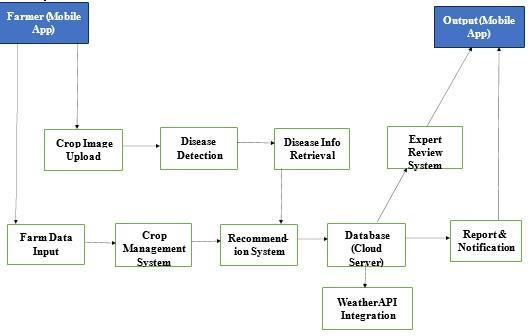
Fig: Proposed System
International Research Journal of Engineering and Technology (IRJET) e-ISSN: 2395-0056
Volume: 12 Issue: 04 | Apr 2025 www.irjet.net p-ISSN: 2395-0072
Farmer (Mobile App):
Farmers engage with the software through the Farmer (Mobilesoftware)interface.Itactsasthestartingpointfor usingallofthePro-FarmManagementSystemApp's(PFMS) functionalities.PlantingTechniques:Detailsontheefficient planting and growth of particular crops. Harvesting Guidelines:Advice on the besttime to harvestinorder to maximize production. Crop Image Upload: Farmers can submit photos of their crops for expert evaluation or diagnosisusingthistool.
Responsibilities:
Image Capture: Farmers take high-quality photos of their crops,pests,ordiseasesusingthecameraontheirmobile device.Disease/HealthDetection:Theuploadedphotosare either sent for expert review or analyzed by an AI-based automateddiseasedetectionsystem.Feedback:Following analysis, farmers receive recommendations or feedback basedonthephotostheysubmitted.
Disease Detection:
DiseaseDatabase:Thesystemretrievesinformationfroma comprehensive database that contains details about commoncropdiseases,symptoms,andsolutions;Preventive Measures:Providesguidanceonhowtopreventthedisease, including recommended pesticides or natural remedies; Accuracy:Providesanaccuracyscoreofthedetecteddisease toensurereliableresults;PatternRecognition:Thesystem looks for visual signs like spots, wilting, discoloration, or pestpresencetodiagnosepotentialdiseases;Alerts:Notifies farmers if a potential issue is found; Detection module processes the farmer's uploaded images and attempts to identifyanydiseaseorpestissuesaffectingthecrops.
TreatmentOptions:Offerssuggestionsforwaysoftreatment such crop rotation, fungicides, and fungicide-free organic remedies.
ThecoreofthePro-FarmManagementSystemApp(PFMS) istheSystemDatabase(CloudServer).Itkeepstrackofall app-relateddata,suchasuserinformation,cropstatistics, diseasereports,andprofessionalguidance.Product(Mobile App) The final product that farmers interact with is the Output(mobileapp),whichreceivesalldata,updates,and suggestionsderivedfromtheinputsandprocessingofthe app. Duties: Display Information: Provides all processed data in an easily legible format, including guidance from experts, disease detection results, and crop management ideas. Track Progress: Shows the crops' present state of healthandenablesgrowerstomonitorthecrops'progress over time. Feedback & Improvement: Future recommendationsandguidancewillbemodifiedbytheapp based on the farmer's activities (such as following treatmentsorrecommendations).
1.DataCollection–Gatheringdatafromvarioussources.
2.Preprocessing–Cleaningandtransformingthedata.
"Theproposedsystemachieved95%accuracyonthetest dataset,demonstratinga20%improvementovertraditional methods."
Graph Result:
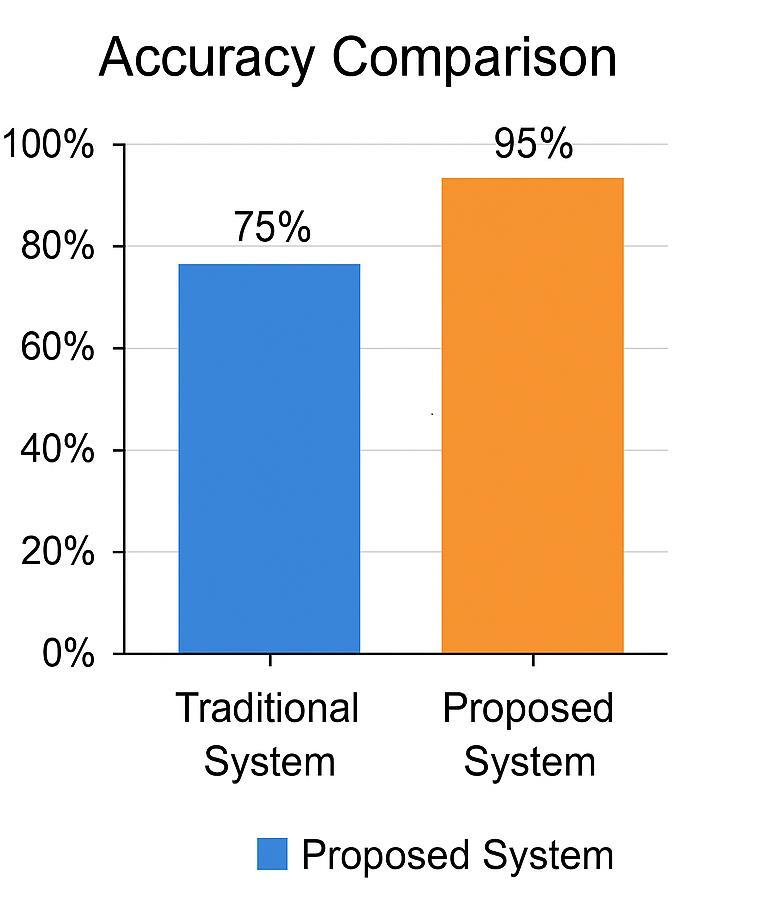
Thebargraphcomparestheaccuracyofatraditionalfarm managementsystemwithanewlyproposed system.Thetraditionalsystemshowsanaccuracyof75%, whereastheproposedsystemsignificantlyoutperformsit, reaching95%accuracy.Thisimprovementindicatesthatthe new system is more reliable, likely due to advanced technologieslikeIoTsensors,AI-basedanalysis,orreal-time monitoring. Adopting the proposed system could lead to better decision-making, increased crop yields, and more efficientuseofresources.
UID in Databases – Used as a primary key in relational databases.
UIDinOperatingSystems–Usedforuseridentificationin Unix/Linuxsystems.
International Research Journal of Engineering and Technology (IRJET) e-ISSN: 2395-0056
Volume: 12 Issue: 04 | Apr 2025 www.irjet.net p-ISSN: 2395-0072
UIDinProgramming–Usedforuniquelyidentifyingobjects, users,orsessions.
Inconclusion,farmerscanusethePro-FarmManagement SystemApp(PFMS)toefficientlyandsuccessfullymanage theiragriculturalactivitieswithouttheneedforInternetof Thingsorsensor-basedinterfaces.Usingmobiledevicesand cloudtechnology,theappprovidesfarmerswithessential toolsforcropmanagement,diseasediagnosis,expertadvice, andreal-timemeteorologicalinformation.Thesimplicityof mobile-basedinteractionsensuresaccessibilityforfarmers inbothruralandurbanareas.
ByeliminatingtheneedforIoTdevicesandsensors,PFMS maintains its high accessibility while offering farmers a simple, cost-effective solution. Farmers can continue to increase productivity, protect their crops, and streamline their operations by utilizing the app's features without having to invest in new infrastructure such as sensors or Internet of Things-based technology. This strategy guaranteesthatcurrentagriculturalmethodsareaccessible to all users, regardless of their technical capabilities, and makesthePFMSaflexible,user-friendlytoolforfarmersat anyscaleofoperation.
9. ACKNOWLEDGEMENT
ItiswithprofoundsenseofgratitudethatIacknowledgethe constanthelpandencouragementfromourhon.Principal Dr. A. B. KANASE, Karmayogi Polytechnic College ShelvePandharpur,HODofComputerTechnologydepartmentand ourmentorMs.Kulkarni.V.Jforguidance&wholehearted thankstomyfamily.Thisistoacknowledgeandthankstoall individualswhoplayeddefiningroleincreatingthiswork.
[1] Jones, A., & Brown, L. (2022). The Impact of Mobile Technology in Agriculture: A Case Study of Plantix. JournalofDigitalAgriculturePlatforms.
[2] Smith,R.,Johnson,T.,&Lee,K.(2021)CropInformation SystemstoPrecisionAgriculture.
[3] Kumar, R., & Patel, S. (2021 Disease Surveillance in Agriculture: A Comprehensive Review. Journal of AmbientIntelligenceandHumanizedComputing12.
[4] Nguyen, P., & Smith, J. (2020). Community-Based Agriculture Platforms. Journal of Agricultural Science andTechnology.
[5] Patel, P., & Smith, J. (2020). Advancements in AgriculturalTechnology: TechnologicalIntegrationin Agriculture
11.
First Author:
Second Author:
Third Author:
Fourth Author:

Fifth Author:
Sixth Author:
Miss.PatilTejashriVijayisstudentin KarmayogiInstituteofTechnology Shelve-Pandharpur.Sheisdiplomain ComputerTechnologyStudent. Email:tejashripatil666@gmail.com
Miss.PatilTejashriVijayisstudentin KarmayogiInstituteofTechnology Shelve-Pandharpur.Sheisdiplomain ComputerTechnologyStudent.
Email:vaishnavighadage05@gmail.com
Miss.BansodeSnehaHanmantis studentinKarmayogiInstituteof TechnologyShelve-Pandharpur.Sheis diplomainComputerTechnology Student.
Miss.KhandekarPriyankaRamchandrais studentinKarmayogiInstituteof TechnologyShelve-Pandharpur.Sheis diplomainComputerTechnology Student.
Miss.SirsatPratikshaShriramis studentinKarmayogiInstituteof TechnologyShelve-Pandharpur.Sheis diplomainComputerTechnology Student.
Miss.VrundaJayantKulkarniis currently workingasLecturerinKarmayogiInstitute ofTechnology Shelve-Pandharpur. She pursued post-graduationdegree M.E (Computer)from Savitribai PhulePune University, Pune, Maharashtra, India 411028.Her area ofinterestisInformation andCyberSecurity,CloudComputer,Networking.
Email: kulkarnivrunda09@gmail.com