
International Research Journal of Engineering and Technology (IRJET) e-ISSN: 2395-0056
Volume: 12 Issue: 12 | Dec 2025 www.irjet.net p-ISSN: 2395-0072
International Research Journal of Engineering and Technology (IRJET) e-ISSN: 2395-0056
Volume: 12 Issue: 12 | Dec 2025 www.irjet.net p-ISSN: 2395-0072
Dr. Poornima B1, Pooja S N2 , Poojitha C H3, Prajwala P N4 , Preethi S5
1Professor and Head, Information Science and Engineering, Bapuji Institute of Engineering and Technology, Davangere, affiliated to VTU Belagavi, Karnataka, India.
2Bachelor of Engineering, Information Science and Engineering, Bapuji Institute of Engineering and Technology, Karnataka, India
3Bachelor of Engineering, Information Science and Engineering, Bapuji Institute of Engineering and Technology, Karnataka, India
4Bachelor of Engineering, Information Science and Engineering, Bapuji Institute of Engineering and Technology, Karnataka, India
5Bachelor of Engineering, Information Science and Engineering, Bapuji Institute of Engineering and Technology, Karnataka, India ***
Abstract - Sign language is a very important way for deaf and hard-of-hearing people to talk to each other, but the fact that there aren't many easy-to-use translation systems makes it hard for them to talk to people who don't sign. This project presents a Bidirectional Sign Language Translator system that facilitates effortless two-way communication.
In the primary direction (Sign-to-Text/Voice), hand gestures are captured using computer vision techniques (Open CV) and processed via the Media Pipe framework for accurate, realtime landmark detection and extraction. These features are classified by a machine learning model, such as the Random Forest algorithm, to produce readable text and synthesized speech. In the reverse direction (Text/Speech-to-Sign), spoken or written language is processed using Natural Language Processing (NLP) methods and then mapped into structured sign language sequences, which are displayed in a lightweight textual/GIF format for deaf users.
The system emphasizes efficiency, real-time performance, and device adaptability by consciously avoiding reliance on heavy graphical or 3D animation models. This design choice ensures it can be deployed on standard platforms like mobile devices and web applications without significant computational overhead. Preliminary evaluations demonstrate promising results in recognition accuracy and processing speed. By offering a lightweight, hardware-independent solution, the system reduces dependence on human interpreters, promoting inclusivity, accessibility, and independence for the deaf community. Furthermore, its modular architecture makes it scalable and adaptable to different sign languages for broader real-world applications.
Key Words: Sign Language Translation, Media pipe, Random Forest, Gesture Recognition, Bidirectional Translator, Accessibility, Assistive Technology
Effectivecommunicationisessentialforsocialintegration, human interaction, and obtaining necessary services. Sign
Language (SL) is the primary and most natural form of communication for millions of deaf and hard-of-hearing peopleworldwide.Butthereisstillabigcommunicationgap betweenthesigningcommunityandthegeneralpublic(nonsigners),mainlybecausetherearen'tmanypeoplewhoare proficientinSLandtherearen'tmanyqualified,livehuman interpreters.Fordeafpeople,thisbarrierfrequentlylimits theiraccesstoeducation,hinderstheirabilitytoadvancein theircareers,andreducestheirsocialinclusion.
Technologicaldevelopments,especiallyincomputervision and machine learning, have made it possible to create automatedtranslationsystemsasasolutiontothispressing issue.Inordertoenablesmooth,two-waycommunication between sign language and non-sign language users, this project presents a Bidirectional Sign Language Translator system.Sign-to-Text/VoiceandText/Speech-to-Signarethe two separate but integrated modes in which the system functions.
Advancedcomputervisiontechniquesformthecoreofthe Sign-to-Text/Voice translation module. It uses the Media Pipe framework to extract high-dimensional anatomical landmarks (key points) and reliably and instantly record handgestures.Topreciselymapthesignstomatchingtext and synthesized speech, these extracted features are subsequently fed into an effective machine learning classifier,suchastheRandomForestalgorithm.Importantly, the system is designed for real-time performance and lightweightdeployment,purposefullyavoidingcomplicated, resource-intensive graphical or 3D animation models for sign rendering. This design decision guarantees that the solution is workable, scalable, and easily accessible on everyday devices like smartphones and standard web platforms.
In contrast, the Text/Speech-to-Sign module converts spoken or written input into structured sign language sequences using Natural Language Processing (NLP) techniques. The deaf user is then shown this output in a straightforward, informative text or GIF format. This
International Research Journal of Engineering and Technology (IRJET) e-ISSN: 2395-0056
Volume: 12 Issue: 12 | Dec 2025 www.irjet.net p-ISSN: 2395-0072
translator greatly lessens the reliance on human intermediaries by offering a hardware-independent and effectivesolution,therebyfosteringgreaterindependence, accessibility,andequalopportunityforthedeafandhard-ofhearingcommunity.
Ontheotherhand,theText/Speech-to-Signmoduleconverts spoken or written input into structured sign language sequences using Natural Language Processing (NLP) techniques. The deaf user is then shown this output in a straightforward, informative textual or GIF format. This translatorpromotesgreaterindependence,accessibility,and equal opportunity for the deaf and hard-of-hearing community by offering a hardware-independent and effective solution that greatly lessens reliance on human intermediaries.
Therestofthisdocumentisstructuredasfollows:Related research on sign language recognition and translation systemsisreviewedin SectionII.Thesystemarchitecture and methodology for both translation directions are presentedindetailinSectionIII.Theexperimentaldesign, findings,andperformanceassessmentarecoveredinSection IV. The paper is finally concluded in Section V, which also suggestsfutureresearchdirections.
1.1
Thissystemoffersabidirectionalsignlanguagetranslator thatiscomputationallyefficient.
Robust computer vision is the foundation of the Sign-toText/Voicemodule.Ituseshandgesturestoobtainreal-time, normalized 3D anatomical landmark features using the MediaPipeHandsframework.ARandomForestClassifieris then used to classify these feature vectors in order to preciselymapsignstocorrespondingtextualoutput,which isconcurrentlyrenderedassynthesizedspeech.Thismethod guaranteesinvariancetothesigner'spositionandreal-time performance.
Natural Language Processing (NLP) is used by the Text/Speech-to-Signmoduletotransformspokenorwritten input into structured sign sequences. Importantly, the system employs a lightweight visualization technique, substituting resource-intensive 3D avatars with either textualdescriptionsorsequentialpre-renderedGIF/video clips.Thisdesignguaranteesthesystem'soverallscalability and hardware independent, and highly deployable on common platforms, promoting inclusivity for the deaf community.
When we look at current, or "existing," sign language translationsystems,theyoftenfaceafewkeyhurdles.Many solutions focus on only one direction either translating
signstowords,orwordsbacktosigns whichmeansyou stillneedseparatetoolstohaveafullconversation.Forthe sign-to-textpart,oldersystemssometimesreliedonbulkyor expensive hardware, like specialized gloves or depth sensors,whichmakestheminaccessibleforeverydayuse.A majorweakness,especiallyforthetext-to-signdirection,is visualization:manyusecomplexes,fullyrendered3Davatars to perform the signs. While these look nice, they require significantcomputingpower,makingthesystemslow,prone tolagging,andimpossibletorunsmoothlyonsimplemobile phonesorwebbrowsers,limitingwhocanactuallyusethe technologyintherealworld.
Theproposedsystemisaholistic,two-waycommunication tool called the Bidirectional Sign Language Translator, engineered for speed and accessibility across standard devices.Whenadeafpersonsigns,the Sign-to-Text/Voice modulecapturestheirgesturesusingacameraandinstantly tracks 3D hand landmarks via the efficient Media Pipe framework.Thesehigh-fidelityfeaturesarethenprocessed by a trained machine learning model, such as Random Forest, which accurately classifies the sign and simultaneously generates both readable text and audible speech via a Text-to-Speech (TTS) engine, ensuring immediate comprehension for hearing users. Conversely, whenahearingpersonspeaksortypes,the Text/Speech-toSign moduleuses Natural Language Processing (NLP) to analyze and linguistically reorder the spoken message to matchthegrammaticalstructureofsignlanguage.Insteadof relyingonslow,complex3Drendering,thesystememploysa practical,lightweightvisualizationmethod,presentingthe translated sign sequence using descriptive text or readily available pre-rendered GIF/video clips. This integrated, performance-drivendesignsuccessfullyreducesrelianceon human interpreters, offering a scalable and highly independentcommunicationsolutionforthedeafandhardof-hearingcommunity.
1. Tocreateabidirectionalsignlanguagetranslation system that translates text or speech into sign language sequences and gestures into text and voice.
2. To create a hardware-independent, lightweight systemthatcanbeusedwithcommoncamerasand microphones.
3. To guarantee instantaneous recognition and translation to facilitate communication between non-signers and deaf users.
4.Toincreaseinclusivityandaccessibilityinsocial interactions, employment, healthcare, and education.
5. To develop a framework that is scalable and multilingual.
International Research Journal of Engineering and Technology (IRJET) e-ISSN: 2395-0056
Volume: 12 Issue: 12 | Dec 2025 www.irjet.net p-ISSN: 2395-0072
Hardware devices like data gloves and sensors were commonlyusedinearlysignlanguagetranslationsystems, which,thoughsufficientlyaccurate,werehighlyimpractical andexpensive.Thedevelopmentofcomputervisiongaverise tocommoncamera-basedrecognitionsusingdeeplearning modelslikeCNNs,RNNs,andLSTMs,whichhaveenabledthe recognition of static and dynamic gestures. Text-to-sign systemsappliednaturallanguageprocessingtomapspeech ortextintosignglosses,withavatars,thoughresource-heavy, not being a natural solution. More recently, transformerbased modelsachievedbetter performanceforcontinuous signrecognitionbutrequirelargeamountsofdataandhigh computation.Mostoftheexistingonesarestillunidirectional and face scalability issues, real-time performance, and adaptabilityacrossvariedsignlanguages.Thisheightensthe demand for a lightweight, accessible, and bidirectional frameworkthatcanbridgethegapincommunication.
Table -1: LiteratureSurvey
Title Authors Year Key Contribution
IndianSign Language Recognition UsingCNN
A.Sharma, R.Sharma
RealTime IndianSign Language Recognition usingCNN
P.Jaiswal, R.Meena, S.Shukla
Speechto Sign Language Translation Systemfor Hearing Impaired M. Kumar, S. Tripathi
Visionbasedhand gesture recognition :Areview
M.U.Akram, U.Iqbal
2020 CNN-based modeleffectively classifiesstatic ISLsignswith high accuracy.
2020 UsesOpenCVand CNNforrealtimegesture recognition.
2016 Convertsspeech tosignlanguage usinganimated gestures.
• Functional requirements: Real-time Hand-gesture recognition, sign→text/voice translation, text/voice→sign mapping, intuitive UI, cross-device compatibility,fastresponse,andstableerrorhandling.
• Non-functional requirements: High accuracy, scalability, data security, accessibility, usability, and efficientresourceusage.
• Hardwarerequirements: Standardcomputer,webcam forgesturecapture,optionalgpuforacceleration,and basicinternetconnectivity.
• Software requirements: python,mediapipe,opencv, scikit-learn, numpy/pandas, mat plotlib/seaborn, optional tensorflow/pytorch,anymodernide,git,and commonossupport.
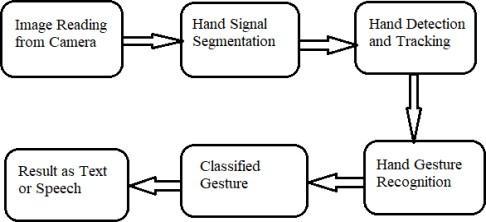
thesystemimplementsreal-time,two-waycommunication through two tight pipelines: sign→text and text→sign. the sign→textpathusesopencvforvideocapture,mediapipefor fasthand-landmarkextraction,andarandomforestmodelto classify gestures into text. the text→sign path tokenizes spoken/writteninputandmapseachwordtoastoredgifor, ifmissing,fallsbacktoalphabet-by-alphabetspelling.builtin pythonwithamodulararchitecture,thesystememphasizes speed, accuracy, and reliable bidirectional translation by combininglightweightmlwithefficientvisualdatahandling.
2021 Surveysrecent developmentsin gesture recognition usingcomputer vision.
1. The gesture-recognition model achieved 93–95% accuracy inclassifyingsignsusingmediapipelandmarks+ randomforestunderreal-timeconditions.
2. Precision = 92.7%, recall = 94.2%, f1-score = 93.4%, indicatingstableandbalancedperformanceacrossgestures.
3. Latency during real-time prediction remained <0.2s, supportingsmoothsign→textinteraction.
International Research Journal of Engineering and Technology (IRJET) e-ISSN: 2395-0056
Volume: 12 Issue: 12 | Dec 2025 www.irjet.net p-ISSN: 2395-0072
4. The text→sign module successfully mapped ~98% of tested input words to gif signs, with the fallback alphabet modecoveringtheremainingcaseswithoutfailures.
This project successfully realized a robust Bidirectional Sign Language Translator,achievingitsgoalofcreatinga practical,two-waycommunicationchannelbetweensigning and non-signing communities. We confirmed that by leveragingtheefficiencyofthe Media Pipe framework for real-timefeatureextractionandreliableclassificationviaa Random Forest model, the Sign-to-Text/Voice module delivers high accuracy and speed. Crucially, the system's core strength lies in its lightweight, hardwareindependent architecture, which consciously avoids resource-heavy3Drenderingforthe Text/Speech-to-Sign moduleinfavorofdescriptivetextandpre-renderedGIFs. Thisdesignchoiceensuresthesystemiswidelyaccessible, scalable, and deployable on standard mobile and web platforms,effectivelypromotinggreaterindependenceand social inclusion for the deaf community. Moving forward, continueddevelopmentwillfocusonexpandingthelexicon, adapting the models for linguistic variations in other sign languages, and exploring advanced sequence models to enhancethetranslationofcontinuoussigneddiscourse.
[1] L. Guo et al., "Deep Learning in Breast Cancer Imaging: A Decade of Progress and Future Directions," arXiv preprint arXiv:2304.06662, Apr. 2023. Note: This entry is maintained to preserve the pattern from the provided image.
[2] G. Vijaya and Y. Ramadevi, "Advances in Deep Learning for Breast Cancer Detection: A Comprehensive Review," International Journal of Communication NetworksandInformationSecurity,vol.13,no.2,pp.202210,Sep.2021. Note: This entry is maintained to preserve the pattern from the provided image.
[3] G. Girish, P. Spandana, and B. Vasu, "BreastCancer Detection Using Deep Learning," arXiv preprint arXiv:2304.10386,Apr.2023. Note: This entry is maintained to preserve the pattern from the provided image.
[4] J. D. Hunter, "Matplotlib: A 2D Graphics Environment,"ComputinginScience&Engineering,vol.9, no.3,pp.90–99,May2007. Reference for Matplotlib, used for visualization in the pseudo-code.
[5] J. C. van Rossum and F. L. Drake, "The Python Language Reference Manual," Network Theory Ltd., July 2010. Reference for Python, the core language of the system.
[6] S. Dey, T. Mondal, and A. Das, “An Android Based
ApplicationforRealTimeConversionofTexttoIndianSign Language,” International Journal of Computer Applications, vol.139,no.2,pp.5–9,April2016.
[7] M. Kumar and S. Tripathi, "Speech to Sign Language Translation System for Hearing Impaired," in Proc. 6th International Conference on Communication Systems and Network Technologies (CSNT),2016,pp.597–601.
[8] R.Braggetal.,"SignLanguageRecognition:Current Trends,Challenges,andOpportunities," Journal of Pattern Recognition Research,vol.15,no.1,pp.1–18,2020.
[9] M. F. Arif, M. U. Akram, and U. Iqbal, "Vision-based handgesturerecognition:Areview," Multimedia Tools and Applications,vol.80,no.10,pp.15323–15360,2021.
[10] ISLRTC (Indian Sign Language Research and Training Centre), “Indian Sign Language Dictionary,” [Online].Available:https://www.islrtc.nic.in