
International Research Journal of Engineering and Technology (IRJET) e-ISSN: 2395-0056
Volume: 12 Issue: 12 | Dec 2025 www.irjet.net p-ISSN: 2395-0072
International Research Journal of Engineering and Technology (IRJET) e-ISSN: 2395-0056
Volume: 12 Issue: 12 | Dec 2025 www.irjet.net p-ISSN: 2395-0072
Dr B.P. Kurpatwar SPPU , M.P. Patil SPPU
Assistant professor, Department of mechanical engineering, Adul’s Technical campus, Chas, Ahilyanagar, India
Abstract - The work has been considered for Sub merged arc welding to determine process parameters with weld bead properties. weld bead that determines its mechanical qualities include the heat affected zone, the width of the weld bead, the area of penetration and the height of the reinforcement. Any welding technique can only be used effectively if associated criteria that affect the quality of the weld are understood. The size of the weld bead, mechanical characteristics, temperature distribution, and microstructural alterations are all factors in the weld quality. The primary composite design technique of response surface methodology is used to generate mathematical modelling of the impact of heat transfer on the properties of the weld bead during the SAW process. Plotting on the mean value, the scatter and contour plots show good consistency
Key Words: SAW, Taguchi method, Optimization, S/N ratio, ANOVA, welding parameters, Design
Inthecurrentmanufacturingperiod,aproduct'svalueinthe market is largely determined by its quality, and all manufacturing firms must make each product in a costeffective way without sacrificing quality. Welding is the permanent connecting technique used in the fabrication industry. It is excellent, reasonably priced, and far faster than alternative methods like casting and riveting. The benefitsofusingSAWtofabricatecircumferentialjointsin boilers, pipes, and pressure vessels are deep penetration, high deposition rate, fast speed, and exceptional surface quality.SAWisalsousedtodeveloppartsandoverlapwith stainlesssteelforrailcarwheels,mining,construction,and agricultural equipment, as well as rollers for continuous castingsteel.Thebead'sgeometrydeterminesthequalityof the weld. The important characteristics of weld bead geometry are the depth of penetration, height of reinforcement,andwidthoftheweldbead.Therefore,itis imperativetodevelopamathematicalmodelbasedonthe inputsetupparametersinordertoevaluatethequantitative value or relationship between them and the weld bead properties in submerged arc welding. The input setting parameters, such as welding current, welding voltage, weldingspeed,andnozzletoplatedistance,definethesound weldshape.Submergedarcweldingispreferredduetoits high melting efficiency, high production rate, ease of robotization, and minimal operator skill requirements. ScientistsandresearchersworkinginthefieldsofSAWand variousaspectsofthefusionweldingprocesshaveproduced avarietyofworksthathavebeendiscussed.
2 Qualities of weld deposited are determined by following
Parameters
Weldingcurrent
Weldingarcvoltage
Electrodesstickout
Gradeofwire
Travelspeed
Sizeofelectrode
Fluxlayerdepth
Wirefeedrate
3 WELDING PARAMETER AND ITS LEVEL
Table1Weldingparameteranditslevel
Testspecimen
EXPERIMENTAL SET-UPS
WeldingRecords
Weldingprocess:SAW
WeldingPosition:1G
Material:S355J0
ElectrodeFlux:EM12K+7A5
Diameter:4.00mm
Sizeoftestplate:20X300X500
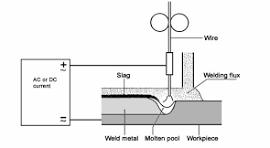
Figure 1 : saw Welding
Volume: 12 Issue: 12 | Dec 2025 www.irjet.net p-ISSN: 2395-0072
SAW operation
3
The signal-to-noise ratio of a random variable (S) to randomnoise N is:[1]

whereEreferstotheexpectedvalue,whichinthiscaseis the mean square of N
If the signal is simply a constant value of s, this equation simplifiesto:

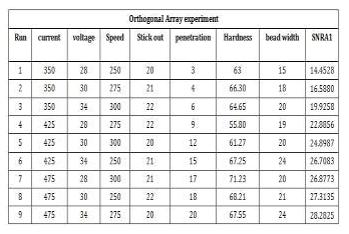
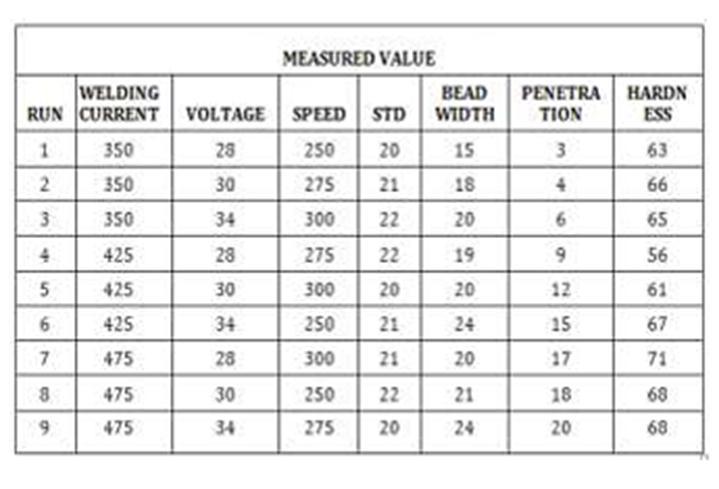
MINITABsoftwareisusedforanalysisofvariation.Thetable displays the ANOVA results for weld bead penetration, hardness, and width. Examination of the width, hardness, and penetration using ANOVA reveals that the welding processparametersthathavethemosteffectsontheweld bead'swidth,hardness,andpenetrationareweldingcurrent and arc voltage. ANOVA is often performed to determine
whether the results fall within a 95% confidence level. MINITAB software is used for analysis of variation. Table displays the ANOVA table for weld bead penetration, hardness, and breadth. Bead width analysis using ANOVA demonstratesthatthekeyweldingprocessparametersthat influence the width of the weld bead, hardness, and penetrationareweldingcurrentandarcvoltage.ANOVAis alsoperformedforadditionalweldcharacteristics,revealing that welding current significantly influences weld bead width and hardness whereas electrode stick out has a negligible impact on these parameters. Arc voltage has a minorimpactonthedepthofbeadpenetration,butwelding speedandweldingcurrenthaveasignificantimpact.Weld parameters are little affected by electrode stick out. The experiment's confirmation revealed that the experimental findingsfallwithinthe Weldbeadwidthandhardnessare mostlyinfluencedbyweldingcurrent,whileelectrodestick out has a slight impact on both. Arc voltage has a minor impactonthedepthofbeadpenetration,butweldingspeed and welding current have a significant impact. Weld parametersarelittleaffectedbyelectrodestickout.
International Research Journal of Engineering and Technology (IRJET) e-ISSN: 2395-0056
Volume: 12 Issue: 12 | Dec 2025 www.irjet.net p-ISSN: 2395-0072
Optimum parameters
Optimum parameters for bead width, maximum hardness and better penetration are current at low level (16.88A)
Voltageatlowlevel(21.3V)speedatlowlevel(22.72mm/s) andelectrodestickoutatlowlevelis22.44mm
8. Result and discussion
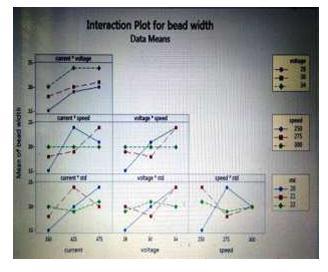
TheTaguchiapproachofexperimentdesignoptimizesthe cost-effective arrangement of welding experiments. According to the ANOVA results, welding current and arc voltage are the important welding process variables that impactthehardnessandbreadthoftheweldbeads.Using input variables, the output values for MINITAB17's bead width,hardness,andpenetrationarecomputed.
9. Conclusion
Optimum parameters for bead width, maximum hardness and better penetration are current at low level (16.88A)
Voltageatlowlevel(21.3V)speedatlowlevel(22.72mm/s)
Futureresearchcanbeexpandedbycreatingandexamining anumberofMethodssuchasgeneticalgorithms,fluxdensity influence,HAZresearch,andmicrostructurecanbeusedto optimizeprocessparameters.
[1] R.V. Rao and V. D. Kalyankar, “Experimental investigation on submerged arc welding of Cr-Mo-V steel”,InternationalJournalofAdvancedManufacturing Technology,V.69,2013,pp.93-106.
[2] K.Y. Benyounis andA.G. Olabi, “Optimization of different welding processes using statistical and numericalapproaches-Areferenceguide”,Advancesin EngineeringSoftware,V.39,2008,pp.483-196
[3] M. Aghakhani, M. R. Ghaderi, A. Karami and A. A. Derakhshan,“CombinedeffectofTiO2
[4] M. A. Moradpour, S. H. Hashemi and K. Khalili, “Multi objective optimization of welding parameters in submergedarcweldingofAPIX65steelplate”,Journal ofIronSteelResearchInternational,V.22,No.9,2015, pp.870-878.
[5] J. E. R. Dhas and S. Kumanan, “Optimization of parameters of submerged arc weld using nonconventionaltechniques”,AppliedSoftComputing,V.11, 2011,pp.5198-5204.
[6] R. Venkata Rao and Dhiraj P. Rai, “Optimization of submergedarcweldingprocessparametersusingquasioppositional based Jaya algorithm” Journal of MechanicalScienceandTechnology,V.31,No.5,2017, pp.2513~2522.
[7] Stephen, D.S.; Sethuramalingam, P. “Optimization of grinding titanium with 2%CNT-CBN wheel using TOPSIS”,MaterialManufacturingProcess,2022.
[8] Huu-QuangNguyen, Van-TungNguyen,Dang-Phong Phan,Quoc-HoangTran,andNgoc-PiVu,“Multi-Criteria Decision Making in the PMEDM Process by Using MARCOS,TOPSIS,andMAIRCAMethodsAppl.”Sci.V.12, 2022,pp.3720
[9] Zeng, Y.-P.; Lin, C.-L.; Dai, H.-M.; Lin, Y. C.; Hung, Optimization J.-C. in “Multi-Performance Electrical DischargeMachiningofAl2O3CeramicsUsingTaguchi BasedAHP-WeightedTOPSISMethod”Processes,V.9, 2021,pp.1647.
[10] Gadakh, V. S., Shinde, V. B., Kenmar, N. S. "Optimization of welding process parameters using MOORAmethod",TheInternationalJournalofAdvanced Manufacturing