
International Research Journal of Engineering and Technology (IRJET) e-ISSN:2395-0056 p-ISSN:2395-0072

Volume: 12 Issue: 12 | Dec 2025 www.irjet.net

International Research Journal of Engineering and Technology (IRJET) e-ISSN:2395-0056 p-ISSN:2395-0072
Volume: 12 Issue: 12 | Dec 2025 www.irjet.net
Dr. Varsha M1 , Niveditha MG 2, Priyadarshini P 3, Punyashree B S 4 , Sahana M K 5
1Associate Professor, Artificial Intelligence and Machine Learning, Bapuji Institute of Engineering and Technology, Davanagere, affiliated to VTU Belagavi, Karnataka, India.
2Bachelor of Engineering, Artificial Intelligence and Machine learning, Bapuji Institute of Engineering and Technology, Karnataka, India
3Bachelor of Engineering, Artificial Intelligence and Machine learning, Bapuji Institute of Engineering and Technology, Karnataka, India
4Bachelor of Engineering, Artificial Intelligence and Machine learning, Bapuji Institute of Engineering and Technology, Karnataka, India
5Bachelor of Engineering, Artificial Intelligence and Machine learning, Bapuji Institute of Engineering and Technology, Karnataka, India
Abstract - In India, most people prefer two-wheeler vehicles as their primary mode of transportation. It is a common form in India. This usually leads to road accidents because of not wearing helmets. In developed cities, the digital system has been used to detect non-helmet riders. Often, this reduces the number of road accidents and the rate of death. But still, in India, there are many cities, even though all rules are followed. Some of the people are not wearing helmets and following the rules. To overcome this, helmet violations have been detected using CCTV surveillance cameras and machine learning models, including deep learning object detection models. This has reduced the rate of accidents and the rate of death. 44.5% of twowheelers, 74,897 people were killed due to this reason. In order to resolve this problem we have developed a model that is having accuracy 95.3, the model is trained on open source dataset, and used yolov8 for model training and integrated cub am for more accurate results even in low light conditions.
Key Words: Helmet Violation Detection, Deep Learning, YOLOv8, CBAM (Convolutional Block Attention Module), Object Detection, Number Plate Recognition (OCR), CNN (Convolutional Neural Network), CCTV Surveillance, Echallah Automation, Twilit Messaging, India Traffic Safety, Performance Evaluation (Accuracy, Precision, Recall, map), Dataset Annotation and Augmentation, Smart City Deployment.
Trafficaccidentsarehappeningandleadingtodeath,especiallyamongtwo-wheelers,whoarehighlyinvolvedinthis.The two-wheelerridersaregettinginjuredduetonotwearingahelmet,whichcausesdeathworldwide.InIndia,overthepast 10 years, non-compliance has remained a significant issue, contributing to an increased number of road accidents. Approximately30%oftotaldeathsonroadswerecausedbyhelmet-violatingriders.[1]
Toovercomethisissue,digitalinformantshavebeenundertakeninIndia.TheuseoftechnologieslikeCCTVcamerasand artificial intelligence systems [2] automatically identifies and finds violations. In this paper, we are going to frame one solution for this. Nowadays, with the improved technologies, helmet violations are decreased using machine learning modelslike YOLOv8, OCR forNumberplateRecognition,and Twilio for messagealert. You Only Look Once isthemost popular object detection model in machine learning and deep learning. [3] Over the past five years, the effectiveness of machinelearninginCCTVhasbecomemoreefficient.Variousresearchpapersandstudiesshowthathigh.
Accuracy of detecting violations using deep learning technologies, such as CNN, i.e., Computational Neural Network, typically ranges from over 90% to 98.56% in controlled experiments.[5] The impact of ML in this is enabling automated detection and the generation of each CNN and notification, which is faster than manual monitoring. The World Health Organization data indicates a reduction in the rate of death by 42% and severe head injuries by up to 69%. This system contributestoareductioninthedeathsorinjuriesoflife.Thedevelopmentofreal-timesolutionscanreducethenumber ofdeathsandinjuries.
International Research
of Engineering and Technology (IRJET) e-ISSN:2395-0056 p-ISSN:2395-0072 Volume: 12 Issue: 12 | Dec 2025 www.irjet.net
TheexistingsystemformonitoringhelmetviolationsmainlyreliesonmanualsurveillancebytrafficpoliceandbasicCCTV monitoring, whichistime-consuming,labor-intensive,andpronetohuman errors.Inmanycases, enforcement islimited due to high traffic density, lack of continuous monitoring, and difficulty in identifying violators accurately. Some automatedapproachesuse simple imageprocessing or traditional machinelearningtechniques, buttheyoften fail under low-light conditions, motion blur, and complex backgrounds, and usually lack seamless integration with number plate recognitionandautomatede-challahgeneration.Asaresult,theexistingsystemisinefficient,lessscalable,andunableto providereal-time,end-to-endenforcementofhelmetsafetyrules.
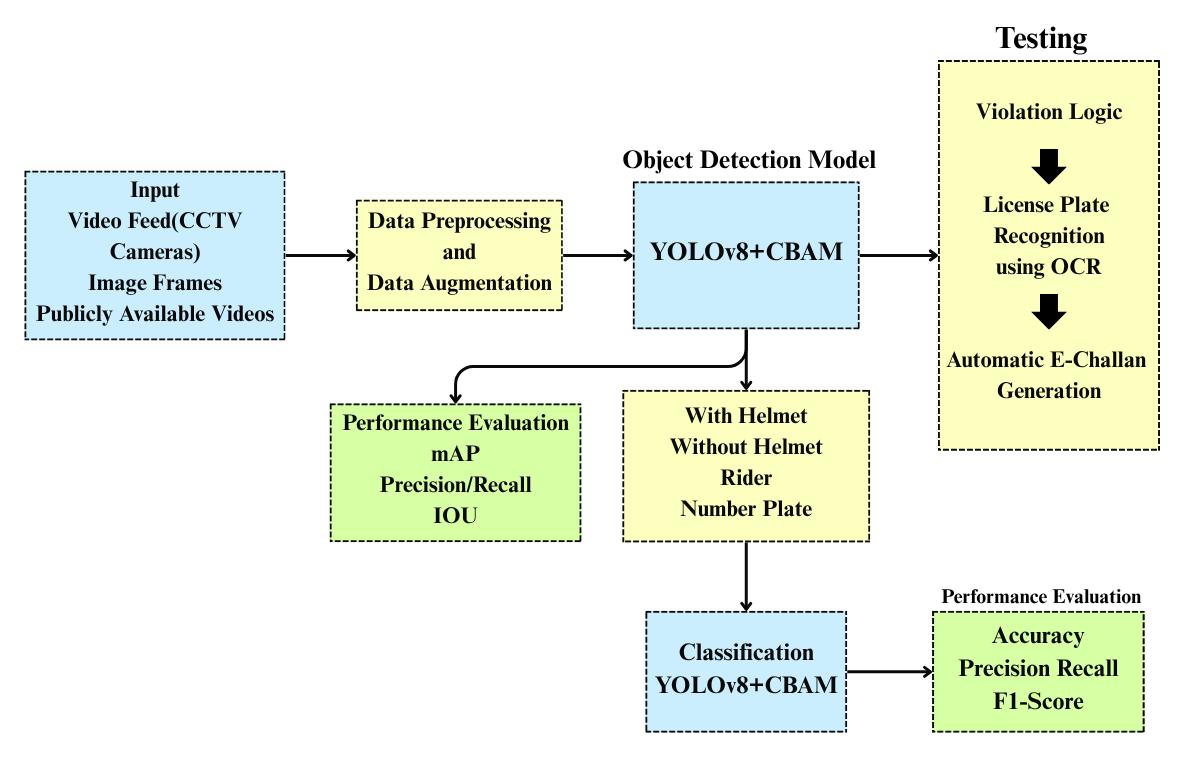
Wedevelopedoursystemusinga Convolutional Neural Network (CNN)andtheYOLOv8model forobject detection.This paperoutlinesthesystem’sdevelopmentthroughastructured,step-by-stepmethodology.
ThefirststepisDataAcquisition.Wecollectedthedatasetsfromopen-sourceplatformssuchasKaggleandRobot flow. We gathered around 1,000–1500 images and manually annotated them to create a well-structured dataset withtheclasslabel,withhelmet,withouthelmet,rider,andnumberplatesuitableformodeltraining.
The second step is Data Pre-processing. We performed data augmentation and normalization. Augmentation techniques like rotation, color adjustments, and scaling increased dataset variability. This improved the model’s ability to generalize. Normalization ensured all images used consistent format during training
The third step focuses on Helmet Detection. For this, we utilized YOLOv8, integrated with the CBAM (ConvolutionalBlockAttentionModule),toenhancethemodel’sabilitytofocusonrelevantvisualfeaturesinlowlight conditions. (Wu et al., 2025) This combination helped in accurately detecting whether a rider is wearing a helmet.
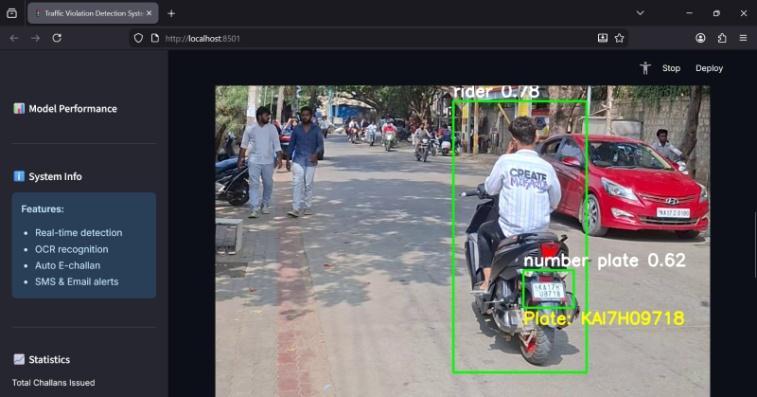
The fourth step is Violation Logic and License Plate Recognition. The system applies a binary logic where ‘0’ indicatestheriderisnotwearingahelmetand‘1’indicatestheyarewearingone.Onceaviolationisdetected,OCR isusedtoreadthelicenseplatenumberandextractit.Followingthis,thesystemwillautomaticallyinitiateanechallangenerationprocess,andTwiliowillbeusedtosendalertnotificationstotheregisteredmobilenumber.
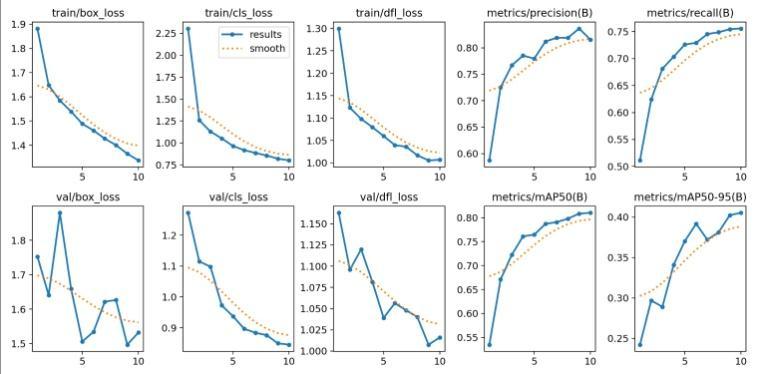
The fifth step is performance evaluation. We evaluated the model using standard metrics such as accuracy, precision,recall,andmeanaverageprecision(mAP)tomeasurehoweffectivelythesystemperforms.(Evaluation ofYOLOv8ModelforObjectDetection,2024).
The sixth step involves classification using a YOLOv8 with CBAM. The attention mechanism in CBAM enhances featureextractionandimprovesclassificationperformance.
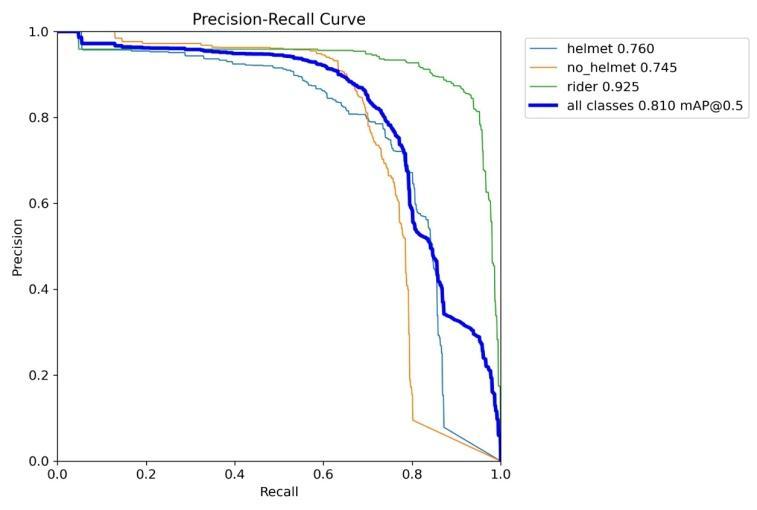
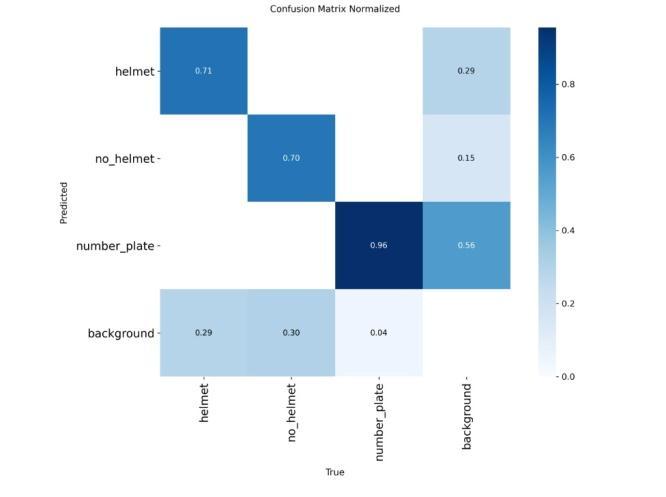
The final step is a detailed performance review. This includes accuracy graphs, confusion matrices, precision–recallcurves,andothervisualperformanceindicatorstohighlightthestrengthsandlimitationsofthesystem.
Todevelopadeeplearning-basedsystemusingYOLOv8todetectriders,helmets,andnumberplatesinreal-time trafficfootage.
To integrate CBAM for fine-grained classification of helmet usage (with/without helmet) and apply OCR for automaticnumberplaterecognitiontoensurereliableidentificationofviolators.
To implement a digital challan system that automatically records violations, stores evidence, and generates penaltynoticesintegratedwithabackenddatabasefortrafficmanagementauthorities.
e-ISSN:2395-0056 p-ISSN:2395-0072 Volume: 12 Issue: 12 | Dec 2025 www.irjet.net
Traditionaltrafficmanagementwasbothlabor-intensiveandsubjecttohumanerror,especiallywithhightrafficproblems. Adequate,theinadequacies ofsuchamore automaticsystemthatcouldresolvetheproblem.Advancesindeeplearning: Earlier systems for helmet prediction focused more on basic image processing, and classic machinelearning models like SVMorKNNclassifierswerelimitedtoonlylow generalizationtodetectmultiplepersons.Thisimprovestheaccuracyof detecting violations. Models like YOLO detect objects in machine learning. These models identify riders and violators in crowdedscenes.Therateofaccuracyofthismodel wasabove90%.Theearlydetectionmethodsusedbyvisionsensors, puzzle logic, and classical image processing could detect vehicles and riders but had slow processing and low real-time accuracy;hence,themachinelearningapproachesareusedforautomaticsystems.Thisimprovesthedetectionaccuracy.
In the year 2024, than extended the application by integrating yellow v11 with H, completing both helmet detection and numberplaterecognitioninrealtime.Thesystemefficientlyminimizesthelatencyandbandwidthconsumption,makingit ideal for deployment in Smart City environments. Saravanan and Rajini, in their 2024 paper, present a three-stage automatic helmet violation detection system incorporating a mass area cylinder for segmentation and classification, like restnetandDense,whicharedeepneuralnetworksthatimprovetheaccuracyofdetection.
This approach provided the most structured pipeline with the existing traffic monitoring system. This research studies collectivelydemonstratetheavailabilityofuseusingofdeeplearningforhelmetdetectioninthehandlingwearingangles motion blur and diverse traffic environments the current research aims to build on this foundations by developing a robust and integrity system that not only detects helmet while it is but also identify them the real license in real time togetherthesestudiesunderscoretheshifttowardsmoreaccurateandrealtimedetectionsystem.Thecurrentresearch6 toaddresstheselimitationsbydevelopingadeeplearningbasedsolution thatintegrateshelmetdetectionwithreal-timenumberplaterecognition.
Table-1: LiteratureSurvey
Title
EnhancingHelmetViolationDetection andLicensePlateRecognitionthrough OptimizationofYOLOv8Modelswith EdgeComputingIntegration
Comprehensive Study on the Development of an Automatic Helmet ViolatorDetectionSystem(AHVDS)
Real-Time Multi-Class Helmet Violation Detection Using Few-Shot Data SamplingTechniqueandYOLOv8
AlgorithmofHelmetWearingDetection BasedonAT-YOLODeepModel
HelmetUseDetectionofTracked MotorcyclesUsingCNN-BasedMultiTaskLearning
Authors
H.D.N.Thanh(2024)
M.Saravanan&G.K. Rajini(2024)
Methodology
OptimizedYOLOv8model deployedwithedge computingforreal-time helmetdetectionandnumber platerecognition.
Multi-stagedeeplearning frameworkusingCNN-based classifiersandstructured detectionpipeline.
A.Aboahetal.(2023) YOLOv8withfew-shot learningfordetectinghelmet andnon-helmetclassesin realtime.
ZhouQ.etal.(2021)
H.Linetal.(2020)
Attention-basedYOLO(ATYOLO)modeltoenhance helmetdetectionaccuracy.
CNN-basedmulti-task learningfortracking motorcyclesanddetecting helmetusage.
Research Gap
Lackofintegrationwith automatede-challansystems andlimitedevaluationfor Indiantrafficconditions.
Real-timeperformance optimizationandSMS-based challanautomationnot addressed.
Performancedegradesin densetrafficandlow-light CCTVenvironments.
Testedmainlyoncontrolled datasetswithlimitedrealworldrobustness.
Highcomputationalcostand poorscalabilityforreal-time urbansurveillance.
Volume: 12 Issue: 12 | Dec 2025 www.irjet.net
The proposed system requires a standard laptop or desktop computer with sufficient processing power to handle realtime video analysis, preferably with at least 8 GB of RAM and an optional NVIDIA GPU to speed up model training and inference.ItoperatesusingthePythonprogramminglanguageandleveragesadvanceddeeplearningtechnologiessuchas YOLOv8 integrated with the CBAM attention module to accurately detect helmet and non-helmet riders from CCTV or recorded video feeds. Open CV is used for video processing, while Easy OCR or Teaser act is employed to extract vehicle number plate details from detected violations. To complete the enforcement workflow, the system integrates the Twilio APItoautomaticallygenerateandsende-challannotificationsviaSMS.Theoveralldesignemphasizeshighaccuracy,realtime responsiveness, scalability for smart city deployment, and reliable performance across different lighting and traffic conditions,whileremainingeasytomaintainandupgradeastechnologyevolves.
The implementation of the project starts with collecting and annotating a diverse dataset of traffic images, labeling helmets,non-helmetriders,riders,andnumberplates.Theseimagesarethen preprocessed and augmented tomakethe model more robust to real-world variations. Next, the YOLOv8 model is trained and enhanced with the CBAM attention module toimproveitsfocusonrelevantregions,especiallyinlow-lightandclutteredscenes.Oncethedetectionmodelis ready, it is integrated into a real-time pipeline that reads frames from CCTV or video files, runs detection, and flags violations. For every non-helmet rider detected, the corresponding number plate region is cropped and passed to EasyOCR,whichextractsthetext.Thisinformationisthenusedto auto-generate an e-challan,andthedetailsaresentas an SMS to the vehicle owner using the Twilio API. Finally, the entire system is thoroughly tested using metrics like accuracy,precision,recall,andmAPtovalidateitsperformancebeforeconsideringdeployment.
Inthissection,wewillgothroughallthedetailsoftheexperimentsconductedtocontributetothiswork.
Here,wehaveusedKaggleandRoboflowdatasets.Startinglearningitis0.001429,andineachtraining,20epochscontain 300iterations.Inordertogetbetterresults, various experimentshavebeenperformed. Wehavechangedthebatchsize, epoch size, and network optimizer to increase the system accuracy. For this work, we have used the most popular
International Research Journal of Engineering and Technology (IRJET) e-ISSN:2395-0056 p-ISSN:2395-0072
OptimizercalledADAM(adaptivemomentestimation)optimizerandRootmeansquarepropagation.Thetrainingbatches aresetto16.
Numberofepochs 20
Batchsize 16
Optimizer ADAM
Activationfunction ReLU
II. Evaluation Matrices:
In order to study the effectiveness of our proposed system, the different evaluation metrics have been considered. We tested our model’s performance using different measures like Precision-recall, F1-score, precision, and accuracy. The evaluationmetricscanbecalculatedas,
F1=
Precision=(TP)/(TP+FP)
Recall=(TP)/(TP+FN)
Where,
TP=TruePositives,
FP=FalsePositivesand
FN=FalseNegatives
III. Detection Results
Volume: 12 Issue: 12 | Dec 2025 www.irjet.net © 2025, IRJET | Impact Factor value: 8.315 | ISO 9001:2008 Certified
Table-3:ObservedResult
BatchSize 16
Imgsz 640
Optimizer Adam,SGD
Momentum 0.947
Weight_decay 0.0005
| Page259
International Research Journal of Engineering and Technology (IRJET) e-ISSN:2395-0056 p-ISSN:2395-0072
Volume: 12 Issue: 12 | Dec 2025 www.irjet.net
International Research Journal of Engineering and Technology (IRJET) e-ISSN:2395-0056 p-ISSN:2395-0072 Volume: 12 Issue: 12 | Dec 2025 www.irjet.net
From the literature survey, it is observed that recent research increasingly focuses on deep learning–based approaches such as YOLO and CNN models for helmet violation detection. While these methods achieve good accuracy in controlled environments, many existing systems face challenges in low-light conditions, dense traffic, and real-time deployment. Moreover, most studies primarily address detection alone and lack a fully automated end-to-end framework that integrates number plate recognition, challan generation, and user notification. These limitations highlight the need for a robust, integrated solution, which motivates the proposed system using YOLOv8 with CBAM and automated e-challan generation.
Theproposedsystemsuccessfullyintegratesdeeplearning-basedobjectdetection(YOLOv8withCBAM)andOCRforrealtime automatic helmet violation detection we achieved 95.3% of accuracy and number plate recognition using CCTV surveillance in Indian cities. By leveraging annotated datasets, data augmentation, and advanced neural network architectures, the solution achieves high accuracy in identifying violators and automates the e-challan process via SMS alerts,contributingtoenhanceroadsafetyandreducedfatalitiesamongtwo-wheelerriders.
[1] S. Hu, P. Wang et al., “Building Occupancy Detection and Localization Using CCTV Camera and Deep Learning,” IEEE InternetofThingsJournal,vol. 10,no. 1,pp.,Jan.2023.
[2] J. Ferrando, C. Borrell et al., “Impact of a helmet law on two wheel motor vehicle crash mortality in a southern Europeanurbanarea,”InjuryPrevention,vol. 6,no. 3,pp.,Sep.2000.
[3]JamtshoY,etal.,Real-timelicenseplatedetectionfornon-helmetedmotorcyclist usingYOLO.ICTExpress2021Mar1;7(1):104–9.
[4]R.S.CharranandR.K.Dubey,“Two-Wheeler Vehicle TrafficViolationsDetectionandAutomatedTicketingforIndian RoadScenario,”[Conference/JournalName],Nov.2022.
[5]WHO.Globalstatusreportonroadsafety.2018June17
[6] Anantharaman R, et al.,. Utilizing mask R-CNN for detection and segmentation of oral diseases. In: In 2018 IEEE internationalconferenceonbioinformaticsandbiomedicine(BIBM).IEEE;3Dec2018.p.2197–204
[7]SilvaRR,etal.,Detectionofhelmetsonmotorcyclists.MultimediaToolsAppl2018Mar;77:5659–83
[8] H. Lin, J. D. Deng et al., “Helmet Use Detection of Tracked Motorcycles Using CNN-Based Multi-Task Learning,” IEEE Access,vol. 8,pp.,Jan.2020.
[9] F. H. Shubho, F. Iftekhar et al., “Real-time traffic monitoring and traffic offense detection using YOLOv4 and OpenCV DNN,”[Journal/ConferenceName],Dec.2021.
[10] A. Hayat and F. Morgado-Dias, “Deep Learning-Based Automatic Safety Helmet Detection System for Construction Safety,” Applied Sciences, vol. 12, no. 8,pp., Aug.2022.
[11]T.Satiennam, J. Kumphong et al.,“Changeinhelmetuse behavior enforced by CCTVcameraswithautomatichelmet usedetectionsystemonanurbanarterialroad,”TrafficInjuryPrevention,vol. 21,no. 6,pp.,Jun.2020.
[12]L.Wei,P.Liuetal.,“Researchonhelmetwearingdetectionmethodbasedondeeplearning,”ScientificReports,vol. 14, no. 1,pp.,Mar.2024.
[13]M.Shoman,S.Gargoum etal.,“Enforcingtrafficsafety:Adeeplearningapproachfordetectingmotorcyclists’helmet violationsusingYOLOv8andDeepConvolutionalGenerativeAdversarialNetwork-generatedimages,”Algorithms,vol. 17, no. 5,pp.,May2024.
International Research Journal of Engineering and Technology (IRJET) e-ISSN:2395-0056 p-ISSN:2395-0072
Volume: 12 Issue: 12 | Dec 2025 www.irjet.net
[14]H.D.N.Thanh,"EnhancingHelmetViolationDetectionandLicensePlateRecognitionthroughOptimizationofYOLOv8 ModelswithEdgeComputingIntegration,"2024
[15] M. Saravanan and G. K. Rajini, "Comprehensive study on the development of an automatic helmet violator detection system(AHVDS)usingadvancedmachinelearningtechniques,"2024.
[16] G. Agorku et al., "Real-time helmet violation detection using YOLOv5 and ensemble learning," arXiv preprint arXiv:2304.09246,Apr.2023.
[17] A. Aboah, et al., "Real-time multi-class helmet violation detection using few-shot data sampling technique and YOLOv8,"arXivpreprintarXiv:2304.08256,Apr.2023.
[18] E. Soltani Kazemi, et al., "Real-time helmet violation detection in AI City Challenge 2023 with genetic algorithmenhancedYOLOv5,"arXivpreprintarXiv:2304.09248,Apr.2023.
[19] Zhou Q, et al., Algorithm of helmet wearing detection based on AT-YOLO deep mode. Comput Mater Contin 1 Oct 2021;69(1)
[20] M. Zhang, et al., "YOLO-AA: an efficient object detection model via strengthening fusion context information," arXiv preprint.
[21] Lee JY, et al., Verification and performance comparison of CNN-based algorithms for two-step helmet-wearing detection.ExpSystAppl2023Sep1;225:120096.
[22] HwangS,etal.,ObjectdetectionforcargounloadingsystembasedonFuzzyCmeans.ComputMaterContin2022May 1;71(2)