International Research Journal of Engineering and Technology (IRJET) e-ISSN: 2395-0056
Volume: 12 Issue: 12 | Dec 2025 www.irjet.net p-ISSN: 2395-0072
International Research Journal of Engineering and Technology (IRJET) e-ISSN: 2395-0056
Volume: 12 Issue: 12 | Dec 2025 www.irjet.net p-ISSN: 2395-0072
Sarvagna S1, Shree Raksha M2 , Mohamed Shaid N3, Abdul Rehman4, Mr. Arun Kumar N5 , Dr. Mohamed Saleem6
1,2,3,4Student, Dept. of Robotics and Artificial Intelligence, Bangalore Technological Institute, Bangalore, India
5Assistant Professor, Dept. of Robotics and Artificial Intelligence, Bangalore Technological Institute, Bangalore, India
6Professor and Head of Department, Dept. of Robotics and Artificial Intelligence, Bangalore Technological Institute, Bangalore, India ***
Abstract - This project of ours presents the development of a Multi-Mode Smart Robot for Assistance and Automation capable of operating four different major modes Voice Control, Bluetooth Remote Control, Human Following and Obstacle Avoidance. The goal of the system is to integrate powerful sensors and autonomous decision making withina compact 4wheel robot. The robot uses an ESP32 microcontroller as the central processingunit, anoffline voice-recognition module for command-based operations, ultrasonic and IR sensors for obstacle detection and an L298N motor driver for motion control. The proposed system user assistance through smart control, allowing hands-free operation, remote command operation, person tracking, and safe obstacle handling. The design aims to support applications in household automation, personal assistance, indoor mobility, warehouse logistics and security patrolling. Experimental results indicate that the robot efficiently works between modes and reliably executes commands, ensuring intelligent and adaptive behavior suitable for real world environments
Key Words: Smart Robot, Voice Control, Human Following, Obstacle Avoidance, ESP32, Automation, Multi-Mode Robot
A smart robot is defined as robotic system capable of sensing,understandingandinteractingwithitssurroundings toperformtasksautomaticorsemi-automatic.Theconcept ofassistancereferstosupportinghumanactivitiessuchas motion, object carrying, navigation and monitoring. Automation refers to enabling machines to perform tasks automaticallywithminimalhumanintervention.Thisproject integratesallthreeconceptsintoasinglerobotthatcanbe operated through multiple intelligent modes. The robot is designedtoactasversatileassistantcapableofresponding to voice commands, following a human user, navigating indoors safely and operating under manual Bluetooth control.Thesefeaturesmaketherobotsuitableforreallife applicationssuchashomeautomation,supportingelderlyor disabledpeople,warehousenavigation,indoordeliveryand securityinspection.
Thisprojectisrelevantintoday’stechnologywhere automationandintelligentrobotassistantsareincreasingly used in homes, industries, healthcare and service sectors. Many existing robots depend on expensive components, cloud-basedvoicecontrol,orhigh-complexitysystems.This project provides a low-cost, offline, real-time smart robot that can perform multiple tasks without internet and externalservers.Therelevancealsoextendstoeducational, research and practical robotic development since it integratesmultimodecontrolandsensing.
1. Technical Feasibility: Thesystemuseseasilyavailable hardware components ESP32, IR sensors, ultrasonic sensor,servomotor,motordriverwhichmakesitideal for implementation. Offline voice recognition reduces dependencyoninternetconnection.
2. Economic Feasibility: All components used are low costandeasilyavailable.Theprojectcanbebuiltwithin asmallbudget,makingitfeasibleforacademic,hobby, andprototypeapplications.
3. Operational Feasibility: Therobotcanoperateindoors on flat surfaces and can shift between modes without requiring reprogramming. The offline voice module ensuresstableperformanceeveninanyenvironments withoutnetworkconnection
1. Paper title: Voice Controlled Robot with Obstacle Detection
Author: Sanjana R,ShivaniR.ShankarandM.V.Sreenivas Rao
Abstractandrelevance:ThisworkusesAndroid-basedvoice recognition to control a robot and ultrasonic sensors for obstacledetection.Thesystemrequiresinternetconnectivity andofferslimitedautonomy. Ourprojectimprovesthisby
International Research Journal of Engineering and Technology (IRJET) e-ISSN: 2395-0056
Volume: 12 Issue: 12 | Dec 2025 www.irjet.net p-ISSN: 2395-0072
usinganofflinevoicemodule,enablingfaster,morereliable commandexecutionwithoutinternetsupport.
2. Papertitle: HumanFollowingRobotBasedonMotion Sensing Technology
Author: V. Buragohain and P. Das
Abstract and relevance: The authors designed a humanfollowingrobotusingsimplemotionsensors.Itdemonstrates that low-cost sensors can maintain human tracking with acceptableaccuracy.SupportsourIRandUltrasonichybrid human-following logic, giving a foundation for distance detectionandfollowing.
3. Paper title: Bluetooth Based and GPS Based Follow Me Robot
Author: Gujar, Ashutosh, and Kalyanee Jadhav
Abstract and relevance: This study operates Bluetooth controlled movement and GPS-based outdoor tracking. Confirmsthereliabilityof Bluetoothmanualcontrol,which ourrobotusesasoneofthemainoperationalmodes.
4. Paper title: A person-following robotic cart controlledviaasmartphoneapplication:designand evaluation
Author: Rawashdeh, Nathir A., Ramez M. Haddad, Omar A. Jadallah, and Abdelhadi E.
Abstractandrelevance: Theycombinedsmartphone-based Bluetooth commands with autonomous following, proving that multi-mode switching is practical and stable. Relevance: Directly supports our system’s dual-mode and multi-modeintegration.
5. Paper title: Design and development of human following robot.
Author: Hassan,MuhammadSarmad,MafazWaliKhan,and AliFahimKhan
Abstractandrelevance:Thisresearchfocusesonultrasonic baseddistancetrackingandmicrocontroller-basedmotion control.Providesstrongtechnicalbackingforourultrasonic distance measurement, servo scanning and navigation adjustments.
3. Existing and Proposed system
3.1 Existing System
Existingrobotsgenerallyoperateinasinglemode suchasonlyvoicecontrol,onlyfollow-meoronlyBluetooth operation.MostdependonGoogleAPI’svoicerecognitionor high-cost hardware,making themunsuitableforlocal and offlineuse
3.1.1 Disadvantages of Existing System
Single-functioncapability
Dependencyoninternetorsmartphone
Limitedsensingcapability
Poorobstaclehandling
Lackofautonomousbehaviour
3.2 Proposed System
The proposed multi-mode smart robot integrates voice control, Bluetooth control, and autonomous follow modeandobstacleavoidanceusingmultiplesensors,making intelligent,flexibleandadaptiveoperation.
4.1 Objectives
Theobjectiveistodesignamulti-moderobotintegrating voice,Bluetooth,human-followingandobstacleavoidance. To make fully offline operation using ESP32 and Gravity voice module, reduce hardware cost while maintaining smartfunctionalities.Alsoto createastable,safeanduserfriendlyroboticassistant.
4.2 Methodology
TheSystemplanningisconsideredfirstwithhardware selection including Circuit and chassis design. Next the developmentforeachmodestartingwithtrainingthevoice modulefollowed bymaking theBluetoothcontrol system. Then comes obstacles avoidance with integration of IR sensorandultrasonicsensorsupportedtoservoforrotation control. Laterallmodestestingandperformance validation.
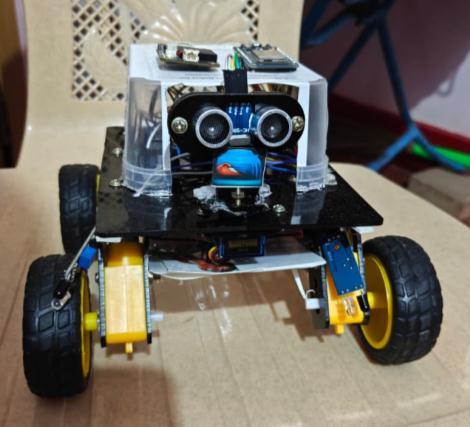
The Design and developing a 4-wheel differential drive mechanism for robot movement. Considering the Servo-mountedultrasonicsensorforscanningleft,rightand front.IRsensorsplacedforwardtiltedtowardsleftandright both side each. Ensuring emergency stop during sudden obstacle.
For controlling the whole robot, the ESP32 microcontrollerischosenwhichhasinbuildBluetoothand Wi-Fi connectivity helps handling the bigger logic system and future enhancements IOT systems. Also considering smoothtransitionsbetweencontrolmodes
All the major considerations are designed and implantation are verified with references. The Proposed systemhasauniquedesignandworkingstructure.
International Research Journal of Engineering and Technology (IRJET) e-ISSN: 2395-0056
Volume: 12 Issue: 12 | Dec 2025 www.irjet.net p-ISSN: 2395-0072
Table -1: ComponentsandSpecifications
Component Specification
ESP32 DevKitV1
Voice Recognition Module
Ultrasonic Sensor
Dual-core32bit MCU and Bluetooth
Gravity Offline Voice Recognition, supports 17 commands
2–200 cm range
Purpose
Main controller
Manual voice control
Obstacle detection andfollow.
IRSensor 2–5cmrange Emergency Stop
L298N Motor Driver Operates 5–35V,2A Motor control
DC Gear Motor
200–255RPM Robot motion
Battery Pack 9–12VLi-ion Power supply
The working of multi-mode robot operates Voice mode control as major mode and all the other modes is switchedfromvoicemode.Whenthevoicecommandsare given, it operates based on the predefined function for all commands. To switch between mode, give command as “Bluetoothmode”itswitchestoBluetoothmodeanditcan beconnectedtophoneappwhichsendscommandslike,FForward,B-Backward,L-TurnsLeft,R-TurnsRight,S-Stop robot.
The Obstacles Avoidance mode is switched when command “Obstacle Avoidance mode” is given which basically moves forward and divert its direction when an obstacle is detected from ultrasonic sensor. For human Following mode switching the command to be used is “Followmode”therobotfollowsthepersoninfrontofrobot about30cmto70cmmaintainingthesafedistanceof30cm.
IRsensorsareusedtodetectsuddenobstaclefrom eithersideofrobottomakedirecttherobottosafermotion. Thesafetyisactiveinallmodesthesensoralwayschecksfor obstacle before any movement is operated to make safe movementwithoutanyharmtoenvironment.
TheServohelpsinscanningtheenvironmentwhich ismountedwithultrasonicsensor.Allmodesworkonvoice commandsandswitchesaccordinglywhenneeded.
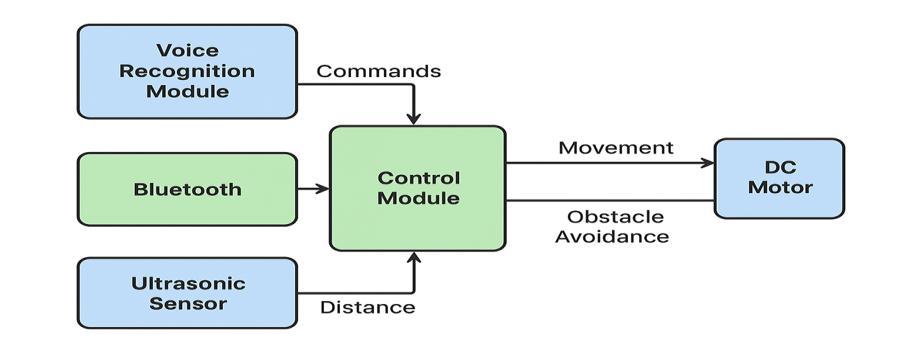
Themulti-modesmartrobotsuccessfullyrespondstoall voice commands with smooth Bluetooth operation also stable follow mode at 30–70 cm and Reliable obstacle detectionupto100cm.TheMode switchingaccurateand fast
SupportedCommands
“HelloRobot”
“Forward”
“Backward”
“Stop”
“Followmode”
“Turnleft”
“TurnRight”
“Bluetoothmode”
“Obstacleavoidancemode”
9.
Themulti-moderobotprovidesanefficientsolution forassistanceandindoorautomationtasks.Itperformsvoice control,Bluetoothoperation,humanfollowingandobstacle avoidanceeffectively.TheDeigninganddevelopingtherobot matcheswiththeobjective.
IntegrationofMachineLearning-BasedHuman Detectionwithcameravision.
GPSandOutdoorNavigation
UpgradedVoiceRecognitionModule
IntegrationofIoTFeatures
BatteryManagementandSolarCharging
AdvancedObstacleAvoidanceUsingAI
Multi-SensorFusionSystem
[1] SanjanaR.,ShivaniR.Shankar,andM.V.SreenivasRao, “Voice Controlled Robot with Obstacle Detection,” International Journal of Advanced Research in Electrical,
International Research Journal of Engineering and Technology (IRJET) e-ISSN: 2395-0056
Volume: 12 Issue: 12 | Dec 2025 www.irjet.net p-ISSN: 2395-0072
Electronics and Instrumentation Engineering,vol.12,no. 4,2023.
[2] V. Buragohain and P. Das, “Human Following Robot BasedonMotionSensingTechnology,” Journal of Mines, Metals & Fuels,vol.71,no.5,2023.
[3] AshutoshGujarandKalyaneeJadhav,“BluetoothBased andGPSBasedFollowMeRobot,” InternationalResearch Journal of Engineering and Technology (IRJET),2021.
[4] Nathir A. Rawashdeh, Ramez M. Haddad, Omar A. Jadallah,andAbdelhadiE.,“APerson-FollowingRobotic Cart Controlled via a Smartphone Application: Design and Evaluation,” in 2017 International Conference on Research and Education inMechatronics (REM),IEEE,pp. 1–5,2017.
[5] MuhammadSarmadHassan,MafazWaliKhan,andAli Fahim Khan, “Design and Development of Human Following Robot,” Student Research Paper Conference, vol.2,no.15,2015
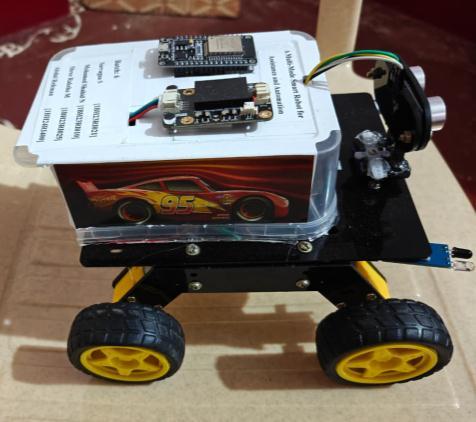
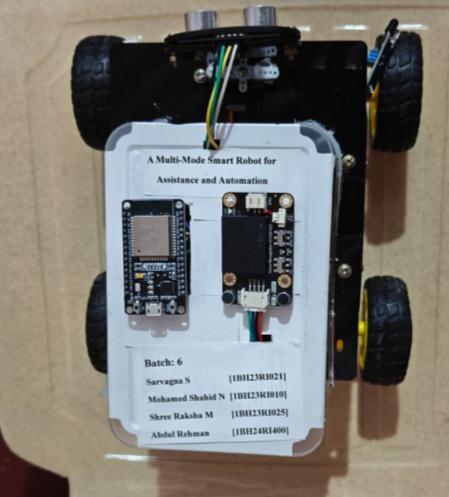
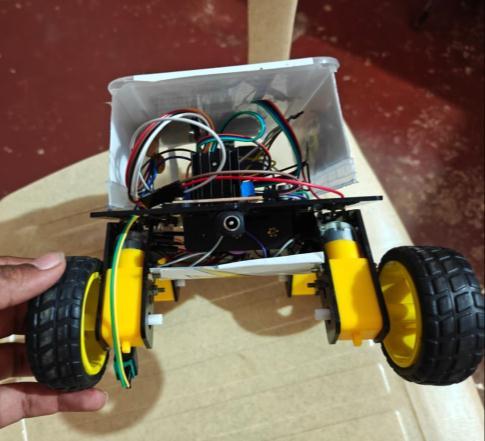
Appendix- Photographs of Prototype