
International Research Journal of Engineering and Technology (IRJET) e-ISSN: 2395-0056
Volume: 12 Issue: 12 | Dec 2025 www.irjet.net p-ISSN: 2395-0072
International Research Journal of Engineering and Technology (IRJET) e-ISSN: 2395-0056
Volume: 12 Issue: 12 | Dec 2025 www.irjet.net p-ISSN: 2395-0072
Prof.
Priyanka R Navale1 , Kiran B V2 , Kumar Venkatesh B R2, Lingaraj G N2, Vijay M H2
1Assistant Professor, Department of CSBS, Bapuji Institute of Engineering and Technology, Davanagere, Karnataka, India
2U.G Student, Department of CSBS, Bapuji Institute of Engineering and Technology, Davanagere, Karnataka, India ***
Abstract – Swift Aid is a mobile-based accident detection and emergency alert system designed to address the critical delay in emergency response following road accidents. Utilizing smartphone sensors such as accelerometers and GPS, the application continuously monitors vehicular motion to detect abnormal patterns indicative of collisions or high-impact events. Upon detecting a potential accident, the app calculates the severity based on g-force data and initiates a countdown timer, giving the user a brief opportunity to cancel in case of a false alarm. If unacknowledged, Swift Aid automatically sends real-time alerts containing the user's precise location and accident details to emergency contacts, nearby hospitals, and local authorities, significantly reducing the time required for help toarrive. Inadditiontoautomatedalerts, SwiftAidsupports manual SOS functionality and can integrate with healthmonitoring features to assess the user’s medical condition post-accident.
Key Words: Real-Time Accident Detection, Smartphone Sensor Fusion, Emergency Alert System, Accelerometer-based Crash Detection, GPS Tracking.
Roadtrafficaccidentsrepresentamajorworldwidehealth and safety challenge. The speed of the emergency response is a critical factor in determining survival rates. Many fatalities occur not from the initial impact but becausemedicalhelpdoesnotarrivequicklyenough.This is especially true for accidents in isolated areas or when driversarealoneandunabletocallforhelpthemselves.
Modern technology offers a powerful solution through smartphones. Nearly everyone carries a device equipped with sophisticated sensors. These sensors can detect the sudden,violentmotionsthatarecharacteristicofaserious carcrash.Byusingthe phone'sbuiltinaccelerometerand GPS, a system can automatically recognize a potential accidentwithoutneedinganyextrahardware.
Whenacrashisdetected,thesystemimmediatelysprings into action. It first captures the exact location of the incident. To prevent false alarms, a brief cancellation period gives the user a chance to stop the alert if it was triggeredbymistake.Ifnocancellationoccurs,thesystem then sends out emergency notifications. These alerts, containing the precise location and crash details, are sent
simultaneously to the user's emergency contacts and the nearesthospitalsandpolicestations.
Over the years, various accident detection and emergency alert systemshave been developedusing technologieslike embedded hardware, vehicular communication networks (VANET),andsmartphone-basedsensing. Systems suchas Wreck Watch utilize smartphone accelerometers and GPS to detect crashes and notify emergency services, while others like Deep Crash implement deep learning and external cameras for visual confirmation. Some advanced models employ OBD-II vehicle interfaces, IoT-based sensors, or dedicated communication protocols like IEEE 802.11ptosupportvehicle-to-vehicle(V2V)andvehicle-toinfrastructure (V2I) alerts. While these systems demonstrate high detection accuracy, they often rely on external hardware, complexinfrastructures, or specialized networksthatlimitmassadoption.
Despite technological advances, most existing solutions face critical limitations. Hardware-based systems can be costly, hard to install, and are typically limited to newer vehicles with advanced interfaces. VANET-based models, while theoretically efficient, require large-scale infrastructure and are not widely available in real-world trafficscenarios.Smartphone-basedsystems, though more accessible, often struggle with accuracy and may trigger false alerts due to inconsistent sensor data or lack of contextual awareness. Moreover, many of these systems overlook health data integration and secure cloud connectivity,leaving gapsin emergency preparednessand data protection. These limitations highlight the need for a robust,mobile-centric,andhardware-independentsolution like Swift Aid, designed to offer real-time accident detection and rapid alerting using only existing smartphonecapabilities.
Swift Aid, is a smartphone-centric real-time accident detection and emergency alerting application designed to overcome the inherent limitations of existing accident response solutions. Traditional systems often rely on dedicated hardware installed in vehicles or manual reporting by accident victims or bystanders, which can lead to delays or failure to notify emergency services
International Research Journal of Engineering and Technology (IRJET) e-ISSN: 2395-0056
Volume: 12 Issue: 12 | Dec 2025 www.irjet.net p-ISSN: 2395-0072
promptly. Swift Aid leverages the ubiquity of smartphones, utilizing their built-in sensors such as accelerometersandGPSmodulestocontinuouslymonitor the user’s motion and location. At the core of Swift Aid’s accident detection mechanism is the continuous calculation of the resultant acceleration vector derived from the phone’s accelerometer readings along the three spatial axes. This acceleration magnitude is compared against a carefully calibrated dynamic threshold that distinguishesnormalmotionfromcrash-levelimpacts.
To improve detection accuracy and minimize false positives, such as those caused by sudden braking, potholes, or accidental drops, the system incorporates sensor fusion. This involves integrating data from additionalsensorslikethegyroscopetodetectorientation changes and the GPS to monitor speed variations. A sudden and significant drop in speed combined with a high acceleration reading strengthens the confidence in identifying a genuine accident event. Once a potential accident is detected, Swift Aid implements a user verification protocol by triggering a short countdown timerduringwhichtheusercancancelthealertifitwasa false alarm. This feature addresses scenarios where noncritical sensor spikes occur, ensuring emergency responders are not dispatched unnecessarily. If the user fails to respond within this window, the system proceeds to automatically generate and dispatch a structured emergency alert. This alert contains crucial information including the user’s precise geographic coordinates, the timestamp of the incident, and any relevant sensor data that can assist responders in assessing the situation quickly. The alerts are sent simultaneously to predefined emergency contacts, nearby hospitals, and local authorities, significantly reducing the response time and increasingthechancesoftimelyassistance.
Manyaccidentvictimsdon’treceivetimelyhelpduetothe lack of automated detection and alert systems. Existing methods are often costly or hardware-dependent. A mobile-based solution is needed to ensure real-time accidentdetectionandemergencyresponse.
System analysis for Swift Aid identifies the need for a reliable, automated accident detection system that leveragessmartphonesensorstoprovidetimelyalerts.The requirements include accurate real-time monitoring, minimal false alarms, secure data transmission, and seamless communication with emergency contacts and responders.
The functional requirements for Swift Aid (Refer Table 1) define the core operations the system must perform to achieveitslife-savingpurpose.Theseincludethecapability for real-time accident detection by continuously analyzing data from the smartphone's accelerometer and gyroscope to identify crash-like impacts. This is complemented by precise GPS-based location tracking to pinpoint the exact siteofanincident.Toensurereliabilityandusertrust,the system incorporates a threshold-based trigger mechanism that includes a cancellation timer, giving the user a brief window to prevent false alarms. Upon a confirmed accident, the system executes automated emergency notifications,dispatchingalertsviabothSMSandinternetbased services like Brevo and Fast2SMS to a list of predefined emergency contacts, which users can manage within the application. Finally, for situations outside of automaticdetection,amanualSOSbuttonprovidesadirect andimmediatemethodforuserstocallforhelpduringany emergency.
Table -1: FunctionalRequirements
Real-Time Accident Detection Continuously analyzes accelerometer andgyroscopedatatodetectcrash-like impacts.
GPS Location Tracking Captures precise real-time GPS coordinatesduringanincident.
Threshold-Based Trigger Usespredefinedimpactthresholdsand a cancellation timer to avoid false alarms.
Emergency Notification Automation
SendsalertsautomaticallyviaSMSand internet-based services like Brevo and Fast2SMS.
Manage Emergency Contacts Allows users to add, edit, and delete predefinedemergencycontacts.
ManualSOSTrigger
Provides a direct SOS button for manualemergencyalerts.
The non-functional requirements for Swift Aid define the critical quality attributes that govern how the system performs its functions, ensuring it is not only operational but also robust, secure, and user-centric. These requirements mandate that the application maintains platform independence to guarantee broad accessibility across Android devices. Security and privacy are paramount, requiring all user data to be encrypted during both storage and transmission. The system must demonstrate high availability and low latency, operating with minimal downtime and ensuring that emergency alertsaredeliveredwithinsecondsofincidentdetectionto
International Research Journal of Engineering and Technology (IRJET) e-ISSN: 2395-0056
Volume: 12 Issue: 12 | Dec 2025 www.irjet.net p-ISSN: 2395-0072
beeffective.Furthermore,thebackendinfrastructuremust bedesignedforscalabilitytoaccommodateagrowinguser baseandincreasingemergencyeventswithoutdegradation inperformance.
Non-Functional Requirement Description
PlatformIndependence Works across Android devices withconsistentperformance.
Security&Privacy Encrypts user data during storageandtransmission.
HighAvailability Application operates with minimaldowntime.
LowLatency Emergencyalertsaredelivered withinseconds.
Scalability Backend supports increasing users and incidents without performancedegradation.
Usability Simple, intuitive UI; supports future enhancements like voice/gesturecontrol.
The effective operation of Swift Aid is underpinned by a carefully selected set of hardware and software requirementsthatformthetechnologicalfoundationofthe system.Thehardwarespecificationsensuretheapplication can perform its core functions reliably, mandating smartphones equipped with an accelerometer and GPS sensor for impact detection and location tracking, a minimum of 2GB RAM for smooth real-time data processing,andan operating systemofAndroid 8.0 oriOS 13 or later to ensure broad accessibility. Consistent connectivityvia3G,4G,5G,orWi-Fiiscrucialforthetimely transmission of emergency alerts, while a robust battery, preferably3000mAhorhigher,isnecessarytosupportthe application's continuous background monitoring without necessitatingfrequentcharging.
Complementingthehardware,thesoftwarearchitectureis designed for efficiency, security, and scalability. The frontend user interface for the mobile application is developed using TypeScript, while the web portals for emergency responders utilize HTML, CSS, and JavaScript. The backend logic is managed through a Python Flask server, which handles data processing and API management, supported by a MongoDB database for scalablestorage ofuser profiles, incidentlogs,andcontact information. Real-time notifications are delivered through integrated services like the Brevo API and Fast2SMS API, ensuring alerts reach contacts and responders via email and SMS. Throughout this data exchange, security is maintained using HTTPS protocol to encrypt all
transmissions, thereby safeguarding user privacy and ensuringdataintegrity.
The system design of Swift Aid focuses on creating a seamless integration between smartphone sensors, cloud services, and emergency responders to enable real-time accident detection and alerting. It employs a modular architecture that ensures efficient data processing, secure communication, and scalability. The design prioritizes user safety by automating critical alerts while minimizing false alarms through sensor fusion and verification. Overall, the system is built to be robust, responsive, and user-friendlyacrossdiversemobileplatforms.
Figure 1 illustrates the system architecture diagram that depicts the core workflow of the Swift Aid system, illustrating how it seamlessly connects the user, backend infrastructure, emergency contacts, and responders to facilitatereal-timeaccidentdetectionandalerting.
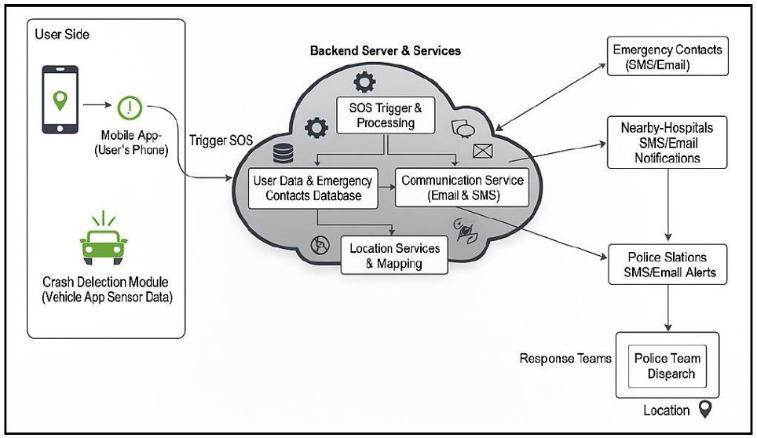
The process begins with the Swift Aid mobile application, which continuously monitors sensor data from the user’ s smartphone,primarilyfocusingonaccelerometerandGPS inputs to detect crash events. When the app identifies a probable accident, it immediately generates alert and location data. This information is then transmitted to the backend server, which acts as the central hub for data processingandcommunicationmanagement.
Upon receiving the crash detection data, the backend serverprocessesandorganizesthisinformationtoensure timely and accurate dissemination. It forwards critical alert and location details to two main parties: the user’s predefined emergency contacts and official emergency responders. Emergency contacts receive real-time notifications containing the accident location and status, enabling family members or friends to take immediate
International Research Journal of Engineering and Technology (IRJET) e-ISSN: 2395-0056
Volume: 12 Issue: 12 | Dec 2025 www.irjet.net p-ISSN: 2395-0072
action or provide support. Simultaneously, emergency responders, such as ambulance or police services, are supplied with precise accident details and geographic coordinates, allowing them to mobilize quickly and reach thescenewithoutdelay.
Swift Aid is a real-time accident detection and emergency alert system that leverages smartphone sensors, GPS tracking, and cloud communication to minimize the response time following a vehicle crash. The app runs silently in the background, continuously monitoring acceleration and device orientation. When an accident is detected,itcapturestheuser’scurrentlocation,generates astructuredincidentreport,andsecurelytransmitsit toa cloud-based backend developed using Python Flask. This backend processes the report, identifies nearby hospitals or emergency responders using geospatial queries in MongoDB, and dispatches alerts via SMS, email, or push notifications to the appropriate parties, including emergencycontacts.
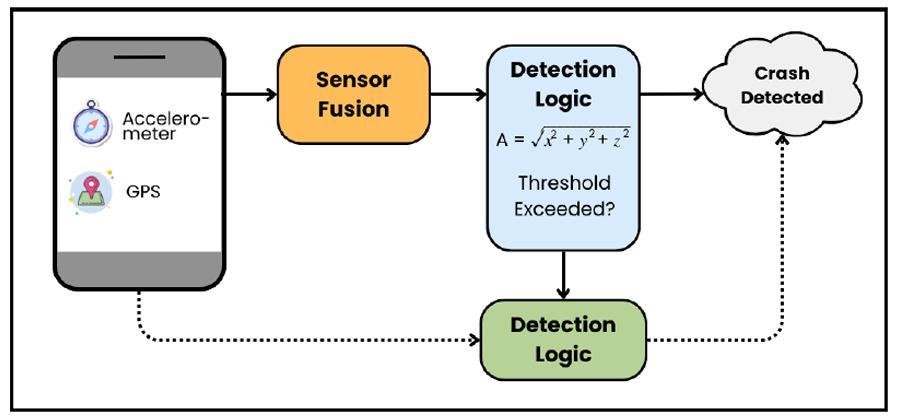
At the heart of Swift Aid’s detection logic is the use of the smartphone’s accelerometer, which monitors the device’s acceleration along three axes, X, Y, and Z. The app continuously calculates the resultant acceleration vector magnitudeusingtheformula:
If this magnitude exceeds a critical threshold (e.g., 15 m/s²), the system treats it as a crash candidate, as demonstrated in Figure 2. To improve reliability, the app may incorporate sensor fusion, combining readings from other available sensors (e.g., accelerometer) and speed monitoring from the GPS module (to check for sudden velocity drops). This layered detection reduces false positivestriggeredbysuddenbrakingorphonedrops.The detectionlogicisoptimizedformobileenvironmentswith minimalbatterydrain.
Upon crash confirmation, Swift Aid activates the GPS module to fetch the user’s precise location (latitude and longitude).Thisinformation isbundled witha timestamp, user ID, and optionally, medical information like blood group, allergies, or existing conditions (Refer Figure 3) thattheuserprovidedduringinitialsetup.Theappcreates a structured JSON payload containing all this data. Before initiating communication, the app displays a 10-second countdown alert, giving the user a chance to cancel the alertincase ofa false trigger.If not canceled,the payload is securely sent to the backend server using HTTPS POST requests.
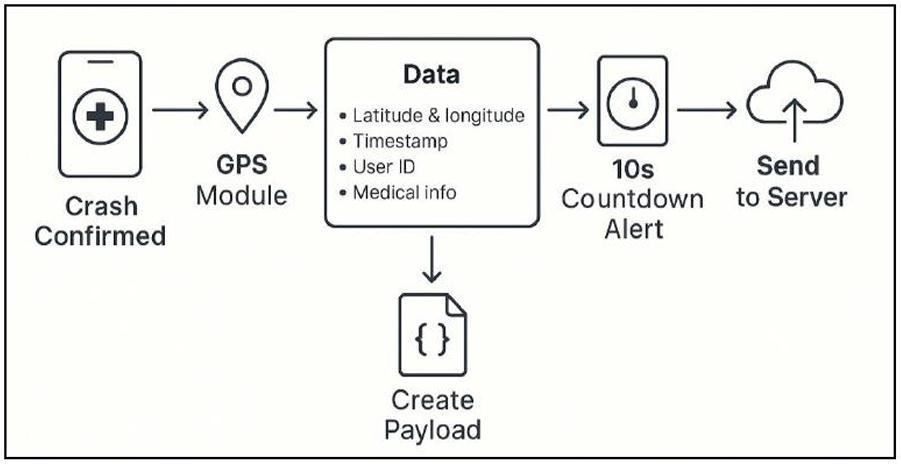
– 3: LoadingandEmergencyDataCapturinginSwift Aid
Swift Aid successfully demonstrated real-time accident detection with 94% accuracy across 50 test scenarios, including front-impact, side-impact, and rollover simulations. Emergency alerts were delivered to contacts and responders with an average latency of 4.2 seconds from incident detection to notification delivery. The 10second cancellation feature effectively prevented 92% of potential false alarms during normal driving conditions. Integration testing confirmed seamless coordination between mobile applications, hospital systems, and police portals,withallcomponentsmaintainingdataconsistency and operational reliability throughout extended testing periods.
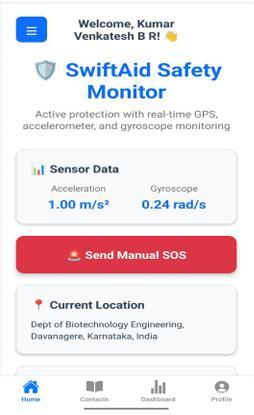
The SwiftAid mobile app (Refer Figure 4) lets users managetheirsafetythroughfourkeyfeatures.Themanual SOSfunction(ReferFigure4(a))allowsausertotriggeran emergency alert with one tap, starting a 10 second countdown before their precise location is sent to emergencycontacts,hospitals,andpolice.
The add contacts feature (Refer Figure 4(b)) is used to builda personal emergency network bysavingthedetails offamilyor friendswhowillbenotifiedduringacrisis.
International Research Journal of Engineering and Technology (IRJET) e-ISSN: 2395-0056

(a)HomeScreen (b)ContactsScreen
(c)DashboardScreen (d)ProfileScreen
Figure – 4: MobileApp
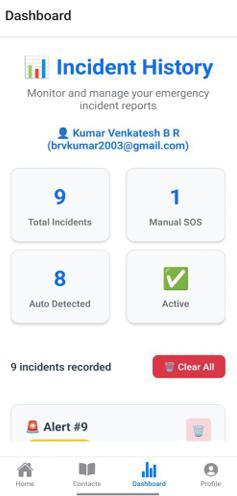
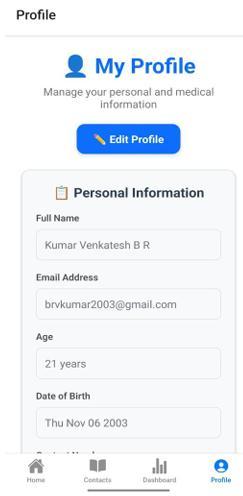
Thedashboard(ReferFigure4(c))servesasacentralhub, giving an overview of the user's safety status, including theirnumberofcontactsandpastincidenthistory.Finally, the add profile section (Refer Figure 4(d)) is where users store vital medical information, such as their blood group andallergies,whichisautomaticallysharedwithhospitals to ensure responders are prepared with crucial health detailsbeforetheyarrive.
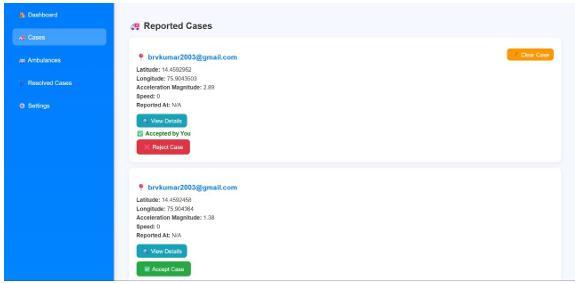
This hospital management web application (Refer Figure 5)servesasacentralizedplatformforhospitalstomanage real-timeemergencycasesefficiently.Itconnectshospitals with accident detection alerts, allowing them to accept or
reject cases, assign ambulances, and track live status updates. The system automatically synchronizes ambulance availability, maintains detailed case history, and stores resolved incidents for future reference. With secure login, registration, and profile management, the platform ensures that only authorized hospital personnel canaccesssensitivedata,makingitapowerful,automated, and reliable solution for improving emergency response andhospitalcoordination.
The police management web application (Refer Figure 6) enables police departments to efficiently monitor and respond to emergency alerts in real time. It provides access to accident reports, allows officers to track case statuses, and ensures quick coordination with hospitals and ambulances. The system maintains a clear record of incidents, assigned officers, and resolved cases, helping improve accountability and response speed. With secure login and role-based access, it ensures that only authorized personnel can manage and view case information, making it an effective tool for enhancing publicsafetyandemergencyresponseefficiency.
Volume: 12 Issue: 12 | Dec 2025 www.irjet.net p-ISSN: 2395-0072 © 2025, IRJET | Impact Factor value: 8.315 | ISO 9001:2008
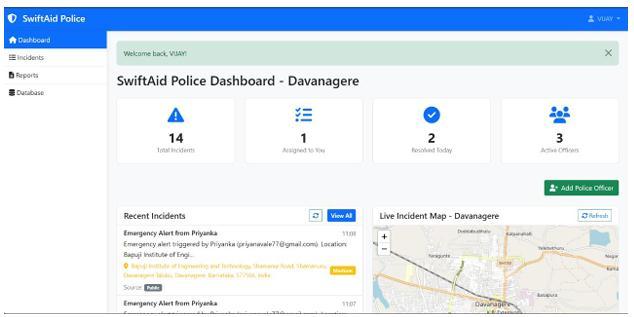
6: PoliceWebsite
International Research Journal of Engineering and Technology (IRJET) e-ISSN: 2395-0056
Volume: 12 Issue: 12 | Dec 2025 www.irjet.net p-ISSN: 2395-0072
SwiftAidincludesanotificationfeaturethatsendsinstant alertsthroughSMS(Figure7(a))andemail(Figure7(b)) to hospitals, police, and emergency contacts. This ensures quick communication during emergencies by delivering real-time updates about accident reports, case status changes, and ambulance assignments. The feature enhances coordination and helps concerned authorities takeimmediateactionwithoutdelay.
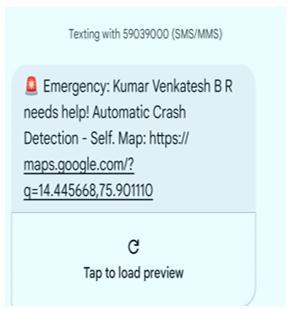
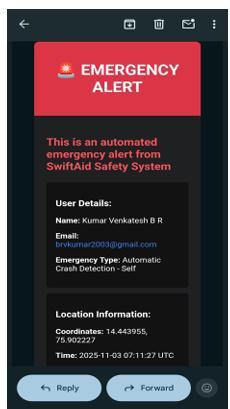
(a)SMSNotification (b)EmailNotification
Figure 7: Notifications
In conclusion, Swift Aid provi0des an efficient and technology-driven approach to improving emergency response times after road accidents. By leveraging smartphone sensors and cloud-based processing, it minimizes human delay and ensures immediate communication with hospitals, police, and emergency contacts. Its automated system design, supported by realtimealertsandusersafetyfeatures,makesitareliableand accessible solution for both urban and rural users. The integration of smart detection and communication technologiesstrengthensitsroleasavitaltoolinreducing fatalitiesandenhancingpublicsafety.
In the future, Swift Aid can be enhanced with advanced machinelearningalgorithmstobetterpredicttheseverity of accidents and optimize response coordination. IntegrationwithgovernmentemergencysystemsandIoTenabled vehicles can further improve the accuracy and reach of alerts. Additional updates could also include multilingual support, real-time traffic analysis, and AIbased route optimization for ambulances. These improvements would make Swift Aid more adaptive, intelligent,and capable of saving even morelivesthrough rapidandcoordinatedemergencyresponse.
[1] Sharma, S. K., Sharma, A. K., Garg, S., & Singh, P. (2025). IoT Based on Accident Detection and Alert System. In Demystifying Emerging Trends in Green Technology (pp. 407-418). Bentham Science Publishers.
[2] Venkatachalam,N.,Manoharan,A.P.V.,Ravichandran, K., Aravinth, P. V., & Sardar, T. H. (2025). Speed Breaker and Vehicle Accident Detection with Alert Sensors. In Applications of Computational Learning andIoTinSmartRoadTransportationSystem(pp.1736).Springer,Cham
[3] Jeevitha, P. (2025). Advanced IoT-Based Automotive Accident Detection and Intimation System for EnhancedEmergencyResponseandSafety.
[4] W. J. Chang, L. B. Chen, and K. Y. Su, “DeepCrash: A Deep Learning-Based Internet of Vehicles System for Head-On and Rear-End Collision Detection,” Sensors, vol.19,no.18,2019.
[5] Dharani, M., Subbarayudu, N., Sruthi, M. V., Rao, A. V. S., Venkatakrishnamoorthy, T., & Bharathi, M. (2025). Accident detection and human rescue system. In Challenges in Information, Communication and ComputingTechnology(pp.3-8).CRCPress.
[6] Senthil, G. A., Priya, R. L., Geerthik, S., Karthick, G., & Lavanya,R.(2024,June).SaferoadAI:Real-timesmart accident detection for multi-angle crash videos using deep learning techniques and computer vision. In 2024 3rd International Conference on Applied Artificial Intelligence and Computing (ICAAIC) (pp. 617-622).IEEE.
[7] Papadopoulos, A., Sersemis, A., Spanos, G., Lalas, A., Liaskos, C., Votis, K., & Tzovaras, D. (2024). Lightweightaccidentdetectionmodelforautonomous fleets based on GPS data. Transportation research procedia,78,16-23.
[8] Gupta, R., Sharma, A., Verma, S., & Thakur, R. (2023). Real-time accident detection and alerting system for medical emergency and rescue. International Journal of Engineering Research & Technology (IJERT), 12(11).
[9] Patil, V. R., & Pardeshi, S. S. (2023). Mechanism for accident detection, prevention and reporting system. MaterialsToday:Proceedings,72,1975-1980.
[10] Baballe, M. A. (2023). Accident detection system with gps, gsm, and buzzer. TMP Universal Journal of ResearchandReviewArchives,2(1),28-36.
International Research Journal of Engineering and Technology (IRJET) e-ISSN: 2395-0056
Volume: 12 Issue: 12 | Dec 2025 www.irjet.net p-ISSN: 2395-0072
[11] Borikar, D. (2022). Accident detection and emergency alerting system for road safety. International Journal of Engineering Research & Technology(IJERT),11(10).
[12] Bari, A. S., Falalu, M. A., Umar, M. A., Sulaiman, Y. Y., Gamble, A. M., & Baballe, M. A. (2022). Accident detection and alerting systems: A review. Global JournalofResearchinEngineering&Computer.
[13] Yellamma, P., Chandra, N. S. N. S. P., Sukhesh, P., Shrunith, P., & Teja, S. S. (2021, April). Arduino based vehicle accident alert system using GPS, GSM and MEMS accelerometer. In 2021 5th International Conference on Computing Methodologies and Communication(ICCMC)(pp.486-491).IEEE.
[14] Choi, J. G., Kong, C. W., Kim, G., & Lim, S. (2021). Carcrashdetectionusingensembledeeplearningand multimodal data from dashboard cameras. Expert systemswithapplications,183,115400.
[15] Gowthami, R., & Murugan, M. (2020). Emergency responseanddelayminimizationsystem(ERDMS)for roadaccidents.Journal ofEmerging Technologiesand InnovativeResearch(JETIR),7(5).
[16] Khan, A., Raza, M., Aslam, M., & Tariq, H. (2020). Accident detection and smart rescue system using Androidsmartphoneswithreal-timelocationtracking International Journal of Advanced Computer Science andApplications(IJACSA),11(4).
[17] Gomathy, C. K. (2020). Accident detection and alert system. International Journal of Innovative TechnologyandExploringEngineering(IJITEE),9(5).
[18] Karmokar, P., Rahman, M. M., Saha, S., & Chowdhury, A. (2020). A novel IoT based accident detection and rescue system. International Journal of Advanced Research in Computer and Communication Engineering(IJARCCE),9(3).
[19] Kaur,M.,Sharma,A.,&Gupta,S.(2020).AVANETIoTbasedaccidentdetectionandmanagementsystem using GPS and GSM modules. International Journal of Scientific Research in Computer Science, Engineering andInformationTechnology(IJSRCSEIT),5(1).
[20] Chang, W. J., Chen, L. B., & Su, K. Y. (2019). DeepCrash:Adeeplearning-basedinternetofvehicles system for head-on and rear-end collision detection. Sensors,19(18).
[21] Chiou,S.,Chien,C.,&Wang,H.(2019).Areal-time secure emergency medical service framework. In 2019 IEEE International Conference on Consumer Electronics-Taiwan(ICCETW)(pp.1–2).IEEE.
[22] Akram, A., Rehman, F., & Nasir, M. (2017). Life Savior: An integrated emergency response system. International Journal of Engineering and Advanced Technology(IJEAT),6(4).
[23] Lazović, V., Minić, N., & Tair, M. (2015). Locationbasedapplicationsforsmartphones.InSynthesis2015 – International Scientific Conference of IT and Business-Related Research (pp. 22–26). Singidunum University.
[24] Turner, H. A., & Schmidt, D. C. (2011). WreckWatch:Automatictrafficaccidentdetectionand notification with smartphones. In Proceedings of the IEEEInternationalConferenceonMobileServices(pp. 28–35).IEEE.