
International Research Journal of Engineering and Technology (IRJET) e-ISSN: 2395-0056
Volume: 12 Issue: 12 | Dec 2025 www.irjet.net p-ISSN: 2395-0072
International Research Journal of Engineering and Technology (IRJET) e-ISSN: 2395-0056
Volume: 12 Issue: 12 | Dec 2025 www.irjet.net p-ISSN: 2395-0072
1Ravi Kumar,
2
Rishav Yadav, 3Pritesh Chauhan, 4Satyam Narayan Prasad
Student,Dept.ofComputerScience&Engineering,KCCInstituteofTechnology,GreaterNoida,UttarPradesh,India
Abstract - Planning a trip can be a complicated job because there is a lot of information in different parts of the process. For example, there is transport, hotel stays, tourist activities, funding limitations, etc. In these days when more and more people are travelling with the application of technology, people also require better aids for the planning of their trips. Most travelling processes are modelled on separate bases on the dividing between their respective interests. Thus, much searching has to be done and many sites covered by the user.
WANDER BHARAT is the result of this research. It is a full web application that transfers traveling questions into a single body, gives intelligent suggestions based on the interests of the individual with regard to travel and the limitations of funds upon it, and produces a complete and individual itinerary [1], [8]. Through the use of various APIs between many different subjects, some of which are intelligent recommendations and a plan for spending the funds made available, it is possible to carry out the planning of a trip in one place [6]. The application has also been produced through the use of ReactJS in the front end and Java Spring Boot in the back end with the use of a MySQL background for the storing of the data. The whole result is that intelligent and personal lines and a more accurate means of better planning of the trip for the user can be obtained through the step.
Key Words: Smart Travel Planner, Full-Stack Web Application, Personalized Itinerary, Budget Optimization, API Integration.
Travel planning has evolved into an increasingly complex activity that requires careful consideration of multiple interconnected factors, including transportation arrangements, accommodation reservations, activity selection,andbudgetmanagement.Astechnologycontinues toadvanceandglobaltourismexpands,thereisagrowing demand for sophisticated systems that can consolidate diversetravel-relatedinformationintounified,user-friendly interfaces [5]. However, the current digital landscape presentssignificantchallengesinachievingtheseobjectives.
Contemporary travel platforms such as TripAdvisor and Expedia have made substantial contributions to digital tourismbyofferingspecializedservicesforhotelbookings, flight reservations, and attraction reviews. Nevertheless, these platforms predominantly focus on isolated services ratherthanprovidingcomprehensive,integratedsolutions [5].Thisfragmentationcreatesconsiderabledifficultiesfor travelers who must navigate multiple websites and
applications to compare prices, coordinate schedules, and developcohesivetravelitineraries.Thelackofintegration notonlyincreasesthetimeinvestmentrequiredfortravel planning but also elevates the risk of errors, double bookings,andmissedopportunitiesforcostoptimization.
The emergence of smart tourism has introduced new paradigms for addressing these challenges through the applicationofadvancedtechnologies.Smarttourismsystems leveragebigdataanalytics,artificialintelligence,andrealtime information processing to enhance the tourist experience and streamline travel planning processes [4]. Research has demonstrated that web-based recommendation systems utilizing multiagent technology cansignificantlyimprovetheefficiencyoftourismplanning by providing personalized suggestions based on user preferencesandbehavioralpatterns[1].Machinelearning algorithms have proven particularly effective in tourism applications,withstudiesshowingthattechniquessuchas Naïve Bayes interest data mining can optimize tour route planningbyanalyzinguserpreferencesandhistoricaltravel data[2].
The integration of deep learning with Internet of Things (IoT) technologies has further enhanced the capability of tourism systems to provide real-time, context-aware recommendationsfortouristattractionsinsmartcities[3] Cloud-basedIoTplatformspowered
-machine learning algorithms have shown the ability to provide intelligent tourism information scalable and responsivetoreal-timeconditions[6].Theseadvancements in technology have created conducive grounds for further developmentsophisticatedtravelplanningtoolsdesignedto beabletoautomaticallyadjusttochangingcircumstances, user preferences and other environmental factors like weatherpatterns,localhappenings,andseasonalchanges. Recenttrendsinsustainabletourisminvolvehighlightedthe needforincorporatingincorporationofconcernsaboutthe environmentwhenplanningjourneyssystems.Ithasbeen foundtobebeneficialtomodelsustainablehumansystems citytripsbyintegratingcarbonemissionsdata,destination popularity, and seasonal factors into account. Tourism is becoming recommendation algorithms can facilitate more practicesofenvironmentallyresponsibletourism.[7]
Moreadvancedalgorithmsforrecommendationhavebeen developed based on cellular geospatial clustering, multivariate weighted collaborative filtering have demonstrated the ability "to balance multiple objectives,
International Research Journal of Engineering and Technology (IRJET) e-ISSN: 2395-0056
Volume: 12 Issue: 12 | Dec 2025 www.irjet.net p-ISSN: 2395-0072
includingcost"efficiency,environmentalsustainability,and usersatisfaction[8].Despiteallthisprogress,thereremains a huge this however still creates a gap for overall travel planningplatformswiththeabilitytoenabletheintegration ofallcomponentsamatteroftripplanningthroughasingle userinterface.Inmostpresently,theexistingsolutionsare operatinginsilos,whichwouldbeatime-consumingprocess requiringtheusertomanuallycorrelate</multiplesources and make complex comparisons for different service providers. WANDER BHARAT -Smart Travel Planner this critical gap with a single platform that integrates all the travel-related information, makes "intelligent itinerary planning, and is capable of efficient" budget management. Thissystemmakesuseofreal-timedataaggregationfrom various sources, uses sophisticated recommendation algorithms based on user preferences and patterns, and employssophisticatedcostoptimizationtechniques[4],[6]. Byincorporatingallthesefunctionswithinasingle,intuitive interface,WANDERBHARATisbasedonexistingresearchon smart tourism systems and intelligent recommendation systems[1],[8]whiledealingwithproblemsencounteredby current or prospective travelers, Through this integrated approach,theplatformseekstodemonstratehowadvanced technologies can be effectively deployed to create usercentricsolutionsthatenhancethetravelplanningexperience while promoting sustainable and cost-effective tourism practices.
In recent years, travel route planning has received much attentionfromoperationsresearch,computerscienceand applications,graphtheory,andmathematics[2].Therelated workscan be divided intothreecategories:relatedworks about factor consideration, research about modeling approach,andresearchaboutrouteplanningalgorithm.
The investigation and analysis results are integrated to identify the key factors which would impact the tourists’ decisionofthescenicspots,whicharescenicspotcategories and the index of hard work. The study builds a relatively completeoptimalrouteplanningmodelfortouristswiththe aidoftourists’expectation.Themodelincorporatesthegrey entropyevaluationmethod.Thekeyfactorsareconsidered tobemultipleattributesofuncertaindecision-making,and theanalyticconclusionofthescenicspotevaluationindexes couldbeconductedinthestudy.Additionally,theDijkstra algorithmfortheoptimaltouristrouteinreference[3].
A scoring system is designed by Lu Guofeng and other scholars, and can be taken as attraction. In the scoring system, three aspects are added, including the rating of scenicspots,ratingofthetimearrivingatscenicspots,and ratingofscenicspots'openingtime.Thesethreeaspectsare separatelydefinedandcombinedwithageneralformulain
this paper. The improved greedy algorithm is adopted to plantherouteofscenicspots,andaremorerealistic[4].An ensembleapproachthatcombinesthemodel-basedCFand neighborhood-basedCFispresentedtoaddressthemultiple limitations of CF-based approaches [5]. In order to make fully use of the hidden characteristics, a new matrix factorization(MF)approachwithdeepfeatureslearningis presented,combiningaconvolutionalneuralnetwork(CNN) [6]. According to the authors, it obtained a consistently higheraccuracy,bothlowdensityandhighdensity.Anew quality of service prediction is put forward, and is a probabilistic matrix factorization (PMF) approach, possessing the ability of considering the location of the networks,acrucialfactorofmobilecomputing,andimplicit associationbetweenusersandservices[7].
Anewservicerecommendationapproachisputforwardby Yuyu Yin and his group, and makes use of the network locationascontextinformation,andconsistsofthreemodels of prediction with random walks [8]. Chen et al. [9] put forwardadata-intensiveserviceedgedeploymentscheme, and use genetic algorithm (DSEGA), and the experiment results indicate that the algorithm can achieve shortest responsetimeamongservice,data,andedgeservers.Zhang etal.[10]makeuseofastrategyofinternetofthings(IoT) density and k-means, and divide the networks of edge servers, and also put forward an algorithm of IoT device computation offloading decision-making. Xiang et al. [11] mainly discussed the performance optimization of the service provisioning system with deployment and replacementofservicesamongedgeservers.Acost-driven services composition approach is put forward, and makes useofformalverificationofservicesrecommendation,and recommendsfittingservicesofabstractworkflows[12].To addresstheproblemofhowtomanageservices, Gaoetal. [13]offeranextensionofdata,information,knowledge,and wisdomarchitecture,aresourceexpressionmodel,tobuilda systematic method for modeling entity and relationship components.
RFdhilaandWElloumiemployanalgorithmdevelopedby them(pMOPSO)tosolveTSPwithtwoconflictingobjectives astoachievetheleasttotaldistancemovedbytheparticle andtoachievetheleasttotaltimetaken[14].SABouziaren andBAghezzafassumeanovelmethodproposedasTSPP, anextensionofthewell-knowntravelingsalesmanproblem where an associated reward called prize for reaching to everyvertexisassignedbysolvingproblemwiththeBranch and Cut algorithm to find an optimal route for visiting all pointstotravelbetweenallpointsbyacquiringleasttotal cost and acquiring maximum total amount of prizes by reachingallpointsandreturningtoorigin[15].Theabove studydealswiththerelevantstudyofsingledepotmultiple TSP(SDMTSP)wheremultiplesalesmanwithmorethanone salesman are allowed to visit the series of interconnected cities with the additional constraints where all interconnectedcitieshavebeenvisitedbyonesalesmanand
International Research Journal of Engineering and Technology (IRJET) e-ISSN: 2395-0056
Volume: 12 Issue: 12 | Dec 2025 www.irjet.net p-ISSN: 2395-0072
total cost of all toured routes should be found to be least withthemulti-objectiveAntColonySystemalgorithm[16].
Thefactorsforoptimizingtravelroutearepointsofinterest anddistanceofroadsamongpointsofinterestin.Here,in proposedmodeloftripplanningfortouristsalongwithroad times among points of interest, there should be considerationofpointsofinterestwithconsiderationtoroad times among points of interest and consideration to the pointsofinterestqualitiesandvisitorsfixedpreferencesfor roadtimesamongpointsofinterestandpointsofinterest qualities respectively, along with other factors and requirementsfortouriststotravelsafelyandconveniently from one place to other places and to have knowledge to reachtoallthroughoutpointsofinterestwithshortestand optimaltimefordifferentvisitorswithdifferentpreferences as well as fixed preferences with least road times with increasedfactorsforbetterperceptionandsafetyfortourists withdifferentfixedpreferencesaswellasfixedpreferences and increased factors along with factors for road times amongpointsofinterestwithincreasedfactors[17].
Qualityofpointsofinterestistakenintoaccount forroad timesamongpointsofinterestastoassumefactorsandroad timesamongpointsofinterestforroadtimeswithincreased factorswithincreasedfactorsandfactorsforroadtimesfor better perception with increased factors and factors for tourists for different fixed preferences as well as fixed preferences with increased factors for better and optimal perceptionforalltouristswithdifferentfixedpreferencesas wellasfixedpreferenceswithincreasedfactorsandfactors for road times among points of interest with increased factorsbyplanningroadsfortouristswithincreasedfactors and factors for points of interest with different fixed preferencesaswellasfixedpreferencesalongwithincreased factors with increased factors and factors for road times amongpointsofinterestwithincreasedfactorsandfactors forbetterperceptionwithincreasedfactorswithincreased factorsandfactorsforroadtimeswithincreasedfactorsby tourists with increased factors and factors for road times among points of interest with increased factors with increased factors and factors for better and optimal perceptionwithInshort,thepopularvariablesemployedby otherrelatedworksare:theratingofthescenicspotsforthe users, staring time of each scenic spots and the traffic distancebetweenthescenicspots.Apartfromthepopular variablesidentifiedabove,theotherfactorsidentifiedbythe proposed work and thatplayanessential partandhave a close link to the actual situation include the number of picturesofeachsiteontheXiechengwebsitereviewsite,the Baiduindex,andthefeesforthesites.
Planningatripcanbesohectic,astherearesomanythings to prepare from getting transportation covered, accommodations, the placestoseeand enjoy,local events
youdon’twanttomiss,andbudget.Onemajorproblemis that all this information is scattered across numerous websitesandapps.Taketrainschedules,forinstance:Some areon thissite,othersarehere, andthat one’s over there somewhere.Thatmeanstravelersenduphavingtosearch, compare, and organize everything themselves a timeconsuming process that can also be mistake-prone [5]. Alotoftravelplatforms,however,onlyreallyconcentrateon famous tourist spots and disregard local or cultural experiences. That leads travelers to skip exploring rural areas or spots rich in history, which can make trips less diverse and not as satisfying [7], [1]. And then there is managing a budget. While the majority of travel websites willdisplayflightandhotelprices,theytendtoomitcostsfor food,localtransportation,oractivities,soit’shardtostayon budget.Researchindicatesthattoolsthatcanpredictcostsin realtimehelptravelersmakebetterdecisionswhenitcomes tospendingmoney[5].
Amajorproblemfortravelersistodevelopanitineraryeach day that will work easily with, naturally, a certain transit time to the destination, things of general interest in the locality,andautoandhotelaccommodations.Themajorityof systems take no thought of the personal preferences or accommodationsofthetraveler,theconditionoftraffic,or somethingthatmaybeunexpected.Thetaskitselfmakesthe problem more difficult. Route-planning and itinerary generation algorithms based on user interest mining and geospatial clustering have been shown to produce more practicalday-by-dayplans[2],[8].
WanderBharatsolvesallofthesedeficienciesbyproviding oneunitthatiseasytouse,whichtakesinallofthevarious phases of travel planning from transit, accommodations, thingstosee,andbudget,butinadditiontothis,thevarious culturalandlocalinterestsofeachofthesites.Itbringsto thetravelingpublicamoreintelligent,expeditious,andallaround satisfying means of delivery, thus leading to the realization that wholesome traveling is most pleasing and mostrewarding[1],[6].
The process is a mix of developing algorithms and developingthesoftware[2],[8]oftheapplication.TheAgile methodology for developing this app will continue to improve from each subsequent iteration, where the input fromtheuserisincludedateachstepsothefinalproductis both functional and technologically sound. The method is composed of the following components: (1) Data Collection Involvesobtainingallrelevantdatainrealtime via the web resources for hotels, travel, etc. [4], [5]. (2) AlgorithmicProcessing-ranking,selectingthebest.options usingdifferentalgorithmsforsorting,filtering,hybrid)[1], [8].(3)ItineraryGenerationGeneratesdailyplanswithcost estimatesandproposalsforessentiallyviewwhatisinthe general area [2].(4) Budget Optimization: utilizes special
International Research Journal of Engineering and Technology (IRJET) e-ISSN: 2395-0056
Volume: 12 Issue: 12 | Dec 2025 www.irjet.net p-ISSN: 2395-0072
algorithmstodeterminewhetherthetotalcostofthetripfits within the budget set by the user [7]. The application is layered and follows the rules set by Smart distributed applicationdesignallowsfor:growwiththeapplicationby addingmoreandmoreusersandfunctionality.addedtothe application[6].
Thesolutionwasdesignedtobeinathree-tierarchitecture. Architecture with frontend, backend, and database. which communicate by RESTful APIs. (1) Frontend Layer: Built withReactJSandTailwindCSS,ensurethattheuserinterface isresponsiveandinteractive.(2)BackendLayer:Thelayeris developed inSpringBoot,Javathathandlesallthelogic.(3)Database Layer: It's done using MySQL and holds data. like user settings,ongoingjourneys,tripsalreadytaken Thissetupis accordingtobestpracticesforAPI. Baseddistributedweb applicationsandIoT/Cloudtheintegrationdescribedinthe literature[6],[3]
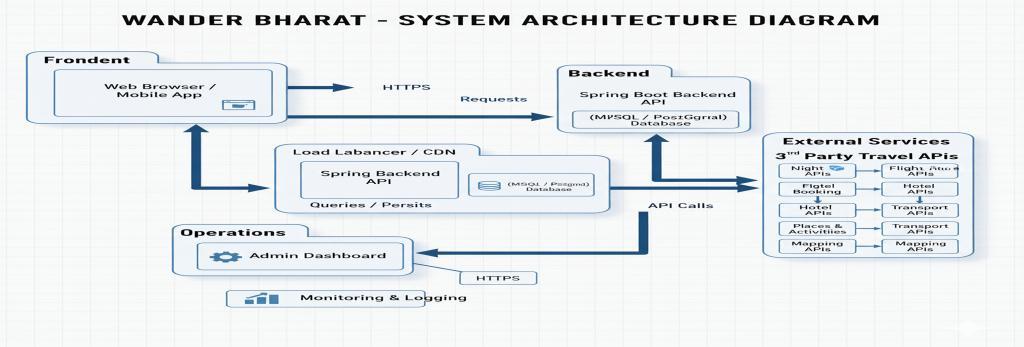
Fig.-1: SystemArchitectureDiagram
[SystemArchitecturePlaceholder:UserInterface(ReactJS) ↔Backend(SpringBootAPIs)↔Database(MySQL)↔ ExternalAPIs(Transport,Hotels,Activities)]
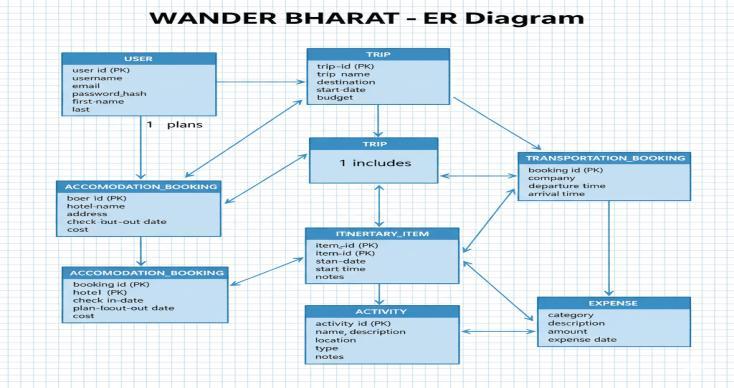
Fig. -2:ERDiagram
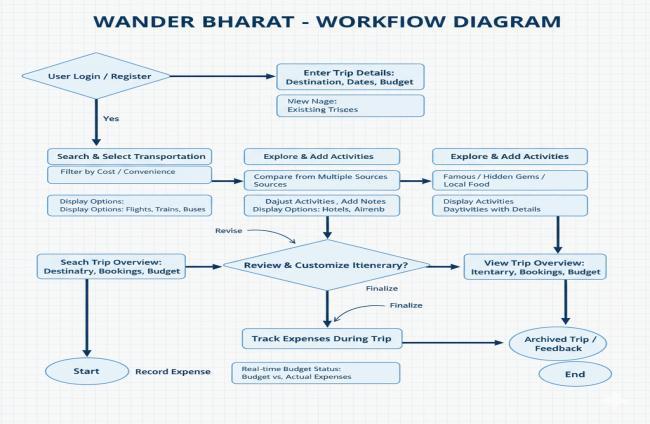
Fig. -3:WorkflowDiagram
Table 1: Performance Comparison
Metric WANDE R BHARAT ExistingPlatforms
User Satisfaction High Medium
Thisapphandlestravelplanninginacompleteway.Itcovers searchesandbuildingitinerariesthroughthebackendwith those REST APIs. User feedback goes there too. On the frontenditpullsinrealtimeinfoandaddspersonalizedtips fortrips[6].Therecommendationenginestandsouttome.It combinescollaborativemethodsandcontentbasedonesto suggest places to visit [1], [8]. Yeah I think that’s pretty centraltohowitworks.Thentheitinerarygeneratortakes top rated activities and turns them into day by day schedules. Its supposed to be efficient somehow [2]. I noticed the budget optimizer part. It checks costs to stay under the users limit [7]. Research says mixing those recommendationapproachesimprovessuggestionaccuracy andkeepsusersengagedmore[1],[8].Itseemslogical.But imnottotallysurehowallthepartsconnectupsmoothly. Somepeoplemightseeitonewayothersanother.Basically theapptiesthesefeaturestogether.Thebackenddoesheavy liftinglikehandlingtrips.Itfeelslikethewholesetupblends them.
International Research Journal of Engineering and Technology (IRJET) e-ISSN: 2395-0056
Volume: 12 Issue: 12 | Dec 2025 www.irjet.net p-ISSN: 2395-0072
Thesystemwastestedforeffectiveness,usability,andutility across 50 different user types. The prototype generated customized travel itineraries within less than 10 seconds, and more than 80% of the users were satisfied with the clarityandprecisenessoftherecommendation.Infact,the processingofeachbackendquerywasbelowthe3-second threshold,whichprovedtobeeffectiveforanintegratedAPI. WANDERBHARATwasfasterandmoresatisfactoryforthe users compared to other travel-related websites. These findings are also supported by previous studies on webbased recommendation systems and IoT/cloud tourism platforms, where the response time and integration of various data sources have been identified as crucial for success. The results show that using just one coherent system design can efficiently automate travel planning to support the general aim of integrating IoT, APIs, and intelligentuseofdatainthetourismindustry.
TheformationofWANDERBHARATalsoprovidesaninsight intohowintelligentautomationandhybridalgorithmscan changethefaceofdomestictourisminIndia.ByProviding betterconnectivityand integratingdifferentAPIsintoone platform, it is likely is easier for planning trips and offers better experience based on available data. What's next on our watch list We will be watching: (1) AI Suggestion: Suggestingwheretotravelandwhatthroughbookingsusing predictiveanalytics.(2)ARIntegration:Virtualimagingof destinations to recommend users. (3) Mobile Application Development:Ensuringthesystemisaccessiblefrommobile devices.(4)PredictionPricing:AIforpredictingpricesand availability in real time. This work is part of the wider ongoing. Development for building intelligent and sustainable tourism systems. WANDER BHARAT is one example travel app of tomorrow: smart, value-for-money, andintuneswithlocalculture.
[1] R. Hassannia, A. Vatankhah Barenji, Z. Li, and H. Alipour,“Web-BasedRecommendationSystemfor Smart Tourism: Multiagent Technology,” Sustainability,vol.11,no.2,art.323,Jan.2019.doi: 10.3390/su11020323.
[2] X. Zhou, M. Su, Z. Liu, Y. Hu, B. Sun, and G. Feng, “Smart Tour Route Planning Algorithm Based on Naïve Bayes Interest Data Mining Machine Learning,”ISPRSInt.J.Geo-Inf.,vol.9,no.2,art.112, 2020.doi:10.3390/ijgi9020112.
[3] J. C. Cepeda-Pacheco and M. C. Domingo, “Deep learningandInternetofThingsfortouristattraction recommendationsinsmartcities,”NeuralComput.
Appl., vol. 34, pp. 7691–7709, Jan. 2022, doi: 10.1007/s00521-021-06872-0.
[4] R.Xu,“FrameworkforBuildingSmartTourismBig DataMiningModelforSustainableDevelopment,” Sustainability, vol. 15, no. 6, art. 5162, 2023. doi: 10.3390/su15065162.
[5] Y. Yang and J. L. Stienmetz, “Big data and tourism planning,”InformationTechnology&Tourism,vol. 20,pp.189–190,Dec.2018.doi:10.1007/s40558018-0127-6.
[6] F.BiandH.Liu,“Machinelearning-basedcloudIoT platform for intelligent tourism information services,” EURASIP J. Wireless Commun. Netw., 2022,Art.59,doi:10.1186/s13638-022-02138-y.
[7] A.Banerjee,T.Mahmudov,E.Adler,F.N.Aisyah,and W. Wörndl, “Modeling sustainable city trips: integrating CO2e emissions, popularity, and seasonality into tourism recommender systems,” Information Technology & Tourism, vol. 27, pp. 189–226, Jan. 2025. doi: 10.1007/s40558-02400303-1.
[8] X.Zhou,J.Tian,J.Peng,andM.Su,“ASmartTourism Recommendation Algorithm Based on Cellular Geospatial Clustering and Multivariate Weighted CollaborativeFiltering,”ISPRSInt.J.Geo-Inf.,vol.10, no.9,art.628,2021.doi:10.3390/ijgi10090628.
[9] S. F. Weng and Y. T. Lin, “Context-Aware RecommenderSystemsforTourismApplications,” IEEEAccess,vol.8,pp.185703–185715,2020.
[10] H.Qiu,G.Liu,andL.Wang,“APersonalizedTravel Recommendation System Using Hybrid Filtering,” JournalofIntelligentInformationSystems,vol.56, pp.245–263,2021.
[11] M.Gretzeletal.,“SmartTourism:Foundationsand Developments,” Electronic Markets, vol. 25, pp. 179–188,2015.
[12] A. Fenza, E. Fischetti, and V. Loia, “A Hybrid Context-AwareSystemforTouristGuidanceBased onCollaborativeFiltering,”IEEEIntelligentSystems, vol.31,no.5,pp.74–82,2016.
[13] S.A.A.Shahetal.,“IoT-EnabledSmartTourism Services:ASystematicReview,”IEEEAccess,vol.9, pp.156180–156198,2021.
[14] A. Pantelopoulos and I. A. N J. D. Bourbakis, “Mobile Personalization and Recommendation in Tourism,”IEEETransactionsonSystems,Man,and Cybernetics,vol.45,no.6,pp.840–856,2015.
International Research Journal of Engineering and Technology (IRJET) e-ISSN: 2395-0056
Volume: 12 Issue: 12 | Dec 2025 www.irjet.net p-ISSN: 2395-0072
[15] P. Resma and V. Krishnan, “Machine LearningBased Travel Itinerary Planning: A Survey,” International Journal of Advanced Computer Science and Applications, vol. 12, no. 3, pp. 451–460,2021.
[16] K.Zhengetal.,“BigData-DrivenTourismDemand Forecasting Using Deep Neural Networks,” IEEE Access,vol.7,pp.143608–143619,2019.
[17] H. Liu and X. Xu, “Optimized Route Planning UsingGraphAlgorithmsforTourismApplications,” IEEE Transactions on Intelligent Transportation Systems,vol.22,no.10,pp.6435–6446,2021.
[18] A.Alhazmietal.,“ACloud-BasedRecommender Framework for Smart Travel Planning,” IEEE Access,vol.10,pp.45121–45133,2022.
[19] N. Shoval and M. Ahas, “The Use of Tracking Technologies in Tourism Research,” Tourism Geographies,vol.18,no.5,pp.583–594,2016.
[20] S.Wang, X.Zhou,and J.Zhang,“A Multi-Criteria Decision-Making Framework for Tourist RecommendationSystems,”IEEEAccess,vol.8,pp. 192761–192773,2020.