
International Research Journal of Engineering and Technology (IRJET) e-ISSN: 2395-0056
Volume: 12 Issue: 12 | Dec 2025 www.irjet.net p-ISSN: 2395-0072
International Research Journal of Engineering and Technology (IRJET) e-ISSN: 2395-0056
Volume: 12 Issue: 12 | Dec 2025 www.irjet.net p-ISSN: 2395-0072
Aditya Bhardwaj1 , Farhad Danish2 , Naeem Choudhary3, Habib ur Rehman4, Rahul Gupta5, Ajit Kumar Singh6
1,2,3,5,6 Department of Mechanical and Automation Engineering, G B Pant Government Engineering College, New Delhi, India
4Department of Mechanical Engineering, IISC Bengaluru, Karnataka, India
Abstract - Go-karts are open wheeled racing kart, which require efficient, and effective braking systems to guarantee the safety of the driver and the controllability of the vehicle. Due to their light weight, moderate operating speed, and lack of any kind of suspension mechanisms, the rear braking designs are widely embraced to reduce the complexity of a system, low cost and weight. This study is an analytical and finite element study of a rear-mounted hydraulic disc braking system that would be used in a go-kart and on a dry track. Braking system is also analysed with stopping distance, braking time, pedal force, hydraulic pressure, braking force, transfer of weight dynamically, and also with thermal loading. The choice of the material to be used in making the brake disc and pedal is done depending on the mechanical and thermal performance requirements. The Finite Element Analysis (FEA) is used to confirm the analytical predictions by structural and thermal modelling of the brake disc and structural analysis of the brake pedal. The analysis indicates that there is a high level of agreement between the analytical and numerical results and the highest level of deviation is under 5% in the maximum temperature. The braking system shows sufficient factor of safety in structural integrity and thermal overload and is thus suitable in a safe and effective operation of the gokarts. The research gives an approved design methodology, which can be applied as a reference to the development of gokart braking systems in the future for student events
KeyWords: Go-kartbrakingsystem,hydraulicdiscbrake, finite element analysis, thermal analysis, braking dynamics.
Go-karts are low-weight racing cars, but they are mainly usedinrecreationalandcompetitivemotorsportpurposes, andsimplicity,lowprice,andperformancearetheimportant design factors. In comparison to traditional cars, go-karts usually have a moderate speed, and do not possess complicatedsystemsofsuspensions.Therefore,thebraking needsofgo-kartsarevariedascomparedtofullsizevehicles. Itiscommontofindmostofcommercialandcompetitiongokarts use rear-only braking systems since they offer the necessary level of stopping force with the lowest level of systemcomplexity,totalweighting,andcostofproduction [1]. Nevertheless, even being seemingly straightforward, rear-mounted braking systems have to be thoroughly
***
designedandanalyticallytestedinordertoachievesufficient performance,structuralintegrity,andthermalsafety.
Everygo-kartbrakingisdeterminedbythemass,velocity, coefficient of friction of tires and the surface of road, and weight transfer in braking. On dry surfaces, there is sufficient friction to enable braking to be carried out adequately by using a single rear disc without adversely affectingstability[2].Becausego-kartshavelow centerof gravityandshortwheelbase,incaseofover-brakingonthe front,thewheelsmightlockorbecomeunstable.Rear-only brakingassuchthusoffers a fairtrade-off betweensafety andcontrolespeciallyintheentrylevelandamateurracing use.
Thepaperisdedicatedtotheanalyticalresearchandfinite element confirmation of the rear-mounted hydraulic disc brakingsystemofago-kartthatworksindryconditionson the road. The analysis method commences with the calculationofbrakingforcewhichisbasedontheprinciples ofvehicledynamics.Thebasicrequirementsincludevehicle mass, initial velocity, desired deceleration, tire, and road coefficient of friction to determine the required rear axle braking torque. These are computed to determine the minimumperformanceofthebrakingsystem[3].
Hydraulicanalysisisimportantinprovidingassurancethat theforceexertedonthepedalistransformedtobeenough clampingforceinthebrakecalliper.Thehydraulicbraking system comprises of a master cylinder, brake lines and calliper assembly. The analytical assessment of the relationshipbetweenpedalforce,mastercylinderpressure, and calliper piston force using the Pascal law is done. Adequatesizingofthemastercylinderandcalliperpistons helps to achieve the right balance of braking power and pedal force withouttoomucheffortonthe pedal whichis essentialtothecomfortandsafetyofdrivers[4].
Theothercriticalfeatureofbrakingsystemdesignisthermal analysis because the kinetic energy is transferred to heat duringbraking.Overarearmounteddiscbrake,theheatis dissipated by the brake disc and air around it. Analytical thermal model is used to approximate the increase in temperatureduring repeatedinstancesof braking.Higher temperatures may result in wear and tear of the brake, material wearor breakages. Thus, the thermal capacity of
International Research Journal of Engineering and Technology (IRJET) e-ISSN: 2395-0056
Volume: 12 Issue: 12 | Dec 2025 www.irjet.net p-ISSN: 2395-0072
the disc material and the ability to evaporate the heat is thoroughly considered so as to maintain a stable performanceattheracingconditions[5].
Inordertoconfirmtheresultsoftheanalyticalstudy,finite elementanalysis(FEA)isconductedonthemostimportant scientificelementsofthebrakingsystem,inthiscase,brake disc and calliper. Structural analysis is done to evaluate stress distribution and deformation at maximum braking loads. The outcomes assist in confirming the fact that the stressesarenotbeyondpermissiblemateriallevels,which guarantee the structural integrity and longevity. Thermal FEA is an additional tool of prediction made through analyticalanalysisbydesignthatsimulatesthetemperature distribution and heat transfer in the brake disc during brakingcycles.
Finally, the combination of braking dynamics, hydraulic analysis, thermal modelling and finite element validation wouldgiveacompleteframeofassessmentofrear-mounted hydraulic disc braking systems in go-karts. The results validatethatinreducingbrakingperformancetobesafeand effective on dry roads; rear-only braking can be either designedorvalidatedtobeeffective.
Thebrakingsystemisdevelopedtosuitago-kartthathasa totalmassof170kgincludingthedriver.Theassumedtyreroadfrictioncoefficientis0.9whereasthepad-rotorfriction coefficientis0.4.Theworst-casescenarioisconsideredtobe thegreatestvehiclespeedof16.67m/sandonthatbasisthe brakingperformanceisconsidered.
Thebrakingsystemwasdesignedforalightweightgo-kart employinga rear-only brakingconfiguration, intendedfor operation underdry track conditions.A rear-only braking system was selected to reduce system complexity and overall mass, which is suitable for low-speed go-kart applications where simplicity and steering stability are prioritized
Thecoefficientoftyre–roadfrictionwasassumedtobe0.9 andwasusedforbrakingforcecalculations.Themaximum speedofthego-kartwas16.67m/s(60km/h).Atthisspeed, theestimatedstoppingdistancewasapproximately15.7m. At a reduced speed of 8.33 m/s (30 km/h), the stopping distance decreased to about 3.9 m, with a braking time of nearly1second.
Thebrakingsystemwasprimarilydesignedconsideringthe worst-casescenario,i.e.,brakingfromthemaximumvehicle speedof16.67m/sonadrytracksurface.Thetotalmassof thesystem,includingthego-kartandthedriver,wastaken as170kg,wherethemassofthego-kartwas110kgandthe drivermasswas60kg
Accordingly, the total weight acting on the vehicle during brakingwascalculatedas:
Weight =m×g =170×9.81=1667.70N
This total weight was used for evaluating braking forces, stoppingdistance,andstabilityduringdeceleration.Vehicle designparameterssuchaswheelbaseandcenterofgravity height were considered and validated through analytical evaluation.
Nomenclature:
• g–Accelerationduetogravity(m/s2)
• µ–Frictioncoefficientbetweenroadandtyre
• u–Initialspeed(m/s)
• v–Finalspeed(m/s)
• h–Heightofcentreofgravity(m)
• m–Totalmass(vehicle&driver)(kg)
• L–Wheelbase(m)
• t–Brakingtime(s)
• a–Maximumachievabledeceleration(m/s2)
• Q–Heatgenerationrate(W)
• Cp–Specificheatcapacity(J/kg-K)
• ΔW–Dynamicweighttransfer(N)
Table -1: DesignInputsandParameters
mass(vehicle+driver) 170kg
Distribution(Front:Rear) 40:60
2.1 The analysis of the braking performance is conducted.
Analysisofbrakingperformanceisanecessaryelementof determiningtheabilitytostopandsafetyofago-kartwhen
International Research Journal of Engineering and Technology (IRJET) e-ISSN: 2395-0056
Volume: 12 Issue: 12 | Dec 2025 www.irjet.net p-ISSN: 2395-0072
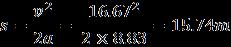
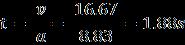
under working conditions. In the current research, it is assumedthatthevehicleattainsaspeedof16.67m/sona dryroad.Themaximumpossibledecelerationisdetermined bytakingthetireroadfrictionandvehiclemassas8.83m/s 2.Thisisinareasonablebrakingrangeofdryasphaltandit meansthatthetiresareabletoefficientlytransmitbraking force without early wheel lock-off [6]. The minimum theoretical stopping distance has been calculated using classicalkinematicrelationsanditis15.74m,withabraking time of 1.88 s. These findings indicate that the braking systemcanbeusedtoofferfastdecelerationtobeappliedin competitivego-kartuses.
The fact that the stopping distance was calculated is especially meaningful because there were no suspension systems and electronic braking systems in go-karts. Mechanical designandadequatedistributionofforcesare importantintherealizationofefficientbrakingperformance [7]. Moreover, it is important to keep the level of braking within the scope of friction in order to avoid frictional skiddingandthelossofdirectionalstability.Theanalytical findings,ingeneral,validatetheeffectivenessofthechosen brakingparametersthatcanbeusedtooffereffectiveand controllable deceleration of a lightweight rear-braking dominatedcar[8].
2.2 Hydraulic and Braking Torque
Thehydraulicanalysisofthebrakingsystemisdonetomake sure that the effort exerted by the driver on the pedal is efficiently turned into the area of an adequate amount of brakingforceatthereardisc.Thisexperimentproducesa force of 450 N at the pedal and a 4:1 pedal ratio which producesanamplifiedforcethatispassedontothemaster cylinder.
1. Pedalforce
=PedaleffortxPedalratio
=450x4
=1800N
2. Brakelinepressure
=Pedalforce/Areaofmastercylinder
=1800/0.000506707
=3552348.79Pa
3. Clampingforce(Twopistoncylinder)
=BrakelinepressurexAreaofcalliper pistonx2
=3552348.79x0.000706x2
=5015.91N
4. Brake torque developed
=ClampingforcexEffectiverotor radiusxCoefficientoffriction betweenpadandrotor
=5015.91x0.0675x0.4
=135.43N-m
Thepressureofthebrakelineisdeterminedbyapplication ofthehydraulicprinciplesthatarebasedonthePascallaw tobe3.55MPa.Thispressureappliesatotalclampingforce onthecalliperpistonstocreateatotalof5015.91Nonthe brake disc [9]. When the resulting clamping force is multiplied by the effective disc radius and coefficient of friction,theresultantbrakingtorqueisobtainedattherear axle,135.43Nm.
5. Brake torque required
=Dynamicweightonrearaxlex rollingradiusoftyrexµ
=674.48x0.1397x0.9
=84.80N-m
6. Factor of safety (disc)
=Braketorquedeveloped/Brake torquerequired
=135.43/84.80
=1.60
Rolling radius was taken from standard go-kart tyre specification.Thebrakingdynamicsaswellastheeffective rear axle load give the number 84.80 N-m, which is the required braking torque. Division of the available torque with the required torque gives a factor of safety of 1.60, which means that the braking system has plenty other capacityintheeventofdynamicbraking[10]. Suchsafety marginiscriticaltotakeintoconsiderationthedifferencesin the friction, thermal and wear of the parts. Hydraulic and torque analysis will assure the fact that the chosen brake parts are properly sized and can provide the adequate performanceofthebrakingsystem[11].
Distributionofweightduringbrakinghasamajoreffecton theefficiencyofbrakingespeciallyinacarlikego-kartthatis not equipped with a suspension system. During the deceleration,theinertialforcecausesapartofweightofthe vehiclerestingontherearaxletoshifttothefrontaxle.In theanalysis,theweighttransferduringbrakingisdynamic and is determined to be 326.14 N in the present analysis.
International Research Journal of Engineering and Technology (IRJET) e-ISSN: 2395-0056
Volume: 12 Issue: 12 | Dec 2025 www.irjet.net p-ISSN: 2395-0072
Consequently,the rearaxle loaddecreasesto674.48N as comparedtoitsstaticvalue.Thisdecreaseinrearaxleload hasadirectimpactonmaximumbrakingforcethatcanbe successfullyusedwithoutlockingwheels[12].
7. Staticweightonfrontaxle
=0.4xmxg=0.4x170x9.81
=667.08N
8. Staticweightonrearaxle=0.6xmxg
=0.6x170x9.81
=1000.62N
9. Dynamicweighttransfer =(mxaxh)/L
=(170x8.83x0.298)/1.3716
=326.14N
10. Dynamicweightonfrontaxle
=Staticweightonfrontaxle+ΔW
=667.08+326.14
=993.22N
11. Dynamicweightonrearaxle
=Staticweightonrearaxle-ΔW
=1000.62–326.14
=674.48N
Go-karthasarear-onlybrakesystemwhichmeansthatthe dynamicrearaxleloadaccuracyisextremelyimportantto predictthenecessarybrakingtorque.Weusethelowerrear load as a basis on which braking force and torque requirementsarecalculated.Underconsiderationofweight transfer may lead to enhanced braking capacity and undermined stability [13]. As shown by the analysis, the braking system can provide sufficient torque with a satisfactoryfactorofsafetyevenwhentherearaxleloadis lessthanthenominal.Theinclusionoftheweighttransfer effectsthereforemakesthedesignofthebrakingsystema realistic and conservative one that would be applicable in high-decelerationconditions.
Analytical calculations are carried out to estimate the performance parameters of braking performance such as
deceleration, stopping distance, braking time, hydraulic pressure,brakingtorqueanddynamicweighttransfer.These computations are the basis of the design of the braking systemandmakesurethatthechosenelementsworkwithin thesafeoperatingmechanicalandthermalrangesunderthe worst-caseoperatingconditions.
Thehighestpossibledecelerationobtainedis8.83m/s2and theminimumstoppingdistanceis15.74mwitha braking timeof1.88s.Thesevaluesarecontrolledmainlybythetyre toroadfrictioncoefficientandarethetheoreticalmaximum performance of the vehicle in dry track conditions. The stopping distance both proves the fact that the braking systemiscapableofslowingthevehicledownsafelyunder thenormalconditionsofthego-karttrack,andthebraking time guarantees that the driver will have enough time to respondandcontrolthevehicleintheeventofemergency braking.
Hydraulic analysis means that a pedal force of 1800 N produces a brake line pressure of 3.55 MPa, and this producesaclampingforceof5015.91Natthecalliper.This hydraulic amplification of the pedal ratio and master cylinder sizing gives assured development of sufficient brakingforcewithoutthedriverputtingtoomuchefforton thebrakepedal.Thisdriverergonomicandbrakingbalance isalsocrucialinthecaseofracing,wheretoomuchdriver fatiguemightarisewithrepeatedcyclesofbrakingwhenthe forcesonthepedalsaretoostrong.
Thebrakingforcegeneratedinthereardiscis135.43Nm, whichismorethanthenecessarybrakingforceof84.80Nm andthisgivesafactorofsafetyof1.60.Thismarginhelpsto provide consistent braking behaviour in the transient condition like small surface irregularities, friction change withtemperature,andpartwear.Itisnecessarytoensure thatafactorofsafetyexceedingunityismaintainedsothat brakefadeortorquedeficiencydoesnotoccurevenwhenit isrequiredtosustainmorethanthenormalbrakingunder extendedorstrenuousbrakingconditions.
Transferofweightduringbrakingisdynamicandresultsina reducedrearaxleloadof674.48Nthatisputintothedesign to provide a conservative design. Dynamic load redistribution, especially in the rear-only braking, should alsobetakenintoconsiderationbecausetheunloadingofthe rear axle may exceed the maximum traction. The braking systemisdevelopedtoaccommodatedynamiceffectsinthe analytical model and hence to drive safely in real-life conditions as opposed to an idealized model based on a minimalsetofassumptions.
Go-kartbrakingisoneofthemostimportantfactorsinthe overallsafety,controlandadherencetotherequirementsof competitions.Inlightweightcarslikethego-kart,thetyreroadfrictionisthemainfactorthatcontrolstheperformance
International Research Journal of Engineering and Technology (IRJET) e-ISSN: 2395-0056
Volume: 12 Issue: 12 | Dec 2025 www.irjet.net p-ISSN: 2395-0072
ofthebrakes,massofthecar,weightdistribution,andthe efficiencyofthebrakingsystem.Analyticalassessmentoffers a credible way of forecasting braking performance in an idealized situation and as a reference point in the further numericalverification[14].
In the current analysis, the performance of braking is measured by measuring the most critical parameters that aremaximumdecelerationthatcouldbeachieved,stopping distance, braking time and braking torque. The greatest decelerationisconstrainedbythetyre-roadfrictionandit has a direct proportional effect on the shortest stopping distance.Indrytrackconditions,thedecelerationcalculated showsthatthebrakingsystemisgoingtooperatenearthe frictional limit ensuring that the available traction is fully utilized without causing a wheel lock-up situation. The associatedstoppingdistanceandbrakingtimeareindicative of the fact that the system is capable of decelerating the vehicle in a safe manner with regards to racing and recreationalusage[15].
Thehydraulicbrakingperformanceisstudiedthroughthe analysis ofthepedal effort, hydraulicpressure generation and the calliper clamping force. Hydraulic amplification is adequate,makingsurethatthereisenoughbrakingtorque producedwitheasydriverinput,thisisrequiredinorderto be consistent in repeated braking cycles. Moreover, the braking torque is compared to the rear axle load which is dynamically reduced to consider the effects of weight transfer during deceleration. This has the benefit of conserving design and avoiding excessively claiming the capabilityofbrakinginrearonlydesigns.
Thetransferofweightthroughdynamicwouldhavemajor impactonbrakingperformanceasitdecreasesnormalload ontherearaxlehencelimitingtractionavailable.Thiseffect isimportanttoaddtotheanalytical modeltoincreasethe brakingtorqueestimationandincreasethereliabilityofthe system.Onthewhole,theanalyticalassessmentofbraking performance demonstrates that the developed braking systemaddressestherequirementonsafety,efficiency,and performance,whichisthestrongbasisofthefiniteelement validationandexperimentalimplementation[16].
The maximum achievable deceleration is calculated using thetire–roadfrictioncoefficient:
Theminimumtheoreticalstoppingdistanceis:
Thecorrespondingbrakingtimeis:
Thesevaluesconfirmeffectivebrakingperformancewithin frictionallimits.
Thehydraulicbrakingsystemiscriticalintransformingthe activityofdriversintoeffectiveforceofbrakingatthewheel. When used in go-karts, the system should have enough braking power as well as easy, reliable, and lightweight. Hydraulic analysis is based on the analysis of pedal force transmission, formation of brake line pressure, calliper clamping force, and the braking torque obtained to guaranteesafeandefficientworkingconditions[17].
Thedriverincreasestheforceappliedbythepedalsthrough the pedal ratio that is applied to the master cylinder to createhydraulicpressureinthebrake lines.Toobtainthe bestrelationshipbetweenthepedalmotionandthebraking, itisimportanttohaveapropersizeofthemastercylinder andthecalliperpistonregions.Sufficienthydraulicpressure also gives uniform calliper clamping force, and frictional contactbetweenthebrakepadsanddisc.Overpressurecan cause wear and less modulation of the components and underpressurecanaffecttheeffectivenessofthebraking.
The braking torque is produced as a result of the force of clamping the calliper, the radius of the disc, and also the coefficientoffrictionbetweentherotorandthebrakepad. The calculated braking torque should be greater than the amountneededtodeceleratethevehicleunderthedynamic loading condition and in the rear braking system only the weight transfer towards the rear decreases the rear axle traction.Measuringbrakingtorqueatdynamicallyreduced normal load provides conservative design, and eliminates the possibility of wheel lock-up or brake fade when using aggressivebrakingmanoeuvres.
In general, the analysis of hydraulic and braking torque proves that the designed system is capable of ensuring adequatebrakingforcewithasufficientsafetymargin,which willallowittoaddresstheissueofvehicledecelerationand drivercontrolwhenoperatinginadverseconditions[18].
Weightshiftduringbrakingisavitaldynamiceventwhich playsaveryimportantroleinvehiclestabilityandbraking performance particularly in low-weight cars like the gokarts.Duringthedeceleration,theinertiacausesashiftin theforwardloadwhichresultsintheincreasednormalforce on the front axle and the decrease of the load on the rear axle. This repositioning of the vertical load has a direct impact on the traction available at the wheels and would havetobethoughtoutinthedesignofbrakingsystems[19].
International Research Journal of Engineering and Technology (IRJET) e-ISSN: 2395-0056
Volume: 12 Issue: 12 | Dec 2025 www.irjet.net p-ISSN: 2395-0072
With rear-only systems the weight transfer is particularly criticaltoevaluate,sinceanexcessiveamountofunloading of the back axle can restrict the amount of braking force availableandsubstantiallyraisethechancesofwheellockup.Theanalysisofweighttransferisbasedontheanalytical wayandtakenintoaccountthevehiclemass,deceleration, centre of gravity height, and wheelbase. A combination of these parameters will define the extent of load transfer during braking which is dynamic. Dynamic effects will be consideredtomakesurethatthebrakingtorquecalculations arenotmadebyassumingastaticload.
Thedecreaseinaxialloadoftherearwhenbrakinghappens affects directly the maximum possible braking force since the friction between tyres and roads increases with the normal load. Through consideration of this decrease, the brakingsystemcanbedesignedinaconservativemannerto workwithinthetractionlimitsduringextremedeceleration. Thishelpsincreasethecontrollabilityofthevehicle,aswell asreducinginstabilitythatoccursduringpanicbrakingor high-speeddecelerationsituations.
Altogether, weight transfer analysis is a crucial source of information on the dynamics of braking and is a crucial factor in achieving safe and predictable braking performance.Weighttransferconsiderationsinthedesignof theanalysisenhancethetrustworthinessofbrakingsystems mountedontherearandaidinverifyingthebrakingtorque andsafetymarginsbythemeansofthenumericalanalysis andexperiments[20].
Dynamicweighttransferduringbrakingisgivenby:
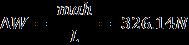
Thereducedrearaxleloadisusedtocomputethebraking torque requirement, ensuring realistic and conservative designconditions.
Thethermalanalysisofthebrakingsystemisnecessaryto testthecapabilityofthebrakedisctosafelyreleasetheheat producedduringbrakingwithoutundergoingthermalfailure andexcessivebrakelife.Whenthevehicleisdecelerating,a largepercentageofkineticenergyisconvertedtothermal energy through the friction of the brake pads on the disc. Whenthebrakediscisusedinlightweightvehicles(e.g.gokarts)hightransientheatfluxesareexperiencedduetothe lowmassandareaofthesurface.
Thethermalanalysisisconductedinthecurrentstudywith theassumptionthatthesignificantproportionofthekinetic energyofthevehicleisconvertedintoheatatthebrakedisc during a single braking event. The heat rate is calculated dependingonthemassofvehicle,theinitialvelocityandthe braking time. The heat flux on the disc pad contacting
surface is then determined and applied in estimating temperature increase of the disc material. These are the calculations that give a first estimate of the maximum operatingtemperaturewhenthebrakingissevere.
Theexpectedtemperatureincrementisthencumulatedto theambienttemperatureinordertoestimatethefinaldisc temperature.Thisvalueisacriticalinputintheassessment of the suitability of materials, as well as in defining the thermalboundaryconditionstoafiniteelementcalculation. Itisnecessarytoensurethatthehighestdisctemperatureis kept at a reasonable level to ensure the same friction properties, to eliminate the possibility of material degradation,andtoavoidthermalcracking.
All in all, the analytical thermal analysis provides informationthatisusefulintheunderstandingthethermal behaviourofthebrakingsystemandformsafoundationof thenumericalvalidationofthethermalbehaviourthrougha finite element thermal analysis, therefore, being able to ensuresafeandreliablebrakingbehaviour.
Thekineticenergyofthego-kartis:
1. Kinetic energy
=1/2xmx(initialspeed)2
=0.5x170x16.67x16.67
=23620.56J
2. Heat generation rate, Q
90%Kineticenergyisconvertedintoheat,
=(0.9xKineticenergy)/t
=0.9x23620.56/1.88
=11307.71W
3. Heat flux
=Q/Surfaceareaofdiscincontactwithpad
=Q/[2xpix(0.08252 -0.05252)]
=11307.71/[2xpix(0.08252 -0.05252)]
=444364.93W/m2
International Research Journal of Engineering and Technology (IRJET) e-ISSN: 2395-0056
Volume: 12 Issue: 12 | Dec 2025 www.irjet.net p-ISSN: 2395-0072
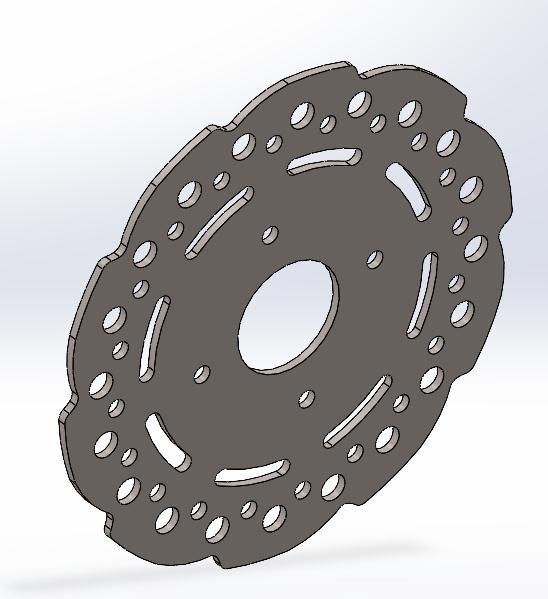
5.
The choice of material used in the brake disc is an important consideration when designinga braking system since the disc is prone to repeated mechanical loads, high contact pressure and harsh thermal treatments during braking. The material of brake disc should have high hardness, wear resistance, high thermal conductivity, and enoughtensilestrengthinhightemperaturetoguaranteethe reliabilityofbrakingperformanceandservicelife[21].Thisis what causes them to be less so that they can be used in braking processes in which consistency of friction and resistance to surface degradation are essential. Moreover, austenitic grades are also more prone to loss of friction stability at higher temperatures and this may have an undesirableimpactonconstantbraking[22].
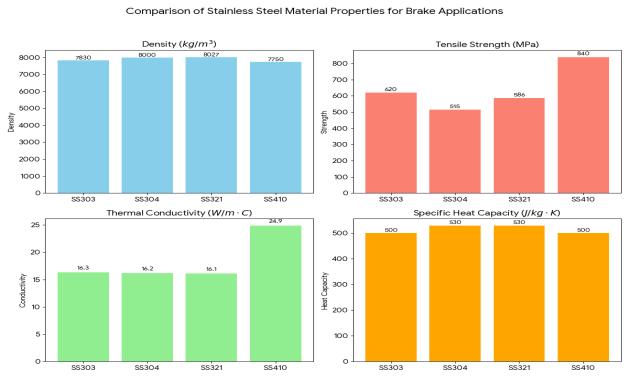
SS 410 was also chosen as the brake disc material comparedtoSS303,SS304andSS321becauseithashigh hardness, wear resistance and the strength at high temperature.Althoughausteniticgrades(SS303,SS304,and SS321)aregoodincorrosionresistance,theycannotbeused inbrakingduetolowfrictionstabilityandwearproperties. Martensitic structure of SS 410 also makes it more appropriateinhigh-frictionandthermallyloadedbrakediscs [23].
5.1.1
Frictionalheatgeneration
=µ×slidingvelocityofdiscsurface×t×clamping force
The disc is exposed to excessive contact stresses and quick changes in temperatures many times in braking systems due to the frictional heat generation. In these circumstances, low hardness and low wear resistance materialsarepronetoweardegradationonthesurfacebeing used and this causes braking performance that is not
consistent and shortened service life. Austenitic stainless steels,thisisaductileandcorrosionresistantmaterialthat typicallyhasalowerhardness,andissusceptibletoadhesive wear and surface glazing with repeated braking. These impacts have the ability of decreasing the coefficient of frictionandunderminingthebrakingperformance[24].

Where:
=massofbrakedisc(kg)
=specificheatcapacityofSS410
4. Rise in temperature
=(Q*t)/(Massofrotor*Cp)
=(11307.71*1.88)/(0.41319*500)]
=102.90K
5. Final disc temperature
=Riseintemperature+ambienttemperature
=102.90+303.15
=406.05K
Thermalanalysisisconductedassumingthat90%ofthe vehicle’skinetic energyisconvertedintoheatatthebrake disc.Thetotalkineticenergyatmaximumspeediscalculated as23.62kJ.Theresultingheatgenerationrateis11.31kW, producingaheatfluxof444,364.93W/m².
Theanalyticallypredictedtemperatureriseofthediscis 102.9 K, resulting in a final disc temperature of approximately 406 K. These values are used as boundary conditionsforfiniteelementthermalanalysis.
Assuming 90% conversion to heat, the heat generation rateis11.31kW.Theanalyticaltemperatureriseofthebrake disc is calculated as 102.9 K, resulting in a final disc temperatureofapproximately406.05K.
Purpose:
Predicthowmuchthedischeatsupduringbraking.
CompareSS410vsausteniticsteels:higherthermal conductivity and mechanical stability of SS 410 → lowerΔT→betterbrakingperformance.
SS 410 has a higher level of mechanical strength and hardnessthatisprovidedbymartensiticmicrostructurethat increasesresistancetowearandsurfacedeformation.Also, SS410hashighthermalconductivitycomparedtoaustenitic grades,andthusitdissipatesmoreheatproducedinbraking. This feature aids in curbing overheating and minimises
International Research Journal of Engineering and Technology (IRJET) e-ISSN: 2395-0056
Volume: 12 Issue: 12 | Dec 2025 www.irjet.net p-ISSN: 2395-0072
chances of overheating and cracking. Moreover, SS 410 is mechanicallystableinhightemperatureandthusitdoesnot fail to hold its structure during aggressive or repeated braking.ThesepropertiescombinedtogethermakeSS410an efficientandeconomicalmaterialofchoiceinthebrakediscs ofsuchlightweightandperformance-basedapplicationsas go-karts[25].
Interpretation:
The relative material information shows that there are apparent variations in mechanical and thermal appropriateness in use as brakes discs. SS303, SS304 and SS321 have close tensile strength and low thermal conductivity and thus, poor capability to cool down heat whenbrakingrepeatedly.Theausteniticstainlesssteelsare notveryresistanttowearandsurfacedeformationathigh contact stresses because they have moderate yield and ultimate strengths, although they have high corrosion resistance. Instead, SS410 has the highest yield and final tensilestrength(840MPa),whichmeansthatithasbetter resistancetomechanicalloadingandwear.Moreover,SS410 hasmuchgreaterthermalconductivity(24.9W/m-K),and thus,thedisccandissipateheatmuchmoreefficientlyand experiencefewerthermalgradients.Itsthermalperformance is also stable due to its similar specific heat capacity. In general, the information proves that SS410 is the best combination of strength, wear resistance, and thermal efficiency,soitisthemostappropriateamongtheapplicants toathermallyloadedandmechanicallyloadedbrakedisc.
The brake pedal is a structurally important part of the brakingsystem,asitdirectlyconvertsthedriverinputinto thehydrauliccircuitandisexposedtotherepeatedbending andcompressiveloadsintheprocessofoperating.Thechoice ofmaterialsusedonthebrakepedalshouldthenbebasedon the need to have high yieldstrength, stiffness, fatigue,and durabilitythatwillprovidesafeandreliableserviceduring thelifeperiodofthevehicle[26].
AISI4130alloysteelwaschosentobethebrakepedalas an alloy in the current research when compared to 6065T6/T8alloyaluminiumandAISI1018steel.Despitethelow density of aluminium alloys, relative low density has a disadvantage in the form of low yield and ultimate tensile strengths, which restrict their application to high loads braking.Aluminiumpedalscanbeover-deformedinextreme or panic brake situations and this reduces pedal feel and drivercontrol.Correspondingly,althoughAISI1018steelhas sufficientmanufacturabilityandrelativelygoodstrength,its loweryieldstrengthvaluegivesoutreducedsafetymarginto repetitivehigh-stressloading[27].
AISI4130alloysteel hasverylargeryieldandultimate tensilestrengthswithahighmodulusofelasticityleadingto betterstiffnessandleastelasticdeformationofthematerial under the influence. It has a better fatigue resistance especially its usefulness in braking components which are subjected to a cyclic loading. Also, AISI 4130 is also mechanicallystableinordertobeusedindifferentloading conditionswiththesamepedalresponseandgreaterdriver confidence. All these characteristics enable AISI 4130 as a strong and dependable material option to use in a structurally sensitive brake pedal exercise in high performancecarslikego-karts[28].
Table 3: Mechanicalpropertiesofbrakepedalmaterials Material
(kg/m^ 3)
(GPa)
(MPa).
6065-T6 2800 68 310
6065-T8 2800 68 390
AISI1018 7870 205 440
AISI4130 7850 210 832.62
The comparison of the materials shows that there are serious differences in mechanical performance which are applicableintheuseofbrakepedals.Aluminiumalloys6065T6 and 6065-T8 are low density and moderate strength materialsthatcanbeusedinlightweightdesign;butwitha relatively low Young’s modulus (68 GPa), they have poor stiffness properties and therefore high levels of elastic
International Research Journal of Engineering and Technology (IRJET) e-ISSN: 2395-0056
Volume: 12 Issue: 12 | Dec 2025 www.irjet.net p-ISSN: 2395-0072
deformationwhenunderbrakingforces.Despitethefactthat 6065-T8isstrongerthan6065-T6withrespecttostrength, itsyieldandultimatestrengthsareconsiderablylowerwhen comparedtothatofsteelalloys.AISI1018steelismuchmore rigidandhasgreaterstrengthalthoughitsyieldstrengthis relatively low so that there is not so much safety margin relatedtothehighloadcyclicbraking.Onthecontrary,AISI 4130exhibitsthegreatestyieldandultimatetensilestrength andstillhashighmodulusofelasticity,whichguaranteeslow levels of deformation, high load-carrying ability as well as increasedfatigueresistance.AllthesepropertiesallowAISI 4130tobethemostappropriatematerial toa structurally importantbrakepedal[28].
The analytical design is checked with finite element simulationsthatareperformedwithcalculatedbrakingloads and thermal input to examine the structural and thermal integrity of the important parts of braking. Finite element method allows the stress distribution, deformation and temperaturegradientstobeevaluatedinadetailedmanner whichwouldotherwisebeimpossibletoevaluatewithinthe simplifiedcasesofanalyticalmodels.
Inthispaperthreedimensionalmodelsofbothbrakedisc andbrakepedalareconstructedandtheirdiscretizationdone with suitable mesh densities to guarantee accuracy of the solutionaswellasmaintainefficiencyincomputation.The propertiesofthematerialtobeusedintheexperimentare allocated to the chosen disc and pedal materials in accordancewithexperimentallyreportedvalues.Boundary conditions are used to make replications of real operating conditions such as fixed mounting areas, applied braking forces, and thermal heat flux in consequence of analytical minimization.Theinteractionbetweenthediscandthebrake padincontactisidealizedtogivetheideaoffrictionalheat generationintheprocessofbraking.
Thermal analysis is conducted to measure peak temperature conditions throughout the disc surface and structural assessment is carried out to measure induced stressesanddeformationsunderbrakingloads.Finally,the finiteelementoutcomesarethencomparedwithanalytical predictions to determine correlation and confirm the assumption of the analytical modelling. Such analyticalnumerical methodology is a sure way to provide good performanceevaluationandverifytheseverityandstrength ofthebrakingsysteminextremebrakingconditions.
Thermalanalysisshowsamaximumdisctemperatureof 387.38 K which is close to the analytical values. The maximumvonMisesstressobtainedbystructuralanalysisis 340.14 MPa and the factor of safety is 2.24 and the deformationobtainedisverylow.
The result of a thermal analysis by using the finite elementmethodisthetemperaturedistributionwhichshows thepeak valuestobeconcentratedinthepad-disc contact areawheretheheatgenerationduetofrictionisgreatest.The smoothnessoftemperaturedistributioninthediscthickness indicatesthatthematerialhasahighabilitytoconductheat, and thus it is unlikely to have hot spots on one hand. It is foundthatthemaximumtemperaturethatispredictedisfar belowthecriticaltemperaturelimitsofSS410,sonofriction behaviour is unstable and a risk to thermal distortion or brakefadeduringextremebrakingeventsislimited.
Structuralanalysisshowsthatthestressconcentrations aremainlyfoundinandaroundthemountingholesandhub interfacewhichareofimportancebecauseofthelimitations of loads transmission. Although these concentrations of stressarelocalized,theywillonlyreachaverylowvalueof theVonMisesstresswhichiswellbelowtheyieldstrengthof SS410. The low deformation suggests that the disc is dimensionally stable under peak loading braking forces, retains effective pad contact and has uniform braking performance. In general, the findings of the finite element analysisindicatethatthebrakediscdesignisstructurallyand thermally sound and supports the assumptions of the analyticaldesignandillustratesthesufficientsafetymargins tooperatego-kartsinreality.
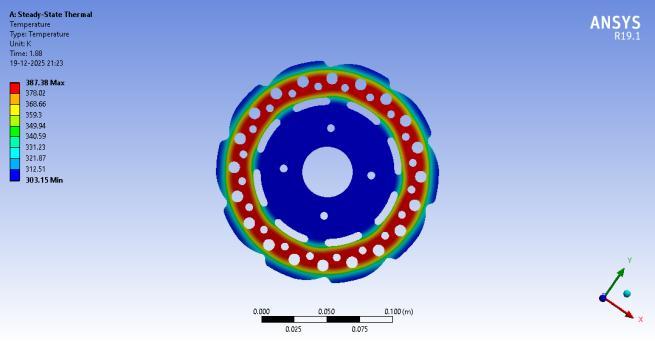
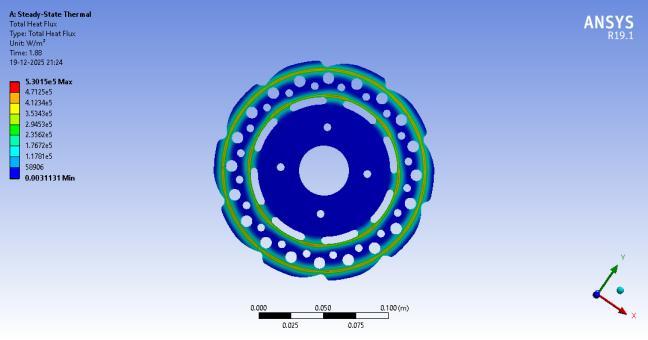
Fig.4: Brakedisctotalheatflux
Specifically, it visualizes the Total Heat Flux across the rotor'sgeometry.Basedonthesimulationdatashown,hereis a suggested title and a breakdown of what the results indicate.
International Research Journal of Engineering and Technology (IRJET) e-ISSN: 2395-0056
Volume: 12 Issue: 12 | Dec 2025 www.irjet.net p-ISSN: 2395-0072
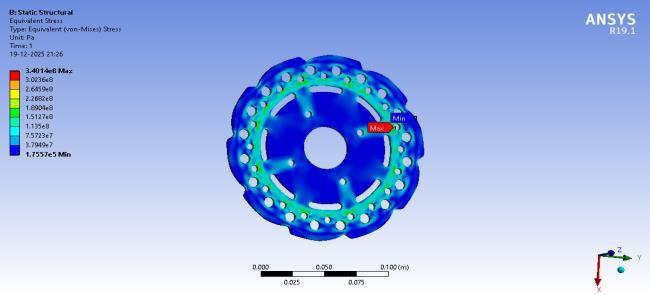
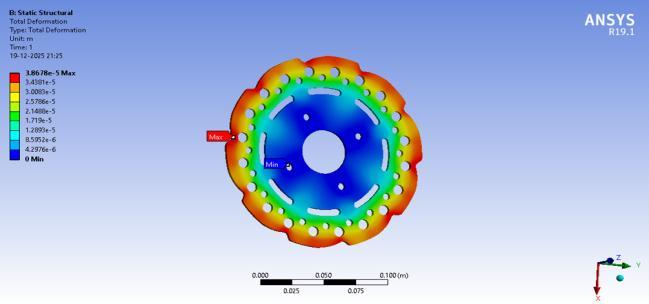
TheimageshowsaStaticStructuralAnalysisofthesame perforatedpetal-typebrakediscusingANSYSR19.1.While thefirstimagefocusedonheatflow,thisonevisualizesthe physicalresponseofthematerialtomechanicalandthermal loads.

Fig.7:Brakediscfactorofsafety
6.2 Brake Pedal Analysis
Structural analysis of the brake pedal indicates a maximumVonMisesstressof240.82MPa with a factorof safetyof1.91.
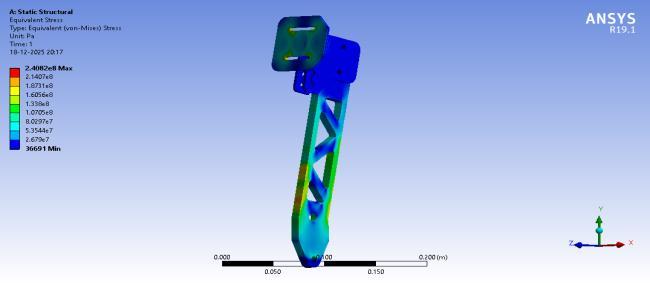
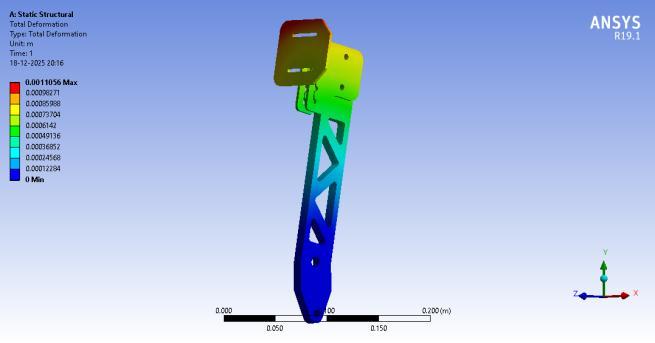

Fig.10: Brakepedalfactorofsafety
6.2.1
Finite element and thermal analysis of the brake disc under the same braking conditions showed that SS 410 experiences a maximum surface temperature of around 387.38 K, with contact stresses well below the material’s yieldstrength.Incontrast,austeniticgrades(SS303,SS304, and SS 321) under identical conditions showed slightly higher surface temperatures due to lower thermal conductivity,andthemaximumvon-Misesstressapproached theirloweryieldlimits.ThemartensiticstructureofSS410 provided higher hardness and wear resistance, reducing surface deformation and ensuring consistent friction performance.Thermalsimulationsalsoconfirmedbetterheat dissipationinSS410,minimizingtheriskofthermalcracking duringrepeatedbrakingcycles.
6.2.2
The analytical calculation and simulation results align closely,confirmingthatSS410issuperiorforgo-kartbrake discs.Whilebothmethodspredictmoderatethermalloads, thecombinationofhighermechanicalstrength,hardness,and thermal conductivity makes SS 410 more capable of withstanding repeated braking stresses compared to austenitic stainless steels. This comparison validates the choice of SS 410asan efficient, reliable, and cost-effective material for lightweight, performance-oriented braking applications.
International Research Journal of Engineering and Technology (IRJET) e-ISSN: 2395-0056
Volume: 12 Issue: 12 | Dec 2025 www.irjet.net p-ISSN: 2395-0072
Analyticalandnumericalresultsshowstrongagreement, validatingthebrakingsystemdesign.Thepercentageerror between analytical and FEA temperature results is approximately4.6%,confirmingtheaccuracyofsimplifying assumptions.Bothdiscandpedal exhibitacceptablestress levelsanddeformationunderseverebrakingconditions.
Theanalyticalevaluationofthebrakingsystemyieldeda maximumachievabledecelerationof8.83m/s²,resultingina minimumtheoreticalstoppingdistanceof15.74mfroman initialspeedof16.67m/s.Thecorrespondingbrakingtime was 1.88 s, confirming effective deceleration within tyre–roadfrictionlimits.
Hydraulic analysisshowedthata pedal effortof450N, amplifiedthrougha4:1pedalratio,generatedabrakeline pressureof3.55MPaandacalliperclampingforceof5015.91 N.Thisproducedabrakingtorqueof135.43N-mattherear disc.Therequiredbrakingtorquebasedondynamicrearaxle loadwas84.80N-m,resultinginafactorofsafetyfordiscof 1.60.
Dynamicweighttransferduringbrakingwascalculatedas 326.14N,reducingtherearaxleloadto674.48N.
Analytical thermal calculations indicated a heat generation rate of 11.31 kW, producing a heat flux of 444364.93 W/m2, and a disc temperature rise of 102.9 K, corresponding to an analytically predicted final disc temperatureofapproximately406.05K.
Finite Element thermal analysis predicted a maximum disctemperatureof387.38K.Thepercentageerrorbetween analytical and numerical temperature predictions was calculated as 4.59%, indicating good agreement and validating the simplifying assumptions adopted in the analyticalthermalmodel.
Finite Element structural analysis of the brake disc showedapeakVonMisesstressof340.14MPa,resultingina factor of safety of 2.24, with a maximum deformation of 0.0386mm.
FiniteElementstructuralanalysisofbrakepedalyieldeda maximum von Mises stress of 240.82 MPa and a factor of safetyof1.91,confirmingadequatestructuralstrengthand stiffness.
8.1 SUGGESTIONS
Test Tracking and Experimental Validation.
Thoughthesafetyandeffectivenessofthebrakingsystem areverifiedbytheanalyticalandthefiniteelementresults, there is a strong recommendation of conducting
experimentalvalidationofthebrakingsystembycontrolled track testing. The real time data that can be given under repeated braking cycles can be measured with the instrumentedtestingthroughtemperaturesensorsandstrain gaugesondisctemperatureincrease,pedaldeformation,and brakingefficiency[29].Thiskindoftestingwouldbeusefulin detectingshort-term effects like brake fade,vibration,and noise, which cannot be measured with simulations alone. Numerical models can also be further calibrated by experimentaldatainordertoachievebetterprediction.
Futureresearchcandiscussotherbrakediscdesignslike a ventilated, drilled, or slotted disc to improve heat dissipationanddiminishthermalgradient.Onemethodthat canbeusedinsuchadesignisoptimizationtominimizethe massofdiscandretainstructural integrity.Comparisonof various disc profiles would have an insight into how to enhance thermal performance and increase the life of the brakepartswithoutaddingcomplicationstothesystem[30].
State
The application of surface coatings group or the use of advancedcompositematerialstobrakediscsandpadscanbe researchedinordertobringaboutimprovedwearresistance andstabilityoffriction.Anti-wearorthermalbarriercoating maydecreasethedegradationofsurfacesandincreasethe performanceinlong-termbraking.Alsolookingatotherpad materialscouldenhanceconsistencyinfrictionandalsolimit thermalstressonthedisc[31].
Implementation of Combined Analytical-FEA Design Approach.
Future designs of the go-kart braking system are suggested to follow a combination of analytical and finite elementapproachasillustratedinthepresentcase[32].This method can be sure of proper estimation of braking performanceandprescientdetectionofstructuralorthermal problemsthussavingdevelopmenttimeandcost.
Designers are advised to always use dynamic weight transferandthermalloadingeffectswhendesigningbraking systems. Failure to pay attention to them may result in excessive braking performance estimates and low safety factors,especiallywhenbrakingisappliedattherear[33].
Thedesignmethodologyandmaterialchoiceusedinthis paperareapprovedasastandardframeworkofcompetitions andentry-levelracingamongstudents.Thiscanbeenhanced bystandardizationofsuchdesignpracticestoenhancesafety,
International Research Journal of Engineering and Technology (IRJET) e-ISSN: 2395-0056
Volume: 12 Issue: 12 | Dec 2025 www.irjet.net p-ISSN: 2395-0072
reliability and consistency of performance across go-kart platforms[34].
The paper provided a detailed analytical and finite elementresearchofarearmountedhydraulicbrakingsystem tobeusedinago-kartinadrytrackenvironment.Themain aim was to test the braking performance, structure, and thermalbehaviourtomakesurethattheoperationissafeand reliableunderextremeconditions,thatis,whenbrakingis required. The initial analytical calculations were used to estimateimportantparametersofbrakingsuchasmaximum deceleration, stopping distance, braking time, hydraulic pressure,brakingtorqueanddynamicweighttransfer.Such calculationsdeterminedthatthebrakingsystemcanallow providing effective deceleration on the basis of tyre-roadfrictionlimitswithsufficientsafetymargins.
Hydraulicandbrakingtorquemeasurementsestablishedthe ratioofthepedalsused,mastercylinder,andcalliperdesign achievestherequiredbrakingtorqueandcanbeoperatedby adriverwithreasonableeffort.Theimportancetodynamic weighttransfereffectswastoguaranteetheconservativeyet realisticapproximationofbrakingcapabilityofrearaxlein especiallytherearonlybrakinggeometry.Thermalanalysis indicatedthatthebrakediscwassafetoabsorbtheamount of heat produced on braking without overheating the materialthusreducingweakbrakefadeandthermalfailure.
The choice of the material was an important factor in the reliabilityofsystems.SS410stainlesssteelwasalsofoundas a perfect material of the brake disc because of its high strength,wearresistanceandthermalconductivityandAISI 4130alloysteelwasusedinthebrakepedaltogiveahigh stiffnessand fatigueresistanceaswellasstructuralsafety. The prediction made through analytical means was confirmedthroughFiniteelementsimulationwhichindicated that the temperature predictions were close to the actual valuesandthatallstressesanddeformationsoccurringinthe brake disc and pedal were within acceptable limits. The factorsofsafetyobtained,showstrongstructuralbehaviour withextremebraking.
Ingeneral,theapproachtoanalysisandnumericaltechnique usedinthispapergiveacredibleframeworkofthedesign andvalidationofgo-kartbrakingsystems.Theresultsofthe presentresearchmaybeutilizedinthefutureasabeneficial source of referencing regarding future student and professional level go-karts and the methodology can be appliedtootherbrakingsystemsonlightvehicles.
[1] Smith, J. D., & Brown, R. L. (2018). Race car vehicle dynamics.SAEInternational.
[2]Limpert,R.(2011).Brakedesignandsafety(3rded.).SAE International.
[3]Gillespie,T.D.(1992).Fundamentalsofvehicledynamics SAEInternational.
[4] Heisler, H. (2002). Advanced vehicle technology (2nd ed.).Butterworth-Heinemann.
[5] Newcomb, T. P., & Spurr, R. T. (1967). Braking of road vehicles.ChapmanandHall.
[6]Gillespie,T.D.(1992).Fundamentalsofvehicledynamics SAEInternational.
[7]Limpert,R.(2011).Brakedesignandsafety(3rded.).SAE International.
[8]Wong,J.Y.(2008).Theoryofgroundvehicles(4thed.). JohnWiley&Sons.
[9] Heisler, H. (2002). Advanced vehicle technology (2nd ed.).Butterworth-Heinemann.
[10] Smith, J. D., & Brown, R. L. (2018). Race car vehicle dynamics.SAEInternational.
[11]Newcomb,T.P.,&Spurr,R.T.(1967).Brakingofroad vehicles.ChapmanandHall.
[12] Dixon, J. C. (2009). Suspension geometry and computation.Wiley.
[13]Milliken,W.F.,&Milliken,D.L.(1995).Racecarvehicle dynamics.SAEInternational.
[14] Gillespie, T. D. (1992). Fundamentals of vehicle dynamics.Warrendale,PA:SAEInternational.
[15]Limpert,R.(2011).Brakedesignandsafety(3rded.). Warrendale,PA:SAEInternational.
[16] Hibbeler, R. C. (2017). Engineering mechanics: Dynamics(14thed.).Boston,MA:PearsonEducation.
[17]Limpert,R.(2011).Brakedesignandsafety(3rded.). Warrendale,PA:SAEInternational.
[18] Gillespie, T. D. (1992). Fundamentals of vehicle dynamics.Warrendale,PA:SAEInternational.
[19] Gillespie, T. D. (1992). Fundamentals of vehicle dynamics.Warrendale,PA:SAEInternational.
[20] Hibbeler, R. C. (2017). Engineering mechanics: Dynamics(14thed.).Boston,MA:PearsonEducation.
[21]Limpert,R.(2011).Brakedesignandsafety(3rded.). Warrendale,PA:SAEInternational.
International Research Journal of Engineering and Technology (IRJET) e-ISSN: 2395-0056
Volume: 12 Issue: 12 | Dec 2025 www.irjet.net p-ISSN: 2395-0072
[22]Totten,G.E.,Xie,L.,&Funatani,K.(2003).Handbookof mechanicalalloydesign.NewYork,NY:MarcelDekker.
[23]Limpert,R.(2011).Brakedesignandsafety(3rded.). Warrendale,PA:SAEInternational.
[24]Totten,G.E.,Xie,L.,&Funatani,K.(2003).Handbookof mechanicalalloydesign.NewYork,NY:MarcelDekker.
[25]Davis,J.R.(1994).Stainlesssteels.MaterialsPark,OH: ASMInternational.
[26] Budynas, R. G., & Nisbett, J. K. (2015). Shigley’s mechanical engineering design (10th ed.). New York, NY: McGraw-HillEducation.
[27]Davis,J.R.(1995).Alloysteels.MaterialsPark,OH:ASM International.
[28] Callister, W. D., & Rethwisch, D. G. (2018). Materials science and engineering: An introduction (10th ed.). Hoboken,NJ:Wiley.
[29] Gillespie, T. D. (1992). Fundamentals of vehicle dynamics.Warrendale,PA:SAEInternational.
[30]Limpert,R.(2011).Brakedesignandsafety(3rded.). Warrendale,PA:SAEInternational.
[31]Incropera,F.P.,DeWitt,D.P.,Bergman,T.L.,&Lavine, A.S.(2017). Fundamentalsofheatandmasstransfer (7th ed.).Hoboken,NJ:Wiley.
[32] Budynas, R. G., & Nisbett, J. K. (2015). Shigley’s mechanical engineering design (10th ed.). New York, NY: McGraw-HillEducation.
[33]Totten,G.E.,Xie,L.,&Funatani,K.(2003).Handbookof mechanicalalloydesign.NewYork,NY:MarcelDekker.
[34]Davis,J.R.(1994).Stainlesssteels.MaterialsPark,OH: ASMInternational.