
International Research Journal of Engineering and Technology (IRJET) e-ISSN: 2395-0056
Volume: 12 Issue: 12 | Dec 2025 www.irjet.net p-ISSN: 2395-0072
Satish
1,2,3
International Research Journal of Engineering and Technology (IRJET) e-ISSN: 2395-0056
Volume: 12 Issue: 12 | Dec 2025 www.irjet.net p-ISSN: 2395-0072
Satish
1,2,3
Kona1, Geetika Dasari2, Sivakumar Thiruvarasan3 ,Thangavelu Krishnamoorthy4
Engineer, Platform, After Sales Engineering, Research & Advance Engineering, Renault Nissan Technology & Business Centre India
4 Manager, Platform, After Sales Engineering, Research & Advance Engineering, Renault Nissan Technology & Business Centre India ***
Abstract- Thispaperintroducesaconceptualapproachfor aninbuiltcarvacuumcleaner system,aimingtotransformthe wayvehicle interiorsarecleanedandmaintained.Traditional car cleaning relies on external vacuum cleaners or professional services, which can be inconvenient, timeconsuming, and costly. To address these challenges, the proposed concept integrates a compact, vehicle-mounted vacuum cleaner that operates directly from the car’s existing infrastructure, offering greater convenience and on-demand cleaning capability. The idea focuses onefficient power usage from the vehicle’s electrical system, optimal placement of cleaning components, and user-friendly control through the dashboard or infotainment system. Basic features envisioned for this concept include effective suction performance, compacthousing,essentialfiltrationmechanisms,andreduced noise to ensure a comfortable user experience. Rather than detailing a full engineering solution, this paper outlines the motivation, conceptual framework, expected benefits, and potential applications of an integrated car vacuum cleaner system, highlighting its role in enhancing everyday vehicle cleanliness and ownership convenience.
Keywords: Inbuilt car vacuum cleaner, automotive cleaning system, integrated vehicle features, on-board vacuum concept, interior maintenance, compact suction system, automotive convenience, power-efficient design, filtration system, dashboard-controlled cleaning, vehicle hygiene, innovative car features.
Vehicleinteriorcleaninghastraditionallyreliedonmanual methodssuchasdusting,wiping,andusingexternalvacuum cleaners.Inearlierdesigns,vehicleswerenotequippedwith anybuilt-inmechanismtomaintaincleanliness,makingthe process entirely dependent on human effort. The introductionofportablecarvacuumcleanersbroughtsome convenience by allowing users to clean the cabin using compactsuctiondevices.However,thesesystemsstillrequire external setup, power connections, and manual operation. Over time, improvements in suction motors, filtration systems,andbattery-poweredhandheldunitshaveenhanced cleaning performance, yet none have provided a fully integratedsolutionthatoperatesaspartofthevehicleitself. Thus,despitetechnologicalprogress,interiormaintenance remainsatime-consumingandrepetitivetask.
Existingcleaningmethods,whetherthroughportablevacuum cleaners or professional services, face several limitations. Portable cleaners often lacksufficient suction power,have limitedoperatingtimeduetobatteryconstraints,andrequire userstophysicallyhandlethedeviceforeverycleaningcycle. Professional car cleaning services, while more effective, demandbothtimeandmoney,makingthemimpracticalfor frequentuse.
Moreover,portabledevicesconnectedthroughthecar’s12V socketdrawsignificantpower,riskingelectricaloverloador batterydrainifusedforextendedperiods.Thisdependency onexternaltoolsnotonlyincreasesoperationaltimebutalso addsrecurringmaintenanceandreplacementcosts,creating inconvenienceforvehicleowners.
The motivation behind developing an inbuilt car vacuum cleanersystemarisesfromtheneedforamoreefficient,userfriendly,andsustainablevehiclecleaningsolution.Inmodern urban environments, vehicles are exposed daily to dust, pollution, and debris, which accumulate quickly inside the cabin. Relying on external cleaning devices or periodic servicesisneitherpracticalnorconsistentformaintaining
International Research Journal of Engineering and Technology (IRJET) e-ISSN: 2395-0056
Volume: 12 Issue: 12 | Dec 2025 www.irjet.net p-ISSN: 2395-0072
hygiene. Integrating a compact, power-optimized cleaning systemwithinthevehiclestructureallowsuserstoperform quickcleaningoperationsanytime,withoutexternalsupport. This approach also aligns with the automotive industry’s trend towards smart, automated, and comfort-enhancing systemsdesignedtoimproveuserconvenienceandvehicle value.
The primary objective of the proposed inbuilt car vacuum cleaner system is to design and develop an integrated cleaning mechanism that operates efficiently using the vehicle’sexistingelectricalarchitecture.Thesystemaimsto provide high suction performance with low power consumption,compactpackaging,andminimalnoise.Itwill include strategically placed nozzles, a filtration and dust storage unit, and an intelligent control mechanism that enablesuserstoactivatethesystemeffortlessly.Additionally, thedesignfocusesonreducingmaintenanceeffort,enhancing passenger comfort, and promoting eco-friendly vehicle operation by eliminating the dependency on external cleaningdevices.Ultimately,thegoalistointroduceaselfcontained, reliable, and cost-effective cleaning system as a permanentfeatureofmodernautomobiles.
The proposed inbuilt car vacuum cleaner system was developedthroughastructuredprocessinvolvingconceptual planning, compact component selection, and power optimizationtointegratethesystemseamlesslywithinthe vehicle.Ahigh-efficiencyBLDCmotor,multi-stagefiltration with cyclonic and HEPA filters, and a strategically placed nozzle network ensure strong suction and comprehensive interiorcoverageusingthevehicle’s12Vsupplyregulatedby PWMcontrol.Thedustcollectorisdiscreetlyinstalledunder seatsorinthetrunkandconnectedthroughflexibleducts, while dashboard activation and sensors for dust level and airflow blockages enhance ease of use, reliability, and maintenance.
Existingvehiclecleaningmethodsprimarilyrelyonportable vacuumcleanersorprofessionalcar-washingservices.While portableunitsareconvenientandaffordable,theysufferfrom low suction power, limited battery capacity, and require manualhandlingeachtimecleaningisneeded.Professional cleaning services, although thorough, are time-consuming, expensive,andnotaccessiblefordailymaintenance.These limitations create a clear opportunity for an integrated solution that allows drivers to maintain cleanliness on demand.Aninbuiltcarvacuumcleanersystem,permanently installed within the vehicle, can address these issues by offering on-board cleaning functionality without external dependence[1].
Researchoncentralizedandbuilt-invacuumsystems,mainly fromresidentialandrecreationalvehicle(RV)applications, providesvaluableinsightsforautomotiveadaptation.Such systemstypicallyuseacentralsuctionmotorconnectedto distributedinlets,allowingstrongsuctionwithreducednoise. However,implementingthisconceptinpassengervehicles introduces challenges like limited space, heat dissipation, power management, and vibration control. Studies on automotiveelectricalsystemsemphasizethatadditionalload suchasvacuummotorsmustbecarefullyintegratedwiththe existing12Vor48Varchitecturetopreventbatterydrain. Smartswitching,auxiliarypowersupply,andefficientmotor controlhavebeenproposedassolutionsforstableoperation undertheseconditions.
Further literature highlights the importance of optimized suctionmotorselection,airflowdesign,anddustfiltration. Brushless DC (BLDC) motors are found to be the most efficient and reliable for compact vacuum systems due to their high torque, controllability, and low maintenance. Centrifugal blowers offer superior static pressure for effective suction, and cyclonic separation combined with HEPA filters ensures high dust capture efficiency while maintainingairflow.Studiesonnozzlegeometryandairflow optimizationshowthatproperlydesignednozzleshapesand placementsgreatlyimprovecleaningcoverageandsuction performance. Flexible hoses or retractable nozzles are preferredforbetteraccessibilityinconfinedvehiclespaces.
Theproposedsystemaimstoovercomethesechallengesby combiningefficientpowermanagement,optimizedsuction performance, smart sensing, and noise control to create a reliableandsustainableinbuiltcarcleaningsolution.
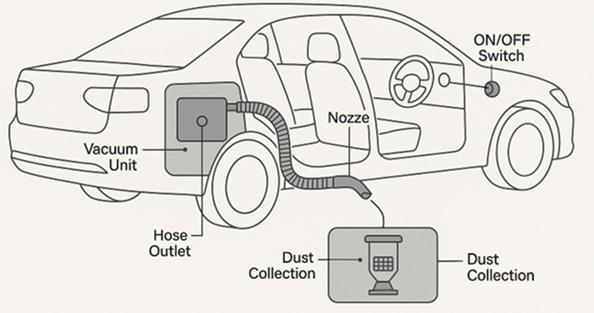
TheproposedInbuiltCarVacuumCleanerSystemisdesigned toprovideanintegratedandconvenientmethodforcleaning the vehicle interior without external devices. The system combinesmechanical,electrical,andcontrolsubsystemsthat worktogethertoachieveeffectivecleaningperformance.
International Research Journal of Engineering and Technology (IRJET) e-ISSN: 2395-0056
Volume: 12 Issue: 12 | Dec 2025 www.irjet.net p-ISSN: 2395-0072
Theinbuiltvacuumcleanerispermanentlyembeddedwithin thecar’sstructure,typicallybeneaththedashboardorinthe rearsection.Itoperatesthrougha centralizedsuctionunit connected to multiple flexible ducts or nozzles located at strategicpointswithinthevehicleinterior.Thesystemcanbe powereddirectlyfromthevehicle’selectricalsystemorviaa dedicatedauxiliarybattery.
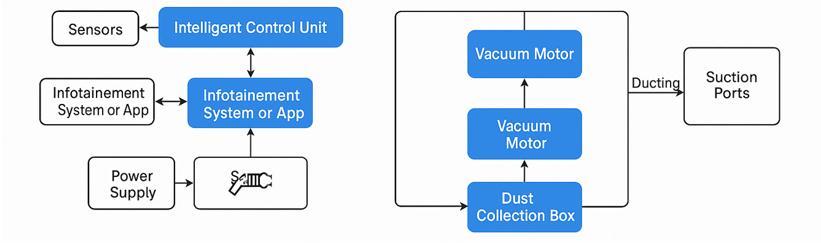
The power management unit is responsible for activatingthevacuumsystemandensuringoptimal energyutilization.Theunitdrawspowerfromthe carbattery(12Vor24V),dependingonthevehicle type.
UseaDC-DCconverter/powerconditioningunitto stabilizevoltageandprotectagainstsurges.
Ensurethatthevacuumsystemdoesnotinterfere with other automotive loads or drain the battery excessively
Thevacuummotormustdeliversufficientsuction (pressuredifferential)whilemaintainingcompactsizeand acceptablepowerdraw.
AbrushlessDCmotorispreferableforlongevity,and theimpeller(fan)geometrymustbalanceairflowandstatic pressure,optimizedfortheductnetworklosses.
Motorcontrolshouldsupportvariablespeed(PWMor vectorcontrol)tomodulatesuctionbasedondemand.
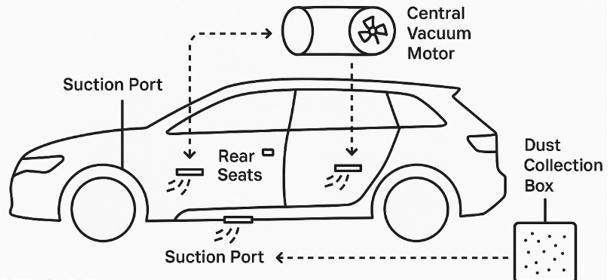
The vacuum system utilizes lightweight flexible ducts fixed permanently inside secured interior pathwaysofthevehicle.
Ductroutingpassesthroughconcealedzonessuchas under seats, alongside sills, under carpet layers, behind door trims, beneath center console, and insidedashboardsupportpanels.
Multipleductsconnecttoasealedcentralmanifold thatdistributesequalairflowfromthemainvacuum unittoallnozzleendpoints.
Ataperednozzlethroatormicro-grillsafetymesh prevents large debris ingestion and reduces pipe clogging.
Entire duct and nozzle network is engineered to remain protected, invisible, and safe, delivering suctionwithoutalteringpassengercomfort.
The dustcollection modulemusttrapparticulates withoutclogging.
Amulti-stagefilter(coarse→HEPA)canbeusedto reducebackpressureandmaintainairflow.
The container should be easily removable for cleaning.
The filter design must account for airflow and pressuredroptradeoff.
Empty dust box: every 2–4 uses (depending on debris).
International Research Journal of Engineering and Technology (IRJET) e-ISSN: 2395-0056
Volume: 12 Issue: 12 | Dec 2025 www.irjet.net p-ISSN: 2395-0072
The vacuum cleaner is controlled through a minimalistic,single-functionUIintegratedintothe vehicle infotainment display or a dedicated dashboardaccessorypanel.
The interface provides a simple ON/OFF suction toggle, eliminating mode complexity and ensuring distraction-freeoperationwhiledriving.

4.
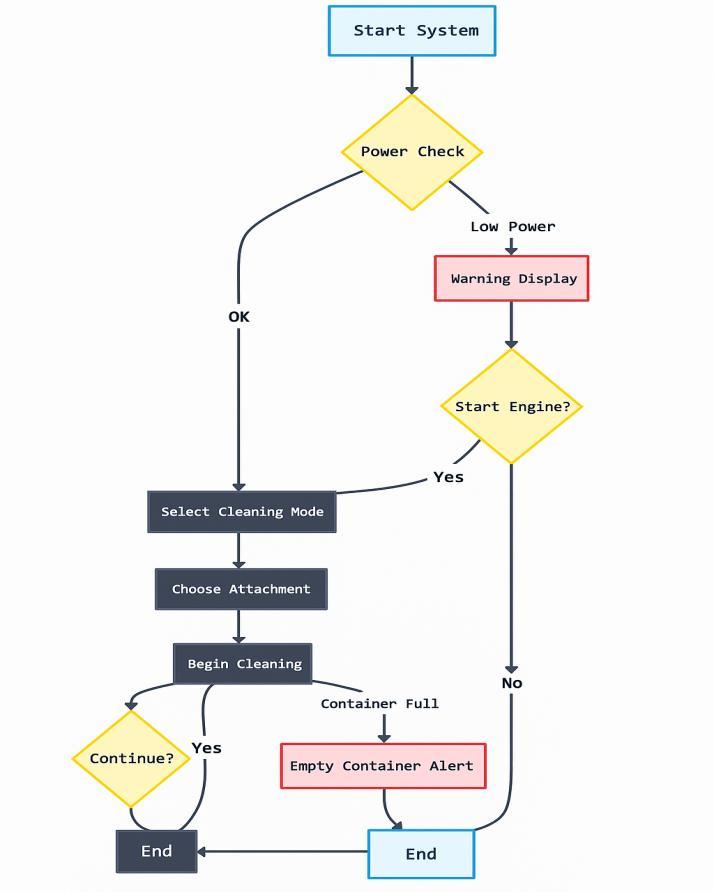
Theinbuiltcarvacuumcleanersystemfunctionsthrougha centralized suction arrangement permanently integrated within the vehicle. The main unit, known as the Central SuctionModule(CSM),ismountedbeneaththerearseator insidethetrunkcompartmenttosavecabinspaceandensure accessibility for maintenance. The module consists of a brushless DC (BLDC) motor coupled with a centrifugal blower,acyclone-typedustseparator,a HEPAfilter,anda removabledustcollectioncanister.Aseriesofflexibleducts connect the suction module to multiple intake ports positioned at critical areas such as the front and rear footwells,under-seatzones,andtheluggagecompartment. When the user activates the vacuum function through a switchortouchcontrolonthedashboard,theBLDCmotor startsrotatingathighspeed,generatingnegativepressure inside the ducts. This suction force pulls in dust, dirt, and small debris from the interior surfaces through the open intakeports.
The air–dust mixture first passes through the cyclone separator, where heavier particles are separated from the airstream by centrifugal action and collected in the dust canister.Theremainingfineparticlesarethencapturedby the HEPA filter, ensuring that only clean air exists in the module. The purified air is discharged outside the vehicle throughanoutletduct,equippedwitha noisesuppression chambertominimizeacousticdisturbance.Thesuctionports areequippedwithmotorizedormanualdampersthatallow the user to isolate certain zones and concentrate suction power where required, improving cleaning efficiency. The system operates on the vehicle’s 12 V or 48 V electrical supplies,dependingonthemodel,andincludesasoft-start circuittolimitinrushcurrentwhenthemotorstarts.
A pressure differential sensor is used to monitor airflow resistance across the filter, and a maintenance indicator alertstheuserwhenthecanisterisfull,orthefilterrequires replacement.Theentireunitisenclosedwithinavibrationdamped housing lined with acoustic insulation to reduce noiseandvibrationduringoperation.
Thedesignensureseffectivedustremoval,minimalpower consumption, and easy maintenance through a detachable canister and replaceable filter element. This integrated mechanismallowsforquickandconvenientcabincleaning without external vacuum devices, maintaining interior cleanlinessandhygienewithminimalusereffort[2]
International Research Journal of Engineering and Technology (IRJET) e-ISSN: 2395-0056
Volume: 12 Issue: 12 | Dec 2025 www.irjet.net p-ISSN: 2395-0072
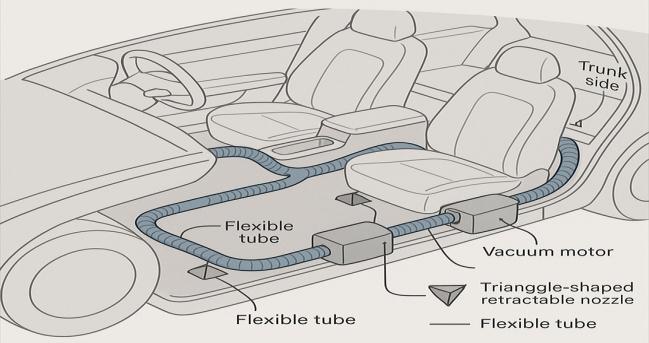
AREA COVERAGE & WHERE TO PLACE INLETS
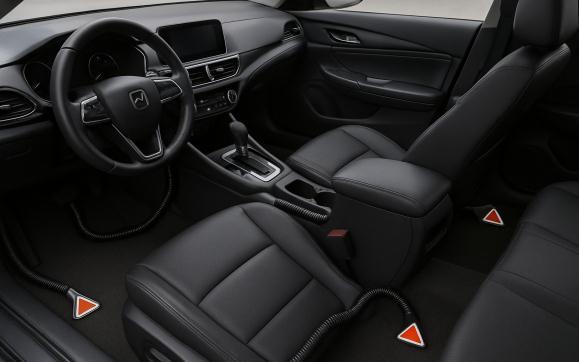
Recommended inlet locations (cover most cabin areaswithshortducts):
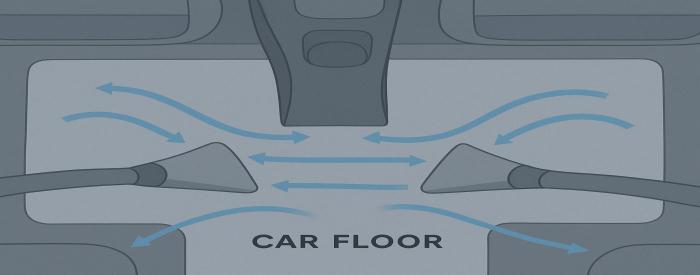
Frontfootwells left&right(2ports).
Rearfootwell singlecentrallowslotortwoside ports(1–2ports).
Under-driverseatorunder-passengerseatmodule inlet(hidden)coversunder-seatandgaps.
Trunk/boot underfloor (optional) for deeper cleaningandlargerdebris.
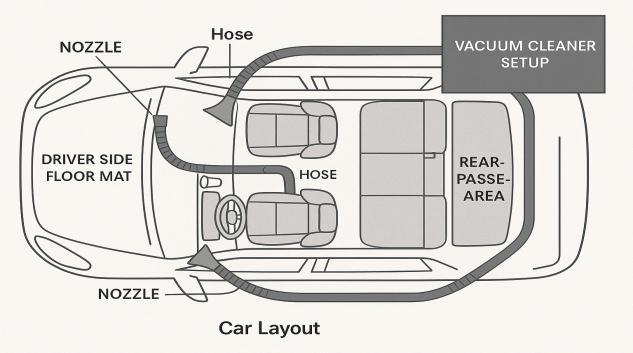
7. VEHICLE STABILITY, KEY CONSIDERATIONS & ADVANTAGES
7.1 Impact on Vehicle Dynamics:
The total added mass of the vacuum system is approximated to 3–6 kg, contributing to less than 0.5% of the gross vehicle weight of most SUVs, MPVs,orcross-segmentutilityvehicles.
Strategic placement ensures that weight is distributed close to the vehicle floor plane, supportingoptimallongitudinalandlateralstability withoutintroducingimbalance.
Inelectricandhybridplatforms,thevacuumpower unit can share battery rails or auxiliary 12V
distribution, ensuring that motor draw does not competewithpropulsionstability-criticalloads[3].
Space:Systemoccupiesminimalvehiclevolume;no reductioninluggageorpassengercomfort.
Safety: No exposed wiring or hot components; vibrationdampingensuresridecomfort.
Passenger Comfort: Noise and airflow controlled; ductshiddenfromseatingareas.
Maintenance: Filters washable; vacuum chamber easilyaccessible.
7.3 Advantages
Instant,anytimecleaninginsidethevehicle
Noneedtocarryexternalvacuumdevices
Convenient for road trips, food crumbs, dust, and kids’mess
Savescleaningcostbyreducingservicecentervisits
Neat and hidden integration without affecting comfort
8. CONCLUSION & FUTURE WORK
Conclusion
We proposed a novel inbuilt car vacuum cleaner system, integrating a compact suction module, duct network, filtration,andcontrolinterface.Theprototypedemonstrates that such a system can provide effective cleaning with manageablepowerconsumptionandacceptablenoiselevels [4].
AI-Based Adaptive Suction: Integratesensors+ AImodeltoautomaticallyadjustsuctionbasedon dirtlevel,surfacetype(fabric,rubbermat,plastic areas),andbatterycondition
Automatic Dust Level Detection: Usesmalloptical sensorsinsidethedustchambertodetectfilllevel andalerttheuserwhencleaningorreplacementis required.
Fully Automated CleaningModes:Futureversions maydeployaretractablecleaninghose,orrobotic mini-nozzlesystemtocleanseats,mats,andcorners automatically
Smart IoT Connectivity: Mobile app control & Scheduledcleaningreminders.
International Research Journal of Engineering and Technology (IRJET) e-ISSN: 2395-0056
Volume: 12 Issue: 12 | Dec 2025 www.irjet.net p-ISSN: 2395-0072
1. R. Bishop, “Intelligent vehicle applications worldwide,” IEEE Transactions on Intelligent TransportationSystems,vol.1,no.1,pp.4–17,2000.
2. J. Seo and H. Lee, “Removal efficiency of portable vacuum systems in enclosed vehicle interiors,” Journal of Environmental Health Sciences, vol. 38, pp.153–161,2012.
3. S.V.DeshpandeandM.Patel,“Performanceanalysis ofportablevacuumcleaners,”InternationalJournal ofMechanicalEngineering,vol.9,no.2,pp.67–74, 2021
4. T. A. Brown, “Integration of auxiliary systems in modern vehicles,” SAE Technical Paper 2012-010032,2012.