
International Research Journal of Engineering and Technology (IRJET) e-ISSN: 2395-0056
Volume: 12 Issue: 12 | Dec 2025 www.irjet.net p-ISSN: 2395-0072
International Research Journal of Engineering and Technology (IRJET) e-ISSN: 2395-0056
Volume: 12 Issue: 12 | Dec 2025 www.irjet.net p-ISSN: 2395-0072
Chinmay Hiremath1, Arafat Khazi2, Adarsh Kalagudi3 ,Prof.Deepa Kalappanavar4
1,2,3, Student, Department of Information Science and Engineering, Basaveshwar Engineering College, Bagalkote, India.
4Assistant Professor, Department of Information Science and Engineering, Basaveshwar Engineering College, Bagalkote, India.
Abstract - This project presents EDURA, a web-based college companion platform developed using PHP, HTML, CSS, JavaScript, and Microsoft SQL Server, designed to centralize and manage academic activities for students and faculty. Using features such as timetables, study materials, examschedules,eventnotifications,andquerymanagement, the system aims to streamline college workflows and improvecommunication.Various modules, includingstudent dashboards, faculty dashboards, and administrative panels, were implemented to ensure role-based access and functionality. The system also incorporates database management, dynamic content rendering, and user authentication mechanisms to enhance usability and data security. The platform’s performance and reliability were assessed through testing of module interactions, data retrieval, and real-time notifications. Additionally, a userfriendly web interface was developed to allow students and faculty to access and manage academic information efficiently.Thissystemaimstoserveasacomprehensivetool for organizing, tracking, and facilitating academic activities in colleges, with potential applications in improving productivity, resource management, and student-faculty engagement.
Key Words: EDURA, College Companion, Student Dashboard,AcademicManagement,StudyMaterials,Exam Preparation, Faculty Interaction, Educational Web Application.
In the 21st century, where data and technology drive academic management, organizing and accessing student and faculty information has become increasingly important. EDURA, the college companion platform, centralizes academic activities such as timetables, study materials, exam schedules, event notifications, and query handling, making it easier to manage large amounts of collegedataefficiently.
Manual tracking of these activities across spreadsheets, notice boards, and separate systems is time-consuming and prone to errors, making traditional methods inefficient. By using a modular web-based platform, EDURAsimplifiesthese processes,providing students and facultywithreal-timeaccesstoinformation.
This approach allows colleges and academic departments to make data-driven decisions, enhance communication, and improve productivity, thereby fostering a more organized and responsive academic environment for both studentsandfaculty.
1. To develop a centralized web-based platform that efficiently manages academic activities for students and faculty, including timetables, study materials, exams,events,andqueries.
2. Toproviderole-baseddashboardsforstudents,faculty, and administrators, enabling seamless access to relevant information and simplifying academic workflows.
3. To enhance communication between students and faculty by integrating a query submission and response system, improving responsiveness and engagement
4. Tocreateauser-friendlyinterfacethatallowsstudents andfacultytoviewschedules,accessmaterials,submit queries,andreceivenotificationsinrealtime.
Themotivation behinddeveloping EDURA stemsfromthe need to harness technology to better organize, manage, and access academic information in colleges. Modern academic environments generate a large volume of data, including timetables, lecture notes, exam schedules, events,andstudentqueries,whichcanbedifficulttotrack andcoordinatemanually.Bycentralizingtheseactivitiesin aweb-basedplatform,EDURAaimstouncoverpatternsin academic workflows, improve communication between students and faculty, and streamline administrative processes. This not only enhances efficiency and reduces errors but also empowers students and faculty to access relevantinformationquicklyandmakeinformeddecisions.
Furthermore, EDURA fosters engagement and collaborationbyprovidingreal-timenotificationsandeasy access to resources. As web technologies evolve, the potential to expand EDURA’s features and improve usabilitycontinuestogrow,makingitanexcitingprojectto
International Research Journal of Engineering and Technology (IRJET) e-ISSN: 2395-0056
Volume: 12 Issue: 12 | Dec 2025 www.irjet.net p-ISSN: 2395-0072
bridge technology and academic management. The ultimate motivation is to provide a comprehensive, organized, and user-friendly system that supports both students and faculty in achieving better academic outcomes.
1. R. Kumar, S. Patil, and A. Sharma, "College Management System Using Web Technologies," 2021 International Conference on Computing and Automation(ICCA),Bangalore,India,2021,pp.
Key Findings:
A web-based college management system was developedtomanagestudentrecords,attendance, andacademicschedules.
Role-based dashboards for students, faculty, and administrators improved accessibility and user experience.
The system highlighted the importance of centralized platforms for efficient academic data management.
2. P. Singh, M. Verma, and R. Gupta, "Design and ImplementationofaStudentInformationSystem," 2020 International Conference on Smart ComputingandSystems(ICSCS),Pune,India,2020
Key Findings:
The study implemented a student information systemtomanagetimetables,examschedules,and coursematerials.
Integration of notifications and query management enhanced communication between studentsandfaculty.
Demonstrated the efficiency of modular web applicationsinreducingadministrativeoverhead.
3. S. Choudhary and A. Rao, "Web-based Academic Portal for College Administration," 2019 International Conferenceon Advanced Computing and Communication Technologies (ICACCT), Hyderabad,India,2019,pp.334-338
Key Findings:
Proposed a web portal for academic management with modules for lectures, exams, events, and notifications.
Use of centralized databases ensured consistency andaccuracyofacademicrecords.
Highlighted the significance of interactive dashboardsforstudentsandfacultyengagement.
4. V. Mehta, R. Joshi, and K. Desai, "Implementation ofCollegeCompanionWebApplication,"20223rd International Conference on Emerging Technologies in Computer Science (ICETCS), Mumbai,India,2022,pp.145-149.
Key Findings:
Developed a modular web application to manage collegetimetables,notes,exams,andevents.
Demonstrated the benefits of real-time notifications and query handling for academic communication.
Introduction
Inthecontextof EDURA–ACollegeCompanionWebsite,the problem formulation focuses on developing a unified digital platform that simplifies academic and communication processes within a college environment. Thesystemaimstoprovidestudentsandfacultywitheasy access to essential resources such as timetables, notes, exam details, events, and faculty information through a singleinteractivedashboard.
The main challenge lies in integrating multiple modules efficiently while ensuring user-friendliness, data security, andsmoothinformationflow.Traditionalmanualmethods of sharing academic materials, managing schedules, and handling student queries are often time-consuming and prone to errors. EDURA addresses these issues by automatingandcentralizingsuchactivities.
This problem can be seen as an integration and data management task that requires effective database design, responsive web interfaces, and secure authentication. The final goal is to create a reliable and scalable system that enhances academic coordination, encourages digital learning, and improves the overall college experience for studentsandfacultymembers.
The current systems used in most colleges rely heavily on traditionalorsemi-digitalmethodsformanagingacademic information and communication. Important resources such as timetables, study materials, announcements, and faculty details are often shared manually or through scattered digital platforms like emails, WhatsApp groups, andprintednotices.Thisresultsininefficiency,delays,and difficulty in maintaining organized access to academic information.
International Research Journal of Engineering and Technology (IRJET) e-ISSN: 2395-0056
Volume: 12 Issue: 12 | Dec 2025 www.irjet.net p-ISSN: 2395-0072
Students frequently struggle to find the correct materials or updates at the right time, while faculty members face challenges in managing schedules, sharing notes, and addressing student queries systematically. Furthermore, most existing systems lack an integrated platform that combines all these essential academic functions in one place.
Hence, EDURA – A College Companion Website is designed to overcome these limitations by providing a centralized, interactive, and accessible digital platform. It simplifies communication, enhances learning, and improves overall academiccoordinationwithinthecollegeenvironment.
Lack of Centralized Access:
In most colleges, important academic information such as timetables, study materials, exam schedules, and announcementsarescatteredacrossmultipleplatformsor communicated manually. This creates confusion and makes it difficult for students to find the required informationquickly.
Inefficient Communication:
Students and faculty often rely on informal channels like WhatsAppgroupsorverbalannouncements,whicharenot reliable or structured. As a result, many students miss importantupdatesordeadlinesduetomiscommunication.
Manual Management of Data:
Many administrative and academic processes are still managed manually, leading to time-consuming tasks and higher chances of human error. Maintaining attendance, distributing notes, or updating exam-related information manuallycausesunnecessarydelays.
There is no dedicated platform for students to raise academic queries or interact directly with faculty members outside of classroom sessions. This limits collaboration and slows down the resolution of academic concerns.
Sincethereisnounifiedsystem,datasuchastimetablesor event schedules may not always be updated in real-time. Outdated information can lead to confusion and schedulingconflicts.
Many colleges still rely on printed notices and physical distribution of materials. This not only consumes
resources but also makes it difficult for students who are absentoroff-campustostayupdated.
The proposedsystem, EDURA,is designed tosimplify and digitalize college-related activities by integrating essential academic and communication features into a single platform.Itaimstoreplacetraditionalmanualsystemsand fragmented communication channels with a centralized, efficient,anduser-friendlywebapplication.
EDURA provides modules such as Timetable, Notes/Materials, Exam Section, Events, Faculty Details, anda Query Box,allowingstudentsandfacultytointeract and access information easily. The system ensures quick updates and smooth information sharing, reducing delays andimprovingcoordination.
Theplatformsupports role-based access,wherestudents, faculty,andadministratorshaveseparatedashboardswith relevant functions. It focuses on improving transparency, communication, and accessibility within the college environment.
Builtwithascalableandmodulararchitecture,EDURAcan be expanded with additional features like attendance trackingandonlineassessmentsinthefuture. Overall,the system enhances college management and serves as a reliabledigitalcompanionforstudentsandfaculty.
The system aims to develop a comprehensive and userfriendly college companion platform that integrates essential academic and administrative features into a singledigitalspace.Currentcollegesystemsrelyheavilyon manual processes and scattered communication channels, leadingtoinefficiencyanddelaysininformationsharing.
EDURA seeks to overcome these limitations by providing anorganized,accessible,andinteractiveweb-basedsystem where students and faculty can manage timetables, study materials, exams, events, and queries efficiently. The goal is to create a unified platform that enhances communication, promotes transparency, and simplifies day-to-dayacademicactivitiesthroughdigitalautomation.
These are the specific features, functions, and operations thatthe EDURA systemmustperformtomeettheneedsof students,faculty,andadministrators.They definethecore behaviorandfunctionalitiesoftheplatform
Functional Requirements of EDURA – A College CompanionWebsite:
International Research Journal of Engineering and Technology (IRJET) e-ISSN: 2395-0056
Volume: 12 Issue: 12 | Dec 2025 www.irjet.net p-ISSN: 2395-0072
User Authentication:
The system must allow secure login and registration for studentsand faculty,ensuringauthorized accessbased on userroles.
Timetable Management:
Studentsshouldbeabletoviewtheirclasstimetables, whilefacultycanupdateormodifyschedulesasneeded.
Notes and Materials Section:
Facultymembersshouldbeabletouploadstudymaterials andnotesthatstudentscaneasilyaccessanddownload.
Exam Section:
The system must display exam timetables, notifications, andresultstokeepstudentsinformed.
Events and Announcements:
EDURA should provide real-time updates about college events, seminars, and important notices through an interactivedashboard.
Query Box:
The system must include a query section where students can post academic questions or issues and receive responsesfromfaculty.
Thesearethequalityattributesandconstraintsthatdefine how the EDURA system performs its functions. They describeessentialsystempropertiessuchasperformance, scalability,usability,andreliability
Non-Functional Requirements of EDURA – A College CompanionWebsite:-
Performance:
The system should provide quick access to information such as timetables, notes, and announcements with minimalloadtime.Itmustefficientlyhandlemultipleuser requestssimultaneouslywithoutaffectingperformance.
Scalability:
EDURA should be scalable to support an increasing numberofstudents,faculty,anddatarecordsasthecollege grows. Thesystem design shouldallowsmooth expansion withoutaffectingfunctionality.
Availability:
Thesystemshouldremainaccessibleatalltimes,ensuring thatstudentsandfacultycanaccessinformationwhenever neededwithminimaldowntime.
Security:
The system must protect sensitive information through user authentication, role-based access control, and data encryption to ensure privacy and prevent unauthorized access.
Usability:
The web interface should be simple, intuitive, and easy to navigate. It must be responsive and accessible across devicessuchasdesktops,tablets,andsmartphones.
Hardware Requirements
Thesespecifythephysicaldevicesandcomponentsneeded to run the EDURA system effectively, including servers, userdevices,networkequipment,andstorageresources.
HardwarerequirementsofOlympicMedalPredictionusing Pythonare:-
Server: Multi-core CPU (Intel i5/i7 or AMD Ryzen), 8–16 GB RAM, 256–512 GB SSD storage to host the web applicationanddatabase.
Networking: High-speed internet connection to ensure smoothaccessformultipleusersandreal-timeupdates.
Backup: Local or cloud-based backup storage and UPS to protectdatafrompowerfailuresorsystemcrashes.
User Access Devices: Client devices including desktops, laptops,tablets,andsmartphonesforstudentsandfaculty toaccessthesystem.
Database Server: Scalable Database Management System (e.g., Microsoft SQL Server) to store user data, academic materials,andactivitylogsefficiently.
Software Requirements
These define the programs, operating systems, tools, and frameworks required to develop, deploy, and operate the EDURA system. They include the necessary software for coding,hosting,testing,andmaintainingtheapplication.
Software Requirements of EDURA – A College Companion Website:-
Operating System: Windows, Linux, or macOS for developmentandserverhosting.
International Research Journal of Engineering and Technology (IRJET) e-ISSN: 2395-0056
Volume: 12 Issue: 12 | Dec 2025 www.irjet.net p-ISSN: 2395-0072
Programming Languages: PHP (for backend), JavaScript (forfrontendinteractivity),HTML,andCSS.
Database: Microsoft SQL Server for storing user data, timetables, notes, and activity logs.Optional Tools & Platforms:
XAMPP/WAMP for local server setup for remote deploymentandscalability.
7. DESIGN
Architecture
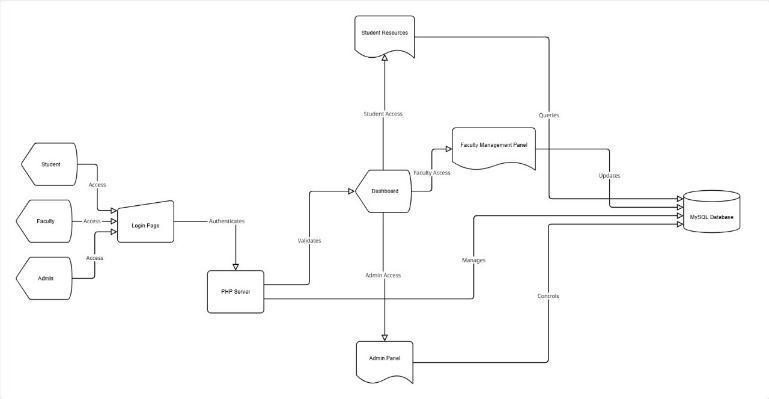
Fig. 7.1 Theabovefigurerepresentsthearchitectureof EDURA.
The architecture of EDURA – A College Companion System provides an integrated platform for students, faculty, and administrators to manage academic and campus-relatedactivities.
Data Storage:
Includes separate databases such as Student Database, Faculty Database, Notes & Materials Database, Events Database, and Queries Database to store structured academicdataandcommunicationrecords.
Server and Processing:
A centralized PHP-based Web Server connected to SQL Server handles all backend operations such as authentication, data retrieval, and management of dashboardsforstudents,faculty,andadministrators.
User Interface:
A responsive front-end built using HTML, CSS, and JavaScript provides access to login/registration pages, dashboards,andcontentupload/downloadfeatures.
Modules:
Key modules include Login & Registration, Dashboard Management, Timetable & Exam Section, Notes & Materials Upload/Download, Events & Notifications, and Query Management. Each module interacts with its respective database and
allows seamless communication between users and the system.
Data Flow Diagrams
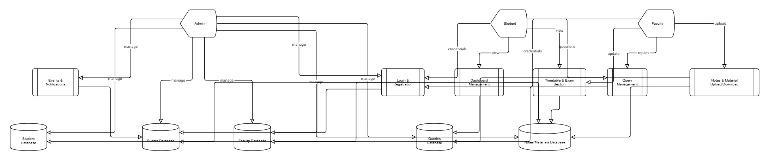
The EDURA system enables smooth interaction between students,faculty,andadministrators.
Students can log in, access notes, timetables, events, and raisequeries.
Faculty upload study materials, update schedules, and respondtostudentqueries.
Admin manages user accounts, events, and maintains the database.
Data flows through modules like Login/Registration, Dashboard, Notes Management, Exam Section, and Query System,allconnectedtoacentral SQL database forsecure storageandretrieval.
Use Case Diagram

Fig. 7.4 UseCaseDiagram
© 2025, IRJET | Impact Factor value: 8.315 | ISO 9001:2008
International Research Journal of Engineering and Technology (IRJET) e-ISSN: 2395-0056
Volume: 12 Issue: 12 | Dec 2025 www.irjet.net p-ISSN: 2395-0072
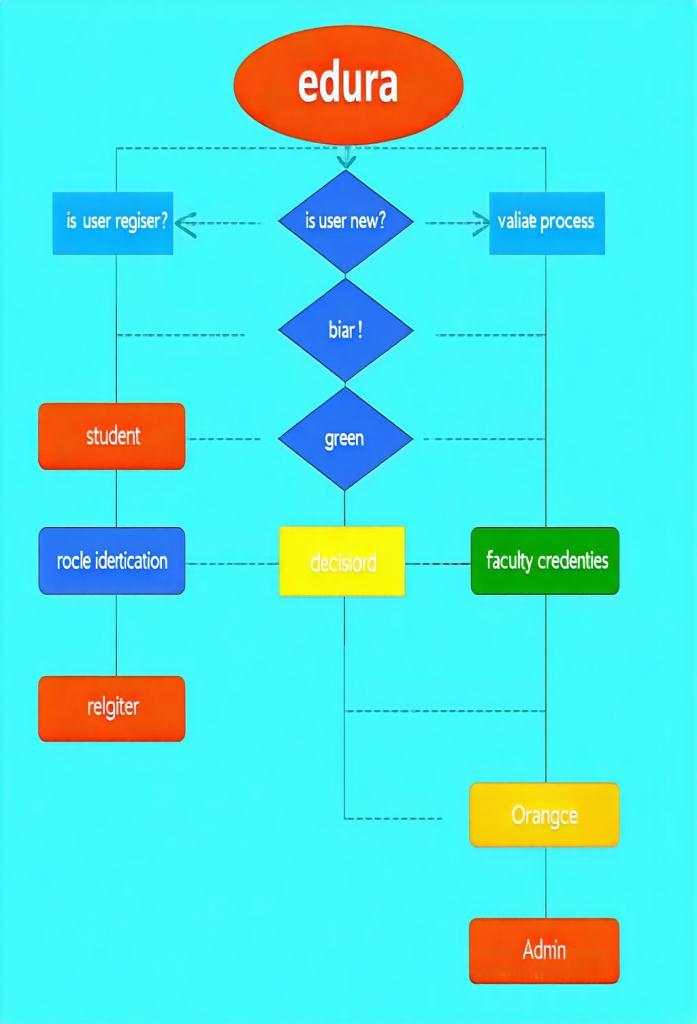
Fig. 8.1 Flowchart
TheabovefigurerepresentstheimplementationofEDURA
Tools
1. Front-End Tools
HTML: Usedforstructuringandorganizingthewebpages andcorecontentoftheEDURAplatform.
CSS: Provides styling, color schemes, and layout design to ensureanappealingandconsistentvisualexperience.
JavaScript: Adds interactivity, dynamic content updates, andclient-sidefunctionalitytoenhanceuserengagement.
2. Back-End Tool
Programming Languages: PHPandJavaScript for server-sidelogic.
Database: MicrosoftSQLServerorMySQLforstoringuser andacademicdata.
Server: ApacheorXAMPPforhostingandtesting.
Version Control: Gitforcodemanagement.
These tools collectively ensure the seamless functionality, interactivity, and reliability of the project, making it userfriendlyandefficientforitspurpose.
TESTING
Test Cases
Test Case 1: Invalid User Role Selection
• Input: User tries to login without selecting Student/Faculty/Admin.
• Expected Result: Prompt displayed to select a validuserrole.
Test Case 2: Invalid Student USN
• Input: Student enters an incorrect or improperly formattedUSN.
• Expected Result: Error message “Invalid Student credentials”isdisplayed.
Test Case 3: Invalid Faculty Login
• Input: FacultyentersincorrectIDorpassword.
• Expected Result: Login denied with an error message
Test Case 4: Invalid Admin Login
• Input: Admin enters wrong username or password.
• Expected Result: Access denied and error messageshown.
10. RESULTS
Login-page
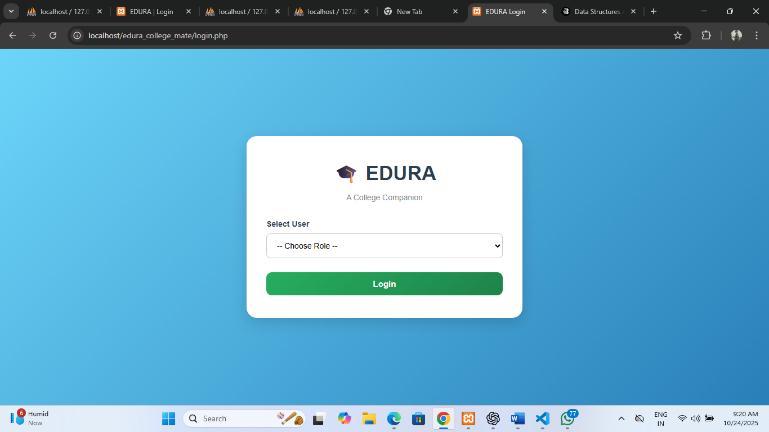
International Research Journal of Engineering and Technology (IRJET) e-ISSN: 2395-0056
Volume: 12 Issue: 12 | Dec 2025 www.irjet.net p-ISSN: 2395-0072
Dashboards
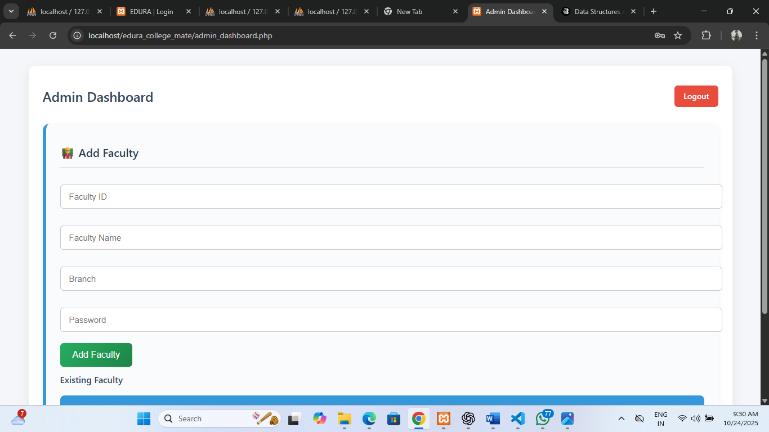
Fig 10.1.2 AdmindashboardPage
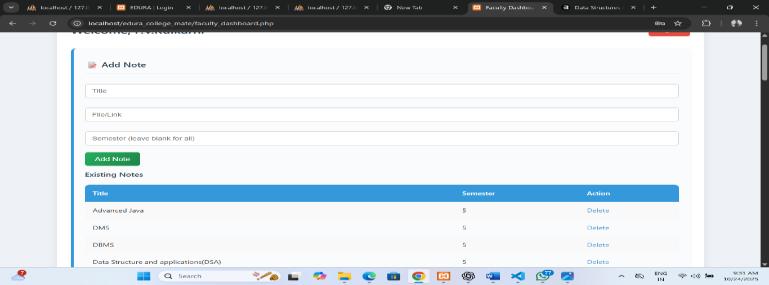
Fig 10.1 3 FacultydashboardPage
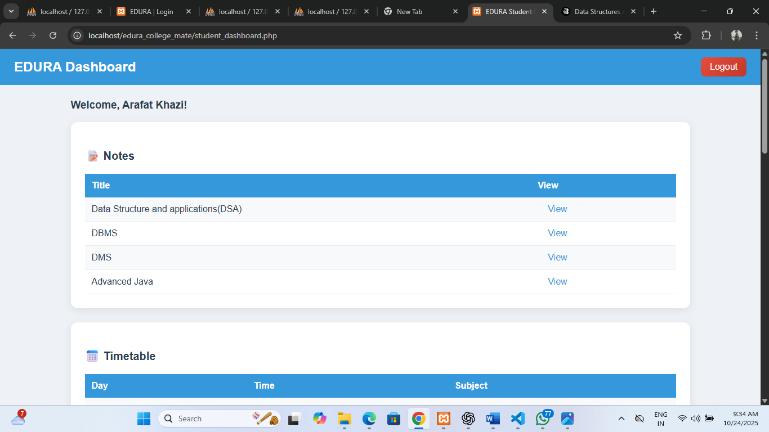
Fig 10.1.4 StudentdashboardPage
11. CONCLUSIONS
The EDURA system serves as an innovative digital platform designed to enhance the academic experience of students and faculty by providing an all-in-one college companion solution. It integrates essential academic modules such as timetables, notes and materials, exam updates,eventnotifications,andfacultyinformationintoa single, user-friendly interface. By leveraging modern web technologies, secure database management, and efficient data handling, EDURA ensures smooth and reliable performanceforusers.
The system is built with scalability, usability, and security in mind, allowing it to handle growing user bases and institutionaldataefficiently.Withitsinteractivedesignand
real-time accessibility, EDURA promotes better communication, organization, and engagement within the collegecommunity.
Ultimately, EDURA has the potential to revolutionize how students and faculty interact with academic resources, offering a seamless, centralized platform that simplifies campus life and supports a smarter, more connected educationalenvironment.
1 S. Sharma and R.Gupta,“Design and Implementation of a Web-Based College Management System,” 2022 International Conference on Computing, Communication, and Intelligent Systems (ICCCIS), Greater Noida, India, 2022,pp.654–659.
2. P.SinghandA.Kaur,“DevelopmentofanOnlineStudent Information Management System,” 2021 International Conference on Smart Electronics and Communication (ICOSEC),Trichy,India,2021,pp.1052–1057.
3. R. Das and M. Roy, “A Web Application for College Management and Student Assistance Using PHP and MySQL,” 2020 IEEE 5th International Conference on Computing, Communication and Automation (ICCCA), GreaterNoida,India,2020,pp.1021–1026.
4. A. Khan, S. Patel, and D. Bansal, “Smart Campus: An Integrated Web Portal for Students and Faculty,” 2019 International Conference on Advances in Computing, CommunicationandControl(ICAC3),Mumbai,India,2019, pp.445–450.
5. M.Jain,P.Sharma,andV.Joshi,“DesignandAnalysisofa Web-Based E-Learning Portal,” 2021 International Conference on Inventive Systems and Control (ICISC), Coimbatore,India,2021,pp.1187–1192.
6. K. R. Nair and J. Thomas, “Enhancing Academic Management through Web-Based Platforms: A Case Study Approach,” 2023 IEEE International Conference on Smart Technologies and Computing in Education (STCE), Chennai,India,2023,pp.234–240.
7. A. Verma and N. Singh, “College Companion System Using Modern Web Technologies,” 2023 International Conference on Intelligent Computing and Communication (ICICC),Delhi,India,2023,pp.511–517.
8. S. Mehta and R. Kumar, “Automation of College Administration and Student Interaction through Web Portals,” 2022 IEEE International Conference on Computational Intelligence and Computing Research (ICCIC),Madurai,India,2022,pp.784–789.