
International Research Journal of Engineering and Technology (IRJET) e-ISSN: 2395-0056
Volume: 12 Issue: 12 | Dec 2025 www.irjet.net p-ISSN: 2395-0072
International Research Journal of Engineering and Technology (IRJET) e-ISSN: 2395-0056
Volume: 12 Issue: 12 | Dec 2025 www.irjet.net p-ISSN: 2395-0072
Mistry Pooja B.1 , Chandresha Sandip P.2 , Tiwari Mohit3
1 Assistant Professor, Applied Mechanics Department, Vishwakarma Government Engineering College, Chandkheda, Ahmedabad, Gujarat, India
2Assistant Professor, Applied Mechanics Department, Government Engineering College, Dahod, Gujarat, India
3 Students, Electrical Engineering Department, Vishwakarma Government Engineering College, Chandkheda, Ahmedabad, Gujarat, India ***
Abstract - India occupies one of the world’s most complex seismotectonic environments due to the persistent convergence of the Indian and Eurasian plates. This report provides an integrated assessment of the nation’s seismic hazard profile by examining geological processes, historical earthquakepatterns,andemerginganthropogenicinfluences. The analysis demonstrates that compressional stresses generatedalongtheHimalayancollisionzonepropagatedeep into the Indian craton, challenging perceptions of the peninsular shield as a stable tectonic block. It further highlights the growing significance of human-induced seismicity,showinghowreservoirimpoundment,groundwater extraction, and related activities can destabilize critically stressedfaultsystems.
A detailed review of India’s seismic zonation framework, major past earthquakes, and the evolution of national preparedness measures reveals a clear transition from reactive disaster response to proactive, mitigation-oriented riskmanagement.Despitesubstantialprogressinmonitoring networks, institutional capacity, and seismic-resistant construction practices, persistent challenges including funding limitations, enforcement gaps, and the intrinsic unpredictability of seismic events underscore the need for sustained research, technological investment, and policy advancement. The study concludes by emphasizing the importance of long-term commitment to building a resilient seismic-riskgovernancesystemforIndia.
Key Words: Disaster preparedness, Hazard mitigation, Geodynamic processes, Paleo seismicity, Structural vulnerability, Risk management
1.1
TheIndiansubcontinenthaslongbeenrecognizedasoneof the most seismically active regions of the world, shaped fundamentallybytheinteractionofmajorlithosphericplates. Itstectonicsettingisdominatedbythepersistentnorthward drift of the Indian Plate and its ongoing collision with the Eurasian Plate an orogenic process responsible for the upliftandcontinuousevolutionoftheHimalayanmountain
system. This convergent plate boundary generates substantialtectonicstress,whichisdistributednotonlyalong the Himalayan arc but also across the broader continental interior. According to the Ministry of Earth Sciences, approximately 59% of India’s land area falls under zones classifiedasmoderatetoveryhighseismicrisk,underscoring theextensivegeographicextentofseismicvulnerability.
Compounding this geological predisposition is India’s vast population density and rapid urban expansion, which significantlyheightenthepotentialimpactofseismicevents. Urban centers with inadequate structural resilience, aging infrastructure,andhighconcentrationsofpeopleandassets face disproportionately greater risk. Consequently, understandingthenation’sseismichazardprofilerequiresa multifacetedexaminationofbothgeophysicalprocessesand socio-environmentalconditions.
Thisresearchseekstodevelopacomprehensive,integrative analysis of earthquake hazards in India. Moving beyond conventionaldescriptionsofseismicallyactiveregions,the report investigates the geological drivers, historical seismicity, and emerging factors such as intraplate earthquakesandanthropogenicallyinducedseismicity that influencetheseismicrisklandscape.Acentralobjectiveisto interrogatetheprevailingmisconceptionthatcertainregions ofIndiaremain“seismicallysafe,”demonstratinginsteadthat vulnerabilitiesextendfarbeyondtheHimalayanfrontalarc.
The study aims to:
Elucidate the tectonic mechanisms underpinning seismic activityinbothinter-plateandintraplatesettings.
Examine major historical earthquakes to identify spatial patternsandrecurrencecharacteristics.
Assess the evolution of national mitigation frameworks, including preparedness, policy reforms, and engineering interventions.
Highlight human-induced seismicity as an increasingly relevantcomponentofIndia’shazardprofile.
International Research Journal of Engineering and Technology (IRJET) e-ISSN: 2395-0056
Volume: 12 Issue: 12 | Dec 2025 www.irjet.net p-ISSN: 2395-0072
Through this approach, the research seeks to deliver a nuanced, evidence-based understanding of the country’s seismic vulnerabilities and to contribute meaningfully to discussionsonnationalresilience.
The organization of this research builds upon the foundational structureofthe academic work “A Study and AnalysisofEarthquakeinIndia.”Toachieveahigherdegree of analytical depthand disciplinary rigor, eachsection has beensubstantiallyexpandedandsupplementedwithinsights drawn from a diverse range of scholarly and institutional sources. These include peer-reviewed scientific literature; technical documents from national agencies such as the NationalDisasterManagementAuthority(NDMA),GSI,and IMD;anddatafromgovernmentalpressreleasesandseismic monitoringreports.
Themethodologicalapproachintegrates:
Geophysical and tectonic analysis based on currentscientificmodels.
Historical earthquake assessment using documentedeventcatalogues.
Policy and institutional review through official governmentframeworks.
Comparativesynthesis ofcontemporaryresearch toevaluatetrendsandvulnerabilities.
Bytriangulatingfindingsacrossmultiplereputablesources, thisstudyprovidesarobust,evidence-drivenintroductionto India’sseismicriskprofile,ensuringbothacademicreliability andpracticalrelevanceforhazardmitigationplanning. intherunningtextshouldmatchwiththelistofreferencesat theendofthepaper.
2. GEOLOGICAL AND TECTONIC FRAMEWORK OF THE INDIAN SUBCONTINENT
2.1 The Indian Plate and the Himalaya–Eurasia Collision
The primary driver of seismicity across the Indian subcontinentistheongoingconvergencebetweentheIndian andEurasianlithosphericplates.TheIndianPlatecontinues to migrate northward at an estimated ~47 mm/year, resulting in its under thrusting beneath the comparatively stable Eurasian Plate. This sustained convergence has produced the Himalayan orogenic belt one of the most rapidlydeformingandseismicallyactivemountainsystems ontheplanet.Thedeformationisprincipallyaccommodated along several major tectonic discontinuities, most prominentlytheMainFrontalThrust(MFT),MainBoundary Thrust (MBT), and Main Central Thrust (MCT), which togetherdefinetheHimalayanmegathrustsystem.
Theseismichazardinthisregion,however,isnotconfinedto theprimaryorogenicfront.Strainaccumulationandrelease occur across a broader network of active fault systems, including the Indo-Burmese Arc to the east and the Sulaiman–Kirthar fold-and-thrust belt to the west. These peripheral tectonic domains absorb significant portions of the compressional stress resulting from India–Eurasia convergence,renderingtheentirenorthernandnortheastern margin of the Indian Plate susceptible to large, potentially catastrophic earthquakes. This distributed deformation underscoresthecomplex,regionallyinterconnectedtectonic architecturegoverningseismicityinSouthAsia.
Although the Himalayan collision zone dominates India’s seismic hazard narrative, the recurrent occurrence of damagingearthquakeswithintheinterioroftheIndianPlate highlightstheimportanceofintraplateseismicityinnational riskassessments.TheIndiancraton,traditionallyregardedas a tectonically stable continental block, continues to experience significant stress perturbations transmitted southward from the Himalayan collision system. These stresses are not fully absorbed at the plate boundary and insteadpropagatethroughthelithosphere,inducingstrain accumulation along ancient, structurally inherited weaknesses.
Many intraplate faults within peninsular India originated duringthebreakupoftheGondwanalandsupercontinentand have remained dormant for millions of years. Under contemporary compressional stress regimes, these paleostructurescanbereactivated,producingseismiceventsfar removed from active plate boundaries. Notable examples includethe1993Laturearthquake(Mw6.2)andthe1967 Koyna earthquake (Mw 6.6), both occurring in regions historicallyconsideredseismicallyquiescent.Theseevents illustrate that tectonic stability is relative rather than absolute; the Indian shield remains sensitive to stress transfer processes and lithospheric-scale deformation. Consequently,intraplateseismicitychallengesanynotionof seismically “safe” zones within the subcontinent and highlightstheneedforcomprehensivehazardassessments thatincorporateinternalplatedynamics.
Inadditiontonaturaltectonicstresses,increasingevidence supports the role of human activities in modulating seismicity, particularly in geologically sensitive environments.Suchevents,classifiedashuman-inducedor anthropogenically triggered earthquakes, occur when anthropogenic processes perturb the existing stress equilibriumalongpre-stressedorcriticallyloadedfaults.
Reservoir-Induced Seismicity (RIS) represents one of the most thoroughly documented mechanisms of induced
International Research Journal of Engineering and Technology (IRJET) e-ISSN: 2395-0056
Volume: 12 Issue: 12 | Dec 2025 www.irjet.net p-ISSN: 2395-0072
seismicityinIndia.Theimpoundmentoflargewaterbodies behinddamsresultsinsignificantloadingandpore-pressure diffusionwithinthecrust,conditionscapableofdestabilizing nearbyfaultsystems.The1967Koynaearthquake,oneofthe most destructive intraplate events in India, is widely recognizedasaclassicexampleofRIS,whereinfluctuations inreservoirlevelscorrelatedstronglywithseismicactivityin theregion.
Groundwaterover-extractionconstitutesanotherimportant anthropogenicdriver.InregionssuchasDelhi–NCRandthe Gangetic plains, accelerated depletion of groundwater between 2003 and 2012 reduced lithostatic support and altered pore-pressure regimes, conditions that were associatedwithanincreaseinshallowseismicity.Subsequent stabilizationofgroundwaterlevelsafter2014corresponded withanotabledeclineinseismiceventfrequency,reinforcing thecausallinkbetweenhydrologicalvariationsandseismic behavior.
Additionalactivities includingminingoperations,deep-well fluidinjection,hydraulicfracturing,andtheconstructionof mega-infrastructure projects further demonstrate the susceptibility of critically stressed crustal faults to anthropogenic influences. These findings reveal a complex interplaybetweendevelopmentalpressuresandtheintrinsic tectonic fabric of the Indian lithosphere, emphasizing the needforrigorousgeotechnicalevaluationandmonitoringin regions undergoing substantial human-driven subsurface modification.
India’sseismiczoningframework,formalizedbytheBureau of Indian Standards (BIS) under IS 1893: Criteria for Earthquake-Resistant Design of Structures, provides the foundational classification used to quantify earthquake hazardacrossthesubcontinent.TheBIShasdelineatedthe nation into four seismic zones II, III, IV, and V, reflecting progressivelyincreasinglevelsofexpectedgroundshaking intensityandearthquakedamagepotential.Thiszonationis based on historical seismicity, active tectonic structures, geophysical observations, and macro seismic intensity distributions.
ZoneII:LowDamageRiskZone(correspondingto MSKVIorlower)
ZoneIII:ModerateDamageRiskZone
ZoneIV:HighDamageRiskZone
ZoneV:VeryHighDamageRiskZone(corresponding toMSKIXandabove)
Each zone is associated with a defined zone factor a numericalcoefficient(e.g.,0.10forZoneII,0.36forZoneV) usedbystructuralengineerstoestimatedesignbaseshear
andseismiclateralforces.Thesezonefactorsserveasinput parameters for seismic load calculations pursuant to structuraldesignstandards.Althoughthezoningmapoffersa broad, national-scale depiction of seismic hazard, it is inherently generalized and does not currently incorporate probabilisticseismichazardanalysis(PSHA),microzonation data,orlocalsiteeffects,whicharecritical forurban-scale riskassessment.
3.2.1
TheHimalayanandnortheasternbeltconstitutesthemost seismicallyactiveandtectonicallycomplexregionofIndia. This region is situated directly along the convergent boundarywheretheIndianPlateunderthruststheEurasian Plate,formingtheHimalayanorogeny.TheMainHimalayan Thrust(MHT) theprincipalmegathrustfaultunderlyingthe region accommodates the majority of the ongoing convergence,leadingtosubstantialstrainaccumulation.This accumulatedstrainisepisodicallyreleasedthroughlargeto great earthquakes (Mw > 7.5), rendering the entire arc exceptionallypronetodestructiveseismicevents.
The northeastern states, lying at the intersection of the Indian, Eurasian, and Burmese plates, are additionally influenced by complex oblique subduction and strike-slip deformationalongtheIndo-BurmeseArc.Thishasproduced severalofthemostpowerfulrecordedearthquakesglobally, underscoringtheregion’sclassificationasZoneV.
Despitebeinglocatedawayfromanactiveplateboundary, the Indo-Gangetic Plain (IGP) exhibits high seismic vulnerabilityattributabletopronouncedsedimentarybasin effects.TheIGPisaforelandbasinfilledwiththicksequences of unconsolidated to semi-consolidated alluvial deposits. When seismic waves originating from Himalayan earthquakes propagate into this basin, they undergo significantamplificationduetothelowshear-wavevelocities ofthesedimentarylayers.
Empirical and modeling studies indicate that peak ground acceleration(PGA)intheIGPcanbeamplifiedbyafactorof2 to 7, with amplification reaching 6–7 times in the Delhi region. This results in severe ground shaking even from earthquakes occurring hundreds of kilometers away. Additionally,concealedbasementfaultsbeneaththealluvium contribute to the seismic hazard, posing risks that are not immediatelyevidentfromsurfacegeologicalmapping.
The combination of basin amplification, dense urban populations,andconcealedtectonicstructuresmakestheIGP one of the most vulnerable regions to widespread seismic impact.
International Research Journal of Engineering and Technology (IRJET) e-ISSN: 2395-0056
Volume: 12 Issue: 12 | Dec 2025 www.irjet.net p-ISSN: 2395-0072
The Kachchh region of Gujarat represents one of the most activeintraplateseismiczonesglobally.Geologically,Kachchh is a pericratonic rift basin, originally formed under an extensional regime during the breakup of Gondwanaland. However,thefar-fieldcompressionalstressesgeneratedby the India–Eurasia collision have reactivated the region’s ancient rift faults in a new compressional tectonic environment.
Major active faults in this region such as the Kachchh MainlandFault(KMF),IslandBeltFault(IBF),andKatrolHill Fault (KHF) have produced several large earthquakes, including:
1819KachchhEarthquake(Mw7.8):Producedthe notableAllahBunduplift.
2001 Bhuj Earthquake (Ms 7.6): One of the most devastating intraplate earthquakes recorded, causingextensivestructuraldamageandlossoflife.
The combination of fault reactivation, basement-involved deformation, and high crustal stress transfer justifies the region'sclassificationunderZoneV,highlightingtheneedfor enhancedregionalseismicpreparedness.
Peninsular and southern India, historically regarded as a tectonicallystablecontinental block,isnow understoodto possess non-negligible seismic potential due to the reactivation of ancient Precambrian faults under the influenceofstresstransmittedfromtheHimalayancollision zone.Significantintraplateearthquakesintheregioninclude: 1967KoynaEarthquake(Mw6.6):Widelystudiedasacaseof reservoir-inducedseismicity.
1993LaturEarthquake(Mw6.2):Resultedfromreactivation ofdeeplyburiedfaultswithinthestablecarton Theseevents revealthatevenregionsclassifiedunderZonesIIandIIIcan experience damaging seismicity, often with little to no precursoryactivity.Thepresenceofcriticallystressedcrustal faults,combinedwithanthropogenicfactorssuchasreservoir loading and groundwater extraction, further increases seismicsusceptibility.
Thus,thepeninsularshieldcannotbeconsideredseismically inert;rather,itremainsvulnerablethroughcomplexinternal deformationmechanismsdrivenbythebroadergeodynamic evolutionoftheIndianPlate.
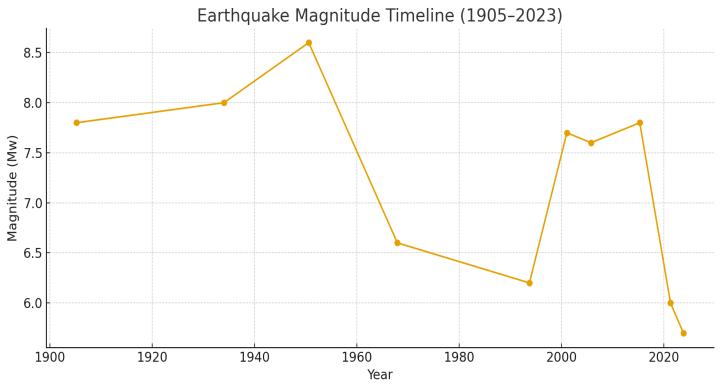
TheseismichistoryoftheIndiansubcontinentispunctuated byseveralhigh-magnitudeearthquakesthathaveprofoundly influenced scientific understanding, urban planning, and national disaster-management frameworks. Early instrumental and macro seismic records document a sequenceofgreatHimalayanearthquakesbeginningwiththe 1897 Shillong earthquake (Mw 8.0), characterized by a massive rupture along the Shillong Plateau’s blind thrust system, and the 1905 Kangra earthquake (Ms 7.8), which producedextensivedamageacrossthewesternHimalayan arc.
Subsequent events, including the 1934 Nepal–Bihar earthquake(Mw8.0)andthe1950Assam–Tibetearthquake (Mw 8.6), are among the most powerful continental earthquakesglobally.The1950earthquake,inparticular,is notable as the largest recorded intraplate continental megathrusteventinmodernseismologicalhistory.
More recently, intraplate seismic events have challenged long-heldassumptionsregardingthetectonicstabilityofthe peninsularshield.The1993Laturearthquake(Mw6.2)and the2001Bhujearthquake(Ms7.7)demonstratedthatdeeply buriedPrecambrianfaultsystemscanbereactivatedunder contemporary stress regimes, producing catastrophic outcomes.Additionally,the2015Gorkha(Nepal)earthquake (Mw7.8),thoughcenteredoutsideIndianTerritory,inflicted significant losses in northern India and highlighted the transboundary nature of seismic hazard within the Himalayanregion.
Collectively,theseeventsunderscorethecomplexinterplay between interpolate megathrust processes along the Himalayan arc and intraplate fault reactivation within the Indianshield.
Indiaexperiencesabroadspectrumofseismicactivity,with 200–250 earthquakes recorded annually, the majority of which fall below Mw 5.0 and remain imperceptible to the population.Thefrequency–magnitudedistributionofIndian earthquakes generally conforms to the Gutenberg–Richter relationship,withapronouncedclusteringofmoderate-tolargeeventsalongtheHimalayancollisionzone.
ThecentralandeasternHimalaya,owingtothelockednature of the Main Himalayan Thrust (MHT), exhibit recurrent moderate-to-strong earthquakes, reflecting ongoing strain accumulation.IntraplatedomainssuchasKachchhandthe Deccanregionfollowadistinctlydifferentseismicitypattern,
International Research Journal of Engineering and Technology (IRJET) e-ISSN: 2395-0056
Volume: 12 Issue: 12 | Dec 2025 www.irjet.net p-ISSN: 2395-0072
characterizedbyepisodic,high-magnitudeeventsseparated bylongrecurrenceintervals.
India’s national geophysical monitoring capability has improved significantly in the past decade. The number of seismicobservatoriesoperatedbytheIndiaMeteorological Department (IMD) increased from 80 in 2014 to 168 by February 2025, resulting indenser instrumental coverage, enhancedhypocentralaccuracy,andbetterdetectionoflowmagnitudeevents.Thisupgradednetworkallowsformore precise characterization of seismic hazard and supports advancedmethodologiessuchasProbabilisticSeismicHazard Analysis(PSHA)andreal-timeearly-warningalgorithms.
Earthquake-induced human and economic losses in India have historically been substantial. Data compiled by the National Disaster Management Authority (NDMA) indicate thatover22,000fatalitiesoccurredbetween1950and2019 due to major earthquakes. Among these, the 2001 Bhuj earthquake remains one of the deadliest intraplate events globally, causing between 13,805 and 20,023 deaths, widespread structural collapse, and economic losses estimatedatUSD10billion.
The 1993 Latur earthquake resulted in 9,748 fatalities, despiteitsmoderatemagnitude anoutcomeattributedto vulnerablemasonrystructuresandhighpopulationdensity intheaffectedareas.Similarly,the2005Kashmirearthquake, thoughcenteredinPakistan,generatedsubstantialdamagein the Indian-administered regions of Jammu and Kashmir, causing over 1,300 deaths and displacing several million people.
The persistent pattern of high casualty rates, disproportionatedamagetonon-engineeredbuildings,and severe socioeconomic disruption underscores India’s systemic vulnerability to seismic hazards. These historical losseshighlightthecriticalneedforsustainedinvestmentin seismic risk mitigation, urban micro zonation, resilient infrastructuredesign,andcommunity-levelpreparedness.
Date Location
(Mw)
(Estimated) TechnicalNotes liquefaction.
195008-15 Assam–Tibet 8.6 1,500–3,300
Strongest instrumentally recorded earthquake in India; large landslides.
Date Location Magnitude (Mw)
(Estimated) TechnicalNotes
190504-04 Kangra, Himachal Pradesh 7.8 >20,000
193401-15 Nepal–Bihar 8.0 6,000–10,700
MajorHimalayan rupture causing widespread devastation.
Severe basin amplification effectsacrossthe IGP; high
196712-11 Koyna, Maharashtra 6.6 177–180
199309-30 Latur, Maharashtra 6.2 9,748
200101-26 Bhuj,Gujarat 7.7 13,805–20,023
200510-08 Kashmir (India–Pakistan) 7.6 86,000–87,351*
201504-25 Nepal (impact in India) 7.8 8,964
202104-28 Assam 6.0 2
202311-03 NorthIndia& Nepal 5.7 153*
Classical case of reservoir-induced seismicity(RIS).
Intraplate reactivation of stable shield faults; unexpected severedamage.
Massive intraplate rupture; triggered major reformsinIndian seismiccodes.
Extremely destructive; causedheavyloss in India and Pakistan.
Devastating Himalayanevent; significant shaking in northernIndia.
Moderate intraplate event; structural damagereported.
Fatalities primarily in Nepal;structural damage across northernIndia.
International Research Journal of Engineering and Technology (IRJET) e-ISSN: 2395-0056
Volume: 12 Issue: 12 | Dec 2025 www.irjet.net p-ISSN: 2395-0072
India’sdisastergovernanceshiftedfromarelief-drivenmodel to a proactive risk-reduction system with the Disaster ManagementAct(2005). ThisAct establishedtheNational Disaster Management Authority (NDMA), State Disaster Management Authorities (SDMAs), and District Disaster Management Authorities (DDMAs) to oversee hazard assessment, policy formulation, and operational response. NDMA’s Earthquake Disaster Risk Index (EDRI) is a key nationalinitiativethatquantifiesseismichazard,exposure, andvulnerabilityacrossmajorIndiancitiestosupportriskinformedplanning.
India’sseismicengineeringframeworkisanchoredintheBIS codes,primarily: IS1893–definesseismiczonesanddesignforces. IS13920–mandatesductiledetailingforreinforcedconcrete structures.
The2001Bhujearthquaketriggeredmajorpolicyreforms, makingductiledetailingmandatoryinhigh-riskZonesIII–V. Thesecodesaimtopreventstructuralcollapseunderstrong shakingandminimizedamageduringmoderateearthquakes.
Recognizing the vulnerability of older, non-engineered buildings,Indiahasprioritizedseismicretrofittingofschools, hospitals,andlifelinestructures.Techniquesincludecolumn jacketing, steel bracing, shear wall addition, and base isolation. Government programs under NDMA and state agenciessupportvulnerabilityassessmentandrehabilitation, thoughlarge-scaleimplementationremainsconstrainedby financialandlogisticalchallenges.
India’s seismic observatory network has expanded significantly,improvingnationalmonitoringcapabilities.IMD nowoperatesmorethan160modernstations,enablingfaster detectionandimprovedhazardmodeling.PilotEarthquake Early Warning (EEW) systems have been deployed in UttarakhandandHimachalPradesh.Emergingtools suchas GNSS deformation networks, InSAR, and machine-learning models enhancereal-timesituationalawarenessandrisk forecasting.
Public awareness, community training, and school safety programsformthebackboneofIndia’searthquakeresilience strategy.Regular mock drills, first-responder training, and capacity-building initiatives for engineers and planners strengthen local preparedness. However, varying institutionalcapacityandlowpublicriskperceptionremain persistentchallenges.
Table – 2 Key Indian Seismic Codes and their Purpose Code Number TechnicalTitle Year of Latest Revision Technical Purpose / Scope
IS 1893 (Part1)
Criteria for EarthquakeResistantDesignof Structures 2002
IS4326
Code of Practice for EarthquakeResistant Design and Construction ofBuildings 1993
Establishes national seismic zoning, defines designbasisearthquake (DBE) forces, response spectra,andlateralload calculations for engineeredstructures.
Provides fundamental design principles, material requirements, and construction techniquesforenhancing seismic performance of masonry and concrete buildings.
IS13827
Guidelines for Improving Earthquake Resistance of EarthenBuildings 1993
IS13920
DuctileDetailingof Reinforced Concrete Structures Subjected to SeismicForces
1993
Offers empirical design rules, reinforcement strategies, and constructionpracticesto improveseismicstability of vernacular earthen structures.
Specifiesductiledetailing provisions(confinement reinforcement,lapsplice rules, shear design) for RC frames and shear walls; mandatory in Zones III–V post-Bhuj 2001.
IS13935 Guidelines for1993 Detailsmethodologiesfor
International Research Journal of Engineering and Technology (IRJET) e-ISSN: 2395-0056
Volume: 12 Issue: 12 | Dec 2025 www.irjet.net p-ISSN: 2395-0072
Code Number TechnicalTitle
RepairandSeismic Strengthening of Buildings
post-earthquakedamage assessment, retrofitting, and strengthening techniquesformasonry, timber, and RC structures.
6.1
ThisresearchdemonstratesthatIndia’sseismicvulnerability arises from a complex interplay of interpolate megathrust dynamics,intraplatefaultreactivation,andanthropogenically modulatedstressperturbations.Thedominantgeodynamic driver the ongoing convergence between the Indian and Eurasian plates continues to generate substantial strain accumulationalongtheHimalayanarcwhilesimultaneously transmitting stresses deep into the Precambrian cratonic interior. This far-field stress propagation facilitates the reactivation of ancient rift-basin faults and shear zones, challenginglongstandingassumptionsregardingthetectonic stabilityofthepeninsularshield.
SeismicriskinIndiaisfurthercompoundedbysite-specific geological amplifiers, most prominently within the IndoGangeticPlains,wherethickalluvialsequencessignificantly amplify ground-motion intensity through basin resonance and low shear-wave velocities. Consequently, seismic vulnerabilityinthisregionisgovernednotonlybyregional tectonicsbutbylocalgeotechnicalconditions,underscoring theimportanceofmicrozonation-basedhazardevaluation. Indiahasmadenotableprogressinstrengtheningitsdisaster management ecosystem through the establishment of institutionalframeworks(NDMA,SDMAs),thedevelopment of seismic design codes (IS 1893, IS 13920), expansion of monitoring infrastructure, and pilot deployment of earthquakeearlywarningsystems.However,theseadvances coexistwithstructural,financial,andoperationallimitations thatcontinuetoconstrainnationalresilience.
Despite improved institutional capacity and scientific understanding, several persistent challenges impede comprehensiveseismicriskreduction: Earthquake unpredictability: The stochastic nature of earthquake nucleation limits the capacity for precise forecasting, necessitating reliance on probabilistic hazard modelsandreal-timemonitoringratherthandeterministic prediction.
Retrofitting and infrastructure modernization: The cost of upgrading India’s vast inventory of non-engineered and
seismicallydeficientbuildingsissubstantial,posingfinancial andlogisticalchallenges particularlyindenselypopulated urbancorridors.
Codeenforcementlimitations:Inconsistentcompliancewith BISseismicprovisions,especiallyinperi-urbanandinformal constructionsectors,underminestheeffectivenessofexisting engineeringstandards.
Anthropogenicseismicityrisks:Largeinfrastructureprojects, groundwaterextraction,andreservoirimpoundmentrequire rigorous seismic risk assessment to mitigate induced seismicity.
Based on these constraints, the following evidence-driven recommendationsareproposed:
Expansionandintegrationofseismicmonitoringnetworks: Increasedensityofbroadbandseismometers,strong-motion accelerographs,andGNSSdeformationstations,particularly in high-risk urban clusters, to support real-time source characterizationandenhancedearlywarningcapabilities. Strengtheningofbuildingcodeenforcementandcompliance: Implementmandatorythird-partystructuralaudits,digitized approval systems,andrigorous fieldinspectionstoensure adherencetoIS1893andIS13920forbothnewconstruction andretrofitprojects.
Systematic retrofitting of vulnerable structures: Prioritizeseismicstrengtheningoflifelineinfrastructure hospitals,schools,bridges,dams andadoptcost-effective retrofit technologies tailored for low-income urban settlements.
Mandatory seismic hazard assessments for major infrastructureprojects:Requireprobabilistichazardanalysis (PSHA),site-responsestudies,andriskmodelingfordams, energyfacilities,metrosystems,andhigh-risedevelopments to reduce the potential for human-induced or triggered seismicity.
Nationwide community preparedness and risk communicationprograms:Institutionalizepubliceducation campaigns, school safety programs, and community emergencyresponsetrainingtocultivateacultureofseismic resilience, ensuring that risk awareness and preparedness extendbeyondtechnicalinstitutionstosocietyatlarge. Collectively,thesemeasuresalignwiththestrategicnational goal of establishing a robust, multi-layered, and sciencedriven earthquake resilience framework capable of safeguardingIndia’srapidlyurbanizinglandscapeandcritical infrastructuresystemsinthedecadesahead.
IrjetTemplatesampleparagraph.Defineabbreviationsand acronymsthefirsttimetheyareusedinthetext,evenafter theyhavebeendefinedintheabstract.Abbreviationssuchas IEEE,SI,MKS,CGS,sc,dc,andrmsdonothavetobedefined. Donotuseabbreviationsinthetitleorheadsunlesstheyare unavoidable.
International Research Journal of Engineering and Technology (IRJET) e-ISSN: 2395-0056
Volume: 12 Issue: 12 | Dec 2025 www.irjet.net p-ISSN: 2395-0072
[1] P.K.Yadavetal.,“AStudyandAnalysisofEarthquakein India,” IndianJournalofScienceandResearch,2023.
[2] Plutus IAS, “Making India More Disaster-Resilient,” PlutusIAS,(n.d.).
[3] Press Information Bureau (PIB), “Making India More Disaster-Resilient,”PIB,(n.d.).
[4] IIT Kanpur, “What are the Indian Seismic Codes?,” EarthquakeTip,IITK,(n.d.).
[5] BMTCP, “What are the Indian Seismic Codes?,” EarthquakeTip,BMTCP,(n.d.).
[6] Wikipedia, “Earthquake Zones of India,” Wikipedia, (accessed2024).
[7] Lukmaan IAS, “Why Are Earthquakes Frequent in the IndianSubcontinentRegion?,”lukmaanias.com,(n.d.).
[8] JICEIAS,“India'sWater-EnergyDemand:SpotlightRisk ofHuman-InducedQuakes,”jiceias.com,(n.d.).
[9] PW Only IAS, “Human-Induced Earthquakes,” pwonlyias.com,(n.d.).
[10] Press Information Bureau (PIB), “Earthquake-Prone AreasoftheCountryHaveBeenIdentified,”PIB,(n.d.).
[11] AcademicOUP,“SedimentaryThicknessandShearWave VelocityStructureintheWesternIndo-GangeticPlain,” academic.oup.com,(n.d.).
[12] ResearchGate,“TheSeismotectonicSettingoftheIndoGangetic Plain and Its Importance,” researchgate.net, (n.d.).
[13] ScholarsMine,“GeotechnicalAssessmentandEvaluation oftheImpactofthe2001Kachchh(Bhuj)Earthquake,” scholarsmine.mst.edu,(n.d.).
[14] GeospatialWorld,“ReappraisalofKachchhEarthquake,” geospatialworld.net,(n.d.).
[15] ResearchGate, “Geological Units and the Tectonic FeaturesinSouthernIndia,”researchgate.net,(n.d.).
[16] Disaster Shiksha, “India Hazard Vulnerability,” disaster.shiksha,(n.d.).
[17] Amoghavarsha IAS KAS, “Earthquake Zones in India,” amoghavarshaiaskas.in,(n.d.).
[18] NationalCenterforSeismology,“EarthquakesinIndia,” seismo.gov.in,(n.d.).
[19] NationalCenterforSeismology,“AboutNationalCenter forSeismology,”seismo.gov.in,(n.d.).
[20] PressInformationBureau(PIB),“NDMAProjects,”PIB, (n.d.).
2025, IRJET | Impact Factor value: 8.315 | ISO 9001:2008