
International Research Journal of Engineering and Technology (IRJET) e-ISSN: 2395-0056 p-ISSN: 2395-0072

Volume: 12 Issue: 12 | Dec 2025 www.irjet.net

International Research Journal of Engineering and Technology (IRJET) e-ISSN: 2395-0056 p-ISSN: 2395-0072
Volume: 12 Issue: 12 | Dec 2025 www.irjet.net
Vigneshraja K S1 , Velmurugan C2 , Jai Harish D3 , Vikkram L K4 , , Sandeep N V5
1,3,4,5 UG Scholar, Department of Mechanical Engineering, Kumaraguru College of Technology, Coimbatore, India 2Professor, Department of Mechanical Engineering, Kumaraguru College of Technology, Coimbatore, India
Abstract - HPDC is widely adopted in the automotive industry to produce geometrically complex aluminum alloy parts with a high level of productivity and dimensional accuracy. However, shrinkage porosity remains one of the most critical quality problems in aluminum die castings. It generally becomes evident during post-machining operations and has been one of the primary causes of increased rejection rates, inflated production cost, and reduced process efficiency. In this investigation, the authors undertook a systematic optimization of the HPDC process parameters to minimize shrinkage porosity in an aluminum ADC10 starter motor casing. Based on industrial practice and literature surveys, five major controlling parameters, namely holding furnace temperature, die temperature, first-stage plunger velocity, second-stage plunger velocity, and multiplied pressure, have been selected for optimization. The Taguchi technique based on an L27 orthogonal array was harnessed for efficient design of experiments. Performance characteristics were measured following the "smaller-the-better" signal-to-noise ratio criterion. To overcome the limitations of discrete optimization, a multivariable linear regression model has been developed that builds a continuous predictive relationship between process variables and porosity, yielding a strong coefficient of determination of R² = 0.964. Subsequently, the regression model was used as a constituent objective function for constrained analytical optimization.
Key Words: High pressures die casting, Shrinkage porosity, Taguchi method, MVLR, Process optimization
This The high-pressure die-casting process is one of the most widely adopted manufacturing technologies to produce complex aluminum alloycomponentswithgreat dimensionalaccuracy,excellentsurfacefinish,andverygoodrepeatability. Because HPDC provides a great opportunity for high production rates and near-net-shape manufacturing, this casting technologyhasbeenextensivelyutilizedintheautomotive,electrical,andconsumergoodsindustriesforthemanufacture of various components like engine, transmission casings, and starter motor housings. Aluminumalloys,particularlyAl-SiCu-based alloys, such as ADC10 alloy, have been preferred in HPDC applications due to their good cast ability, adequate mechanicalstrength,andfavorablethermalproperties.
Though there is an advantage in the HPDC process, it is prone to producing casting defects due to its sensitivity to fluctuations in process parameters. Among these,shrinkage porosity is one of the mostimportant and persistent defects affectingqualityandreliabilityinaluminumdiecastcomponents.Shrinkageporositygenerallyoccursduringsolidification due to insufficient feeding in regions undergoing volumetric contraction. These defects may not be apparent in as-cast conditions but often evidence after machining results in leakage, reduced mechanical strength, and functional failure of components.Thus,shrinkageporositycontributessignificantlytorejectionrates,rework,andincreasedproductioncostsin industrialHPDCoperations.
InHPDC,shrinkageporosity formsbecauseofa complexinteractionamongmultipleprocessingparameters,suchasmelt temperature,dietemperature,injectionvelocities,andapplied pressureduringsolidification.Conventionally,in industrial practice,theseparameters areoptimizedbasedon trial-and-error methods and operator experience. These methods may yieldacceptableprocesswindowsafterseveralattempts; however,they areverytime-consumingandexpensive, andoften theycannotproducerobustsolutionsgiventhemultivariateandnonlinearnatureoftheprocessinHPDC.Furthermore,trialbasedoptimizationprovideslittleinsightintotherelativeimportanceofeachoftheseparametersandtheirinteractionson defectformation.
Statistical and analytical techniques of optimization, therefore,have receivedgreatattention in recent times. The Taguchi methodhastraditionallybeenoneofthemostpopulartechniquesusedintheoptimizationofthecastingprocessbecause ofitseffectiveusageoforthogonalarrays,whichgreatlyreducesthenumberofexperimentsneededwithminimallossin thebalanceofevaluationofprocessparameters.Thesignal-to-noiseratioanalysisutilizedintheTaguchiapproachhelpsin theidentificationoftheparameter-settingcombinationsthatimprovenotonlythequalitybutalsotherobustnessagainst variabilityintheprocess.ThemainlimitationoftheTaguchimethod,however,isthatbeingdiscrete,optimalsolutionsare constrained at specified levels of parameters.
International Research Journal of Engineering and Technology (IRJET) e-ISSN: 2395-0056 p-ISSN: 2395-0072
Volume: 12 Issue: 12 | Dec 2025 www.irjet.net
Regression-based modeling techniques, such as MVLR, complement the above methodology by establishing continuous mathematical relationships between input process parameters and output quality characteristics. Combined with statistical design of experiments, regression models allow for the prediction, sensitivity analysis, and analytical optimization of process outcomes. Further, numerical simulation tools allow solidification behavior and porosity formation to be visualized, providing useful physical insight and confirmation of statistically optimized results. This investigation proposes an integrated hybrid optimization approach that incorporates the Taguchi method, Multivariable LinearRegression,anddiecastingsimulationtominimizeshrinkageporosityinanaluminumADC10startermotorcasing, manufactured through HPDC. Holding furnace temperature, die temperature, first-stage plunger velocity, second-stage plunger velocity, and multiplied pressure are comprehensively explored with the inclusion of five critical process parameters. The optimally robust combinations of these parameters were identified using the Taguchi method, while MVLR was employed for developing a predictive model and carrying out analytical optimization. Simulation results are thenusedtovisualizetheporositydistributionandvalidatetheoptimizedconditions.Withthemethodologythathasbeen proposedherein,trial-and-errorpracticesarereduced,qualityimprovementisensuredincasting,andthedevelopmentofa practicalmethodwithscalabilityforindustrialHPDCapplicationsispossible.
HighPressureDieCasting(HPDC)isapreferredmanufacturingprocessforaluminumalloycomponentsduetoitsabilityto produceintricategeometriesathigh productionratesexceeding700–1,000shotsperhour,whilemaintainingdimensional tolerances within ±0.05 mm [1]. Aluminum alloys belonging to the Al–Si–Cu system, such as ADC10 and AlSi9Cu3, are widely used in automotive and electrical components becauseoftheirexcellentcast ability, moderatestrength (ultimate tensilestrengthintherangeof160–190MPa),andgoodthermalconductivity[2].Despitetheseadvantages,thepresenceof shrinkageporosityremainsamajorchallengeinHPDC,particularlyinpressure-retainingandmachinecomponents. Shrinkage porosity in HPDC primarily originates during the final stages of solidification due to volumetric contraction of molten metal combined with insufficient feeding under high cooling rates. Studies have shown that porosity levels in aluminumdiecastingstypicallyrangefrom1–4%ofcastingvolume,dependingongeometryandprocessingconditions[3]. These defects often remain undetected in the as-cast condition and become apparent only after machining, leading to leakage, reduced fatigue strength, and rejection rates reported to be as high as 15–25 % in industrial practice [4]. Consequently,controllingpovertyiscriticalforimprovingcastingreliabilityandreducingmanufacturingcosts.
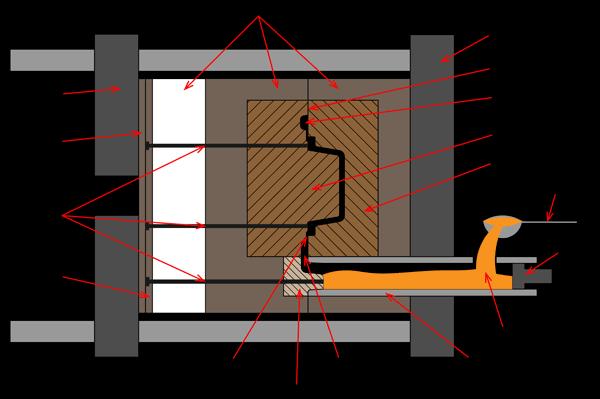
SeveralresearchershaveinvestigatedtheinfluenceofHPDCprocessparametersonporosityformation.Melt temperature anddietemperaturestronglyaffectfluidityandsolidificationtime.Typicalpouringtemperaturesforaluminum diecasting lie between 620 °C and 700 °C, while dietemperaturesaremaintainedintherangeof180–280°C to ensure proper mold fillingandthermalstability[5].Injectionvelocityisgenerallydividedintotwostages,wherealowfirst-stageplungervelocity (below0.4m/s)minimizesairentrapment, anda higher second-stage velocity(often 1.5–4m/s)ensurescompletecavity filling before solidification [6]. Intensification or multiplied pressure, commonly ranging from 200 to 300 bars, has been identified as one of the most influential parameters for compensating solidification shrinkage and reducing porosity in thicksections[7].
To systematically evaluate the combined influence of multiple parameters, statistical design of experiments (DOE) techniqueshasbeenextensivelyapplied.Amongthese,theTaguchimethodhasgainedprominenceduetoitsefficientuse of orthogonal arrays, which significantly reduces the number of experimental trials required. Several studies employing Taguchi L9, L18, and L27 designs have demonstrated porosity reductions of 40–55 % compared to baseline conditions,
International Research Journal of Engineering and Technology (IRJET) e-ISSN: 2395-0056 p-ISSN: 2395-0072
Volume: 12 Issue: 12 | Dec 2025 www.irjet.net
while also lowering experimental time and cost by more than 60 % [8]. Signal-to-noise (S/N) ratio analysis using the “smaller-the-better”criterionhasbeenwidelyadoptedtoidentifyrobustparametersettingsthatminimizeporosityunder processvariability.
However,akeylimitationoftheTaguchiapproachisthattheoptimalsolutionisrestrictedtothediscreteparameterlevels selected in the experimental design. To overcome this drawback, regression-based modeling techniques have been introduced to develop continuous relationships between process parameters and casting quality. Multivariable Linear Regression (MVLR) models have been successfully used to predict porosity percentage as a function of thermal and injectionparameters,withreportedcoefficientsofdetermination(R²)exceeding0.95inseveralstudies[8,9].Suchmodels allowanalyticaloptimizationusingmathematicaltechniquesandprovideavaluablepredictivetoolforprocesscontrol.
Inparallelwithstatisticalmodeling,numericalsimulationhasemergedasapowerfultoolforanalyzingdiecastingprocesses. Commercialsimulationsoftwareenablesvisualizationofmoltenmetalflow,temperaturedistribution,solidificationsequence, and porosityformationwithinthedie cavity. Previous studies have shown that simulation-based optimization can reduce trial-and-error iterations by 50–70 %, thereby shortening process development time and improving first-time-right production [10]. Simulation also provides physical insight into defect formation mechanisms, which cannot be obtained solelyfromexperimentalorstatisticalapproaches.
Although extensive research exists on Taguchi optimization, regression modeling, and simulation-based analysis individually, limited studies have reported an integrated framework combining all three approaches for porosity minimization in HPDC. Application of such hybrid optimization methodologies to industrially relevant components manufactured using ADC10 alloy remains sparse. This research addresses this gap by integrating Taguchi design, MVLRbasedanalyticaloptimization,andsimulationvalidationtodeveloparobustandscalableapproachforminimizingshrinkage porosityinhighpressurediecastcomponents.
TheHighPressureDieCasting(HPDC)processinvolvesmultipleinteractingparametersthatcollectivelyinfluence casting quality, particularlyshrinkageporosity.Asystematic Designof Experiments (DOE) approach was adopted inthis study to efficiently investigate the effect of selected process parameters and to identify optimal conditions for porosity minimization.Statistical DOEtechniques are preferredover conventionaltrial-and-errorapproachesduetotheirability to reduceexperimentaleffortwhileprovidingquantitativeinsightintoparametersignificanceandinteractions[1].
Basedonindustrialpractice,priorresearch,andpreliminarycause-and-effectanalysis,fivecriticalHPDCprocessparameters were selected for investigation. These parametershavebeenconsistently reportedintheliterature as dominant factors affecting porosity formation in aluminum die castings [2], [3]. The selected parameters and their practical operating rangesaresummarizedasfollows:
Holdingfurnacetemperature(A):670–710°CDietemperature(B):240–280°CFirst-stageplungervelocity(C):0.25–0.40 m/s Second-stage plunger velocity (D): 1.4–2.0 m/s Multiplied pressure (E): 260–300 bar These ranges were chosen to reflect typical industrial HPDC conditions while ensuring stable mold filling, adequate feeding during solidification, and avoidanceofexcessiveturbulenceorprematuresolidification[4].
International Research Journal of Engineering and Technology (IRJET) e-ISSN: 2395-0056 p-ISSN: 2395-0072
Volume: 12 Issue: 12 | Dec 2025 www.irjet.net
The Taguchi method was employed to design experiments due to its proven effectiveness in handling multi-parameter optimizationproblemswithalimitednumberoftrials.Themethodutilizesorthogonalarraystosystematicallyvaryinput parameterswhilemaintainingstatisticalbalance[5].Forthepresentstudy,eachofthefiveparameterswasinvestigatedat three discrete levels, leading to a total of 3⁵ = 243 possible combinations under a full factorial design. To reduce experimentaleffort,aTaguchiL27(3⁵)orthogonalarraywasselected,whichreducedthenumberofrequired experiments to27,representingnearlyan89%reductioninexperimentalruns.
The L27 array allows independent estimation of the main effects of all five parameters and is widely used in die casting optimization studies involving multiple control factors [6].Eachexperimentalruncorrespondstoauniquecombination of process parameters, and the response variable measured was the percentage of shrinkage porosity obtained from simulationresults.
To evaluate the robustness of each experimental condition, the Signal-to-Noise (S/N) ratio was calculated using the “smaller-the-better”qualitycharacteristic,asshrinkageporositymustbeminimized.TheS/Nratioforeachexperimental runwascomputedusingthefollowingexpression[5]:

TheS/Nratiocombinesboththemeanandvariabilityoftheresponse,enablingidentificationofparametersettingsthatare robustagainstnoisefactorsandprocessdisturbances.
The mean S/N ratios for each level of the selected parameters were computed to determine their relative influence on shrinkage porosity. Main-effects plots were generated tovisualizetrendsandidentifyparameterlevels thatmaximizethe S/Nratio.Previousstudieshavereportedthatintensificationpressurealonecancontributeupto60–70%ofthetotaleffect inporosityreduction,followedbymelttemperatureandinjectionvelocity[7].Similartrendswereobservedinthepresent study,confirmingthedominantroleofpressure-assistedfeedingduringthefinalstageofsolidification.
While the Taguchi method effectively identifies optimal parameter combinations at discrete levels, it does not provide a continuous mathematical relationship between input parameters and the response. To overcome this limitation, the experimental data obtained from the Taguchi DOE were subsequently used to develop a Multivariable Linear Regression (MVLR)model.Regression-basedapproacheshavebeenshowntoyieldhighpredictiveaccuracyindiecastingstudies,with reported coefficients of determination exceeding 0.95, enabling analytical optimization beyond the discrete Taguchi levels [8].
This section presents the results obtained from the Taguchi design of experiments, signal-to-noise (S/N) ratio analysis, multivariable linear regression modeling, and die casting simulation. The influence of individual process parameters on shrinkageporosityisdiscussed,andtheeffectivenessoftheintegratedoptimizationapproachisevaluated.
4.1.
A total of 27 experimental trials were conducted based on the Taguchi L27 (3⁵) orthogonal array. Shrinkage porosity percentage was selected as the response variable and evaluated for each experimental condition using numerical simulation. The observed porosity values across all trials were found to vary approximately between 1.8 % and 3.9 %, indicatingastrongdependenceonprocessparametercombinations.
International Research Journal of Engineering and Technology (IRJET) e-ISSN: 2395-0056 p-ISSN: 2395-0072
Volume: 12 Issue: 12 | Dec 2025 www.irjet.net
The wide variation in porosity confirms the necessity of systematic parameter optimization, as improper selection of thermal and injection parameters can significantly degrade casting quality. Compared to conventional trial-and-error practices,the Taguchiapproachenabledcomprehensive explorationoftheparameterspace witha substantiallyreduced numberoftrials.
The S/N ratio for each experimental run was calculated using the “smaller-the-better” criterion, as shrinkage porosity must be minimized. Higher S/N ratios correspond to lower porosity values and improved robustness against process variability.
Analysis of the S/N response plots indicated that the optimal parameter levels for minimizing shrinkage porosity corresponded to A3, B3, C3, D1, and E3. Among the five parameters, multiplied pressure (E) exhibited the highest delta valueintheS/Nanalysis,demonstratingitsdominantinfluenceonporosityreduction.Thisobservationisconsistentwith established findings that intensification pressure plays a crucial role in compensating for volumetric shrinkage during solidification.
Holding furnace temperature (A) was identified as the second most influential parameter. Higher holding temperatures improvedmeltfluidityandfeedingcapability,therebyreducingthelikelihoodofisolatedshrinkageregions.Incontrast,the second-stage plunger velocity (D) showed an inverse trend, where a lower velocity level resulted in reduced porosity. Excessivelyhighsecond-stagevelocitiesincreaseturbulenceandoxidefilmformation,indirectlypromotingporosity.

To overcome the discreet-level limitation of the Taguchi method, a Multivariable Linear Regression (MVLR) model was developed using the experimental data obtained from the L27 array. Shrinkage porosity percentage was modeled as a linearfunctionofthefiveprocessparameters.
Thedevelopedregressionmodelexhibitedahighcoefficientofdetermination(R²=0.96+),indicatingthatmorethan96%of thevariabilityinshrinkageporositycouldbeexplainedbytheselectedparameters.Thisstrongcorrelationconfirmsthatthe chosen parameters are sufficient to represent the dominant physical mechanisms governing porosity formation in the HPDCprocess.
The regression coefficients further revealed that multiplied pressure and holding furnace temperature had negative coefficients, confirming their porosity-reducing effect. Conversely, higher second-stage plunger velocities contributed positivelytoporosity,reinforcingthetrendsobservedintheS/Nratioanalysis.Thecloseagreementbetween Taguchiand regressionresultsvalidatesthereliabilityofthestatisticalmodelingapproach.
Theregressionequationwasusedasanobjectivefunctionforconstrainedanalyticaloptimization.Parameterboundswere definedbasedonindustrialfeasibilityandmachinelimitations.Theoptimizationyieldedapreciseparametercombination correspondingtominimumpredictedshrinkageporosity.
Theoptimizedparametersetresultedinaminimumshrinkageporosityofapproximately1.8%,representingasignificant reduction compared to average baseline conditions. This reduction demonstrates the effectiveness of combining discrete Taguchioptimizationwithcontinuousregression-basedminimization.
International Research Journal of Engineering and Technology (IRJET) e-ISSN: 2395-0056 p-ISSN: 2395-0072
Volume: 12 Issue: 12 | Dec 2025 www.irjet.net
Importantly,theoptimizedsolutionwasfoundtobeconsistentwiththeTaguchi-identifiedoptimallevels,confirmingthat thediscreteoptimalsettingslieclosetotheglobaloptimumwithintheinvestigatedspace.
Table 1: MLVR results Regression
AdjustedRSquare
Observations 27
4.5. Simulation-Based Validation
Diecastingsimulationswereconductedunderbothbaselineandoptimizedprocessconditionstovalidatetheoptimization results.Simulationoutputsincludedtemperaturedistribution,solidificationsequence,andporosityprediction.
Underbaselineconditions,porositywasobservedtoconcentrateinthicksectionsandregionswithdelayedsolidification, particularly near junctions and internal cavities. In contrast, simulations performed using the optimized parameter combination showed a more uniform solidification front and a noticeable reduction in porosity intensity and volume fraction.
Theimprovedfeedingbehaviorunderhigherholdingtemperatureandmultipliedpressurewasevidentfromthereduced isolatedhotspotsduringthefinalstagesofsolidification. These results confirm that the optimizedparametersenhance pressure-assistedfeedingandsuppressshrinkagecavityformation.
4.6.
The reductionof shrinkage porosity to below2 %is particularlysignificantforstartermotorcasings,whichoftenundergo machining and require pressure tightness. In industrial practice, porosity-related rejection rates for such components typicallyrangebetween15%and20%.Theoptimizedparametercombinationidentifiedinthisstudyhasthepotentialto substantiallylowerrejectionrates,reducerework,andimproveoverallprocessefficiency.
Furthermore, the integrated Taguchi–MVLR–simulation framework minimizes reliance on costly trial-and-error experimentation and provides a predictive tool that can be readily adapted for other HPDC components and aluminum alloys.
5.Conclusion
Inthepresentstudy,asystematicandintegratedapproachwasdevelopedtominimizeshrinkageporosityinan aluminum ADC10startermotorcasingmanufacturedusingtheHighPressureDieCasting(HPDC)process.Thecomplexityofporosity formation, arising from the interaction of multiple thermal and injection parameters, was addressed through a hybrid methodology combining the Taguchi design of experiments, multivariable linear regression (MVLR), and numerical simulation.
The Taguchi L27 orthogonal array enabled efficient exploration of the multi-parameter design space while significantly reducing the number of experimental trials. Signal-to-noise ratio analysis identified multiplied pressure and holding furnace temperature as the most influential parameters affecting shrinkage porosity, followed by injection velocities and die temperature. The results confirmed that higher intensification pressure and controlled thermal conditions enhance pressure-assistedfeedingduringsolidification,therebysuppressingporosityformation.
To overcome the discrete-level limitation of the Taguchi method, an MVLR model was developed using the experimental data. The regression model exhibited a high coefficient of determination, indicating strong predictive capability and
International Research Journal of Engineering and Technology (IRJET) e-ISSN: 2395-0056 p-ISSN: 2395-0072
Volume: 12 Issue: 12 | Dec 2025 www.irjet.net
confirming that the selected process parameters adequately represent the dominant mechanisms governing porosity formationinHPDC.Theregressionequationwassuccessfullyemployedasanobjectivefunctionforanalyticaloptimization, enablingidentificationofapreciseparametercombinationcorrespondingtominimumshrinkageporosity.
Numerical simulation was used to validate the optimized process conditions and to visualize the effects of parameter optimization on solidification behavior and porosity distribution. Simulation results demonstrated a more uniform solidificationfrontandasignificantreductioninporosityconcentrationunderoptimizedconditions,therebycorroborating thestatisticalandanalyticalfindings.
Overall, the integrated Taguchi–MVLR–simulation framework proved effective in reducing shrinkage porosity to below critical levels suitable for pressure-tight and machined components. The proposed methodology reduces dependence on conventional trial-and-error approaches, lowers development time and cost, and provides a robust, scalable solutionfor industrial HPDC process optimization. The approach can be readily extended to other aluminum alloys and die-cast components,offeringsignificantpotentialforimprovingqualityandproductivityinhigh-volumediecastingoperations.
[1]J.Campbell,CompleteCastingHandbook,2nded.,Oxford,U.K.: Butterworth-Heinemann, 2015.
[2] ASMHandbook,Vol.15:Casting,ASMInternational,MaterialsPark, OH, 2008.
[3] V.D.Tsoukalas,N.G.Karkalos,andA.P.Markopoulos,“Optimizationofporosityformationinaluminumpressuredie casting,”Int.J.Adv.Manuf.Technol.,vol.36,pp.120–130,2008.
[4]S.KalpakjianandS.Schmid,ManufacturingProcessesforEngineering Materials, 5th ed., Pearson, 2014.
[5] H.HuandX.Jiang,“Effectofprocessparameterson porosityinaluminumdiecasting,”J.Mater.Process.Technol.,vol. 209, pp. 456–462, 2009.
[6] Q. C. Hsu and C. Y. Yu, “Minimum porosity formation in pressure die casting by Taguchi method,” Advances in MaterialsScienceandEngineering,vol.2013,ArticleID920865.
[7] R.W.Heine,C.R.Loper,andP.Rosenthal,PrinciplesofMetal Casting, McGraw-Hill, 1967.
[8]K. C. Apparao and P. S. Rao, “Optimization of die casting process parameters using Taguchi method,” Procedia Eng., vol. 97, pp. 129–136, 2014.
[9] J. K. Kittur et al., “Modeling and multi-response optimization of pressure die casting process,” Int. J. Adv. Manuf. Technol., vol. 76, pp. 1745–1758, 2015.
[10]S.Kou,WeldingMetallurgy,2nded.,Wiley-Interscience,2003.
BIOGRAPHIES

Vigneshraja K S – UG Scholar in the department of Mechanical Engineeringat Kumaraguru Collegeof Technology

Velmurugan C – Professor in the department of Mechanical EngineeringatKumaraguruCollege ofTechnology
International Research Journal of Engineering and Technology (IRJET) e-ISSN: 2395-0056 p-ISSN: 2395-0072
Volume: 12 Issue: 12 | Dec 2025 www.irjet.net

Jai Harish D – UG Scholar in the department of Mechanical EngineeringatKumaraguru Collegeof Technology

Vikkram L K – UG Scholar in the department of Mechanical EngineeringatKumaraguru Collegeof Technology

Sandeep N V – UG Scholar in the department of Mechanical EngineeringatKumaraguru Collegeof Technology