
International Research Journal of Engineering and Technology (IRJET) e-ISSN: 2395-0056
Volume: 12 Issue: 12 | Dec 2025 www.irjet.net p-ISSN: 2395-0072
International Research Journal of Engineering and Technology (IRJET) e-ISSN: 2395-0056
Volume: 12 Issue: 12 | Dec 2025 www.irjet.net p-ISSN: 2395-0072
Ajay Jaiswal1, Sachin Verma2, Om Ninawe3, Vipul Tayde4,Vedant Borkute5, Ashwini Galhat6 , Nihal Bawankule7, Maithili Dhage8
1Head of Department, Dept of Computer Science and Engineering, KDK College of Engineering, Maharashtra, India
2Assistant Professor, Dept of Computer Science and Engineering, KDK College of Engineering, Maharashtra, India 345678UG Student ,Dept of Computer Science and Engineering, KDK College of Engineering, Maharashtra, India
Abstract - Accesstotimelyhealthcareservicesremainsa major challenge in rural areas due to limited medical infrastructure and lack of coordination between patients and local pharmacies. Health Bridge 360 is a web-based healthcare support platform designed to improve medicine accessibility, prescription handling, and medication adherence for rural communities. The system enables users to search nearby pharmacies, upload digital prescriptions, receive automated medicine reminders, and accessemergencyassistancethroughaunifiedinterface.A dedicated pharmacy dashboard supports inventory management, order processing, and emergency alerts. Experimental implementation and testing demonstrate that HealthBridge 360 functions as a reliable working model capable of reducing treatment delays and enhancing healthcare service delivery. The proposed solution highlights the potential of digital platforms in strengtheningruralhealthcareecosystems
Key Words: Rural Healthcare, Local Pharmacy Integration, Digital Prescription Management, Medicine Availability System, Automated Medication Reminders, HealthcareAutomation.
Healthcaredeliveryinruralareasremainsaffectedby inadequate infrastructure, shortage of medical professionals,andlimitedaccesstopharmacies.Patients often rely on paper-based prescriptions and manual follow-ups, which increases the risk of delayed treatment and improper medication intake. Elderly individuals and patients suffering from chronic illnesses are particularly vulnerable to missed doses and lack of monitoring.
The increasing penetration of smartphones and digital services presents an opportunity to improve healthcare accessibility through technology-driven solutions. However, many existing healthcare applications are designed primarily for urban users and fail to consider rural challenges such as language diversity, low digital literacy, and absence of real-time information on local medicineavailability.HealthBridge360isproposedasa mobile-first healthcare platform that connects rural patients with nearby pharmacies while providing digital
prescription management and automated medication reminders.
The primary aim of Health Bridge 360 is to deliver a reliable, accessible, and user-friendly healthcare system tailored to rural needs. By integrating prescription uploads, local pharmacy coordination, and reminder services, the platform seek to enhance medication adherenceandimproveoverallhealthoutcomes.
Recent studies have emphasized the growing role of digital technologies in improving healthcare monitoring and medication adherence, particularly in resourceconstrained environments. Several researchers have proposedreminder-basedsystemstosupportpatientsin following prescribed medication schedules effectively. IoT-based medicine reminder systems have demonstrated improved compliance by delivering automated alerts and basic monitoring functionalities. Similarly, mobile applications developed for medication reminders have shown positive outcomes in reducing misseddosesandenhancingtreatmenteffectiveness.
In addition to software-based solutions, researchers have also explored smart medicine reminder boxes and integrated healthcare monitoring devices that combine bothhardwareandsoftwarecomponents.Thesesystems aim to assist patients, especially elderly individuals, in maintaining regular medication routines. Analytical studies examining the impact of reminder systems report a strong correlation between automated notifications and improved medication adherence, with notable benefits observed among elderly and rural populations.
Despite these advancements, most existing solutions address healthcare management in a fragmented manner.Manyapplications focussolelyon remindersor monitoring without integrating local pharmacy services or digital prescription handling. Furthermore, limited consideration has been given to multilingual support, real-time medicine availability, and the operational requirements of small-scale rural pharmacies. As a result, there remains a need for a comprehensive,
International Research Journal of Engineering and Technology (IRJET) e-ISSN: 2395-0056
mobile-first healthcare platform that can integrate patientservices,pharmacycoordination,andmedication adherence mechanisms within a unified system tailored specificallyforruralhealthcareenvironments.
Ananalysisofexistingliteraturerevealsseveralresearch gapsthatneedtobeaddressed:
1. Most existing digital healthcare solutions are primarily designed for urban settings and centralized hospital systems, with limited focus on addressing healthcare accessibility challengesinruralareas[1],[2].
2. Current medicine reminder and prescription management applications improve medication adherence but lack real-time integration with nearby local pharmacies for medicine availabilityandprescriptionverification[3].
3. Existing healthcare platformsdo not adequately support inventory management, order tracking, and operational needs of small-scale rural pharmacies, leading to delays in medicine procurement[4].
4. Emergency healthcare solutions discussed in prior studies rely mainly on hospital-based infrastructures and do not incorporate community-level support through local pharmacies and location-based emergency alerts[5].
5. A significant portion of the literature presents conceptual frameworks or survey-based analyses, with limited evidence of a fully implemented and tested working model that integrates patient services, pharmacy dashboards, and emergency assistance in a singleplatform[6].
HealthBridge 360 addresses these gaps by offering an integrated, location-aware, and multilingual healthcare platformdesignedtomeetruralhealthcareneeds.
The primary objectives of the Health Bridge 360 system areoutlinedbelow:
1. To design and develop a mobile-first healthcare platform specifically tailored for rural communities, ensuringease ofuse,accessibility, andsupportformultipleregionallanguages.
2. To facilitate seamless access to essential medicinesbyenablinguserstosearchforlocally
available medicines and place orders through nearby pharmacies using location-based services.
3. To implement a secure digital prescription managementsystemthatallowsuserstoupload prescriptions and enables pharmacists to verify andprocessthemefficiently.
4. To improve medication adherence by providing automated medicine reminders and real-time notifications related to dosage schedules, order status,andprescriptionverification.
The development of Health Bridge 360 is motivated by thefollowingkeyproblemsobservedinruralhealthcare systems:
1. Rural populations face limited access to timely healthcare services due to inadequate medical infrastructure and insufficient availability of nearby pharmacies, resulting in delayed treatment.
2. Manual handling of prescriptions and lack of digital systems often lead to difficulties in medicine procurement, prescription mismanagement, and missed medication schedules.
3. Absence of automated reminder mechanisms causes poor medication adherence, especially amongelderlypatientsandindividualssuffering fromchronicillnesses.
4. Existing healthcare applications are largely urban-centric and fail to address rural-specific challengessuchaslanguagebarriers,lowdigital literacy, and lack of integration between patientsandlocalpharmacies. Thesechallengeshighlighttheneedforaunified,mobilebased healthcare platform that can connect rural patients with nearby pharmacies, support digital prescription management, and provide automated reminders to improve healthcare accessibility and treatmentcompliance.
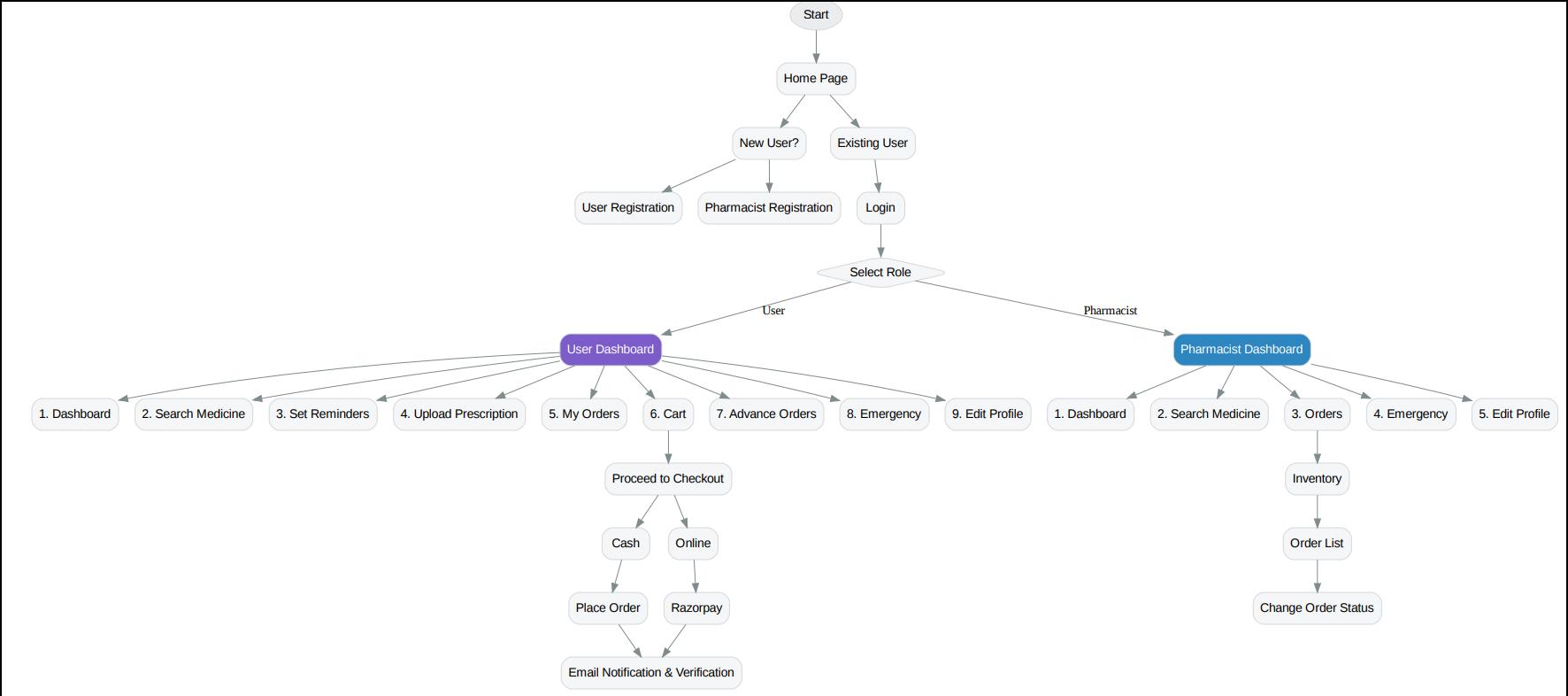
This section describes the design approach and operational workflow of the Health Bridge 360 system. The methodology outlines the system architecture, user interaction flow, backend processing, and notification mechanisms employed to achieve the proposed objectives. Health Bridge 360 is developed using a modular and scalable architecture that integrates frontendinterfaces,backendprocessing,andthird-party services to deliver efficient and reliable healthcare support for rural communities. The overall system flow isillustratedinFig.1.
Volume: 12 Issue: 12 | Dec 2025 www.irjet.net p-ISSN: 2395-0072 © 2025, IRJET | Impact Factor value: 8.315 | ISO 9001:2008 Certified Journal | Page1080
International Research Journal of Engineering and Technology (IRJET) e-ISSN: 2395-0056
Volume: 12 Issue: 12 | Dec 2025 www.irjet.net p-ISSN: 2395-0072
The existing rural healthcare system largely depends on manual and disconnected processes for medicine procurementandprescriptionmanagement.Patientsare often required to physically visit healthcare centres and local pharmacies, which frequently results in treatment delays due to limited medicine availability and poor coordination.Prescriptionsarecommonlymaintainedin paperform,makingthemsusceptibletoloss,damage,or misinterpretation. Moreover, the absence of automated reminder mechanisms contributes to poor medication adherence, particularly among elderly patients and individuals suffering from chronic illnesses. These limitations highlight the necessity for a digital, integrated, and user-friendly healthcare solution designedspecificallyforruralcommunities.
To address the shortcomings of the existing system, HealthBridge 360 is proposed as a mobile-centric and integrated healthcare platform. The system enables users to upload digital prescriptions, search for locally available medicines, place orders through nearby pharmacies, and receive automated reminders and notifications. By establishing direct coordination between patients and pharmacists, the proposed solution reduces communication gaps and enhances healthcare accessibility. Additional support for multilingualinterfacesandsimplifiednavigationensures usabilityevenforuserswithlimiteddigitalliteracy.
The Health Bridge 360 platform follows a modular and scalable architecture comprising the following components:
● Frontend Layer: Developed using Next.js, React, Type Script, and Tailwind CSS, this layer provides a responsive and intuitive user interfaceforbothpatientsandpharmacists.
● BackendLayer:ImplementedusingDjango5.2.7, the backend handles core business logic, authentication, role-based access control, and requestprocessing.
● Database Layer: PostgreSQL is used to securely store structured data, including user profiles, prescriptions, medicine details, and order information.
● Third-Party Services: SendGrid is integrated for automatedemailnotifications,whilegeolocation APIs are utilized to identify nearby pharmacies basedonuserlocation.
The interaction among these components ensures efficient data flow, system reliability, and scalability for futureenhancements.
The system utilizes Django’s built-in authentication frameworktoprovidesecureuserregistrationandlogin functionality. Role-based access control is implemented to distinguish between patients and pharmacists. Patients are permitted to upload prescriptions, search for medicines, and configure reminders, whereas
International Research Journal of Engineering and Technology (IRJET) e-ISSN: 2395-0056
Volume: 12 Issue: 12 | Dec 2025 www.irjet.net p-ISSN: 2395-0072
pharmacists are authorized to verify prescriptions, manageinventory,andupdateorderstatuses.
Users can upload prescription images directly through the platform. These prescriptions are securely stored in the database and made accessible to registered pharmacists for verification. Upon successful verification, the prescription is linked to the medicine ordering process, ensuring authenticity and minimizing theriskofincorrectmedicationdispensing.
Geolocation services are employed to identify pharmacieslocatedneartheuser’scurrentlocation.This feature allows users to check real-time medicine availability at nearby pharmacies, thereby reducing procurement delays and improving access to essential medicinesinruralareas.
An automated notification and reminder module is implemented using SendGrid. The system sends timely email alerts related to prescription verification, order confirmation, delivery updates, and scheduled medicine intake reminders. This functionality plays a vital role in improving medication adherence and supporting timely treatment.
The platform incorporates secure authentication mechanisms, controlled access, and encrypted data handling practices to protect sensitive user information. The modular system design supports scalability and allows for future extensions, such as telemedicine services, advanced analytics, and health monitoring features.
Theadoptedmethodologyensuresthefollowing advantages:
● Efficiency:Reductioninmanualprocessesand treatmentdelays.
● Accessibility: Improved access to medicines through integration with local pharmacies. Reliability: Secure prescription handling and pharmacistverification.
● Scalability:Afuture-readyarchitecturecapable ofsupportingexpandedhealthcareservices.
The experimental implementation of the Health Bridge 360 platform confirms the successful integration of multiple healthcare services into a single, functional system.Thedevelopedapplicationdemonstratesreliable performance across key modules, including user registration, digital prescription upload, medicine search, pharmacy coordination, order management, automatedreminders,andemergencyassistance.
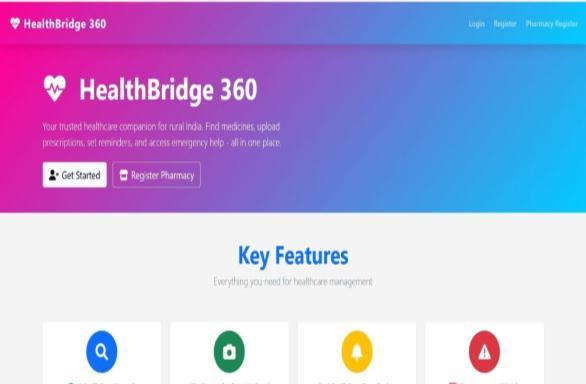
Fig. 2.HealthBridge360HomePageInterface
Fig. 2 illustrates the Health Bridge 360 home page interface, providing access to essential services such as user login, pharmacy registration, medicine search, prescriptionuploads,andemergencysupport.
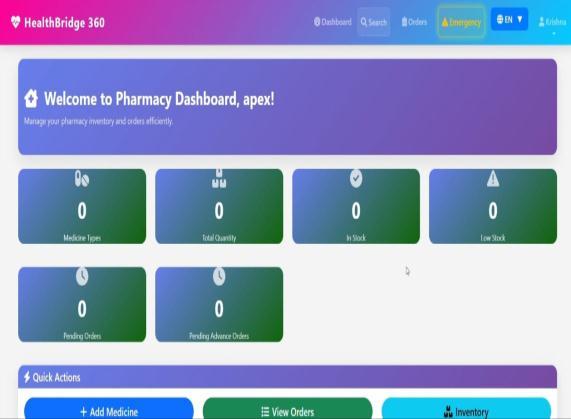
Fig. 3.PharmacyDashboardofHealthBridge360
The pharmacy-side implementation, shown in Fig. 3, validatestheeffectivenessofthepharmacydashboardin managing medicine inventory, monitoring stock levels, andhandlingincomingorders.
International Research Journal of Engineering and Technology (IRJET) e-ISSN: 2395-0056
Volume: 12 Issue: 12 | Dec 2025 www.irjet.net p-ISSN: 2395-0072

Fig. 4. PharmacyOrdersManagementModule
Orderprocessing,statustracking,andrevenueoverview functionalities are demonstrated through the pharmacy ordersmanagementmoduledepictedinFig.4.
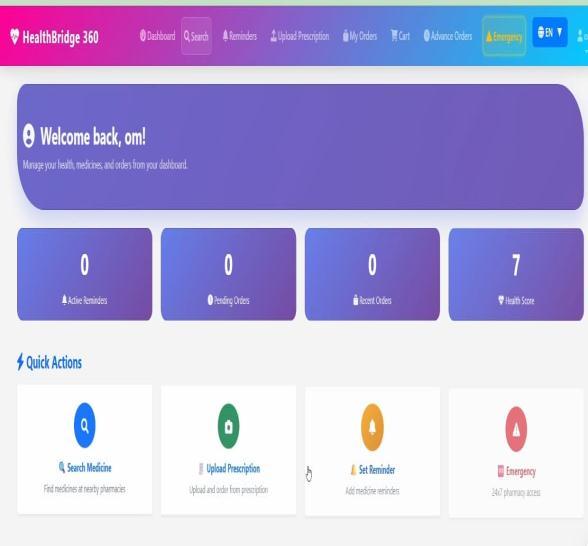
Fig. 5. UserDashboardInterfaceofHealthBridge360
Fig.5demonstratestheuserdashboardofHealth Bridge 360, highlighting core functionalities such as active medicine reminders, prescription uploads, order monitoring, health score overview, and emergency access.Thedashboardoffersacentralizedviewforusers to manage their healthcare activities efficiently, thereby improving medication adherence and reducing dependencyonmanualfollow-ups.Thepresenceofrealtimeremindercountsandorderstatusindicatorsfurther confirmsthepracticalusabilityofthesystem
The implementation results confirm that Health Bridge 360 operates as a fully functional working model rather thana conceptual prototype.The successful deployment of user interfaces, pharmacy dashboards, inventory statistics, order management, and emergency features demonstrates the practical feasibility of the proposed systeminaddressingruralhealthcarechallenges
Health Bridge 360 successfully demonstrates the effective use of digital technologies to address key challenges in rural healthcare delivery. The developed platform integrates medicine availability, digital prescription management, automated reminders, and pharmacy coordination into a single, unified system. By connecting rural users with nearby pharmacies through geolocation services and providing timely notifications, the system significantly improves accessibility and medicationadherence.
The successful deployment and testing of core modules such as the user interface, pharmacy dashboard, inventory management, order tracking, and emergency features confirm that Health Bridge 360 functions as a practical working model rather than a conceptual prototype. The modular and scalable architecture ensures system reliability, data security, and ease of futureenhancement.
Overall,HealthBridge360offersasustainableanduserfriendly healthcare solution tailored to rural communities. The platform has strong potential to reduce treatment delays, enhance patient compliance, and strengthen the digital healthcare ecosystem by bridgingthegapbetweenpatientsandlocalpharmacies.
Theauthorswouldliketoexpresstheirsinceregratitude to Prof. Ajay Jaiswal (Guide) and Prof. Sachin Verma (Co-Guide) for their continuous guidance, valuable suggestions, and encouragement throughout the development of this research work. Their technical insights and academic support played a crucial role in shapingtheproject.
The authors are also thankful to the Department of Computer Science and Engineering, Karmavir Dadasaheb Kannamwar College of Engineering, Nagpur, for providing the necessary infrastructure, resources, and a conducive environment for successful completionofthiswork.
Finally, the authors acknowledge all those who directly or indirectly contributed to the development and implementationofthe HealthBridge 360 platform.
[1].Ancey,M.,ImelDifrugine,A.S.,DevaBalaSanthiya,M., & Dhamayanthi, M.J. (2019). “Medicine Reminder and Monitoring System for Secure Health using IoT”. International Research Journal of Multidisciplinary Technovation(IRJMT),1(6),81-86.
International Research Journal of Engineering and Technology (IRJET) e-ISSN: 2395-0056
Volume: 12 Issue: 12 | Dec 2025 www.irjet.net p-ISSN: 2395-0072
[2]. Kale, S.R., Dave, J.M., Gulhane, J.S., Ingole, P.K., & Kadu, S.S. (2025). “Medicine Reminder System”. International Research Journal of Modernization in EngineeringTechnologyandScience,7(3).
[3]. Bhavani, P. Ganga, Vineeth, K.V. Surya, & Veeraj, Y. (2025). “Smart Medicine Reminder Box”. International Journal of Scientific Research in Engineering and Management(IJSREM),9(1).
[4].GardareKaran,VaishnaviGawali,SuhaniGore,Hritik Dhawale, & Hiranawe S.B. (2022). “Design and Implementation of Medicine Reminder Box and Health Checker”. International Journal for Research in Applied Science&EngineeringTechnology(IJRASET),10(11).
[5]. Ameta, Deepti, Mudaliar, Kalpana, & Patel, Palak. (2015). “Medication Reminder and Healthcare An Android Application”. International Journal of Managing Public Sector Information and Communication Technologies(IJMPICT),6(2). [6]. Saha, Saibal Kumar & Jha, Ajeya. (2022). “Impact of Reminder on Medication Adherence: A Structural Equation Model, Based on Study in Sikkim, India”. BioscienceJournal,38,e38014.
[7]. Shinde, B. N., Tondare, Omkar, Patil, Siddhesh, & Bankar, Om. (2025). “Smart Medicine Reminder and Healthcare Assistance System”. International Journal for Research in Applied Science & Engineering Technology (IJRASET),13(4).
[8]. Siddiqha, Ayesha, Nadig, Neha, Kruthi, V P, Jain, Manavi A N, & Divya, R S. (2024). “IoT Based Pill ReminderandMonitoringSystem”.InternationalJournal for Research in Applied Science & Engineering Technology(IJRASET),12(4)
2025, IRJET | Impact Factor value: 8.315 |