
International Research Journal of Engineering and Technology (IRJET) e-ISSN: 2395-0056
Volume: 12 Issue: 12 | Dec 2025 www.irjet.net p-ISSN: 2395-0072
International Research Journal of Engineering and Technology (IRJET) e-ISSN: 2395-0056
Volume: 12 Issue: 12 | Dec 2025 www.irjet.net p-ISSN: 2395-0072
Er. Aman Ullah Khan1 , Dr. Syed Mohammad Noman Tariq2
1MURP 2nd Year, Department of Architecture
2Associate Professor, Department of Architecture 1,2Aligarh Muslim University, Aligarh, Uttar Pradesh, 202001, (India)
Abstract - Rapid urbanization in Indian cities has resulted in the expansion of slum settlements characterized by inadequate access to basic urban services. Medium-sized cities such as Aligarh face increasing pressure on water supply, sanitation, housing, and solid waste management systems, while institutional and financial capacities remain limited. This study assesses the condition, accessibility, and utilization of urban basic services in selected slum areas of Aligarh city and examines redevelopment prospects in light of nationalstandards and best practices.
The study is based on a review of planning standards, policy frameworks, and documented slum redevelopment projects in India, supported by secondary data and field-level observations. Service conditions related to water supply, sanitation, drainage, electricity, and housing are compared with benchmarks prescribed by MoHUA, CPHEEO, PMAYUrban, and Service Level Benchmarks. Selected national case studies, including Ahmedabad, Chennai, Bhopal, and Indore, are reviewed to identify critical success factors and recurring implementation challenges.
The analysis reveals a significant gap between service availability and actual utilization, influenced by tenure insecurity, poor maintenance, affordability constraints, and limited community participation. The paper argues that relocation-based redevelopment often weakens livelihoods and social networks, whereas in-situ upgrading integrated with municipal systems yields more sustainable outcomes. The study proposes a structured framework for phased service improvement and slum redevelopment in Aligarh, emphasizing community participation, governance coordination, and long-term service sustainability.
Key Words: Urban Basic Services, Slum Redevelopment, Accessibility, Utilization, In-Situ Upgrading
1.
Rapid urban growth in India has intensified pressure on cities to provide essential services such as water supply, sanitation, housing, and electricity. Projections indicate that nearly 40% of India’s population will reside in urban areas by 2030, accelerating the growth of informal settlements.Slumsemergewhereplanningsystemsfailto accommodate low-income populations, resulting in
congested housing, insecure tenure, and limited access to basicservices.
Slum residents face persistent challenges related to poor sanitation, irregular water supply, inadequate drainage, and unreliable electricity, which directly affect health and quality of life. Despite multiple government initiatives such as JNNURM, PMAY-Urban, AMRUT, and Swachh Bharat Mission, service delivery in slums remains uneven due to governance gaps, implementation constraints, and weak community engagement. This study focuses on Aligarhcitytoexamineexistingserviceconditionsinslum areas and explore redevelopment strategies aligned with nationalstandardsandprovenplanningapproaches.
Jawaharlal Nehru National Urban Renewal Mission(JNNURM):Launchedin2005toimprove urbaninfrastructureandprovidebasicservicesto the urban poor through integrated city-level reforms.
Pradhan Mantri Awas Yojana – Urban (PMAY-U): Launched in 2015 to achieve “Housing for All,” with a specific focus on in-situ slum redevelopment and affordable housing for economicallyweakersections.
Atal Mission for Rejuvenation and Urban Transformation (AMRUT): Aims to strengthen water supply, sewerage, and drainage infrastructure in urban areas, directly impacting servicedeliveryinslumsettlements
SwachhBharatMission–Urban(SBM-U):Focuses on universal sanitation coverage, elimination of open defecation, and improved solid waste management, particularly in informal and underservedareas.
National Urban Livelihoods Mission (NULM): Targets livelihood enhancement, skill development,andfinancialinclusionof theurban poor, supporting the socio-economic Sustainabilityofslumredevelopment.
International Research Journal of Engineering and Technology (IRJET) e-ISSN: 2395-0056
Volume: 12 Issue: 12 | Dec 2025 www.irjet.net p-ISSN: 2395-0072
2.1 Aim
Theaimofthestudyistodevelopastructuredframework for improving urban basic services and guiding slum redevelopmentinselectedslumareasofAligarhcity.
1. To review relevant literature, policies, and standards related to urban basic services and slumredevelopment
2. To study existing serviceconditionsinselected slumsincomparisonwithnationalbenchmarks.
3. Toidentifygapsbetweenserviceprovisionand utilization.
2.3 Need of Study:
Existing data on service conditions in Aligarh’s slums is limited or outdated. Rapid population growth and continued rural-urban migration necessitate updated assessmentstosupportinclusiveandsustainableplanning. The study provides evidence-based inputs to assist planners and local authorities in improving service deliveryandredevelopmentoutcomes
2.4 Methodology
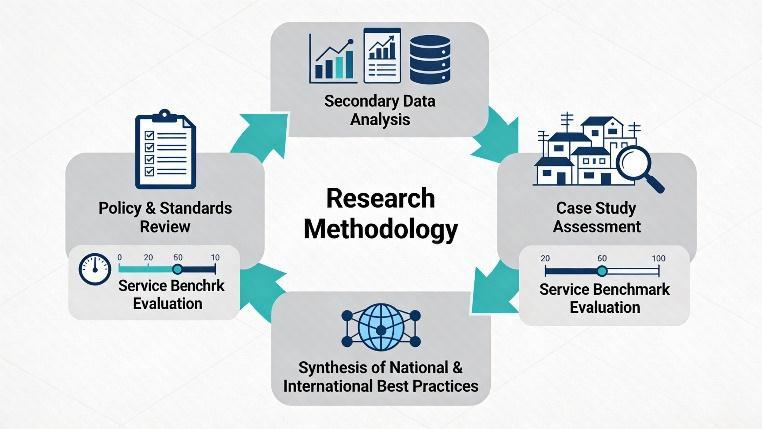
Fig- 1 Methodology
3. Literature Study
Urban studies highlight that the availability of basic services does not guarantee their effective utilization. Research emphasizes that service reliability; affordability, safety, and tenure security strongly influence usage patterns in slum areas. Studies on sanitation and water supply reveal persistent underutilization due to overcrowding, poor maintenance, and social factors, particularly affecting women and children. Case studies from Indian cities demonstrate that relocation-based
redevelopment often disrupts livelihoods and social networks, whereas in-situ upgrading with municipal integration and community participation leads to improvedserviceoutcomesandlong-termsustainability.
The Slum Networking Project (SNP) in Ahmedabad is a widely recognized example of in-situ slum upgrading focused on integrating informal settlements with formal municipal infrastructure. Initiated through collaboration betweentheAhmedabadMunicipalCorporation,NGOs,and community groups, the project aimed to provide basic services such as water supply, underground sewerage, stormwater drainage, paved roads, and street lighting withoutrelocatingresidents.
A key feature of the project was strong community participation, where households contributed partially to infrastructure costs, fostering a sense of ownership and responsibility. The provision of secure tenure further encouraged residents to invest in housing improvements. As a result, the project achieved near-universal access to basic services, improved public health conditions, and enhancedsocialinclusion.
The SNP demonstrates that in-situ upgrading, when supported by institutional coordination and community involvement,cansignificantlyimproveserviceaccessibility and utilization while maintaining existing social and livelihoodnetworks.
Chennaihasimplementedlarge-scaleslumredevelopment projects primarily based on relocation to peripheral housing sites. These projects aimed to improve housing quality and sanitation by providing multi-storey apartment units equipped with basic services such as watersupply,toilets,andelectricity.
However, several evaluations indicate that relocation has led to challenges related to livelihood disruption, increased commuting costs, and weakening of social networks. Although physical infrastructure was provided, utilization of services declined over time due to inadequate maintenance, unreliable water supply, and limited community engagement. Many relocated households reported difficulties in adapting to new environments, resulting in partial abandonment of housingunits.
The Chennai experience highlights the limitations of relocation-based approaches and underscores the importance of proximity to employment, social networks,
International Research Journal of Engineering and Technology (IRJET) e-ISSN: 2395-0056
Volume: 12 Issue: 12 | Dec 2025 www.irjet.net p-ISSN: 2395-0072
and long-term service management in slum redevelopment.
Aspect In-situ Upgrading Ahmedabad Slum Networking Project
Strategy focus Integrates existing slum settlements into the urban fabric through insituupgrading.
Treatment ofresidents Residents remain on-site with minimal or no displacement, preserving spatial continuity.
Services provided Comprehensive package of water supply, sewerage, drainage, paved roads, and street lighting integrated withcitynetworks.
Community role Strong community participation through residents’ associations and cost-sharing, fosteringownership and better maintenance.
Tenure and investment
Enhanced tenure securityencourages household-level investment in incremental housing improvements.
Livelihoods and commuting Proximity to existingworkplaces helps preserve livelihoods and keeps commuting costsmanageable.
Social networks Socialtiesandlocal support networks arelargelyretained within upgraded settlements.
Long-term outcomes Higher and more sustained service utilization, better living conditions, andintegrationinto municipalsystems.
Relocation based Redevelopment ChennaiResettlement
Focuses on peripheral resettlement and construction of new housing blocks away fromoriginallocations.
Households are relocatedfromcentralor well-connectedareasto peripheral resettlement colonies.
Basic services such as water, sanitation, and electricity are provided initiallybutoftensuffer fromweakmaintenance overtime.
Limited community involvement; projects are largely top-down, leadingtoweakersense ofownership.
Tenure and future securityoftenperceived as uncertain, discouraging long-term residentinvestment.
Displacement to the periphery disrupts livelihoods and increases commuting time and transport expenses.
Socialnetworksweaken due to relocation and fragmentationofearlier neighbourhood relations.
Underutilizationofsome infrastructure, declining service quality, and persistent socioeconomicstress.
6. Way Forward
Thisstudyexaminedtheconditionofurbanbasicservices and slum redevelopment prospects in Aligarh city with reference to national standards and selected best practices. The findings indicate that gaps in service deliveryarenotlimitedtoinfrastructureshortagesbutare strongly influenced by tenure insecurity, weak institutional coordination, limited community participation, and inadequate maintenance mechanisms. In several cases, services are physically available but remain underutilized due to issues of reliability, affordability,andsocialacceptance.
Comparative assessment of slum redevelopment approaches demonstrates that in-situ upgrading integratedwithmunicipalsystemsyieldsmoresustainable outcomes than relocation-based redevelopment. Projects thatpreserveproximitytolivelihoodsandsocialnetworks show higher levels of service utilization, community ownership,andlong-termviability.Incontrast,relocationfocusedinterventionsoftenresultinsocialdisruptionand decliningserviceperformanceovertime.
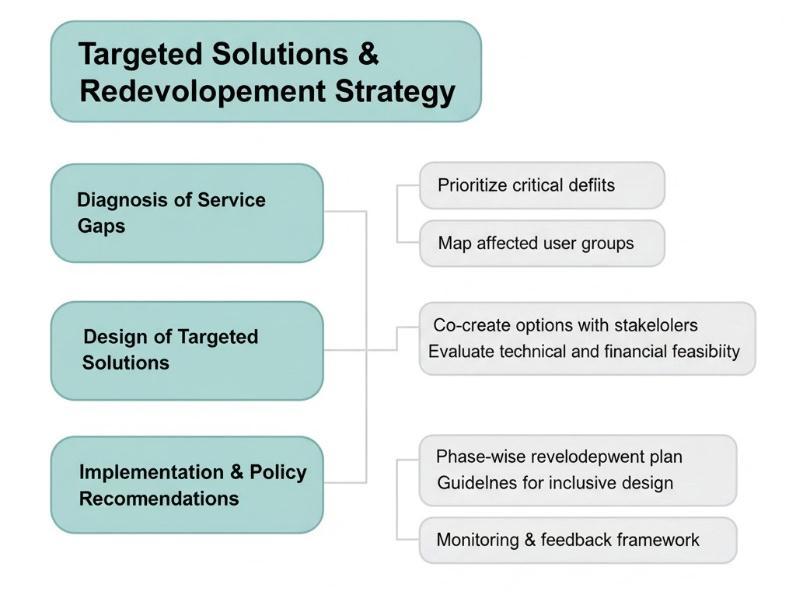
For Aligarh city, the study underscores the need for a phasedandintegratedredevelopmentstrategyprioritizing water supply, sanitation, drainage, and housing improvements, supported by tenure security and active community engagement. Strengthening coordination between local authorities and aligning redevelopment initiatives with national missions can enhance service effectiveness and sustainability. The study contributes practical insights for planners and policymakers seeking inclusive and context-sensitive solutions for slum redevelopmentinmedium-sizedIndiancities.
International Research Journal of Engineering and Technology (IRJET) e-ISSN: 2395-0056
Volume: 12 Issue: 12 | Dec 2025 www.irjet.net p-ISSN: 2395-0072
[1] UN-Habitat, the Challenge of Slums: Global Report on Human Settlements, United Nations Human Settlements Programme,Nairobi,2003.
[2] Ministry of Housing and Urban Affairs (MoHUA), National Slum Policy, Government of India, New Delhi, 2011.
[3] Ministry of Housing and Urban Affairs (MoHUA), PradhanMantriAwasYojana –Urban:MissionGuidelines, GovernmentofIndia,NewDelhi,2015.
[4] Ministry of Housing and Urban Affairs (MoHUA), ServiceLevelBenchmarksforUrbanServices,Government ofIndia,NewDelhi,2010.
[5] Central Public Health and Environmental Engineering Organisation (CPHEEO), Manual on Water Supply and Treatment, Ministry of Housing and Urban Affairs, GovernmentofIndia,NewDelhi,2013.
[6] Central Public Health and Environmental Engineering Organisation (CPHEEO), Manual on Sewerage and Sewage TreatmentSystems,MinistryofHousingandUrbanAffairs, GovernmentofIndia,NewDelhi,2013.
[7] Hasan, A., and Raza, M., “Community-based sanitation and slum upgrading: Lessons from the Orangi Pilot Project,”EnvironmentandUrbanization,vol.13,no.2, pp. 117–130,2001.
[8]Patel,S.,d’Cruz,C.,andBurra,S.,“Beyondevictionsina global city: People-managed resettlement in Mumbai,” EnvironmentandUrbanization,vol.14,no.1,pp.159–172, 2002.
[9]Bhan,G.,“Inthepublic’sinterest:Evictions,citizenship, and inequality in contemporary Delhi,” University of GeorgiaPress,2016.
[10] McKinsey Global Institute, India’s Urban Awakening: Building Inclusive Cities, Sustaining Economic Growth, McKinsey&Company,2010.
[11]GovernmentofIndia,SwachhBharatMission–Urban: Operational Guidelines, Ministry of Housing and Urban Affairs,NewDelhi,2014.
[12] World Bank, Upgrading Urban Communities: A Resource Framework, World Bank Publications, WashingtonD.C.,2001.

Aman Ullah Khan is a postgraduate student of Urban and Regional Planning at Aligarh Muslim University, India, with an academic background in Civil Engineering. His research interests include infrastructure development, sustainability planning, sustainable urban mobility,andtransportplanning.

Dr. Syed Mohammad Noman Tariq isanAssociateProfessorin theDepartmentofArchitectureat Aligarh Muslim University, specializing inarchitecturaldesign and planning education. He has guided numerous student projects and research works, contributing to the academic and professional development of futurearchitectsatAMU.