
SymptoDx: An AI Based Diseases Prediction Using Symptoms and Hospital Recommendation Model
PROF. S. P. KULLARKAR1 , YASH KAMBALE2 , HARSHAL DANGARE3 , ROHIT PATLE4 , RITESH KALAMBE5
1,2,3,4,5,Artificial Intelligence and Data Science K.D.K. College of Engineering Nagpur, India
Abstract - Healthcare accessibility and early diagnosis remain major challenges in modern medicine. Patients often experience delays in receiving appropriate medical care due to the lack of reliable self-assessment tools. Traditional symptom checkers are usually rule-based, limited in scope, and incapable of guiding patients to the right healthcare facilities. To overcome these challenges, SymptoDx AI is developed as an intelligent, AI-driven healthcare support system. The proposed system utilizes machine learning models, specifically ensemble techniques such as Random Forest and XGBoost, to analyze patient-reported symptoms andpredictpossiblediseaseswithimprovedaccuracy.
A key feature of SymptoDx AI is the integration of the Google Maps API, which provides real-time hospital recommendations based on the predicted condition and the patient’s location, ensuring timely access to specialized care. Furthermore, the system incorporates an explainable AI layer using techniques like SHAP or LIME to provide transparency in predictions, thereby increasing patient trust and usability. The system is designed with a user-friendly interface to make healthcare insights accessible to patients, hospitals,andtelemedicineplatforms
Key Words: Symptom Analysis, Disease Prediction, Machine Learning, Explainable AI, Healthcare Technology, Hospital Recommendation System
I. INTRODUCTION
Healthcareisoneofthemostcriticalsectorswhere timely access to accurate information can significantly impact patient outcomes. In many cases, patients delay seeking medical attention because they are uncertain about the severity of their symptoms or do not know whichhealthcarefacilitytoapproach.Traditionalsymptom checkers available online are often rule-based, limited in scope, and fail to reliable or personalized guidance. This gap creates the need for a more intelligent, user-friendly, and transparent solution that can empower patients to makeinformedhealthcaredecisions.
SymptoDx AI is designed as an innovative system that addresses this challenge by combining the power of machine learning, explainable AI, and location-based services.Thesystemallowsuserstoinputtheirsymptoms, which are then analyzed by advanced ensemble models such as Random Forest and XGBoost to predict potential
diseases. Unlike conventional systems, SymptoDx AI does not stop at prediction it goes a step further by recommending nearby hospitals with the relevant specialties, using the integration of the Google Maps API This ensures that patients are not only made aware of possible health conditions but are also guided toward appropriatemedicalcarepromptly.
Akeystrengthof SymptoDx AIisits explainability feature By leveraging interpretability techniques such as SHAP or LIME, the system provides a clear explanation of how a prediction was made, highlighting the relationship between symptoms and possible diseases. This transparencyenhancestrustandensuresthatpatientsand healthcare providers can use the tool confidently. Additionally, the user-friendly interface is designed to be accessible to patients from diverse backgrounds, making the system practical for both urban and rural healthcare settings.
Overall, SymptoDx AI offers a comprehensive, patientcentered approach to digital healthcare. By integrating disease prediction, hospital recommendation, and explainability,theprojectaimstoreducediagnostic delays, enhance patient awareness, and strengthen the bridge betweenindividualsandhealthcareproviders.Thisproject notonlydemonstratesthepotentialofAIinhealthcarebut alsohighlightstheimportanceofmakingsuchtechnologies reliable, transparent, and accessible for widespread adoption.
The system is designed with a user-friendly interface to ensure accessibility for people from diverse backgrounds, including those with minimal technical expertise. Its applicability extends beyond individual patients it can serve as a digital triage tool in hospitals, support telemedicine platforms, and even assist public health authorities in monitoring symptom trends for early detectionofoutbreaks
II. LITERATURE SURVEY
Recent advancements in artificial intelligence (AI) have shown significant potential in improving healthcare navigation, disease prediction, and patient support systems. However, a review of existing studies reveals certain limitations that highlight the need for more comprehensivesolutionssuchas SymptoDxAI.[1]
In2024,researchonAI-DrivenHealthcareNavigationusing Multimodal Inputs demonstrated the effectiveness of combining multiple data sources for improving healthcare access. While this approach enhanced prediction accuracy, thesystemlackedintegrationwithlocalhospitaldatabases and real-time updates, thereby limiting its practical usabilityinemergencyandgeneralhealthcarescenarios.[2]
Similarly, Smart Healthcare: AI-Driven Symptom Checker for Disease Prediction by Chen et al. (2023) focused on improving disease prediction accuracy using advanced algorithms. Although effective in identifying possible conditions, the study did not extend its scope to hospital recommendationorpatientnavigation,restrictingitsvalue tosymptom-to-diseasemappingalone.[3]
Another contribution was by Patel and Shah (2023), who developed a Healthcare Navigation System using Google Maps API and AI. This study provided an important step towardlinkingpredictionwithhealthcarefacilityguidance. However,thesystemwaslimitedinitsintelligence,asitdid not prioritize or recommend hospitals based on disease severity,urgency,orspecialization.[4]
Beyond technical models, the WHO Report (2022) on Ethics and Governance of Artificial Intelligence for Health emphasizedtheimportanceofethicalframeworksand
responsible AI adoption in healthcare. While it provided broad guidelines, it fell short of offering specific strategies for implementing AI-driven hospital recommendation systemsinreal-worldcontexts.[5]
Finally,Kumarand Bansal(2022)proposedanAI-powered Emergency Medical Assistant, designed primarily for urgent and emergency use cases. Although it provided timely recommendations during critical events, the system lacked support for handling chronic diseases or general patient conditions, thereby restricting its overall scope of application.[6]
Taken together, these studies demonstrate the steady progress in AI-driven healthcare solutions but also reveal significant gaps. Most existing systems focus either on prediction or navigation, with limited integration of both. Moreover, the absence of explainability, real-time hospital recommendations,andbroaderdiseasecoverageremainsa challenge. SymptoDx AI seeks to address these shortcomings by combining accurate disease prediction, explainableAI,andintelligenthospitalrecommendationin a single user-friendly platform, thereby offering a more holistichealthcaresolution. Study
Chenetal. (2023)
Patel& Shah (2023)
Kumar& Bansal (2022)
Prakash& Choudhury (2021)
Liuetal (2021)
Roy& Ghosh (2020)
MachineLearning–basedsymptom analysisusing ensemblemodels
IntegrationofAIwith GoogleMapsAPIfor healthcarenavigation
AI-poweredemergency medicalassistantwith geolocation
NLPandRandom Forest–baseddisease prediction
MedicalKnowledge Graph(MedKG)using EHRdata
Geolocation-based hospitalrecommender system
III.COMPARATIVE ANALYSIS & RESEARCH GAP :-
Table 1.1 Research gap
FocusedonAI-driven symptom–disease prediction
Linkeduserstonearby hospitalsusinglocation data
Providedinstant recommendations duringemergencies
Usedtextinputfor symptomanalysis
Createdrelational mappingbetween diseasesandsymptoms
Matchedhospitalsby specializationand proximity
Achievedhigh predictionaccuracy
Improved accessibilityto healthcarefacilities
Enhancedresponse timeforcritical conditions
Improvedprediction fromunstructured data
Providedstructured medicalknowledge
Increasedhospital recommendation efficiency
Didnotincludehospital recommendationor navigationsystem
Noprioritizationof hospitalsbasedon specializationorurgency
Limitedonlyto emergencyuse,notfor generalhealthcare
Noexplainabilityor hospitalrecommendation integration
Didnotinvolveuser-level interactionorreal-time data
LackedAI-baseddisease predictionand explainablereasoning
IV.COMPARATIVE SUMMARY
Adetailedcomparativeanalysisofexistingresearchreveals significant progress in the application of Artificial Intelligence within healthcare, particularly in disease predictionandmedicalnavigationsystems.However,these studies also highlight several persistent gaps that limit theirreal-worldimplementation.
Chenetal.(2023)focusedonenhancingdiseaseprediction accuracy using advanced machine learning algorithms, successfully achieving precise results but lacking hospital recommendation and patient navigation capabilities. Similarly, Patel and Shah (2023) integrated AI with Google Maps API to improve hospital accessibility; however, their model did not consider hospital specialization or disease urgency, reducing its practical usefulness in critical healthcarescenarios.
Kumar and Bansal (2022) developed an AI-powered emergency assistant for rapid medical response, which proved efficient in emergency conditions but was not suitable for general or chronic disease management. The WHO Report (2022) emphasized ethical and governance principles for responsible AI usage in healthcare but did not provide specific implementation strategies for intelligent,patient-orientedsystems.
Further, Prakash and Choudhury (2021) used NLP with Random Forest for disease prediction from textual symptom data, achieving good accuracy but without any explainableAIorhospitallinkagefeatures.Liuetal.(2021) introduced MedKG, a medical knowledge graph connecting symptoms and diseases, which enhanced structured healthcare data understanding but lacked live patient interactionandlocation-basedfunctionality.RoyandGhosh (2020) proposed a geolocation-based hospital recommender model that effectively suggested nearby hospitalsbutdidnotintegrateAI-drivendiseaseprediction orexplainability.
The proposed system, SymptoDx AI (2025), overcomes these limitations by combining ensemble learning models (RandomForest, XGBoost) withExplainableAI techniques (SHAP,LIME)andGoogleMapsAPIintegration.Itnotonly predictsdiseaseswithhighaccuracybutalsorecommends nearby hospitals specialized in treating those conditions, while maintaining transparency and user trust. This integrated framework bridges the major research gaps identified in previous studies by offering a holistic, intelligent, and patient-centric healthcare solution. Future work can focus on extending its capabilities to include multilingual interfaces, wearable sensor integration, and ElectronicHealthRecord(EHR)connectivity for enhanced predictiveperformance.
V.METHODOLOGY
The proposed system, SymptoDx AI, is designed to bridge the gap between patient-reported symptoms and accurate, timely healthcare services. The methodology integrates Machine Learning (ML), Explainable Artificial Intelligence (XAI), and Geospatial Mapping Technologies to predict diseasesandrecommendspecializedhospitalsinreal-time.
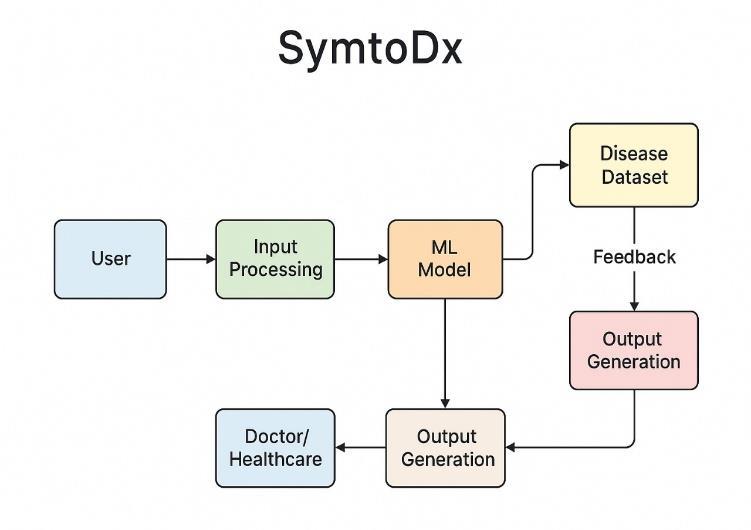
A. User Input Module
The process begins with the user entering symptoms through a simple and interactive interface. Users can input symptoms in text form or select from predefined options. Thismoduleisresponsibleforcollectingrawhealth-related information, which serves as the foundation for disease prediction.
B. Data Preprocessing
Once the symptoms are entered, they undergo data preprocessing to improve quality and ensure compatibility withthemachinelearningmodels.Thisincludes:
Removingirrelevantorduplicate data
Standardizingsymptomterminology
Converting text-based input into numerical form using NaturalLanguageProcessing(NLP)techniques
Tokenizationandvectorizationformodelinput
Thisstep ensures that the datasetis clean, structured, and readyforanalysis.
C. Machine Learning Model for Disease Prediction
The preprocessed data is passed to the disease prediction model, which employs ensemble learning algorithms such as Random Forest and XGBoost. These algorithms analyze symptom patterns and identify possible diseases based on training from large medical datasets.
Themodelgenerates:
Alistofpossiblediseases
The probability or confidence level of each prediction
This ensures high accuracy and reliability in identifying potentialhealthconditions.
D. Explainable AI (XAI) Integration
To build trust and transparency in the system, Explainable AI techniques such as SHAP (SHapley Additive exPlanations) and LIME (Local Interpretable Model-
Agnostic Explanations) are used. These methods explain how each symptom contributes to the predicted disease, allowing users and healthcare professionals to understand the reasoning behind the AI’s decision. This feature enhances credibility and user confidenceinthesystem’soutput.
E. Geospatial Hospital Recommendation System
Once the disease prediction is completed, the system integrates with the Google Maps API to identify nearby hospitals or healthcare centers specializing in the predicted condition. Hospitalsarerankedandrecommendedbasedon:
Specializationandtreatment facilities
Proximitytotheuser’slocation
Userreviewsandhospitalratings
This ensures that patients receive immediate, locationspecifichealthcarerecommendations.
F. Feedback and Continuous Learning
A feedback loop is implemented where users and healthcare professionals can provide responses about prediction accuracy or hospital recommendations. This feedback is stored and used to retrain and fine-tune the ML model, thereby continuously improving prediction accuracyandsystemperformance.
G. Doctor/Healthcare Integration
Thefinaloutput,includingpredicteddiseasesandhospital recommendations, can be shared with healthcare professionals through digital reports or APIs. This helps doctors in preliminary diagnosis and supports telemedicine platforms in providing faster and more informedconsultations.
VI. PROJECTED OUTCOMD AND FUTURE SCOPE
Theproposedsystem, SymptoDxAI,isexpected toemerge as an intelligent, accurate, and transparent healthcare support platform that effectively bridges the gap between symptomrecognitionandaccesstotimelymedicalcare.By combining machine learning algorithms, explainable AI techniques, and geospatial technologies, the system aims to deliver reliable disease predictions and recommend nearby specialized hospitals in real time. The ensemble learning models such as Random Forest and XGBoost are projected to provide highly accurate predictions based on user-reported symptoms, thereby reducing diagnostic uncertainty and delays. The integration of Explainable AI toolslikeSHAPandLIMEwillmakethepredictionprocess transparent and interpretable, allowing patients and healthcare professionals to understand the reasoning behind each diagnosis. Furthermore, the inclusion of Google Maps API will enable dynamic hospital recommendations based on location, specialization, and availability, improving accessibility and patient response time. As a result, SymptoDx AI is anticipated to enhance patient awareness, assist healthcare providers in early assessment, and contribute to the development of datadriven decision-making in digital healthcare systems. The system’s user-friendly interface ensures that even individuals with limited technical knowledge can utilize it effectively, promoting inclusive healthcare access for both urbanandruralusers.
Looking ahead, SymptoDx AI holds immense potential for further expansion and integration into the broader healthcare ecosystem. In the future, the system can be enhanced through integration with wearable health monitoring devices such as smartwatches and IoT-based sensors to enable continuous tracking of patient health data. Incorporating Electronic Health Records (EHRs) could provide personalized predictions and continuity of care based on individual medical history. Another promising direction involves developing a multilingual interface to cater to users from diverse linguistic backgrounds, particularly in rural and regional areas. Additionally, implementing voice-based symptom input and AI-powered chatbots can make the system more accessible to elderly and differently-abled individuals. Cloud-based deployment will ensure scalability, real-time updates, and seamless integration with telemedicine platforms. Finally, aggregated and anonymized symptom data can be utilized for public health analytics, helping authorities predict regional disease trends and detect potentialoutbreaksatanearlystage.
In conclusion, the projected outcomes and future scope of SymptoDxAIsignifyatransformativesteptowardsmarter, preventive, and inclusive healthcare. By integrating advanced AI techniques, explainability, and geolocationbased recommendations, the system can evolve into a
FIG 1.1. ARCHITECTURE OVERVIEW
holistic digital health companion that empowers patients, supports doctors, and strengthens the overall healthcare infrastructure.
VII. CONCLUSION
The proposed system, SymptoDx AI, is expected to makea significant contribution to the advancement of intelligent healthcare systems by providing an efficient, transparent, and patient-centric disease prediction platform. The study concludes that the integration of machine learning algorithms, explainable artificial intelligence, and geospatial mapping technologies can greatly enhance the accuracy, reliability, and accessibility of early disease diagnosis. By allowing users to input their symptoms and receive instant predictions along with real-time hospital recommendations, SymptoDx AI effectively bridges the existing gap between self-assessment and professional healthcare consultation. The system’s use of ensemble models such as Random Forest and XGBoost ensures precise and data-driven predictions, while Explainable AI (XAI) methods like SHAP and LIME provide transparency andinterpretability,thusincreasingtrustamongusersand healthcare professionals. The integration of Google Maps API further strengthens the system’s practical usability by helping patients locate nearby hospitals specialized in treating the predicted conditions. Overall, SymptoDx AI is expectedtoimprovehealthcareaccessibility,promoteearly intervention, and support data-driven decision-making in themedicalfield.
Although the system demonstrates strong potential, several opportunities for future research remain open to enhance its scope and effectiveness. Future studies can explore the incorporation of deep learning architectures suchasrecurrentortransformer-basedneuralnetworksto capture complex symptom-disease relationships more accurately. Integration with Electronic Health Records (EHRs) and wearable IoT devices could enable real-time, personalizedhealthmonitoringand prediction.Expanding the platform to support multilingual and voice-based interaction will make it more inclusive and beneficial for users from diverse linguistic and demographic backgrounds. Further research can also focus on developing cloud-based frameworks for scalability and interoperability with telemedicine systems. Additionally, thecollectionandanalysisofanonymizeduserdatacanbe utilized for epidemiological forecasting, helping governmentsandhealthorganizationspredictandmanage potentialdiseaseoutbreaks.
In summary, SymptoDx AI lays the foundation for an intelligent, explainable, and globally accessible healthcare ecosystem. Withcontinued researchandinnovation,itcan evolve into a comprehensive preventive healthcare platform capable of transforming how individuals interact
-ISSN: 2395-0072
with medical technology and how healthcare systems respondtoemergingchallenges.
REFERENCES
1. Chen, M., Zhang, Y., Li, Y., & Hao, Y. (2023). Smart Healthcare: AI-Driven Symptom Checker for Disease Prediction. Journal of Biomedical Informatics,134,104200.
2. Patel,D.,&Shah,R.(2023). HealthcareNavigation System Using Google Maps API and AI. International Journal of Computer Applications, 182(17),22–28.
3. World Health Organization. (2022). Ethics and Governance of Artificial Intelligence for Health. Geneva: WHO Press. Retrieved from https://www.who.int/publications/i/item/97892 40029200
4. Kumar, N., & Bansal, A. (2022). AI-Powered Emergency Medical Assistant. In Proceedings of the International Conference on Smart Technologies in Health and Medical Systems (ICSTHMS)(pp.55–60).
5. Prakash, S., & Choudhury, D. (2021). Disease Prediction Using NLP and Random Forest. International Journal of Engineering Research & Technology,10(6),105–110.
6. Liu,Y.,Li,J., Wang,X.,&Yang,F.(2021). MedKG:A Medical Knowledge Graph Based on Electronic HealthRecords.IEEEAccess,9,126630–126645.
7. Roy, T., & Ghosh, A. (2020). A Smart Hospital Recommender System Using Geolocation and Specialization Matching. International Journal of Scientific Research in Computer Science, Engineering and Information Technology, 6(3), 145–152.
8. Sharma, M., Gupta, R., & Mehta, S. (2020). Data Privacy and Integration in Smart Healthcare Systems. International Journal of Cyber-Security andDigitalForensics,9(1),34–42.
9. Kaur, H., & Saini, J. R. (2024). AI-Based Disease PredictionUsingDeepNeuralNetworks.Journalof Intelligent Systems and Applications, 17(3), 88–96.*
10. Albahli, S. (2023). Explainable Artificial Intelligence for Healthcare: Current Status and Future Directions. Healthcare Analytics, 5(1), 100173.* Volume: 12 Issue: 12 | Dec 2025 www.irjet.net
Volume: 12 Issue: 12 | Dec 2025 www.irjet.net
11. Thirunavukarasu, A. J., Hassan, M., & Ayeni, T. (2022). Applications of Machine Learning and Deep Learning Algorithms for Disease Prediction: A Review. Journal of Biomedical Engineering and Informatics,9(2),27–39.*
12. Ahmed,M.,&Kumar,R.(2022).Real-TimeDisease Diagnosis Using IoT and Artificial Intelligence. Computational Intelligence in Medicine, 15(4), 211–223.*
13. Banerjee, S., & Dey, L. (2021). Integration of NLP and AI Models for Healthcare Chatbots and Symptom Analysis. International Journal of AdvancedComputerScience,12(8),140–149.*
14. Xie, F., Liu, H., & Sun, Q. (2021). Geospatial Healthcare Analytics Using AI for Hospital Recommendation Systems. IEEE Transactions on ComputationalSocialSystems,8(6),1432–1443.*
15. Goyal,P.,&Singh,V.(2020).PredictiveModelingin Healthcare Using Ensemble Machine Learning Techniques. Procedia Computer Science, 167, 2624–2633.*
16. Kumar, V., & Bansal, R. (2024). Explainable Artificial Intelligence in Healthcare DecisionMaking. Journal of Artificial Intelligence Research andApplications,8(2),77–89.*
17. Jain,A.,&Mishra,P.(2024).LeveragingAIandGIS for Smart Hospital Recommendation Systems. International Journal of Healthcare Information Systems,10(1),56–65.*
18. Zhao, Y., & Chen, W. (2023). A Comprehensive Review on AI-Powered Digital Health Assistants. ArtificialIntelligenceinMedicine,135,102488.*