
International Research Journal of Engineering and Technology (IRJET) e-ISSN: 2395-0056
Volume: 12 Issue: 12 | Dec 2025 www.irjet.net p-ISSN: 2395-0072
International Research Journal of Engineering and Technology (IRJET) e-ISSN: 2395-0056
Volume: 12 Issue: 12 | Dec 2025 www.irjet.net p-ISSN: 2395-0072
Atharva Baodhankar1
1 Computer Science Student, Department of Computer Engineering, MIT Academy of Engineering, Pune - 412 105, Maharashtra, India
***
Abstract - Blockchain technology has gained widespread attention due to its applications in finance, governance, and decentralized digital platforms. Despite this growth, many studentsandbeginnerdevelopersstruggletolearnblockchain application development effectively. The primary challenge lies intheabsence ofa clearandstructuredlearningpathway that connects fundamental concepts with practical implementation. Learners are often exposed to scattered tutorialsthatfocusonindividualtoolsortechnologieswithout explaining how they fit together in a complete decentralized application workflow.
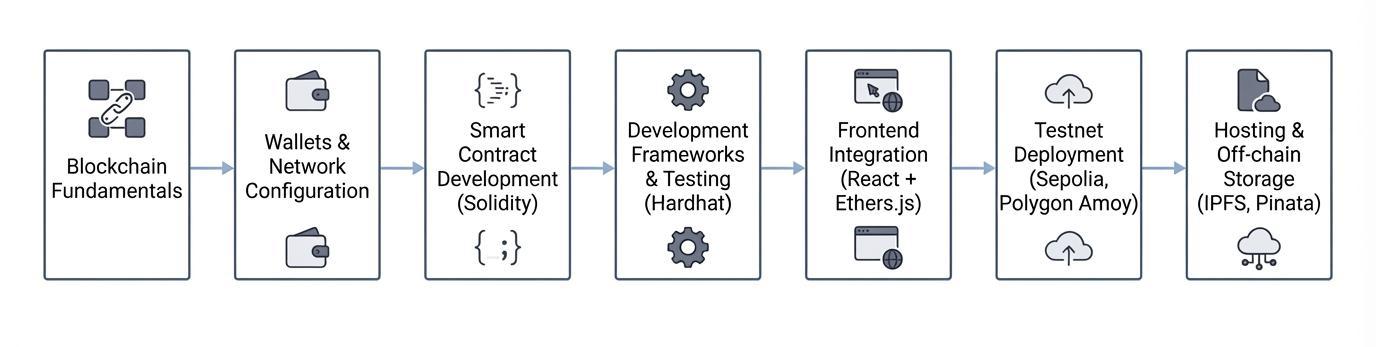
This paper proposes a structured, phase-wise roadmap designed to guide students from basic blockchain concepts to the development and deployment of full-stack decentralized applications. The roadmap begins with blockchain fundamentals and wallet interaction, progresses through smart contract development and testing, and concludes with frontend integration, testnet deployment, and off-chain storage using IPFS and pinning services. Each phase is designed with specific learning objectives and short practical exercises to reinforce understanding.
The effectiveness of the proposed roadmap is validated through its application in real-world blockchain projects, including a decentralized voting system and a decentralized social media platform. The results indicate that a structured learning approach significantly reduces confusion, improves conceptual clarity, and enables students to build productionready blockchain applications with confidence
Keywords: Blockchain education, Decentralized applications, Smart contracts, Solidity, MetaMask, IPFS, Web3 development
Blockchain technology has evolved from a niche concept associated with cryptocurrencies into a foundational technology for decentralized systems. Platforms such as Ethereumhaveenableddeveloperstodeployprogrammable logic in the form of smart contracts, leading to the rise of decentralized applications (dApps). As industries increasinglyadoptblockchain-basedsolutions,thedemand forskilledblockchaindevelopershasgrownrapidly.
However, learning blockchain application development remains challenging for students. Unlike traditional web development, blockchain development introduces new concepts such as decentralized consensus, cryptographic identities,gasfees,andimmutablestorage.Beginnersoften struggle to understand where to start and how different components wallets,smartcontracts,frontendinterfaces, and storage systems connect with each other. Most availablelearningresourcesfocusonindividualtopics,such asSolidityprogrammingorwalletusage,withoutpresenting acompletedevelopmentflow.
In academic environments, blockchain is still not consistently integrated into undergraduate curricula. As a result, students rely heavily on online tutorials, documentation, and trial-and-error learning. This unstructuredapproachoftenleadstoconfusion,knowledge gaps, and difficulty in building complete, functional applications.
Thispaperaddressesthisproblembyproposingastructured learningroadmapforblockchainapplicationdevelopment. The roadmap organizes the learning process into clear phases,eachfocusingonaspecificsetofskillsandtools.By following this roadmap, students can gradually progress from theoretical understanding to real-world implementation.Theproposedapproachaimstobridgethe gapbetweenconceptual learningandpractical blockchain development.
Several studies and educational initiatives have explored blockchain learning and curriculum design. Research on blockchain education highlights that the technology’s interdisciplinary nature makes it difficult to teach using traditional computer science curricula. Many universities introduce blockchain concepts only at advanced levels, leavingundergraduatestudentswithlimitedexposure.
Existingliteratureemphasizestheimportanceof handson learning for complex technologies. Studies in engineering education suggest that project-based learning improves comprehension, retention, and skill development when compared to purely theoretical instruction. This is particularlyrelevantforblockchain,whereabstractconcepts
International Research Journal of Engineering and Technology (IRJET) e-ISSN: 2395-0056
Volume: 12 Issue: 12 | Dec 2025 www.irjet.net p-ISSN: 2395-0072
suchasconsensusandimmutabilitybecomeclearerthrough implementation.
Developer documentation provided by platforms such as Ethereum, Hardhat, and IPFS offers detailed technical guidance,but these resources are often tool-centric. While theyexplainhowindividualcomponentswork,theydonot provideacompletelearningsequencetailoredforbeginners. Asaresult,learnersfrequentlyjumpbetweentopicswithout understandingtheirdependencies.
Some educational frameworks propose modular learning approaches for blockchain, covering fundamentals, smart contracts, and applications. However, many of these frameworkslack validationthroughreal-worldprojectsor failtoaddresspracticaldeploymentchallengessuchaswallet integration,testnetusage,andoff-chaindatastorage.
Theliteratureindicatesaclearneedforaunified,studentfriendly roadmap that integrates theory, tools, and deployment practices into a single learning pathway. This paperbuildsuponexistingeducationalinsightsbyproposing astructuredroadmapvalidatedthroughpracticalblockchain projects.
A.
Theproposedsystemisastructuredlearningroadmapthat divides blockchain application development into seven sequential phases. Each phase introduces a limited set of conceptsandtools,allowinglearnerstofocusononeaspect ofdevelopmentatatime.Thisphasedapproachminimizes cognitiveoverloadandensuresthatstudentsbuildastrong foundationbeforemovingtoadvancedtopics.
The roadmap is designed for students with basic programming knowledge and aims to guide them from blockchain fundamentals to the deployment of complete decentralized applications. Each phase includes learning objectives,practicalexercises,andexpectedoutcomes.
Table -1: Phase-wiseSummaryofLearningObjectivesand Outcomes
Phase Learning Objectives Key Technologies
deployment Sepolia, PolygonAmoy 1weeks
7 Distributed storage,hosting IPFS,Pinata 2weeks
B. Phase 1: Blockchain Fundamentals
This phase introduces the core concepts of blockchain technology. Students learn how blocks are linked using cryptographic hashes, how transactions are validated, and how decentralized consensus mechanisms operate. Public andprivateblockchains,alongwiththeirusecases,arealso discussed.
Exercise:Studentsanalyzeasimpleblockchainsimulatorto observe how altering a block affects the entire chain. Outcome:Studentsdevelopaconceptualunderstandingof decentralization,immutability,andtrustlesssystems
C. Phase 2: Wallets and Network Configuration
Inthisphase,studentsinteractwithrealblockchainnetworks usingwalletssuchasMetaMask.Theylearnaboutaccounts, privatekeys,andnetworkIDs,andgasfees.Testnetworks suchasSepoliaandPolygonAmoyareintroducedtoprovide asafeenvironmentforexperimentation.
Exercise:StudentsconnectMetaMasktoatestnet, request testtokens,andperformabasictransaction.
Outcome:Studentsbecomecomfortableusingwallets and interpretingblockchaintransactionsthroughexplorers.
D. Phase 3: Smart Contract Basics
ThisphasefocusesonwritingsmartcontractsusingSolidity. Studentslearncontractstructure,statevariables,functions, andevents.Basicsecurityconsiderationsarealsointroduced.
Exercise: Students write and deploy a simple Solidity contractusingtheRemixIDE.
Outcome:Studentscanwriteandinteractwithbasicsmart contracts
International Research Journal of Engineering and Technology (IRJET) e-ISSN: 2395-0056
Volume: 12 Issue: 12 | Dec 2025 www.irjet.net p-ISSN: 2395-0072
Studentsareintroducedtoprofessionaldevelopmenttools suchasHardhatorFoundry.Theylearntocompilecontracts, writeautomatedtests,anddeploycontractslocally.
Exercise:StudentscreateaHardhatprojectandwriteunit testsforasmartcontract.
Outcome: Students understand structured development workflowsandtestingpractices.
Outcome: Students understand hybrid on-chain/offchain architecture.
The application of the proposed roadmap demonstrated improved learning clarity and reduced confusion among students.Thephasedstructurehelpedlearnersunderstand the relationship between blockchain components. Project based validation confirmed that students could independentlydeployfunctionaldecentralizedapplications.
This phase connects smart contracts with frontend applicationsusingReactandEthers.js.Studentslearnhowto connect wallets, call contract functions, and handle transactionstates.
Exercise:StudentsbuildasimpleReactinterfacethatreads andwritesdatatoasmartcontract.
Outcome: Students can build interactive decentralized applications.
G. Phase 6: Testnet Deployment
Studentsdeploysmartcontractstopublictestnetworksand verifythemusingblockexplorers.Deploymentchallenges suchasgasestimationandfailedtransactionsarediscussed. Exercise:Studentsdeployacontracttoatestnetandinteract withitthroughafrontend.
Outcome:Studentsgainreal-worlddeploymentexperience.
H. Phase 7: Hosting and Off-chain Storage
Large data such as images and videos cannot be stored directlyonblockchainduetocostandscalabilitylimitations. This phase introduces IPFS for decentralized storage and pinningservicessuchasPinata.OnlyIPFScontentidentifiers arestoredon-chain
Exercise: Students upload a file to IPFS, store its CID in a smartcontract,andretrievethefileusingthefrontend.
ChainElect implementsa transparentandverifiable voting system that addresses common concerns about election integrity and voter privacy. The system demonstrates the applicationofblockchaintechnologyincreatingtrustworthy democraticprocesses.
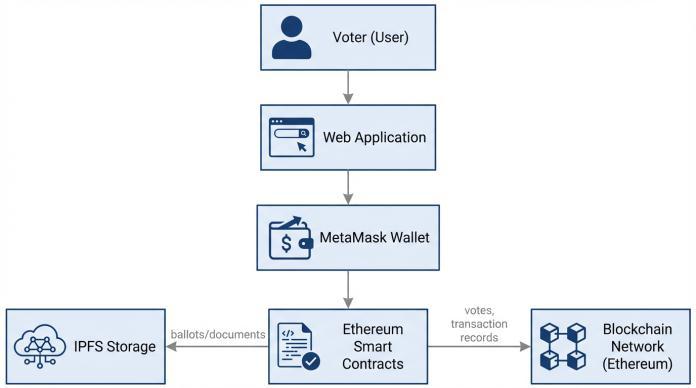
2. SystemarchitectureoftheChainElectblockchainbasedvotingapplication.
The ChainElect system architecture separates voter authentication, ballot casting, and result tabulation into distinctsmartcontractstoensuresecurityandauditability. Votereligibilityismanagedthroughapermissionedsystem thatmaintainsprivacywhilepreventingduplicatevoting.
Ballot information, candidate profiles, and supporting documentation are stored on IPFS with content hashes recorded on-chain. This approach ensures that voting
International Research Journal of Engineering and Technology (IRJET) e-ISSN: 2395-0056
Volume: 12 Issue: 12 | Dec 2025 www.irjet.net p-ISSN: 2395-0072
materialsremainaccessibleandunmodifiedthroughoutthe electionprocesswhileminimizingon-chainstoragecosts.
Thevotingmechanismimplementscryptographictechniques toensureballotsecrecywhilemaintainingverifiability.Each vote is recorded as a blockchain transaction, creating an immutableaudittrailthatcanbeindependentlyverifiedby electionobserversandparticipants.
Socio3 represents a comprehensive implementation of decentralizedsocialmediafunctionality,incorporatinguser authentication, content creation, and social interaction features.Theplatformdemonstratesthepracticalapplication of blockchain technology in creating censorship resistant socialnetworks.
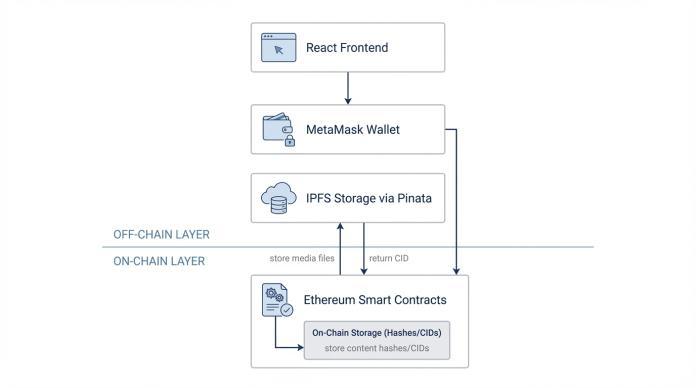
Fig. 3. Hybridon-chainandoff-chainarchitectureofthe Socio3decentralizedsocialmediaplatform,wheremedia contentisstoredonIPFSandonlycontentidentifiers (CIDs)arerecordedontheblockchain.
The Socio3 architecture implements a hybrid storage approachwhereuserprofiles,posts,andmediacontentare storedonIPFS,whilesocialinteractionssuchaslikes,follows, and content hashes are recorded on-chain. This design ensures content immutability while maintaining costeffectivenessforlargedatastorage.
Smart contract functionality includes user registration, contentpublishing,socialgraphmanagement,andreputation systems. The platform utilizes ERC-721 tokens for unique useridentitiesandimplementsadecentralizedgovernance mechanismforcontentmoderationdecisions.
The frontend application, built with React and Ethers.js, providesafamiliarsocialmediainterfacewhileseamlessly integratingblockchainfunctionality.Userscanconnecttheir wallets, create profiles, publish content, and interact with otheruserswithoutrequiringdeepblockchainknowledge.
Key technical implementations include real-time content synchronization using blockchain events, IPFS content pinning through Pinata integration, and responsive design
optimizedforbothdesktopandmobiledevices.Theplatform demonstrates scalability considerations through efficient smartcontractdesignandstrategicuseofoffchainstorage.
Both projects were developed following the seven-phase roadmap,witheachphasecontributingspecificcomponents to the final applications. The validation process involved multipleassessmentcriteriaincludingtechnicalfunctionality, user experience, security considerations, and educational effectiveness.
Technicalvalidationincludedcomprehensivetestingofsmart contractfunctionality,frontendintegration,andIPFSstorage reliability. Security assessments examined common vulnerabilitiessuchasreentrancyattacks,integeroverflow, andaccesscontrolissues.Performancetestingevaluatedgas usage optimization and application responsiveness under variousnetworkconditions.
Educational effectiveness was assessed through student feedback and learning outcome measurement. Students reported improved understanding of blockchain concepts and increased confidence in developing decentralized applications. The structured progression provided by the roadmap helped students overcome common learning barriers and maintain motivation throughout the developmentprocess.
The application of the proposed roadmap demonstrated improved learning clarity and reduced confusion among students.Thephasedstructurehelpedlearnersunderstand the relationship between blockchain components. Project based validation confirmed that students could independentlydeployfunctionaldecentralizedapplications.
Student feedback indicated that the structured approach significantly reduced the learning curve associated with blockchain development. The sequential progression from fundamentals to advanced topics prevented cognitive overload while maintaining engagement throughout the learningprocess.
Technical validation through the ChainElect and Socio3 projects confirmed that students following the roadmap couldsuccessfullyintegratemultipleblockchaintechnologies into cohesive applications. The hybrid storage approach using IPFS proved particularly effective in addressing scalabilityconcernswhilemaintainingdataintegrity
Performancemetricsshowedthatstudentscompletingthe roadmap demonstrated higher success rates in deploying functionaldecentralizedapplicationscomparedtotraditional learningapproaches.Theemphasisonpracticalexercisesin
International Research Journal of Engineering and Technology (IRJET) e-ISSN: 2395-0056
Volume: 12 Issue: 12 | Dec 2025 www.irjet.net p-ISSN: 2395-0072
each phase reinforced theoretical concepts and improved retentionrates.
Thispaperpresentedastructuredroadmapforblockchain application development aimed at students and beginner developers. By organizing learning into sequential phases andvalidatingtheapproachthroughreal-worldprojects,the roadmapbridgesthegapbetweentheoryandpractice.
Theseven-phasestructureprovidesaclearlearningpathway thataddressescommoneducationalchallengesinblockchain development.Eachphasebuildsuponpreviousknowledge whileintroducingnewconceptsinamanageableprogression. The emphasis on practical exercises ensures that students gainhands-onexperiencewithindustry-standardtoolsand practices.
ValidationthroughtheChainElectvotingsystemandSocio3 socialmediaplatformdemonstratestheeffectivenessofthe proposed approach. Students following the roadmap successfullydevelopedanddeployedfunctionaldecentralized applicationsthatintegratemultipleblockchaintechnologies.
Future work includes developing interactive learning platforms and extending the roadmap to advanced blockchain topics such as cross-chain communication and zero-knowledge proofs. Additional research will focus on adaptingtheroadmapfordifferenteducationalcontextsand measuringlong-termlearningoutcomes.
[1] S. Nakamoto, “Bitcoin: A peer-to-peer electronic cash system,” Bitcoin.org, 2008. [Online]. Available: https://bitcoin.org/bitcoin.pdf
[2] P. Zhang, M. A. Imran, and K. Yang, “A comprehensive surveyofblockchaineducation:Currentstateandfuture directions,” IEEE Access, vol. 8, pp. 145932–145951, 2020.
[3] R.KumarandS.Patel,“Project-basedlearningapproach for blockchain technology education in computer sciencecurricula,”inProc.IEEEInt.Conf.Engineering Education(ICEED),2021,pp.187–192.
[4] M. Rodriguez, L. Chen, and A. Thompson, “Securityfocused curriculum design for smart contract developmenteducation,”IEEETrans.Education,vol.64, no.3,pp.298–306,Aug.2021.
[5] J. Chen and W. Liu, “Teaching distributed storage integrationinblockchainapplications:Challengesand solutions,” in Proc. IEEE Frontiers in Education Conf. (FIE),2022,pp.1–8.
[6] A.Thompson,K.Williams,andR.Davis,“Competencybasedframeworkforblockchaintechnologyeducation: Mapping skills to learning outcomes,” Computers & Education,vol.178,pp.45–58,2022.
[7] V.Buterin,“Ethereum:Anext-generationsmartcontract and decentralized application platform,” Ethereum Foundation, 2014. [Online]. Available: https://ethereum.org/whitepaper/
[8] J.Benet,“IPFS-Contentaddressed,versioned,P2Pfile system,”arXivpreprintarXiv:1407.3561,2014.
[9] G.Wood,“Ethereum:Asecuredecentralizedgeneralized transactionledger,”EthereumProjectYellowPaper,vol. 151,pp.1–32,2014.
[10] M. Swan, “Blockchain: Blueprint for a new economy,” O’ReillyMedia,Inc.,2015.