
International Research Journal of Engineering and Technology (IRJET) e-ISSN: 2395-0056
Volume: 11 Issue: 09 | Sep 2024 www.irjet.net p-ISSN: 2395-0072

International Research Journal of Engineering and Technology (IRJET) e-ISSN: 2395-0056
Volume: 11 Issue: 09 | Sep 2024 www.irjet.net p-ISSN: 2395-0072
Kalleshappa C M1 , Srinidhi R Kulkarni2, Praveen Kumar D G3 , Shashikala K J4 , Amarnath P C 5
1Professor, Dept. of Chemical Engineering, BIET, Davangere.
2Assistant Professor, Dept. of Chemical Engineering, BIET, Davangere
3Associate Professor, Dept. of Chemical Engineering, BIET, Davangere.
4,5Assistant Professor, Dept. of Chemical Engineering, BIET, Davangere
Abstract - The development of nano-technology has directed to significant advancements in science and technology, including solutions for water contamination caused by industrial dyes, which pose serious ecological challenges. Zinc oxide nanoparticles (ZnO NPs), known for their unique photocatalytic properties at the nano-scale, offer a potential remedy for these issues. In this study, calcium-coated zinc oxide nano-particles were produced using beetroot extract as a reducing agent. The effects of these nanoparticles on various dyes were examined, and their properties were categorized through methods such as FT-IR, XRD, TEM, and UV spectrophotometry. The synthesized ZnO nanoparticles were bean or sphericalshaped, with sizes ranging from 29 to 49 nm. The calcium coatingreducedtheparticlesizefurtherto20–100nm.The photocatalytic efficiency of these nanoparticles was evaluated by their ability to degrade dyes such as Rhodamine B,Methylene Blue,CongoRed,andAcidBlue 92 (AB92) under natural sunlight, with UV-Vis spectrophotometer monitoring the degradation process. Both the uncoated and calcium-coated ZnO nanoparticles demonstrated promising results in breaking down these dyes.
Key Words: Zinc Oxide nanoparticles, FT-IR, XRD, TEM and UV Spectro-photometer, Rhodamine B, Methylene Blue, Congo Red and Acid Blue 92(AB92)
In recent decades, nanotechnology has emerged is one of the significant dynamic fields in customizable materials science, with broad applications in clinical settings. This growth is largely attributed to the unique size-dependent properties of nanomaterials, which result from precise controlduringthesynthesisprocess.Thisinteractionatthe nanoscale enables metal-oxide nano-particles (MONPs) to enters through biological barriers, like the blood brain barrier (BBB), which was previously a significant obstacle in drug supply.MONPs, such as zinc oxide (ZnO), titanium dioxide(TiO2),andironoxide(Fe3O4),havedemonstrated potent applications in cancer therapy, antimicrobial treatments,andimagingmethodslikemagneticresonanceimaging (MRI). For instance, iron-oxide nano-particles are widely applied as contrast agents in MRI due to their
magneticproperties,allowingforenhancedvisualizationof tissues. Additionally, MONPs' ability to act as carriers for drugs or therapeutic agents opens novel targeted and controlled drug release. Their surface is to be modified withligands,antibodies, orpeptides to specifically bindto cancer cells or pathogens, minimizing side effects and improving therapeutic efficiency. However, the use of MONPs in clinical applications is not without challenges. Concerns about toxicity, environmental-impact, and potential long-term effects on human-health have prompted ongoing research to better understand the biocompatibilityandsafetyofthesematerials.Researchers are focused on optimizing the synthesis, surface functionalization, and degradation profiles of MONPs to ensuretheirsafeandeffectiveuseinmedicaltreatments.In summary, MONPs represent a promising tool in nanomedicine, offering unique opportunities for disease identification,targeteddrugdelivery,andmedicalimaging. Continued advancements in their design and application willlikelyleadtofurtherbreakthroughsinhealthcare.The extensive research on these metal-oxide nano-particles (MONPs) highlights their potential in revolutionizing biomedical applications due to their diverse therapeutic and diagnostic capabilities. Each of MONPs offers unique appearancesthatcreatethemsuitablefordifferentclinical uses, primarily attributed to their size, surface area, and functionalization potential, which enable targeted interactionwithcellsandtissues.
Zinc oxide nanoparticles (ZnO NPs):Knownfortheir antimicrobial and wound-healing properties, ZnO NPsarecommonlyintegratedinto wound dressingsto preventbacterial infectionsandfacilitatetissuerepair. They also exhibit potential in anticancer therapies due to their capability to induce oxidative stress selectivelyintumorcells.
Cerium oxide nanoparticles (CeO2 NPs): CeO2 NPs stand out due to their antioxidant properties, allowing them to scavenge free radicals and reduce oxidative stress, making them valuable for treating conditions related with oxidative damage, including neurodegenerative diseases. Their regenerative redox cycling also positions them as promising agents in anti-inflammatory treatments.
International Research Journal of Engineering and Technology (IRJET) e-ISSN: 2395-0056
Volume: 11 Issue: 09 | Sep 2024 www.irjet.net p-ISSN: 2395-0072
Iron oxide nanoparticles (Fe2O3 NPs): The magnetic properties of Fe2O3 NPs make them highly useful as MRI contrast agents and in magnetic hyperthermia therapy for cancer treatment. Their abilitytobefunctionalizedfordirecteddrugdeliveryis alsoamajorfocusinprecisionmedicine.
Silver oxide nanoparticles (AgO NPs): AgO NPs are well-known for their broad-spectrum antimicrobial activity, making them effective against antibioticresistantstrains.Theirinclusioninmedicaldevicesand coatings helps prevent infections, and they are frequentlyusedin antimicrobial wound dressings.
Magnesium oxide nanoparticles (MgO NPs): MgO NPs exhibit antibacterial properties and are gaining kindness for their potential in bone regeneration, owingtomagnesium'sroleinbonemetabolismandits abilitytopromoteosteoblastactivity.
Titanium oxide nanoparticles (TiO2 NPs): Widely used in photocatalytic applications, TiO2 NPs are explored in photodynamic therapy (PDT) for cancer treatment. Their ability to produce reactive oxygen species (ROS) under light exposure is used to target anddestroycancercells.
Nickel oxide nanoparticles (NiO NPs): NiO NPs are being discovered for biosensor applications due to their excellent electrical properties. However, further research work is required to fully understand their biocompatibilityandtoxicityprofiles.
Zirconium oxide nanoparticles (ZrO NPs): ZrO NPs are highly biocompatible and are being explored in orthopedic and dental implants due to their hardness and resistance to wear. Their stability also creates themsuitableforbiosensorsanddrugdelivery systems.
Cadmium oxide nanoparticles (CdO NPs): CdO NPs have indicates promising results in anticancer therapy and biosensing applications, but their potential toxicity remains a significant concern. Cadmium's known toxic effects require careful regulation and further research to mitigate risks in clinicalapplications.
Nano-particles can be synthesized using either a "topdown" or "bottom-up" approach. The top-down technique involvesbreakingdownbulksubstancesintonanoparticles through size reduction techniques such as lithography, milling, grinding, laser ablation, or sputtering. In contrast, thebottom-upapproachinvolvesassemblingnanoparticles from smaller units using chemical, physical, or biological methods, along with plant materials, microbes, or biologicalproducts.
For the blending of metal-oxide nanoparticles (MONPs), chemical and physical bottom-up approaches are commonlyused,astheyefficientlyproducelargequantities of nanoparticles. However, these method exists with certain drawbacks, such as higher costs, the applicationof toxic chemicals that may remain on the nanoparticle surface and cause harmful effects in biomedical applications, and the need for stabilizers to ensure nanoparticle stability. Some of the main synthesis techniquesinclude:
Chemicalprecipitation,
Wetchemicalsynthesis,
Hydrothermalmethods,
Solvothermalmethods,
Sol-gelprocesses,
Solid-statepyrolytictechniques,
Thermaldecomposition,and
Microwave-assistedsynthesis.
Reaction ( ) ( ) ( )
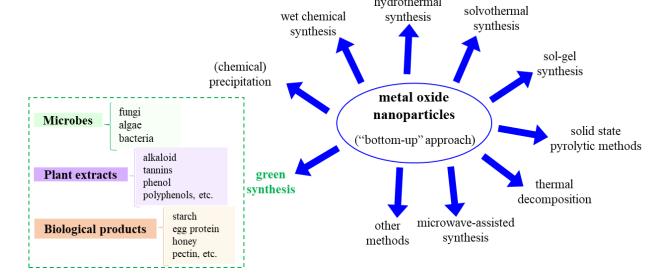
1. Potentialsynthesismethodsformetaloxide nanoparticles(usinga"bottom-up"approach)
2. METHODS AND METHODOLOGY
2.1 Preparation of beetroot extract
Beetroots were purchased from the local market and rinsed with distilled water (DW) to remove dust particles. 40 g were grinded in a beaker and boiled with distilled water (100 ml) for 15 min. Then the beaker was kept for cooling.Aftercooling,thesolutionwasfilteredtoeliminate the insoluble part. The wine-coloured solution was then stored in glass bottles and kept in the refrigerator for furtheruse.
International Research Journal of Engineering and Technology (IRJET) e-ISSN: 2395-0056
Volume: 11 Issue: 09 | Sep 2024 www.irjet.net p-ISSN: 2395-0072
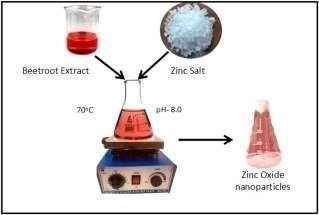
To synthesize ZnO nano-particles, 500 ml of beetroot extract was transferred in a 500 cm3 beaker having a magnetic bead. The solution was heated to 60 °C followed by the mixture of 45 g of zinc acetate. The pH of the solutionwasmaintainedbetween8.0.
ItwasstirredatthistemperatureandpHfor40min.tillthe formation of pale yellow solution. The resulting solution was centrifuged and washed applying double distilled water at 80 °C and dried in the oven. After that, the dried powderwascalcinatedat450°Cinamufflefurnacefor15 min. The synthesized samples were preserved for further experimentalstudy
2.3 Synthesis of Calcium coated Zinc Oxide nanoparticles
Ca-coated ZnO nano-particles were synthesized by the coprecipitation method. Zn (CH3COO)2. 2 H2O and calcium chloride were takenin 1:1wt. ratio. To synthesizeCa-ZnO nanoparticles,weighedZn(CH3COO)2.2H2Owasdissolved in40mlofBeetrootextractat60°CtemperatureandpH8, followedbyaddingaweightamountofcalciumchloride.It was agitated for 1 h and then centrifuged to separate the Nanocomposite.Itwas rinsedwith DoubleDWtoremove impuritiesanddried.Itwascalcinatedat450°Cinamuffle furnace for 15 min. The Ca-ZnO nanoparticles prepared in 1:1 ratio, The samples were retained for further experimentalstudy
2.4 Preparation of Stock Solution
1gm of dye was dissolved in 1L of distilled water. 100mL of stock solution was taken and 1gm of nanoparticles & 10mL of this solution was placed in UV spectrometer every10mintodeterminethephotocatalyticdegradation ofthedyes.
A. X-RAY DIFFRACTIONS
XRDspectraofbeetrootextractmediatedZinc-oxidenanoparticle was shown in figure 3. Beetroot extract refereed Zinc-oxide nano-particles have characteristic peaks at 32.080-100,36.280 -002,36.570 -101,47.89°-102,56.790 -110,63.040 -103,68.190 -201thatrepresentshexagonal structure.IntensityofZineOxidepeakat47.89°(102)was higher than the intensities of other peaks, indicating that there is growth in nanoparticles. In calcium coated Zine Oxide nanoparticles, growth mainly took place in the (102) plane. We should note that Calcium coated did not affectthecrystallinityofZinc-oxidenano-particles
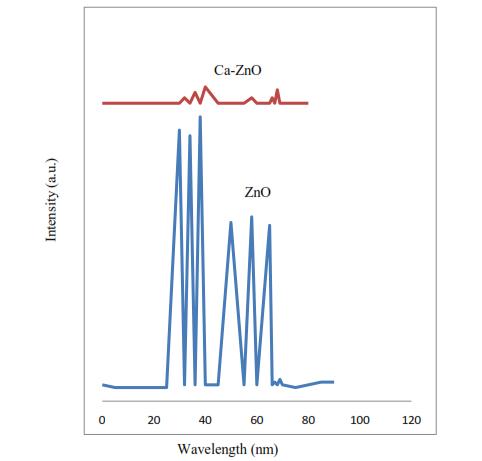
Figure 3 Beetroot extract refereed Zin-oxide nanoparticlescharacteristicsatXRD.
( ) ( ) ( )
B.
The FTIR of Zinc-oxide nano-particles & its calcium Nano composites is indicated in figure 4. The spectra shows association of OH stretching at 3437cm-1, Co group stretchingat1614cm-1 &ZincOxidestretchingat459cm-1 respectively.
International Research Journal of Engineering and Technology (IRJET) e-ISSN: 2395-0056
Volume: 11 Issue: 09 | Sep 2024 www.irjet.net p-ISSN: 2395-0072
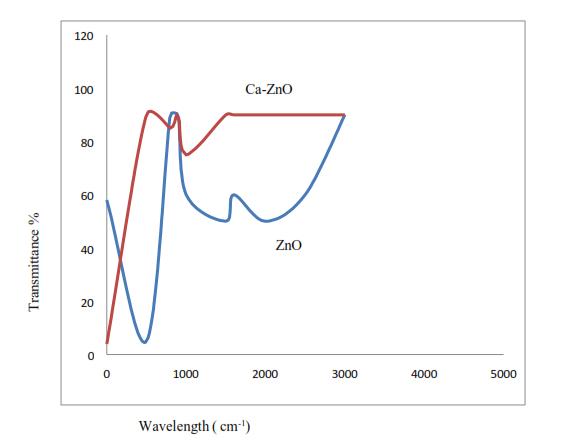
4. FTIRofZinc-oxidenano-particles&itscalcium Nanocomposites
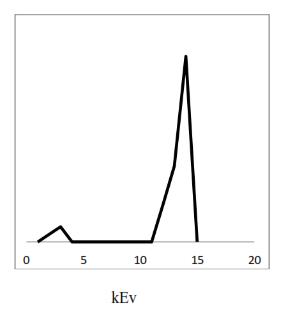
Figure 5. SEMstudiesofZnonanoparticles
Table 1. SEMZnonanoparticles
Element wise Weight% and Atomic% distribution of Zno nanoparticles and Ca-Zno nanoparticles are indicated in table1andtable2respectively.
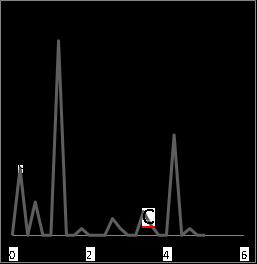
Figure 6. SEMstudiesofCa-Znonanoparticles
Table 2. SEMCa-Znonanoparticles
The External morphology of dried Zinc-oxide nanoparticles with or without were determined using SEM. ShapeandSurfacemorphologyaredisplayedinfigure 5& 6. This shows that the nano-particles are likely to be hexagonal in shape. The particle size ranges from 29-49 nm for Zinc Oxide & from 72-89 nm for calcium coated ZincOxidenanoparticles.Figure7showsthevariationsin chemicalcompositions.
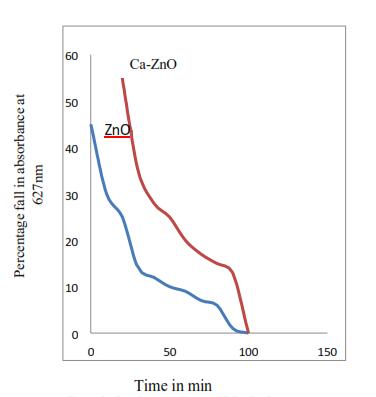
Figure 7. a,c-ZnONanoparticles,b,d-CalciumcoatedZnO Nanoparticlesshapeandsize
D. UV ABSORPTION:
i) Methylene Blue:
Figure 8 shows that there is 80% degradation in 100 min with blank ZnO nanoparticles at wavelength of 627nm & 100% degradation after 60min with calcium coating at 627 nm. This shows that calcium coating increases the percentageofdegradationincaseofMethyleneBlue.
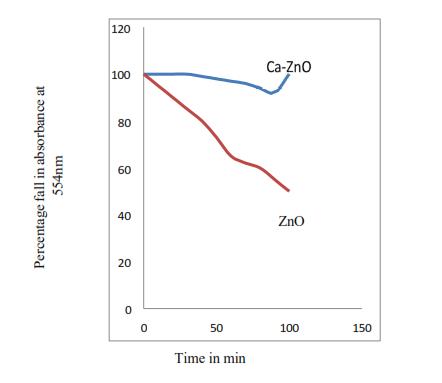
Figure 8. AbsorptionofMethyleneBule
International Research Journal of Engineering and Technology (IRJET) e-ISSN: 2395-0056
Volume: 11 Issue: 09 | Sep 2024 www.irjet.net p-ISSN: 2395-0072
i. Rhodamine B:
Figure9showsthatthereis60%degradationafter100 mins with blank ZnO nanoparticles at wavelength of 554nmandalmostnodegradationwithcalciumcoating at any wavelength. This shows that calcium coating doesn’taffectthephotocatalyticpropertyofZinc-oxide Nano-particlesforRhodamineB.
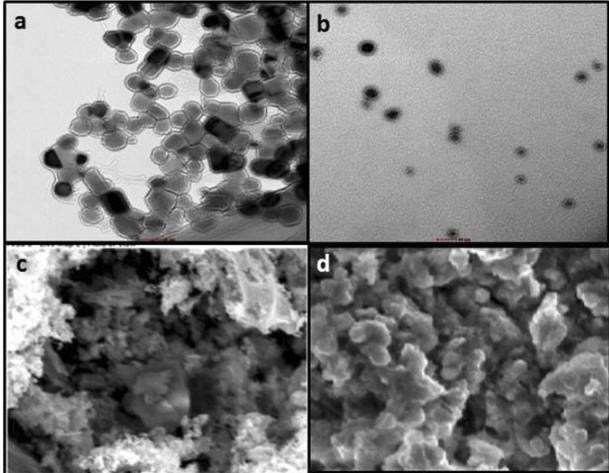
Figure 9. AbsorptionofRhodamineB.
ii.Congo Red:
Figure10representsthatforCongoredtheadsorption is the maximum at 45 min and 100 min with 52% and 50% respectively for blank Zinc Oxide Nanoparticles 54% and 52% respectively for calcium coating. This indicates that there is no much difference in degradation with or without coating. The increase and decrease in adsorption is owing to the loss of photo catalysisduetoblockagecreatedbythedye.
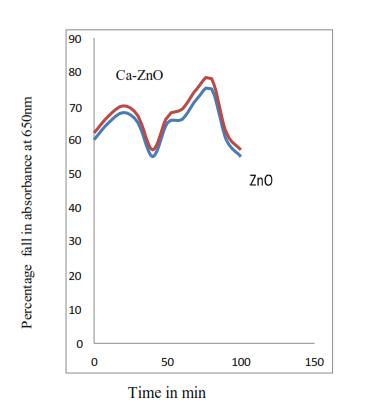
Figure 10. AdsorptionofCongoRed
iii. Acid Blue:
There is no release with both blank and coated nanoparticlesforacidbluedye.Thisshowsthatthereisno effect of ZnO Nano-particles and Calcium coated ZnO Nano-particlesonAcidblue.
The present work shows that the synthesized Zinc-oxide nano-particles and Calcium coated Zinc-oxide nanoparticles (1:1) act as a good photo catalyst. Degradation efficiency of Zine oxide nanoparticles for Methylene Blue is 80% after 100 min, for Rhodamine B is 60% after 100 minutes,forCongoRedis52%after45minutes.
Degradation efficiency of Calcium coated Zinc oxide nanoparticlesforMethyleneBlueis100%after60min,for Rhodamine B there is no release, for Congo Red is 54% after45minutes.
These results indicate the potential application of Zincoxide nano-particles with or without the Calcium coating indegradingtoxicorganiccompoundsfromwastewater.
Bio-genic synthesis of calcium coated zinc oxide nanoparticles from beetroot extract and their photodegradation study on methylene blue and rhodamine B Darshan Singh, Anuradha, Divya Mathur, Surendra Kumar, Balaram Pani, Amar Kumar, Rajni Kanojia, Ravi Gupta, Laxman Singh Plant nano Biology 4,100031may2023.
Nano-zinc oxide fibers: Synthesis, characterization, adsorption of acid blue 92 dye, isotherms, thermodynamics and kinetics. Deepro DS, Qais MN Nazrul Islam, Mohd Hafiz Dzarfan Othman, H.N.M. Ekramul Mahmud, Md Emran Quayum, Md Anwarul Islam, Iqbal Mohammad Ibrahim Ismail, Ahsan Habib (2023).
Photocatalytic degradation of Congo red dye using zinc oxidenanoparticlespreparedusingCaricapapayaleaf extract, Materials Today Sustainability V0122 june (2023)J.Gaur,K.Vikrant,K-H.Kim,S.Kumar,M.Pal, R.Badru,S.Masand,J.Momoh
Efficient dye degradation strategies using green synthesized ZnO based nano-platforms: A review Vandana Batra, Inderbir Kaur, Diksha Pathania, Sonu, VishalChaudhary(2022).
EffectiveremovalofCongored-dyefromaqueoussolution using biosynthesized zinc-oxide nano-particles, Priyanka Debnath, Naba Kumar Mondal Environmental Nanotechnology, Monitoring & Management,Vol14,Dec(2020).
S.Alamdari,M.Sasani.Ghamsari,C.Lee,W.Han,H.H.Park, M.JAppl.Sci10(10)3620.
Tafreshi, et al. Preparation and characterization of zincoxide nano-particles using leaf extract of Sambucus ebulusAppl.Sci.,10(2020)
International Research Journal of Engineering and Technology (IRJET) e-ISSN: 2395-0056
Volume: 11 Issue: 09 | Sep 2024 www.irjet.net p-ISSN: 2395-0072
Abdeltil.A, Assadi, A.Nguyen -tri, p., Nguyen, a. p.. rtimi,s.,2020A Nanomaterials for air remediation elsevier,pp.193.(2020)
Abdeltil.A, Assadi, A..Nguyen -tri, p., Nguyen, a. p.. rtimi,s.,2020B Nanobioscensor for virus detection in environmentvol9elsevier,pp(2020)
Daman TC, Porto S P S, Tell B, Raman effect in Zinc-oxide physicsrevies(2015).
BIOGRAPHIES





Professor&Head
Dept. of Chemical Engineering, Bapuji Institute of Engineering andTechnology
Davangere-577004
AssistantProfessor
Dept. of Chemical Engineering, Bapuji Institute of Engineering andTechnology
Davangere-577004
AssociateProfessor
Dept. of Chemical Engineering, Bapuji Institute of Engineering andTechnology
Davangere-577004
AssistantProfessor
Dept. of Chemical Engineering, Bapuji Institute of Engineering andTechnology Davangere-577004
AssistantProfessor
Dept. of Chemical Engineering, Bapuji Institute of Engineering andTechnology Davangere-577004