
International Research Journal of Engineering and Technology (IRJET) e-ISSN: 2395-0056
Volume: 11 Issue: 09 | Sep 2024 www.irjet.net p-ISSN: 2395-0072

International Research Journal of Engineering and Technology (IRJET) e-ISSN: 2395-0056
Volume: 11 Issue: 09 | Sep 2024 www.irjet.net p-ISSN: 2395-0072
VIMAL SENTHIL1 , MATHAN RAJ JOHNBRITO2 , A C MARIAPPAN3 , G PETEPACKIYARAJ4
1,2 Final Year B.E Marine Cadets, PSN CET, Tirunelveli, Tamil Nadu 3,4 Assistant Professor, Department of Marine Engineering, PSN CET, Tirunelveli, Tamil Nadu
ABSTRACT
Electrical energy production using exhaust gas from main engines represents a promising approach to increase the energy efficiency of various industrial and transportation applications. This method involves capturing waste heat from engine exhaust gases and converting it into electrical energy using thermoelectric generators or other heat recoverytechnologies
The integration of such systems can lead to composite fuels. Efficiency and reduction in greenhouse gas emissions. These abstract outlines the principles, benefits, and potential applications of exhaust gas-based power generation, emphasizing its role in advancing sustainable energy practicesandoptimizingengineperformance
Key word: HeatRecoverySystem(WHRS),CombinedHeat and Power (CHP), Exhaust Gas Energy Conversion Performance Optimization, Thermal Efficiency Enhancement, Engine Exhaust Monitoring, Control Systems for Waste Heat Recovery, Electric Power GenerationfromExhaust
In modern industrial and transportation systems, engines are at the heart of operation, but they also generate substantial amounts of waste heat through exhaust gases. Thiswastedenergy not onlyrepresentsa loss ofpotential powerbutalsocontributestoenvironmentalpollution. To address these issues, innovative approaches have been developedtoharnessthiswasteheat,particularlythrough electricalpowergenerationsystems.
Electrical energy production from exhaust gases involves capturing thermal energy from engine exhaust and convertingitintousableelectricalenergy.Thisprocesscan be achieved through a variety of technologies, including thermoelectric generators (TEGs), organic Ranking cycle
(ORC) systems, and thermodynamic cycles. By applying thesetechnologies,itispossibletorecoveraportionofthe energy that would otherwise be lost, thereby improving theoverallenergyefficiencyoftheengine.
The application of exhaust gas-based power generation is particularly relevant in sectors with high energy consumption such as the marine, automotive and power generation industries. For example, in marine engines, where large amounts of heat are expelled through the exhaust, integrating the power generation system can reduce fuel consumption and reduce emissions. Similarly, in automotive applications, such systems can increase the efficiency of vehicles and support the development of hybridandelectricvehicles.
This introduction will explore the mechanisms of various exhaustgaspower generationtechnologies, their benefits, and the challenges associated with their implementation. Byimprovingourunderstandingof these systems, we can better appreciate their potential to contribute to energy conservationandenvironmentalsustainability
The exhaust gas is used to generate steam or heat a medium, which then powers a turbine to generate electricity. Waste Heat Recovery systems these systems can reduce fuel consumption by up to 15% and generate electricity,steam,hotwaterandcoldair.
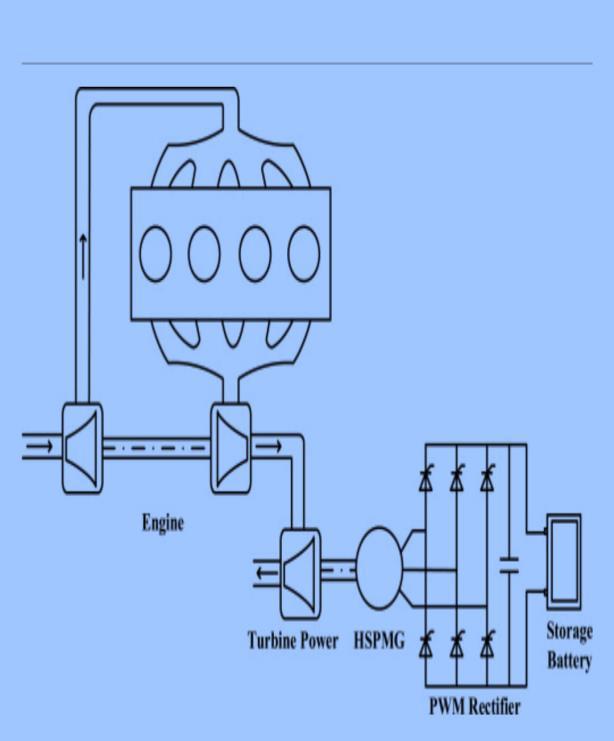
2.1 EXHAUST GAS SYSTEM The exhaust gas system of a marine engine to recover most of the waste energy from theunusedgasesleavingthecylinder.
2.2 Turbo charging Thisprocessusestheflowofexhaust gases to drive a turbine, which is mechanically connected toacompressor.
International Research Journal of Engineering and Technology (IRJET) e-ISSN: 2395-0056
Volume: 11 Issue: 09 | Sep 2024 www.irjet.net p-ISSN: 2395-0072
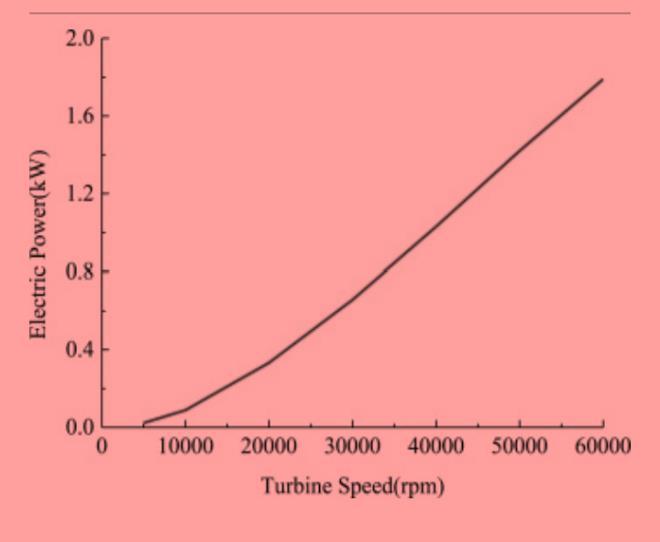
Reveals the Relationship between generated power and turbo-generator speed. It is clear that the electric power increases linearly as the speed increases. Power increases gradually from 5000 rpm to 60,000 rpm with a maximum powerof1.8kwat60,000rpm.
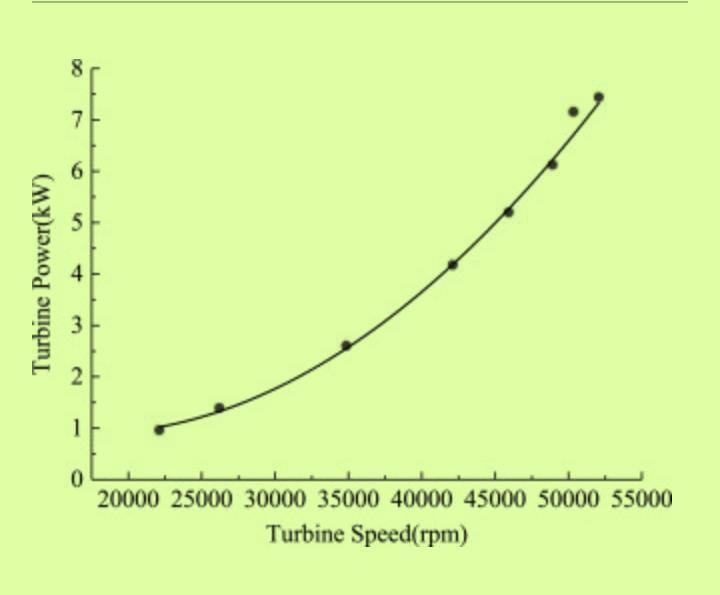
Furthermore, turbine power is investigated at various massflowratesandspeeds.Theresultispresentedin.The power of the Turbine increases linearly as mass flow increases.Themaximumachievedpoweris8.9kWat0.18 kg/sec mass flow rate as shown. Presents variation of turbinepowerwithturbinespeed.
Time-varying power turbine speed at different engine speeds.Itcanbeseenfromthefigurethatwhenthespeed increases from 1800 r/min to 3600 r/min, the turbine speedalsoincreasesgradually
The Relation of system efficiency with engine speed is showninItcanbefoundthatastheenginespeedincreases from 1800 r/min to 3000 r/min, the system efficiency gradually increases. The system efficiency then gradually decreases from 3000 rpm to 3600 rpm and reaches a maximumefficiencyof42.8%at3000rpm.
International Research Journal of Engineering and Technology (IRJET) e-ISSN: 2395-0056
Volume: 11 Issue: 09 | Sep 2024 www.irjet.net p-ISSN: 2395-0072
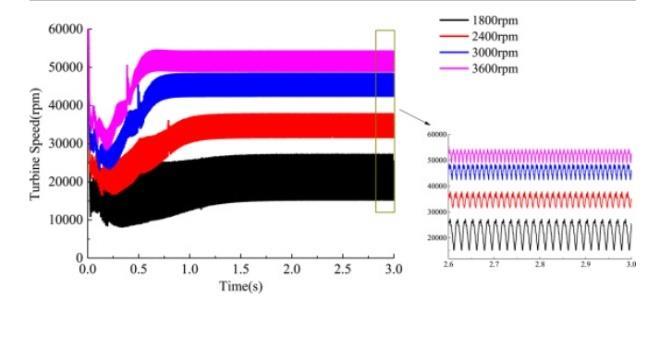
Fig.4 THE POWER TURBINE SPEED WITH TIMEVARIATION AT DIFFERENT ENGINE SPEED.
4.1THERMAL EFFICIENCY: Measures how effectively a system converts waste heat into useful energy. For example, combined heat and power (CHP) systems typically achieve 70–90% efficiency by simultaneously generating electricity and useful heat, while Organic Rankine Cycle (ORC) systems typically produce low-grade heatatabout10%efficiency.Convertstoelectricitywith20%efficiency.
4.2HEAT SOURCE TEMPERATURE: Higher temperature wasteheatsourcesgenerallyleadtobetterefficiency.
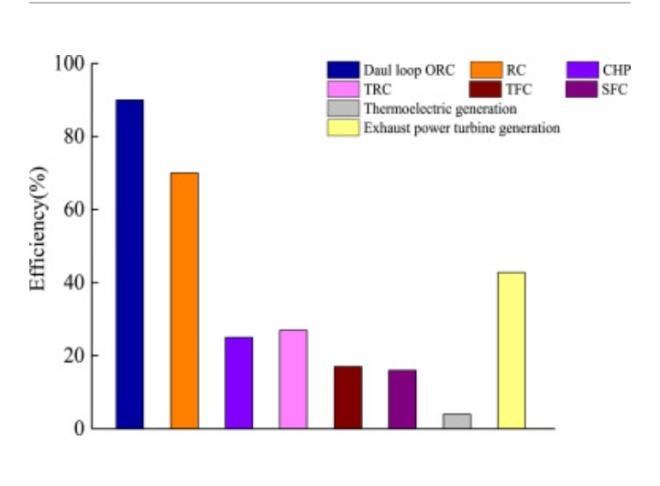
Fig.5 THE SYSTEM EFFICIENCY COMPARISON OF WASTE HEAT RECOVERYSYSTEM
5. THE INFLUENCE OF INJECTION TIMING ON THDU OF GENERATOR:
Shows the system efficiency comparison of this research with dual loop ORC system Imperia et al., 2020 Combined heat and power generation (CHP), Rankine cycle (RC), trans critical Rankine cycle (TRC), tripartite flash cycle (TFC) and single flash cycle (SFC) (Rajkumar et al., 2017),
andthermoelectricproduction[1].Itshould benotedthat the efficiency in the picture is only for a certain research case,whichmaydifferfordifferentresearchobjects.
Presents the effect of injection timing on the THDU of the generator.Itcanbeseenfromthatwhenthefuelinjection timingdecreasesfrom-9.93°to-5.93°,theTHDUincreases from 0.032 to 0.09. The change in fuel injection advance angle will cause changes in the diesel engine exhaust energy, and then the generator speed will fluctuate in different limits, and the electromagnetic performance of the generator will also change. When the fuel injection advance angle becomes smaller, the exhaust gas energy flowingintotheturbineandthegeneratorspeedincreases.
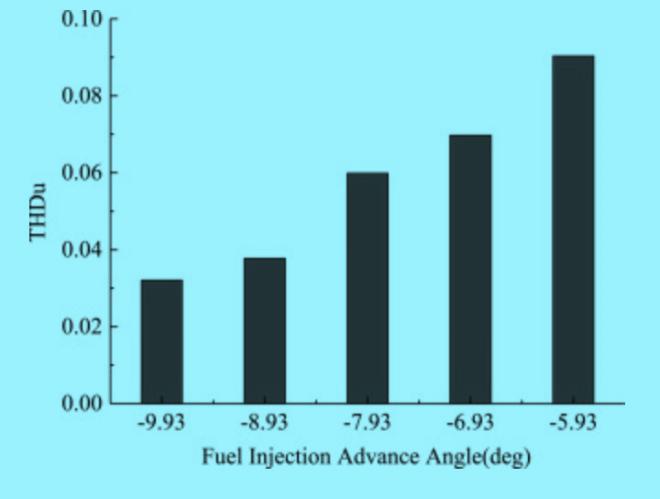
Fig.6 THE INFLUENCE OF INJECTION TIMING ON THDU OF GENERATOR:
6.CONCLUSIONS
A computational study has been conducted on using an exhaust power turbine with a high-speed permanent magnet generator to recover waste heat from engine exhaust gas. A high-speed permanent magnet generator (60,000 r/min) is designed for this purpose. A diesel engine (88 kW at 3600 r/min) is used as the primary mover. Computational models of the engine and exhaust turbine power generation systems are developed using GT-Power(fordieselengines).
[1] NRC. Review of the 21st century truck partnership. Washington(D.C.):
[2] Zhang XX, Zeng K, He MG. New technology of thermodynamic cycle for waste heat recovery of vehiclegasolineengine.
International Research Journal of Engineering and Technology (IRJET) e-ISSN: 2395-0056
Volume: 11 Issue: 09 | Sep 2024 www.irjet.net p-ISSN: 2395-0072
[3] Houn alas DT, Katsanos C, Lamaris VT. Recovering energy from the diesel engine exhaust using mechanicalandelectricalturbocompounding.
[4] Zhao R, Li W, Zhuge W, Zhang Y, Yin Y. Numerical study on steam injection in turbot compound diesel engineforwasteheat recovery.
[5] Karvountzis-Kontakiotis A, et al. Effect of an ORC waste heat recovery system on diesel engine fuel economyforoff-highwayvehicles.
BIOGRAPHIES:




I am pursuing B.E final year Marine Engineering cadet at PSN College of Engineering & Technology, Tirunelveli, TamilNadu.
I am pursuing B.E final year Marine Engineering cadet at PSN College of Engineering& Technology, Tirunelveli, TamilNadu.
Project Guide cum Assistant Professor
PSN College of Engineering & Technology, Tirunelveli, Tamil Nadu. Also having 15 years’ experience in OilandGasindustries.Specializationin NDTandworkedvariesGulfCountries.
Project Guide cum Assistant Professor
PSN College of Engineering & Technology, Tirunelveli, Tamil Nadu MEO Class-IV Marine Engineer and workedvariesCountries.