
International Research Journal of Engineering and Technology (IRJET) e-ISSN: 2395-0056 p-ISSN:2395-0072
Volume: 11 Issue: 09 | Sep 2024 www.irjet.net

International Research Journal of Engineering and Technology (IRJET) e-ISSN: 2395-0056 p-ISSN:2395-0072
Volume: 11 Issue: 09 | Sep 2024 www.irjet.net
Abstract -
Deepak
Kumar Jha1 ,
Pallavi Mishra
2 , Aradhya A Rathore3 , Sankalp Verma4
1-4Vellore Institute of Technology, Vellore, Tamil Nadu, India
In the digital world, phishing is still a prevalent and developing problem that can be extremely costly for both individuals andbusinesses. The ever-evolving strategies used by fraudsters make it more difficult to identify phishing assaults with high precision. As a reaction, we suggest creating an intricate phishing detection system that makes use of cutting-edge machine learning techniques. Our method looks for trends and abnormalities in large datasets to increasethe efficacy and accuracy of phishing attempt detection. Our solution aims to offer a comprehensive defence mechanism that can adapt to the dynamic nature of phishing attacks, protecting users and organisations from sophisticated and newly emerging phishing schemes as digitalenvironmentsgetmorecomplicated.
Key Words: Phishing Detection, Machine Learning, Cybersecurity, Fraud Prevention, Digital Threats, Attack Identification,DataAnalysis,ThreatMitigation
1. INTRODUCTION
1.1 Brief History
Earlyinthe1990s,America Online(AOL) computers were the target of the first known phishing assault [37]. By establishing fictitious accounts with erroneous credit card information, attackers took advantage of AOL's initial validation procedure. Theseaccountswereusedto access AOLresources afterthey wereactivated. In response,AOL strengthened its verification processes; however,hackers adjusted by obtaining personal data from actual users. Theyobtained usercredentials byimpersonating AOL staff in phishing emails and instant chats. This strategy spread to encompass a number of e-commerce and banking websites.
1.2
2.97 billion people, or more than 38% of the world's population, were online as of 2014. These users havebeen the subject of phishing schemes more often, which have resulted in large financial losses. Phishing attacks increased 160% in 2012 over 2011. Approximately 450,000 phishing assaults resulted in losses over $5.9 billion in 2013. There were 125,215 attacks in the first
quarterof2014,up10.7%fromthepreviousquarter.99.4% ofphishingsitesusedport80,andmorethan55%usedthe nameofthetarget.123,972phishingassaultswerereported in the second half of 2014; as a result, 4.5 billion dollarsin 2014and4.6billiondollarsin2015werelostfinancially.
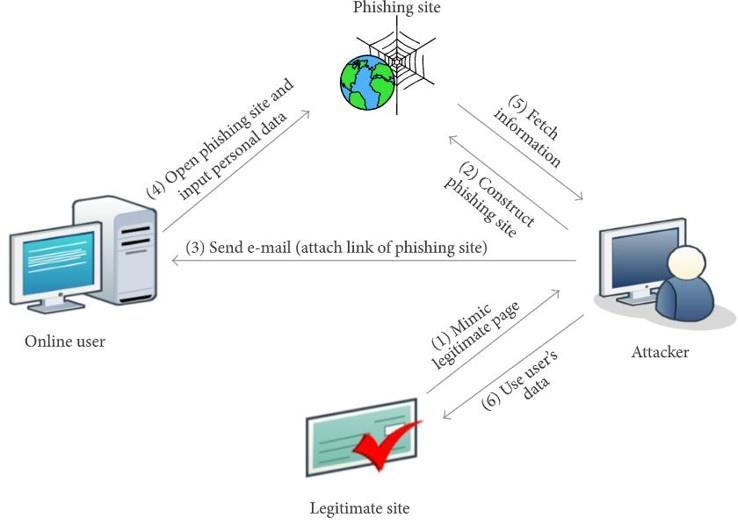
The following image shows a simplified version of how phishingwebsitesoperate.
2. METHODOLOGY
2.1 Workflow
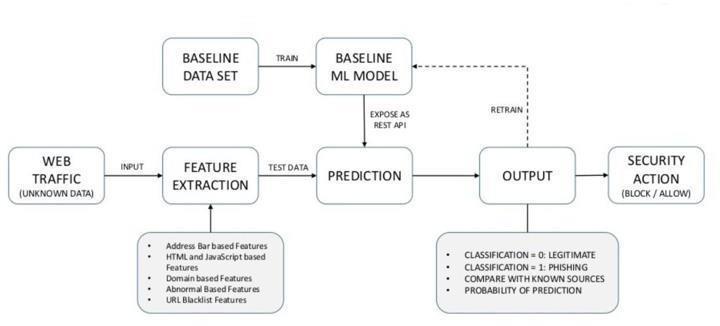
Fig-2:FlowchartofthePhishingDetectionSystem
e-ISSN: 2395-0056 p-ISSN:2395-0072 Volume: 11 Issue: 09 | Sep 2024 www.irjet.net
2.2 Module Description
2.2.1 Exploratory Data Analysis (EDA)
Inthisstepwestudythetrendsindataandcountthenumber of observations for each class of data (i.e. whether it is a phishingwebsiteoralegitimatewebsite).
2.2.2 Data Visualization
In this module we create simple graphs to visualize the trends in data, namely we make a heatmap whichvisualizes the correlation of the data features and thetarget class and howheavythesecorrelationsare, furthertosimplifythiswe create a simple bar graph again showing the correlation of ourdatafeatureswiththetargetclassthishelpsusinvisually understandingwhichfeaturesaffectthetargetclassthemost andwhichfeaturesareratherinsignificant intheoutcomeof ourclassification.
2.2.3 Pre - Processing the data
In the dataset we are using the result class has two distinct values (-1 and 1), a machine learning classifier generally accepts the 2 values of 0 and 1 so we remap the -1 class results to 0, we also check if the datasethas any NaN values andtrytofillthemoutusingpropertechniques.
2.2.4 Train Test Validation split
Inthisstepwesplitthedata intotwodata setswhichwill be outrespectivetrainingand testingdata sets which will bein theratioof80:20(trainingdata:testdata)
2.2.5 Implementation Using Streamlit:
Streamlit is an open-source python library that is useful to create and share data web apps. It is slowlygaining a lot of momentum in the data science community. Because of the ease with which one can develop a data science web app, many developers use it in their daily workflow. In this final moduleweaimtotakethebestfittingmoduleandimplement ina user-friendly Web Application that any common person with minimal knowledge of machine learning or internet security can use to easily get a highly accurate prediction of whetherawebsiteislegitimateoraphishingwebsite.
2.3 Procedure Description
Inthisstudy,weexperimentedwithvariousmachinelearning models, including Decision Trees and Random Forests, to identify the most suitable model for our dataset. After extensive evaluation, we selected the model that demonstrated the highest accuracyamong all thealgorithms tested.
Technique Description 1.Logistic Regression
LogisticRegressionusesthe equation-
ℓ=β0+(β1)(x1)+(β2)(x2)
Where:
ℓisthelinearcombinationof theinputfeatures.
β0istheintercept(bias term).
β1,β2,…,βnarethe coefficients(weights)for eachfeaturex1,x2, ,xn
Theoutputispassedthrougha sigmoidfunction,whichreturnsa valuebetween0and1.Acut-offpoint (e.g.,0.5)classifiestheresultinto binaryclasses.
Where:
P(y=1) represents the predicted probability thatthe output class is 1
σ(ℓ) is the sigmoid function, which squashesthe linear output into therange [0, 1]
Anewdatapointisclassifiedusingthe k-Nearest Neighbours (k-NN) techniquebyutilizingtheclassesofthe k closest data points from the training set. Metrics like the Minkowski, Manhattan, and Euclidean distances are frequently used to calculate the distancebetweenthepoints
Thejudgmentisextremely susceptibletonoiseoroutliers whenk=1,astheprocedure allocatestheclassoftheclosest singledatapointtothenew instance
Whenkisbiggerthanzero,the algorithmselectstheclassthatismost commonamongtheknearestpoints (majorityvoting).This methodlessenstheeffectofnoise
Volume: 11 Issue: 09 | Sep 2024 www.irjet.net
since the algorithm considers more neighbours before reaching a conclusion
Theselectionofkisessential:
-Smaller k values: The model willbe more adaptable, but it may be unduly impacted by spurious or unimportant dataitems
-Large k values: The model gets more stable and broadly applicable, but it could also over smooth the borders between classes, which could lead to points close to the decision boundaries beingincorrectlyclassified.
Another option is weighted voting,in which neighbours who live closer to the new point have a greater say in howtheareaisclassified.
For both classification and regression tasks, a supervised learning approach called a decisiontree is employed. The arrangement resembles a flowchart, wherein:
Every internal node depicts a test on a feature(attribute),everybranchshows the test's results, andevery leaf node showsaclasslabelorotherresult.
To reduce uncertainty (as assessedby metrics like Gini impurity or information gain), the tree dividesthe dataset into subgroups depending on the most important characteristic at eachstage.
Decision trees are quite versatile because they may capture nonlinear correlations between characteristics and the target variable
A Random Forest is a powerful ensemble learning technique that constructs multiple decision trees during training and aggregates their predictions to make a final decision. Each tree in the forest is built using a different random subset of the training data, a process known as bagging (bootstrapaggregating) Additionally, at each node split, only a random subset of features is considered, which introduces further diversityamongthetrees
4. Random Forest Classifier
5. Support Vector Classifier
p-ISSN:2395-0072
Thefinaloutputisdeterminedby:
Majority voting for classification tasks, where the class most predicted by the individualtreesisselected.
Averaging for regression tasks, where the mean of all tree outputs is taken as the finalprediction.
This combination of multiple trees reduces variance and overfitting, improving generalization to unseen data Random Forests are also known fortheirabilitytohandlelargedatasets and high- dimensional spaces, offering better performance on complex problems while retaining interpretability through feature importanceanalysis.
Inthisstudy,SupportVectorClassifiers (SVC) are employed to determine the optimal decision boundary for classifying data points The primary objective of SVC is to maximize the margin, which is the perpendicular distance between the decision boundary(hyperplane)andthenearest datapointsfromeachclass,referredto as support vectors
By focusing on maximizing this margin, SVC aims to enhance the model's generalizationcapabilitytonew,unseen data. The support vectors play a crucial rolein definingthe positionand orientation of the hyperplane, as they are the closest data points to the decisionboundary.
In scenarios where the data is not linearly separable, SVC utilizes kernel functions such as the radial basis function (RBF) or polynomial kernels to map the data into a higher-dimensional space where a linear separation is feasible. This kernel trick allowsSVC to effectively manage complex decision boundaries thatcannotbecapturedintheoriginal featurespace
International Research Journal of Engineering and Technology (IRJET) e-ISSN: 2395-0056
Volume: 11 Issue: 09 | Sep 2024 www.irjet.net
The SVC algorithm involves solving a quadratic optimization problemto find the hyperplane that maximizes the margin while ensuring accurate classificationoftraininginstances This approach contributes to SVC's robustness in high-dimensional spaces and its ability to create effective decision boundaries, even for intricate datasets
Deep Learning is an advanced machine learning technique that utilizes neural networks with multiple layers to model complex relationships between inputs and outputs These neural networks consist of an input layer, hidden layers, and output layer, where each layer learns to transform the data through learned weights and activationfunctions
6. Deep Learning and Artificial Neural Networks
Neural Network Structure: Deep learning models are composed of multiple interconnected layers, which enable the network to learn hierarchical features and capture intricate patterns in data
Training Mechanism: The network is trained using backpropagation and optimization algorithms, such as stochastic gradient descent (SGD), to minimize prediction errorsandimproveaccuracy.
Applications: This approach is widely used in various fields, including computer vision, language translation, andspeechrecognition,dueto its ability to effectively handle high-dimensional and unstructureddata.
In essence, deep learning provides powerful tools for modeling and interpreting complex data, makingit a pivotaltechnologyin modernartificial intelligence.
p-ISSN:2395-0072



In conclusion, our project signifies a critical step forward incombatingphishingandothercyberthreats.Byutilizing a range of models, including Support Vector Machines (SVM), K-Nearest Neighbors (KNN), Logistic Regression, Decision Trees, Random Forest, and Deep Neural Networks (DNN), we achieved diverse accuracy scores: SVM and Decision Trees at 94%, KNN at 91%, Logistic Regression at 92%, DNN at 95%, and Random Forest achieving the highest at 97%. This peak accuracy of 97% illustrates the efficacy of our approach in accurately identifying phishing attacks, which can play a pivotal role
International Research Journal of Engineering and Technology (IRJET) e-ISSN: 2395-0056 p-ISSN:2395-0072
Volume: 11 Issue: 09 | Sep 2024 www.irjet.net
in mitigating the substantial financial losses associated withsuchthreats.
Given that phishing attacks led to approximately $4.5 billioninfinanciallossesin2014alone,evena modest1% reduction in these attacks achieved through improved detection and prevention could lead to a significant reductioninfinancial losses, potentiallysavingmillions of dollars.Ourmodel’sabilitytoaccuratelydetectandreport malicious websites, therefore, contributes not only to enhancing internet security but also to reducing the economicburdenonindividualsandorganizationsalike.
With these results, our technology stands as a powerful tool in reducing the number of fake websites and, consequently, the financial impact of phishing. This positionsourmodelasanessentialcomponentinfostering a saferonline environment, boostinguserconfidence,and enhancing overall security. As phishing schemes continue to evolve, thecontinual refinement of our model will be crucial in maintaining and improving upon these protectivemeasures.
[1]GregAaronandRonnieManning.[n.d.].APWGPhishing Reports.APWG.2014.
[2]Iztok Fister, Dusan Fister, and Xin She Yang. 2013. A hybrid bat algorithm. Elektrotehniški Vestnik/ElectrotechnicalReview80,1-2(2013),1–7.
[3]FrançoisCholletetal.2015.Keras.https://keras.io.
[4]FederalBureauofInvestigationofUSA-InternetCrime Complaint Center. 2016. Internet Crime Report. Technical Report.FederalBureauofInvestigationofUSA.
[5]M. Lichman. 2013. UCI Machine Learning Repository. Availableathttp://archive.ics.uci.edu/ml.
[6]J. Shad and S. Sharma, “A Novel Machine Learning Approach to Detect Phishing Websites Jaypee Institute of InformationTechnology,”pp.425–430,2018.
[7]Y. Sönmez, T. Tuncer, H. Gökal, and E. Avci, “Phishing web sites features classification based on extreme learning machine,”6thInt.Symp.Digit.ForensicSecur.ISDFS2018 -Proceeding,vol.2018–Janua,pp.1–5,2018.
[8]T. Peng, I. Harris, and Y. Sawa, “Detecting Phishing Attacks Using Natural Language Processing and Machine Learning,”Proc.-12thIEEEInt.Conf.Semant.Comput. ICSC 2018,vol.2018–Janua,pp.300–301,2018.
[9]M. Karabatak and T. Mustafa, “Performance comparison of classifiers on reduced phishing website dataset,” 6th Int. Symp.Digit.ForensicSecur.ISDFS2018Proceeding,vol.2018–Janua,pp.1–5,2018
[10]S.Parekh,D.Parikh,S.Kotak,andP.S.Sankhe,“ANew MethodforDetectionofPhishingWebsites:URL Detection,” in 2018 Second International Conference on Inventive Communication and Computational Technologies (ICICCT),2018,vol.0,no.Icicct,pp.949–952.
[11]AmaniAlswailem,BashayrAlabdullah,NorahAlrumayh and Aram Alsedrani,”Detecting Phishing Websites Using Machine Learning”, 2019 2nd International Conference on ComputerApplications&InformationSecurity(ICCAIS).
[12]Joby James, Sandhya L. and Ciza Thomas, ”Detectionof Phishing URLs Using Machine Learning Techniques”, 2013 International Conference on Control Communication and Computing(ICCC).
[13]Rishikesh Mahajan and Irfan Siddavatam , “Phishing Website Detection using Machine Learning Algorithms”, International Journal of Computer Applications (0975 –8887)Volume181–No.23,October2018.
[14]Jehad Ali , Rehanullah Khan , Nasir Ahmad and Imran Maqsood, “Random Forests and Decision Trees”, IJCSI International Journal of Computer Science Issues, Vol. 9, Issue5,No3,September2012.
[15]Gerard Biau, “Analysis of a Random Forests Model”, Journal of Machine Learning Research 13(2012) 10631095.