
International Research Journal of Engineering and Technology (IRJET) e-ISSN:2395-0056 p-ISSN:2395-0072

Volume:11Issue:09|Sep2024 www.irjet.net


International Research Journal of Engineering and Technology (IRJET) e-ISSN:2395-0056 p-ISSN:2395-0072
Volume:11Issue:09|Sep2024 www.irjet.net
Dhruv Nadkar1 , Aditya Avhad2 , Bhushan Gajare3
1Professor V.R. Jaiswal, Pune Institute of Computer Technology, Pune, Maharashtra, India
Abstract - In the automobile domain, advanced driver-assistance systems (ADASs) are employedtoimprove safety, however existing ADASs do not take into consideration drivers' conditions, such as whether they are emotionally suited to drive. In the automotive industry, advanced driver-assistance systems (ADASs) are employed to improve safety, however existing ADASs do not consider drivers' circumstances, such as whether they are emotionally fit to drive. Many road accidents and unanticipated situations are caused by driver inattention, which is one of the key characteristics and reasons.Face expression recognition is a relatively new image processing technique that is becoming increasingly important in applications such as driver warning systems. Even when given a noisy input or incorrect data, current algorithms can recognise facial expressions, but theylackaccuracy.It's also useless when it comes to dealing with uncontrollable emotions and recognition. Based on Deep Neural Networks and Convolutional Neural Networks, the proposed technique provides a driver warning system that efficiently identifiesfaceexpressions(CNN).
Key Words: Convolutional Neural Networks (CNNs), Deep Learning (DL), Driver Warning System, Facial Emotion Recognition (FER), Advance Driving AssistanceSystem(ADAS).
Excessive driver distractions, alcohol consumption, and speeding beyond safe limits are widely recognized as majorcausesofroadaccidentsandmishaps.Accordingto statistics from respective departments, it is observed, another very crucial factor contributing to road accidents is the fatigue condition that a driver experiences while driving. Drivers experiencing mental fatigue also suffer from excessive sleepiness and loss of consciousness after regularintervals.Driversdrivingfor more than 8 hours a day, undergoing immense physical activities and lack of sleepusuallysuffermentalfatigue.
In recent years, a rising amount of automation has penetrated the automobile industry. In terms of manual driving, this automation has opened up new options. On-board Advanced Driver-Assistance Systems (ADASs), whichare used inautomobiles,trucks,andothervehicles, provide exceptional opportunities for increasing the qualityofdriving,safety,andsecurityforbothdriversand passengers. Adaptive Cruise Control (ACC), Anti-lock Braking System (ABS), automotive night vision,

drowsiness detection, Electronic Stability Control (ESC), Forward Collision Warnings (FCW), Lane Departure Warning System (LDWS), and Traffic Sign Recognition (TSR) are examples of ADAS technology. The majority of ADASs are electronic systems that adapt and improve vehiclesafetyanddrivingquality.Bycorrectingforhuman mistakes, they have been shown to minimize road deaths. Proposed System uses CNN and deep learning algorithms to detect and predict facial emotion of drivers by keeping trackofimagesandthroughvideos.
Face recognition has gotten a lot of attention in recent years as one of the most successful uses of image analysis andcomprehension.AutomaticFERapproacheshave been extensively researched for many years, and because the use of the most discriminative options is the most importantfactordeterminingaFERmethod'seffectiveness, they'll be divided into two categories: those using handsewnoptionsandthoseusingoptionsgeneratedbyadeep learningnetwork.OneofthemostprominentusesofFERis intheAdvancedDrivingAssistanceSystem.
The driver's gaze was fixed on the specially constructed drowsy driver detection system, which was utilized to assessweariness.Techniquesfordetectingdrowsiness are dividedintotwogroupsbasedonthecriteriaemployedfor detection:intrusiveandnon-invasivemethodsofdetection. The distinction is made depending on whether or not an instrument is attached to and paired with the driver. An instrument is well-connected to thedriverintheinvasive technique, and the value of that instrument is examined andrecorded.
In their paper, S. Suchitra, S. Sathya Priya, R. J. Poovaraghan, B. Pavithra, and J. Mercy Faustina [1] propose a Local Octal Pattern-Convolutional Neural Network (LOP-CNN) approach to develop a more efficient Driver Warning System using Deep Learning. The CNNbased feature extraction reduces the semantic gap and enhances overall performance by utilizing Facial Expression Recognition. In their paper, Mira Jeong and Byoung Chul Ko [2], explain that ADAS integrates psychological models, sensors to capture physiological data, human emotion categorization algorithms, and human-car interaction algorithms. Researchers are focusing on issues such as using subtle psychological and physiological indicators (e.g., eye closure) to enhance the detection of dangerous situations like distraction and

International Research Journal of Engineering and Technology (IRJET) e-ISSN:2395-0056 p-ISSN:2395-0072
Volume:11Issue:09|Sep2024 www.irjet.net
drowsiness. They also aim to improve the accurate recognition of risky conditions, such as fatigue, by monitoring driving performance metrics like "drift-and-jerk" steeringanddetectingvehiclemovements indifferentdirections.
"Pixel Selection for Optimizing Facial Expression Recognition Using Eigenfaces," by C. Frank and E. Noth, was a contribution. They devised a technique for facial expression recognition that uses only pixels that are relevant for facial expressions to generate an eigenspace. A training set of face photos with facial emotions selects these relevant pixels automatically.Eigenspacetechniques are well-known in the field of face recognition (e.g. [Tur91], [Yam00], [Mog94]). Each person's eigenspace is constructed using numerous images of that person in a traditional face recognition system. To create an eigenspace with training photos, a partial Karhunen-Loeve transformation, also known as principal componentanalysis(PCA),isutilized.
"FacialEmotionAnalysisUsingDeepConvolutionalNeural Network," by Rajesh Kumar G A, Ravi Kant Kumar, and Goutam Sanyal [6], was published in 2017. They believed thathumanemotionsarementalstatesofsentimentsthat develop without conscious effort and areaccompanied by physiological changes in facial muscles, resulting in facial expressions. Happy, sad, rage, contempt, fear, surprise, and other key emotions are examples. Facial expressions play a significant part in nonverbal communication since they represent a person's interior sentiments.There has been a great deal of study on computer modeling of human emotion. However, it still lags behind the human visual system by a factor of 13. They are employing deep Convolutional Neural Network (CNN) to provide a better technique to anticipate human emotions (Frames by Frames) and how emotional intensity varies on a face from low to high levels of emotion in this system. The FERC-2013 database has been used to train this algorithm. The results of the suggested experiment are fairly good, and the accuracy attained may stimulate researchers to develop future models of computer-based emotionidentificationsystems.
A Convolutional Neural Network, which is also known as CNN, is a distinct type of neural network that primarily focuses on processing information that has a grid-like structure, for example, a picture. A binary illustration of visual information could be a digital image. It possesses a series of constituents arranged in a grid-like fashion that has component values to indicate how bright and which coloreverypixelhastobe.
A CNN generally has 3 layers: a convolutional layer, a poolinglayer,andafullyconnectedlayer.
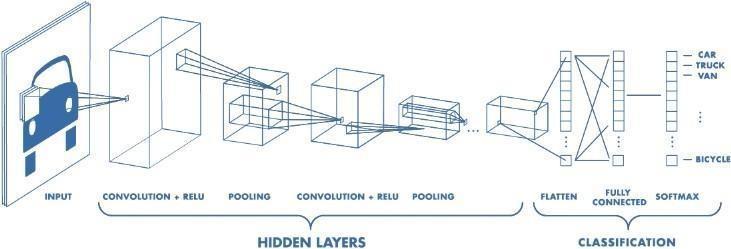
The convolution layer is the core component of a CNN, responsible for mostofthenetwork'sprocessingpower.It performs a dot product between two grids: the learnable parameters(kernel)andaspecificportionofthereceptive field.Althoughthekernelissmallerthantheimage,itholds a significant amount of information. For an image with three (RGB) channels, the kernel's height and width are smaller, but its depth spans all three channels. During the forward pass, the kernel moves across the image's height and width, producing a visual representation of the receptive area. This results in an activation map, a 2D representation showing the kernel's response at each spatiallocation.
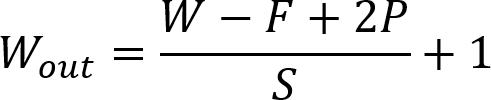
IfwehaveaninputofsizeWxWxDandaDoutvarietyof kernels with an abstraction sizeofF,strideS,andpadding amount P, the output volume scale is frequently given by thefollowingformula:
MotivationbehindConvolution:
Three key principles driving advancements in computer vision research are distribution interaction, parameter sharing,andequivariantrepresentation.Let’sexploreeach in detail. Simple neural network layers rely on matrix operations, where a matrix of parameters represents the interactionbetweeninputandoutputunits,meaningevery output unit is connected to every input unit. In contrast, convolutionalneuralnetworks(CNNs)havemoreselective interactions by using a kernel smaller than the input. Although images may contain thousands or millions of pixels, the kernel focuses only on relevant information covering tens or hundreds of pixels. This reduces the number of parameters, lowering memory requirements andimprovingstatisticalefficiency.Ifdetectingafeatureat one location (x1, y1) is useful, it should also be useful at another location (x2, y2). Thus, for creating an activation map, CNNs force neurons to use the same set of weights. Unliketraditional neural networks, where eachpart of the weight matrix is used only once, CNNs share parameters,
International Research Journal of Engineering and Technology (IRJET) e-ISSN:2395-0056 p-ISSN:2395-0072
Volume:11Issue:09|Sep2024 www.irjet.net
meaning the same weights are applied across different inputregionstogeneratetheoutput.
The layers of convolutional neural networks can have equivariance to translation due to parameter sharing. It states that if we change the input in one method, the outputwillalsobechangedinthatmethod.
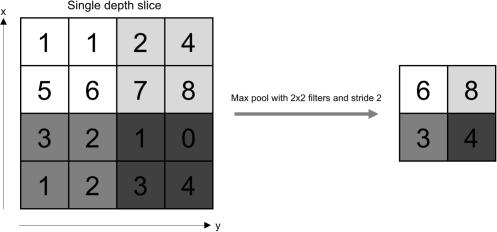
The pooling layer replaces the network's output at constrainedareasusinganoutlinestatisticofsurrounding outputs. This decreases the abstraction size of the illustration, lowering the needed number of computationsand weights. During the pooling step, each sliceoftheartworkishandledindependently.
The common of the rectangle neighborhood, L2 norm of therectangularneighborhood,andaweightedaverageare all pooling functions that support the gap fromthecenter component. The most used option, however, is max pooling, which reports the neighborhood's maximum output.
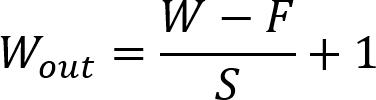
Ifwe'vegotanactivationmapofsizeWxWxD,apooling kernel of abstractionsizeF, andstride S, then thescaleof output volume are often determined by the subsequent formula:
3.3.FullyConnectedlayer
Ina typical CNN,neuronsin thislayerarefullyconnected to all neurons in both the previous and next layers. As a result, matrix operations followed by a bias adjustment canbeusedtocomputetheirvalues.
The FC layer assists with the illustration's mapping betweentheinputandoutput.
ViolaJones Face Detector is used to recognize and search for faces in photos and videos taken by the camera.
Learning is slower in response to this strategy, but detectionisfaster.Thisapproachdoesn'tusemultipliers,it uses filters from the underlying Haar function. Most searches occur in a single search window. After optimally determining the minimum and maximum frame sizes, the detection frame is moved correctly over that face image and finally a sliding step size is chosen for each recognizable size. It then uses the active shape model to find many available facial landmarks in the face image. In most cases, groups of points are used to represent the shape of an object. Facial landmarks are mapped using an ideal mapping approach based on center of gravity coordinates. Facial landmarks are categorically aligned with their average face shape model using an optimal mapping procedure based on centroid coordinates. The centroid mapping procedure uses these individual face markers to align each face image in the database for an averagefaceshapeapproach.
In the feature extraction step, a 7X5 grid is essentially extracted for each observed facial component, and each grid is represented by a square patch. The aligned face imagehasatotalof175meshesrepresentedbythe5 main facialfeatures,includingthetwocornersofthemouth,the tipofthenose,andthetwoeyes,usingthesameapproach as in the projection. Each grid contains a section of a face image. Uprooted and retrieved, a LOP function handle is created and evaluated as a local function. After that, the CNN is trained and matched using the LOP feature vectors as input. It critically recognizes facial expressions in specific supported categories based on CNN output and combines each LOP feature vector matching with a fully connected network. The LOP function is successfully passed to the CNN classifier for further classification. The technology we propose raises an alarm when the driver's facialexpressionisdetected.
Convolutional neural networks are one of the best known andidealwaystorepresentnetworktopologiesinthefield of deep learning. In the field of identification and classification of facial images, he has undoubtedly gained popularity. ConVnet quickly processes the generated data in the form of packages of multiple array sets. A CNN can take raw image data as input and run it through feature extraction and reconstruction techniques as part of an existing learning algorithm. In terms of the structure of weight distribution networks, they are similar to biological neural networks. As a result, the overall complexity of the network model and the number of weights associated with it are reduced. Directions such as transforms,scales,gradients,andothertransformationsdo not affect the CNN. The deep learning facial emotion recognition method is very reliable. An additional preprocessing approach for fast training on input face
International Research Journal of Engineering and Technology (IRJET) e-ISSN:2395-0056 p-ISSN:2395-0072
Volume:11Issue:09|Sep2024 www.irjet.net
pictures based on facial physics. CNNs are the preferred network model among all existing deep learning models. In the CNN-based approach, the input image is convolved with a filter bank of convolutional layers to obtain the extracted vector feature maps. When each feature vector map is integrated and connected to a fully connected network, facial expressions are identified naturally. CNNs are made up of numerous layers. Convolutional, MaxPooling,andfullyConnectedlayersarethethreetypes of layers you can use. The first convolutional layer is applied to the main components of the face, such as the left eye, right eye, the two corners of the mouth and the tipofthenose.Arectangulargridofneurons.Eachneuron in the convolutional layer receives and processes input from the rectangular region of the previous face component layer, and the weight of this rectangular section is the same for all neurons in the convolutional layer. The result is the convolution of the previous layer imageandtheweightssimplydefinetheconvolutionfilter. Additionally, each convolutional layer can contain multiple meshes that use inputs from previous layers, most with completely different filters. When the convolutional layeriscompleted,apoolinglayerisadded. The merge layer subsamples small rectangular pieces of face components in the previous convolutional layer to produce a single composite output from that block. Pooling can be done in a number of ways, such asusing a maximum or average number of neurons per block, or using a linear combination of neurons per learned block. The merged layer that counts can be the maximum merged layer. This means that the maximum number of blocks being merged in the face element is taken into account. Finally, multi-layer fully connected layers are usedto performhigh-levelmodesofinterpretationwithin neural networks when applied to multiple layers of convolution and max pooling. Thisstratifiedlayercollects input from all neurons in the previous face component layer and connects with each neuron. A fully connected layer is not followed by a convolutional layer because a fully connected layer is not spatially constrained in the samewayasaconvolutionallayer.TheLOPCNNapproach is shown in Figure 3. For example, suppose you have aconvolutionallayerafteryourneurallayer.Tocomputea pre-nonlinear input for units in a layer, we need to add a weight filter component from the cells of the previous layerandprovideanoutput.
After obtaining local feature descriptors, each descriptor is quantized into sparse codewords in the quantization process and indexing step, and the same approach is applied to all components of the same face image to identifydifferentsemanticcodewords.
Support Vector Machine (SVM) is a supervised machine learning technique that efficiently generates hyperplanes in high-dimensional space to perform classification or recognitiontasks.ThegoalofSVMtrainingistochoose the optimalhyperplanethatmaximizesthedifferencebetween thetwoclasses.SVMsworkbasedonbinaryclassifiersthat divideorclassifydataintotwogroups.
The activity will begin with the definition of realistic UCs, whichwillsubsequentlybeimplementedinan automobile contextbasedonvariousUserStories(USs)(aswellasina drivingsimulator).Simultaneously,thesystemarchitecture will be designed in order to determine which sensors and communication needs should be included in the development.
The software components will then be trained through an iterativeexperimentaldatagatheringeffort.
Finally, the state detection system and the Decision Support System (DSS) will be incorporated in the driving simulator.
By analyzing the previous model and keeping in mind its pros and cons given in the reports. We have divided the process of optimizing the model into 1 test case which is face-aging or Face-age invariance. As shown in the Confusion matrixclassificationalgorithmsperforms73%
on anger expression, 74.4% on disgust, 47.1% on fear, 94.8% forhappiness, 78.8% onsadness andforsurpriseit performs82.0%.
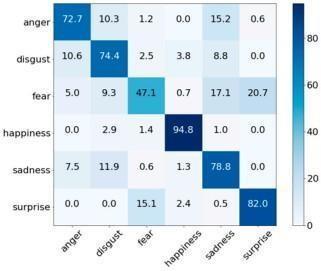
Fig-3: ConfusionMatrix
International Research Journal of Engineering and Technology (IRJET) e-ISSN:2395-0056 p-ISSN:2395-0072
Volume:11Issue:09|Sep2024 www.irjet.net
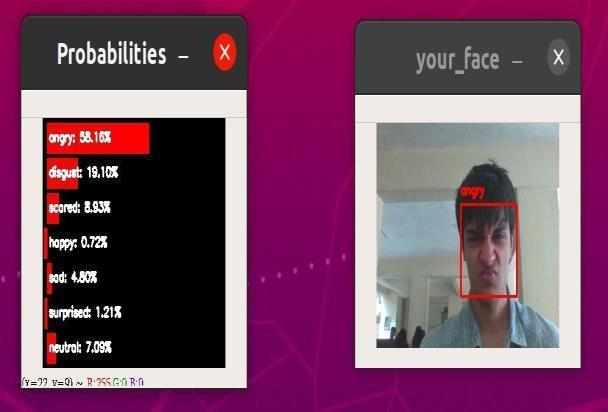
AngryExpressions
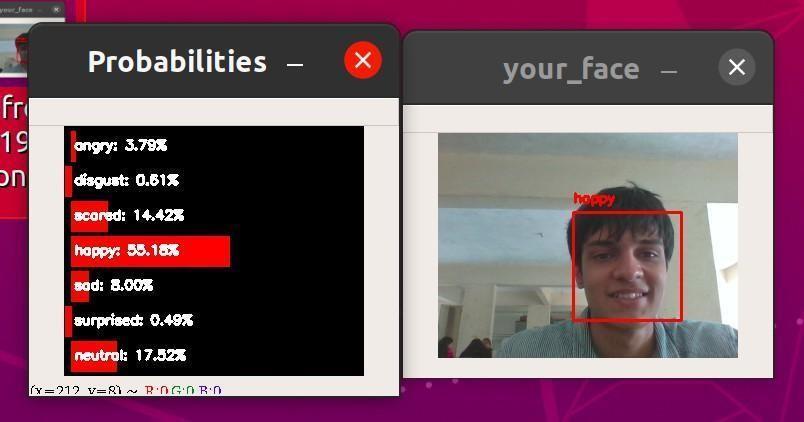
Fig-5: HappyExpressions
This paper provides a thorough review of the latest technologies in ADAS, highlighting both the opportunities for enhancing driving quality and safety and the limitations, such as some systems only using basic mechanisms to consider the driver's state or ignoring it entirely. The study centers on emotional and cognitive analysis in ADAS development, with a focus on machine learning techniques like Convolutional Neural Networks. The review stresses the need to improve classifiers that assessbothcognitiveandemotionalstates.
[1] S.Suchitra, S.Sathya Priya, R.J. Poovaraghan, B.Pavithra, J.Mercy Faustina, “Intelligent Driver Warning System using Deep Learning-based Facial Expression Recognition”International Journal of Recent Technology and Engineering (IJRTE) ISSN: 2277-3878,Volume-8Issue-3,September2019
[2] Mira Jeong and Byoung Chul Ko, “Driver’s Facial ExpressionRecognitioninReal-TimeforSafeDriving” KeimyungUniversity,Daegu42601,December2018.
[3] Lee B G, Jung S J and Chung W Y “Real-time physiological and vision monitoring of vehicle driver for non-intrusive drowsiness detection”, IET Commun.,2011
[4] Reza Azmi and Sam iraYegane,”Facial Expression Recognition in the Presence of Occlusion Using Local Gabor Binary Patterns”, 20th Intl Conf. on Electrical Engg.,May15-17,Tehran,Iran
[5] Qintao Xu,Najing Zhao, “A Facial Expression Recognition Algorithm based on CNN and LBP Feature,” 2020 IEEE 4th Information Technology,Networking,Electronic and Automation ControlConference(INTEC2020).
[6] “Facial Emotion Analysis using Deep Convolution NeuralNetwork”,RajeshKumarGA,RaviKantKumar, GoutamSanyal,IEEE,2017.
[7] Jeong, M.; Ko, B.C.; Kwak, S.; Nam, J.Y. Driver Facial Landmark Detection in Real Driving Situations. IEEE Trans. Circuits Syst. Video Technol. 2018, 28, 2753–2767.
[8] Hasani,B.;Mahoor,M.H.FacialExpressionRecognition Using Enhanced Deep 3D Convolutional Neural Networks. In Proceedings of the IEEE Conference on Computer Vision and Pattern Recognition Workshops (CVPRW), Honolulu, HI, USA, 21–26 July 2017; pp. 2278–2288.
[9] Eduard Zadobrischi, Lucian-Mihai Cosovanu, Mihai Negru and Mihai Dimian, “Detection of Emotional States Through the Facial Expressions of Drivers EmbeddedinaPortableSystemDedicatedtoVehicles” Serbia,Belgrade,November24-25,2020.
[10] Mollahosseini, A.; Chan, D.; Mahoor, M.H. Going deeper in facial expression recognition using deep neural networks. In Proceedings of the IEEE Winter Conference on Applications of Computer Vision (WACV), Lake Placid, NY, USA, 7–10 March 2016; pp. 1–10.