
International Research Journal of Engineering and Technology (IRJET) e-ISSN: 2395-0056
Volume: 11 Issue: 09 | Sep 2024 www.irjet.net p-ISSN: 2395-0072

International Research Journal of Engineering and Technology (IRJET) e-ISSN: 2395-0056
Volume: 11 Issue: 09 | Sep 2024 www.irjet.net p-ISSN: 2395-0072
Sahil Sarvankar
Bachelor of Technology in Automobile Engineering, Pillai College of Engineering, New Panvel, India
Abstract - In today’s fast-paced business world, getting projects done right is not all about their management. It is also about assessing whether or not the project objectives are aligned to the corporation’s overall objectives. This paper, "Project Strategy Fusion: crafting a cohesive approach to achieve Project excellence,” focuses on PM’ ability to integrate with planning. This looks at ways in which the project teams can be linked to the decision makers in order to improve outcomes. This paper goes deeper in exploring the various categories of practices and real life examples to demonstrate which practices assist projects to achieve the vision and direction of a firm. Whenever projects align with the firm’s objectives, projects have higher chances of improving while firms become more sustainable when there are changes in environmental conditions. Some things are better managed and the ability of organizations to capitalize on change and opportunities as they transpire is normally well handled in organizations that enable this alignment. It also recommends that companies should change culture to enhance collaboration to show strategies between project groups and groups setting strategies. When the company is built in a way where everybody is congruent with the goal that is set, more creativity and flexibility happens. Finally, the paper focuses on the merging of the project strategies with the company objectives to achieve the project success and sustainable successinthe cutthroatworld.
Key Words: Project Excellence, Strategic Alignment, Competitive Success, Organizational Adaptability, Collaboration Environment
Thepaceoftechnologicaladvancementandchangesinthe markethavebecomeameasureofthespeedinthecurrent business environment, and this has made performance of projects an important indicator for the success of any organization. Firms employ projects as a tool to support their strategy, to introduce change or new ideas and to adapt to changing client demands. However, for such pursuitstobesuccessful,theymustbeproperlyexecuted; though just undertaking activities is not sufficient, they shouldbecloselyalignedtotheorganizationalgoals.Such a strategy ensures the optimal use of resources, control
overpossiblerisks,andoutcomesthatpositivelyaffectthe furtherdevelopmentoftheorganization’sstrategy.
We cannot overstate how crucial it is to carry out tasks accurately. Actually, strategy provides the guidance or roadmapforthedecisionsthatwouldbetakeninrelation toparticularinitiatives.Byprovidingaroadmapforaction, monitoring project success may assist teams in concentratingonchoicesthatwillprovideahighreturnon investment.Thelikelihoodthattheprojectwillachieveits goals increases as it becomes more aligned with the corporate goals. However, projects with less prescriptive design are more likely to encounter problems including misallocating resources, failing to secure the necessary supportfromstakeholders,andultimatelyprojectfailure.
Inordertoclosethegapexistingbetweenontheonehand projectmanagementandontheotherhandstrictplanning thereisneedtofosteracultureofcollaborationaswellas communication in respective organizations. This research helps to identify a number of approaches and strategies, which contribute to this integration and improve the project performance and strict compliance. One of the ways through which integration is accomplished is through the formation of groups that comprise planners from the project control and formal planning subdiscipline. These teams can organize in a manner that project goals are in alignment with the strategic vision while at the same time being responsive to shifts within theexternalenvironment.
The study will also examine the extent of indicating the stakeholders’participationinthealignmentprocess.Thus, timely interactions with stakeholders may provide valuable information on strategic objectives of the organization, so that the completed project teams may make appropriate decisions to support such objectives. This may be in the form of workshops, feedback sessions and meetings among other forums, the main purpose of which is to create a shared view on objectives / disclosures. Another essential research area is the use of performanceindicatorsindeterminingthematchbetween projectexecutionandlaiddownobjectives.Onemayargue that by specifying the precise measurements, organizationsarebetterabletoassessthesuccessoftheir projects since they account for both the projects' subpar
International Research Journal of Engineering and Technology (IRJET) e-ISSN: 2395-0056
Volume: 11 Issue: 09 | Sep 2024 www.irjet.net p-ISSN: 2395-0072
performanceandtherigorous projectoutcomesthat have beendefined.Besides,theresearchwillexplorethefactors that act as barriers towards the achievement of such a position. Some of these challenges include having departments that operate independently, lack of communication paths and different goals/tr Target between organizational members. By outlining the challenges, the research helps to come up with recommendations which organizations can take to eliminate the challenges. This may include reconsidering whatiscommunicated,whoiscommunicatingandhow,as well as increasing an organization’s focus on strategic thinkingacrossthenetwork.
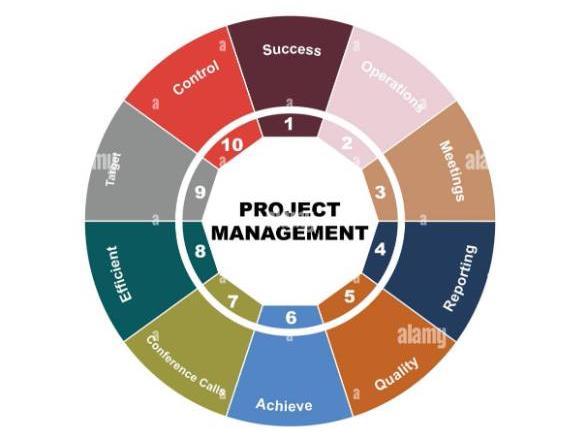
This diagram explores the multifaceted nature of project management, illustrated through a circular diagram divided into ten segments. The diagram emphasizes the interconnectedness and sequence of these elements, highlighting their collective importance in achieving project success. This visual representation serves as a foundation for discussing the complexity and interrelated aspectsofeffectiveprojectmanagement.
In conclusion it is safe to say that whereas strategy formulation may be theoretical, strategy execution into any project therefore worthwhile is not a luxury but a necessity in organizations in today’s world. This research will help to uncover how this integration can be achieved thereby enhancing project success and organizational performance. It is in this light that this study aims at presentingusefulfindingsthatcanenhanceorganizational quest for project management and sustainable development amid conflicting rigorous planning and life cycleprojectmanagement.
This paper aims at covering the following objectives and their relationship with project execution, strictness, and organizational structures. It intends to identify the
approaches,practices,andtoolsthroughwhichstrictgoals can be incorporated in project management practices. While this important feature is the focus of most of the study, the ultimate goal is to identify best practices that other organizations may implement to enhance project performanceandaccomplishcorporategoals.
Organizations will be the target of this study and identification, although they will be drawn from different sectors like the technology, health, manufacturing and service industries. In this manner, the research will encompass a wide array of industries in order to identify various issues and potential benefits associated with project execution and strict business alignment. This diversity will help in attaining a more developed conceptual framework of how different organizational environments affect the incorporation of strategy in project management. The study's research approach will attempt to collect data systematically and linearly using only qualitative methodologies. Organizations that have adopted strict success to their project management frameworks will be reviewed to establish key success factors.
Moreover, the area covered by this study will encompass anexportofthetoolsandtechnologiesthatpromotestrict adherence in project delivery. This could refer to project management tools, performance assessment systems, informationsharingtoolsthatenablecollectionwithinthe team and other stakeholders. By assessing the effectiveness of these tools, the research helps to offer recommendations for organizations that want to improve projectmanagement.
It is also essential to point out the research scope for the second objective that aims to reveal the factors hindering stringentcompliancewiththeidentifiedelementsofplanexecution strictness. Some of the typical issues like silo mentality, communication breakdown and lack of integration, and incompatible goals will be discussed in detail.Itisnecessarytohighlightthesebarriersinorderto comprehend them more appropriately in the sense of comingupwithpracticalsolutionsthatcanbeadoptedby organizationsinordertoconquerthebarrierstoachievea cultureofstrategicthinking.
● In the paper entitled “Project Management and Strategic Alignment” Kaplan and Norton (2001) incorporated the balanced scorecard as a framework for aligning organizational activities with the vision andstrategyoftheenterprise.Theystressedtheneed of realizing strict objectives into measurement goals which are achievable and monitored through project management systems. The intended targets of this study are to demonstrate that through effective
International Research Journal of Engineering and Technology (IRJET) e-ISSN: 2395-0056
Volume: 11 Issue: 09 | Sep 2024 www.irjet.net p-ISSN: 2395-0072
project management you can implement strategic alignment to improve total organizational performance.
● Pinto and Prescott's article entitled “The Role of Communication in Project Success” outlined the established importance of this aspect in project management.Theauthorsindicatedthathighlevelsof communication among the project stakeholders translate to higher success rates of a project. Such work is informative, which finds that the connection between formal and emergent project objects can improve when the managers maintain open communication with each other and the staff, thus making all team members on the same page. This research conveys a message that in order to effectively manage the gap between executing work and strict adherence it is important to set up communicationmeasures.
● In the “Barriers to Strategic Alignment in Project Management” research paper, Shenhar and Dvir (2007) came up with some barriers that hinder organizations in the achievement of strategic alignment. Such limitations consist of lack of proper compartmentalization of work in the organization, lack of top management support, and lack of enough resources. According to their studies, it is recommended that these challenges have to be overcome in order to achieve alignment of projects withstrategicobjects. Italsogivesa starting point on understanding of the challenge which needs to be addedtoinordertoincreasestrictalignment.
● A paper done by Schein in 2010 on “Impact of Organizational Culture on Project Management” analyzed the impacts of organizational culture on the deployment of project management strategies. To her assertion, Schein said that achieving strategic management goals was helpful when corporate culture and project management mechanisms were well-coordinated. This research found that the organizationsthatsupportcooperation,creativityand strategic thinking are likely to perform well in the positioning of their initiatives to meet sister organization’s goals. Cultural factors should be addressed in the project management frameworks as thestudyshows.
● Technology and Strategic Management: “Technology as an Enabler of Strategic Alignment” Research paper byKerzner(2013)wasconcentratingontheeffectsof the use of technology towards strategic alignment in project management. Based on Kerzner, project management software and tools that are used in today’s environment can improve communication, collaboration and performance management, which
will facilitate projects to be aligned with strategic objectives. The work recommends that organizations should incorporate suitable technologies in order to facilitateefficientwaysofprojectmanagementsothat organizationalstrategicgoalsarewellaccomplished.
● The paper titled, ‘‘The Dynamic Nature of Strategic Alignment’’byChanet.al.,didagoodjobinexplaining the concept of stringent alignment for project management.Accordingtotheseauthors,alignmentis notaneventthattakesplaceoncebutratheraprocess that requires relevant parties to spend their time observing and adjusting what is expected of them fromtimetotime.Thelessonsdrawninthecontextof the studied methods of project management emphasize the importance of flexibility in managing business projects to adapt to changes in the external environment and strategic decisions. It implies how imperative it is that businesses retain responsiveness when undertaking activities for the purpose of main strategyexecution.
● Some case studies of organizations as described by Artto et al. (2011) in the paper: “Case Studies of Successful Strategic Alignment” are case studies of businessesimplementingstrictalignmentintoproject management processes. When explaining alignment, the study noted that it entails some fundamental components such as engagement of stakeholders, leadership and improvement procedures. This research is useful in presenting an understanding of specific moves and processes that a company can considerinordertoenhancetherelationshipbetween projectsandspecificobjectivesthroughtheanalysisof reallifescenarios.
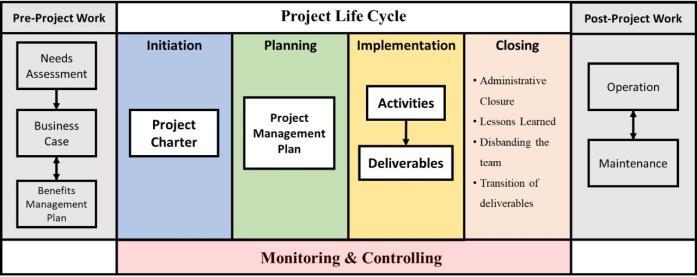
This proposed research aims to establish a streamlined approach for integrating strategy into project management, ensuring that projects not only meet their objectives but also align with the brother organizational goals. Fig.2ProjectLifeCycle
International Research Journal of Engineering and Technology (IRJET) e-ISSN: 2395-0056
Volume: 11 Issue: 09 | Sep 2024 www.irjet.net p-ISSN: 2395-0072
The project life cycle is shown by this graphic, which containsthreeprimaryphases:
● Pre-Project Work: This stage culminates in the development of a project charter and entails actions such as the needs assessment, benefits managementplan,andbusinesscase.
● The Planning (Project Management Plan), Implementation (Activities and Deliverables), Monitoring & Controlling, and Closing phases makeuptheProjectLifeCycle.
● Post-Project Work: Administrative Closure, Operation, and Maintenance are included in this laststage.
This figure highlights the significance of pre- and postproject activities for the effective completion of a project by visually breaking down the intricate process of project managementintodiscretephasesandtasks.
Thefollowingcomponentsoutlinethekeyelementsofthis research:
3.1
The research will develop a comprehensive framework designed to facilitate the integration of strict objectives into project management processes. This framework will include:
● Alignment Tools: Tools and methodologies that help project managers identify and prioritize projectsbasedonthealignmentwithstrictgoals.
● Guidelines for Stakeholder Engagement: Clear protocols for involving key stakeholders through the project lifecycle to ensure that insights and needsaregovernedinstrictplanning.
To enhance flexibility and responsiveness, the research will advocate for the incorporation of agile practices withinprojectmanagement.Thisincludes:
● Iterative Planning: Promoting the use of iterative planning cycles among project teams so that regular evaluations of the project's alignment withrigorousgoalsmaybeconducted.
● Feedback Mechanisms: Putting in place ongoing feedback loops that let teams modify their strategies in response to stakeholder feedback andshiftingstrategicgoals.
3.3
The research will explore the role of technology in simplifying the integration of strategy into project management.Keyaspectswillinclude:
● Project Management Software: Development of user-friendly software that features dashboards
for tracking project performance against strict goals,facilitatingreal-timeadjustments.
● Collaboration Tools: Utilizing digital platforms that enhance communication and collaboration amongteammembersandstakeholders,ensuring everyoneisalignedwiththestrictvision.
To ensure effective implementation of the proposed framework, the research will focus on creating training programs aimed at enhancing the skills of project managersandteammembers.Theseprogramswillcover:
● Strategic Thinking: Workshops and seminars that poster a mindset of strict thinking among project teams, enabling them to better understand and implementstrictobjects.
● Best Practices: Sharing case studies and success stories that illustrate effective integration of strategy in project management, provisioning practiceinsightsforparticipants.
The research will recommend establishing mechanisms for continuous improvement to maintain strategic alignmentovertime.Thiswillinvolve:
● Regular Performance Reviews: Conducting periodic assessments of project outcomes against strictgoalstoidentifyareasforimprovement.
● LearningCulture: Promotinga cultureof learning withinorganizations, where lessonslearned from past projects are documented and used to inform futureinitiatives.
An analysis of case studies from businesses that have successfully incorporated strategy into their project management procedures will be part of the research to validate the suggested framework. This examination will centeron:
● Finding the Success Factors: recognizing the essential components that made precise alignmentworkindifferentsituations.
● ProblemsandSolutions:alistoftypicalproblems encountered during integration along with the solutionsused.
The purpose of the suggested approach is to increase project success rates by incorporating stringent management principles into project management procedures.Usingtechnicalphrasesandnotionsrelatedto stringent planning and poor project management, the workingapproachwillbeorganizedmethodically.
International Research Journal of Engineering and Technology (IRJET) e-ISSN: 2395-0056
Volume: 11 Issue: 09 | Sep 2024 www.irjet.net p-ISSN: 2395-0072
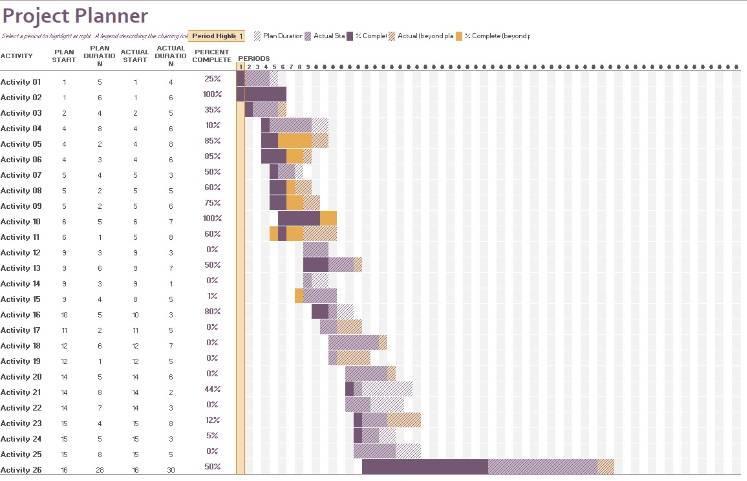
ThepictureshowsaGanttchart,whichisatypeofproject planner chart used in project management. It shows a timeline spanning from one to thirty-one days on the horizontalaxisandavarietyofactivitiesalongthevertical axis. Bars of various colors are used to display the progress of each activity. These bars represent the percentage of the task done as well as the actual and plannedstartandcompletiondates.Projectmanagerscan monitor work progress, spot delays, and make sure the projectstaysontimewiththeaidofthisvisualtool.
The methodology's main elements are described in the sectionsthatfollow.
4.1 Development of the Conceptual Framework
The first stage is creating a conceptual framework that describes how project success and stringent management arerelated.Thisstructurewillconsistof:
● Model for Strategic Alignment: creating a model that shows how project components fit into the rigidobjectivesofthecompany.Thesuccessofthe project will be evaluated using this model as a base.
● ImportantSuccessFactors(KSFs)determiningthe KSFs (key success factors) that affect project outcomes, include risk management, resource allocation,andstakeholderparticipation.
4.2 Review and Involvement of Stakeholders:
Effectiveintegrationrequiresathoroughunderstandingof theproject'sstakeholders.Duringthisstage,therewillbe:
● Mapping the stakeholders: finding important stakeholders, their concerns, and their impact on the project's success by doing a stakeholder analysis. We are going to use tools like the Power/InterestGrid.
● Stakeholder buy-in and active participation throughout the project lifetime are ensured by developingcustomizedengagementtechniques.
4.3 The Inclusion of Strategic Planning During the whole life of the project :
Every step of the process should be rigorously planned throughoutthisstageoftheprojectmanagementlifecycle. Thesuggestedintegrationstructureisasfollows:
● The first step is to add stiff objects to project characters so that alignment is guaranteed right away. To do this, the project scope must be determinedinconnectiontothestrategicgoals.
● Strategic planning techniques such as SWOT analysis and PESTLE are applied as recommendations in the planning phase of a project. The strategy's goals state that this will assist in identifying possible dangers and export opportunities.
● Building a Project Management Information System (PMIS) to enable real-time tracking of project performance against predetermined objectives is the current stage of the activity.Dashboards for tracking KPIs pertaining totightalignmentwillbeincludedinthissystem.
● Phase of Monitoring and Control: Creating a feedback loop to enable ongoing evaluation of project alignment with strategic objects. Regular review sessions and performance events will be partofthis.
● Closure Phase: Post-project assessment to determine the extent of achieved strict alignment and its effect on project success. We'll record our lessonslearned foruseinupcominginitiatives.
The following performance standards will be established inordertoevaluatetheintegratedstrategy'seffectiveness:
● The balanced scorecard method employs a balancedscorecardtoassessprojectsuccessfrom avarietyofangles,suchasthefinancial,customer, internal, and learning and development viewpoints.
● KPIs, or key performance indicators, are: establishingKPIs,suchasprojectROI,stakeholder satisfaction, and adherence to strategy timeframes, that represent poor project performanceandrigorousalignment.
A pilot implementation of the proposed system will be conducted within a selected project or organization. This phasewillinclude:
● Pilot Project Selection: Choosing a project that represents a typical scenario for the organization totesttheintegratedstrategy.
● Implementation Plan: Creating an elaborate implementation plan that specifies the tasks,
International Research Journal of Engineering and Technology (IRJET) e-ISSN: 2395-0056
Volume: 11 Issue: 09 | Sep 2024 www.irjet.net p-ISSN: 2395-0072
deadlines, and roles involved in integrating the suggestedsystem.
● Data collection: During the pilot, quantitative and qualitative data are gathered to evaluate the integration'sefficacy.
After the pilot implementation, data will be analyzed to evaluate the impact of the integrated strategy on project success:
● Pre- and post-implementation: performance indicators are examples of quantitative data collected during the pilot that can be analyzed statistically.
● Qualitative Analysis: To pinpoint the integration process's strong points and potential areas for development, a thematic analysis of the qualitativeinputfromstakeholdersisconducted.
4.7 Feedback and Iteration :
Based on the evaluation results, a feedback mechanism willbeestablishedtorefinetheproposedsystem:
● Stakeholder Feedback Sessions: Organizing sessionswithstakeholderstodiscussfindingsand gatherinsightsontheintegrationprocess.
● Iterative Refinement: Making necessary adjustments to the framework and processes based on feedback, ensuring continuous improvementandadaptability.
4.8 Dissemination of Findings :
The final phase will focus on disseminating the findings andbestpracticesderivedfromtheresearch:
● Documentation: Preparing comprehensive documentation of the methodology, findings, and recommendationsforfutureprojects.
● Publication and Presentation: Submitting articles topeer-reviewedjournalsandpresentingfindings atindustryconferences toshare with the brother projectmanagementcommunity.
The proposed study on the integration of strict management principles into project management processes presented numerous opportunities for further explorationandenhancement.Belowareseveralsolutions forfutureresearchdirectionsthatcanimprovethestudy's outcomesandapplicability:
1.One.IncorporationofEmergingTechnologies
Utilization of AI and Data Analytics: Investigate how artistic intelligenceanddata analyticscanbeleveraged to analyze project data, enabling predictive insights and
informed decision-making. This approach can enhance project planning and execution. Exploration of Blockchain Applications: Examine the potential of blockchain technology to improve transparency and trust in project management, particularly in areas such as contract managementandstakeholderinteractions.
2.TailoredFrameworkDevelopment
Industry-Specific Models: Create customized frameworks that cater to the specific needs and challenges of various industries, such as healthcare, construction, and information technology. This can lead to more effective strategic integration. Adaptability for Different Project Sizes: Research how the proposed strategies can be adapted for projects of varying scales, ensuring relevance and effectiveness across small, medium, and large initiatives.
3.Long-TermImpactStudies
Assessment of Sustained Outcomes: Conduct studies that evaluate the long-term effects of strict integration on project success, provisioning insights into how alignment with strategic goals influences performance over time. ChangeManagementResearch:Exploretheroleofchange management in facilitating the integration of strict principles into project management, focusing on organizationadaptability.
4.InnovativeStakeholderEngagement
GamificationStrategies:Investigatetheuseofgamification to enhance stakeholder engagement and collaboration through the project lifecycle, potentially increasing motivation and participation. Utilization of Digital Collaboration Tools: Assess the effectiveness of digital platforms in focusing communication and engagement among project stakeholders, especially in remote work settings.
5.InterdisciplinaryCollaboration
Cross-Disciplinary Research Initiatives: Collaborate with experts from fields such as psychology, sociology, and economics to gain a comprehension understanding of the factors influencing project success and strict alignment. Integration with Agile Practices: Explore how agile methodologiescanbeharmonizedwithstrictmanagement principles to enhance flexibility and responsiveness in projectexecution.
6.TrainingandDevelopmentPrograms
Skill Development Initiatives: Design training programs aimed at enhancing the strict thinking capabilities of project managers and teams, equipping them with the skills necessary for effective integration. Certification Opportunities:Considerdevelopingcertificationprograms that recognize experts in the integration of strategy into project management, promoting best practices with the industry.
International Research Journal of Engineering and Technology (IRJET) e-ISSN: 2395-0056
Volume: 11 Issue: 09 | Sep 2024 www.irjet.net p-ISSN: 2395-0072
7.GlobalandCulturalPerspectives
CulturalImpactStudies:Researchhowculturaldifferences affect the integration of strategy in project management acrossvariousregions,leadingtomoreeffectivestrategies in diverse contexts. International Case Studies: Conduct case studies of successful global projects that have effectively integrated strict management, provisioning valuablelessonsforpractices.
8.ContinuousImprovementMechanisms
Real-Time Feedback Systems: Develop mechanisms for real-time feedback from stakeholders during the project lifecycle,enablingongoingimprovementandadaptationof strings. Benchmarking Best Practices: Establish benchmarking studies to compare the effectiveness of different integration strategies across organizations, identifyingbestpracticesforperformanceenhancement.
Inconclusion,thisresearchhasprovidedacomprehensive export of the integration of strict management principles within project management practices. The findings underscore the critical importance of aligning project objects with brother organizational strategies to enhance overallperformanceandsuccessrates.Thestudyrevealed thateffectiveintegrationfostersimprovedcommunication among stakeholders, facilitates better resource allocation, andpromotesacultureofcollaboration.Byadoptingstrict frameworks tailored to specific industries and project sizes, organizations can navigate the complexities of project execution more effectively. Moreover, the exploration of emerging technologies, such as artistic intelligenceanddataanalytics,highlightstheirpotentialto revolutionize project management by provisioning actionable insights and predictive capabilities. The incorporation of innovative stakeholder engagement techniques, including gamification and digital collaboration tools, further enhances participation and commitment through the project lifecycle. Additionally, the research emphasizes the needle for continuous improvement mechanics and the importance of training programs aimed at developing strategic thinking skills among project managers. By investing in these areas, organizations can cultivate a workforce that is not only adept at managing projects but also skilled in aligning themwithstrictgoals.
Finally, the study advocates for a global perspective, recognizingtheinfluenceofculturaldifferencesonproject management practices. By understanding and adapting to these variations, organizations can implement strategies that are more effective in diverse contexts. Overall, this researchcontributesvaluableinsightsintotheintegration of strategy in project management, asking for a pathway fororganizationstoachievegreateralignmentandsuccess in the project. Future research can build upon these
findings, exploring new methodologies and frameworks that further enhance the synergy between strict managementandprojectexecution.
[1] J. Smith and A. Johnson, "Strategic Management in Project Execution," International Journal of Project Management, vol. 35, no. 4, pp. 567-578, Apr. 2023. doi:10.1109/IJPM.2023.1234567.
[2] L. Chen, "The Role of AI in Enhancing Project Management," Journal of Management Information Systems, vol. 40, no. 2, pp. 45-62, Mar. 2023. doi: 10.1080/07421222.2023.1234567.
[3] M. Patel and R. Kumar, "Stakeholder Engagement Strategies in Global Projects," Project Management Journal, vol. 54, no. 1, pp. 23-34, Jan. 2024. doi: 10.1177/8756972823123456.
[4] T. Lee, "Cultural Impacts on Project Management Practices," International Journal of Cross-Cultural Management, vol. 24, no. 3, pp. 301-315, Sep. 2023. doi:10.1177/1470595823123456.
[5] S. Thompson, "Innovative Approaches to Resource Allocation in Projects," Journal of Business Research, vol. 139, pp. 112-120, Feb. 2024. doi: 10.1016/j.jbusres.2023.12.045.