
International Research Journal of Engineering and Technology (IRJET) e-ISSN:2395-0056
Volume: 11 Issue: 09 | Sep 2024 www.irjet.net p-ISSN:2395-0072

International Research Journal of Engineering and Technology (IRJET) e-ISSN:2395-0056
Volume: 11 Issue: 09 | Sep 2024 www.irjet.net p-ISSN:2395-0072
Ryna Goyal
Class 12, Sat Paul Mittal School, Ludhiana
Abstract: Evenafter77yearsofIndependence,financialliteracyremainsagreatestconcernforIndianwomen, despitethecountry'sprogressinvarioussectors.AccordingtotheHumanityWelfareCouncil,80%ofwomenin India struggle with financial literacy, and around 62% do not own bank accounts or have limited access to banking services. This study assesses the financial literacy of Indian women aged 14-46 in Ludhiana, Punjab, throughanonlinesurveythatgarnered52responsesfromadiversedemographicgroup.Thesurveyevaluated financial behaviour and knowledge across variables such as education level, marital status, age, and employment. Using both quantitative and qualitative methods, the study reveals that while women face significant gender-related challenges, they demonstrate a strong interest in achieving financial independence. Respondents suggested the integration of financial literacy into school curricula and the promotionof gender equality as key measures for improvement. This research underscores the necessity of financial skills for women to navigate today’s complex financial environment, advocating for societal investment in women’s financialeducation.
Keywords: Investments,FinancialLiteracy,GenderDisparity,FinancialDecisionMaking
1. Introduction
Financialliteracyisfoundationaltotheeconomicgrowthanddevelopmentofanynation.Asdescribed byRemund(2010),financialliteracyreferstoanindividual’scapacitytounderstandandeffectivelyusevarious financial concepts. Similarly, Hung et al. (2009) describes financial literacy as having an "understanding of fundamental economicand financialconcepts, aswell as thecapacitytouse that knowledge andother money managementskillstocontrolmoneywiselyforaprolongedamountoftimewell-being."
Research consistently shows a gender disparity infinancial literacy, with men often exhibiting greater knowledge of financial products and markets compared to women (Nilesh, 2022). Gender differences also extend to financial decision-making, wheremen and older individuals, particularly those with higherlevels of education and income, tend to display greater financial acumen (Hung et al., 2009). Poor financial literacy is linkedtofinancialmismanagementinkeyareassuchasbudgeting,saving,borrowing,andinvesting,increasing thelikelihoodofadversefinancialoutcomes(Lusardi&Mitchell,2011;Galetal.,2020).
Financial literacy equips individuals with the skills needed to understand inflation’s impact on purchasing power, make informed decisions about risk and return, and navigate the complexities of money managementinadynamicmacroeconomicenvironment.However,inIndia,womenfaceuniquechallengesthat hinder their financial literacyandindependence, rooted insocietal norms and gender inequality. Theongoing struggle for equality in status, rights, and opportunities exacerbates these challenges, making it imperative to addressfinancialliteracyasakeyfactorinwomen’sempowerment.
The education and empowerment of women are critical issues globally, particularly in developing countries like India. Despite advancements in educational attainment, women often do not translate this into financial independence or economic participation. Financial ignorance has severe consequences, leading to higher transaction fees, larger debts, and lower savings (Lusardi & Tufano, 2015; Lusardi & de Bassa Scheresberg, 2013). The failure to impart financial literacy to women not only perpetuates gender inequality butalsounderminesbroadereconomicprogress.Thisstudyaimstoexploretheimpactoffinancialliteracyon women's empowerment in India, focusing on the barriers they face and strategies to overcome them. By
International Research Journal of Engineering and Technology (IRJET) e-ISSN:2395-0056
Volume: 11 Issue: 09 | Sep 2024 www.irjet.net p-ISSN:2395-0072
analysing both primary and secondary data, this research seeks to contribute to the ongoing discourse on genderequalityandfinancialinclusion.
Nikita M. Daga (2021) conductedasurveyamong131Indianwomenaged23andabovetoinvestigate the factors influencing their financial independence. The study used a mixed-method approach to examine factors such as education, financial knowledge, cultural pressures, household responsibilities, and empowerment. Daga found that younger women (aged 23-40) placed greater importance on household responsibilitiesthanolderwomen(41+),reflectingevolvingattitudestowarddomesticroles.However,despite financial security, womenwith caregivingduties oftenwithdrewfrom the workforce, hinderingtheir financial independence.Thestudyhighlightsthesocietalpressuresandculturalnormsthatcontinuetorestrictwomen's financialautonomy,suggestingthateducationaloneisinsufficientwithoutbroadersocietalchange.
Anushree Srivastava (2020) exploredtheroleoffinancialindependenceinenhancingwomen'sstatus in society. Utilizing both primary data from questionnaires and secondary data from previous studies, Srivastavatracedtheevolutionofwomenfromhomemakerstoactivedecision-makersinvariousstagesoflife. The study emphasized the importance of financial awareness in enabling women to achieve greater independence.Thestudyalsoexaminedtheimpactofgovernmentinitiatives,suchasBetiBachaoBetiPadhao and Mahila Shakti Kendra, which aim to empower women through education and financial inclusion. Srivastava'sworkunderscoresthetransformativepotentialoffinancialliteracyinfosteringgenderequality.
Maanya Singh (2022) analysed the factors impacting the success and profitability of urban women entrepreneursinthesmallfoodandbeverage(F&B)sector.Thesampleinvolved21femaleentrepreneursaged 20-60andusedacombinationofin-depthinterviewsandonlinesurveystogatherdata.Singh'sfindingssuggest that entrepreneurship significantly enhances financial independence and social empowerment for women. However, the study also identified key barriers, such as a lack of mentorship (42.9%), financial support (23.8%), emotional support (9.5%) and legal understanding (9.5%), that hinder the scalability of these ventures. The research highlights the need for targeted support systems to maximize the potential of women entrepreneurs,therebycontributingtotheirfinancialempowerment.
Martha Klatt (2009) examined the financial literacy of women, focusing on the barriers that prevent financial knowledge from translating into effective financial behaviour. Surveying 300 women aged 16 and above,Klattfoundthatwomenfacedsignificantobstaclesinfinancialmatters,includinglowerparticipationin retirementplanninganddiscomfortinseekingfinancialadvicecomparedtomen.Thestudyalsohighlightedthe role of education in enhancing financial literacy and advocated for workshops on money management and investing. Klatt's research suggests that early intervention and continuous financial education are crucial in preventingpoverty.
Chetna Singh and Raj Kumar (2017) conducted a survey of financial literacy among 700 working women in Pune, with 500 respondents completing the questionnaire. The study examined socio-demographic factors such as education, age, income, marital status, and residence. The findings revealed that only 35% of women with graduate degrees were financially literate, with significantly lower literacy rates among lesseducated women. Additional, 68% of respondents indicated that male family members primarily made investment decisions. The study concluded that low financial literacy among women is often due to a lack of awareness about financial products and a reliance on male relatives for financial decision-making. Singh and Kumar recommended the development of tailored financial literacy programs that address women’s specific educational and financial needs, emphasizing the importance of spending, saving, insurance, retirement planning,andinvestmentstrategies.
3. Methodology
Thisresearchstudyutilizedtheprimarydatacollectionapproachthroughquantitativeonlinesurveysto assesstheleveloffinancialindependenceandawarenessamongyoungwomeninLudhiana,Punjab.Atotalof
International Research Journal of Engineering and Technology (IRJET) e-
Volume: 11 Issue: 09 | Sep 2024 www.irjet.net p-ISSN:2395-0072
52 women participated in the survey, which aimed to gauge their awareness and involvement in financial matters.
Astructuredquestionnaireof24questionswasdevelopedforthispurpose.Thequestionswerebased on the comprehensive review of existing literature and aligned with the researchers' objectives. The survey included questions on basic financial concepts, such as the impact of inflation on returns and knowledge of various financial products. Additionally, the questionnaire explored gender bias in financial decision-making amongtheparticipants.Thesurveyalsoaimedtoidentifyeffectivemeasuresandnecessarytrainingprograms toenhancefinancialliteracyamongwomen.Tosupporttheresearch,datawascollectedfromadiversegroupof womenvaryinginageanddemographicbackground.Theanonymityofallparticipantswasensuredtomaintain confidentiality.
Thesampleconsistedof52women,primarilybetweentheagesof14and18,whopossesshighschoollevel education. The demographic breakdown of the sample includes three-fourth single and one-fourth marriedwomen.Oftheparticipants,14wereemployed,while38werenotengagedinformalemployment.All respondents were residents of the urban area of Ludhiana, providing a focused perspective on the financial literacyofyoungurbanwomeninthisregion.
4. Results
International Research Journal of Engineering and Technology (IRJET) e-ISSN:2395-0056
Volume: 11 Issue: 09 | Sep 2024 www.irjet.net p-ISSN:2395-0072
Thesurveyyieldedahighresponserate,withnearly100%ofparticipantsansweringmostquestions.To evaluate the respondents' financial knowledge, the questionnaire included basic questions about various financialproductsandservices.
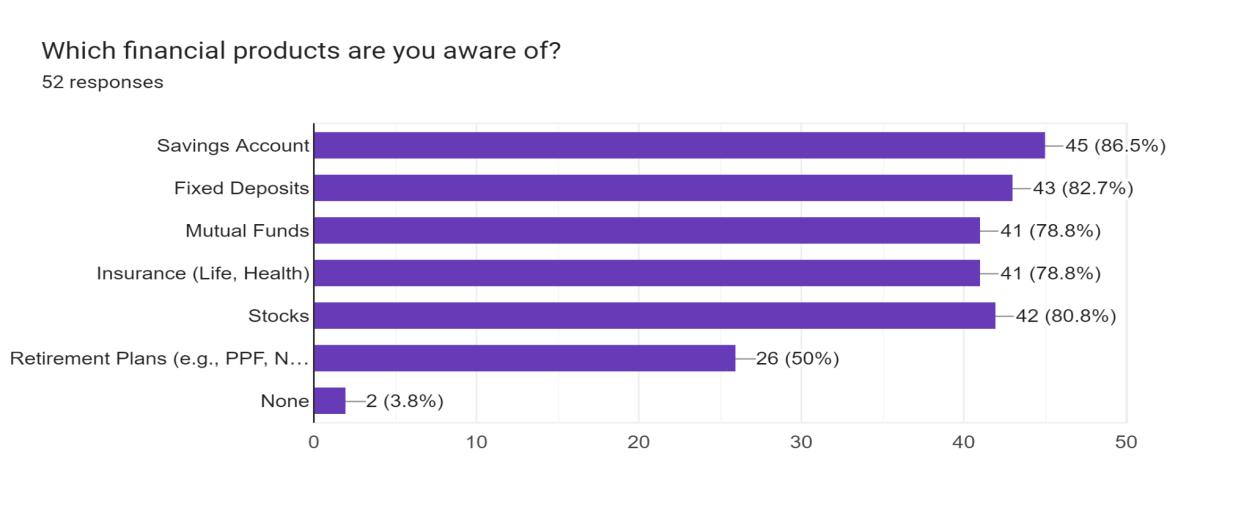
The results, as illustrated in Figure 1, indicate that a significant majority of the women surveyed are familiar with key financial instruments. Specifically, 86.5% of respondents are knowledgeable about savings accounts, 82.7%aboutfixed deposits,80.8% aboutstocks, and78.8% aboutbothmutual fundsandinsurance products. However, awareness drops when it comes to retirement plans, with only 50% of the respondent’s indicatingfamiliaritywiththeseproducts.Notably,asmallpercentageofparticipants(3.8%)reportedalackof knowledgeaboutallofthefinancialproductsmentioned.
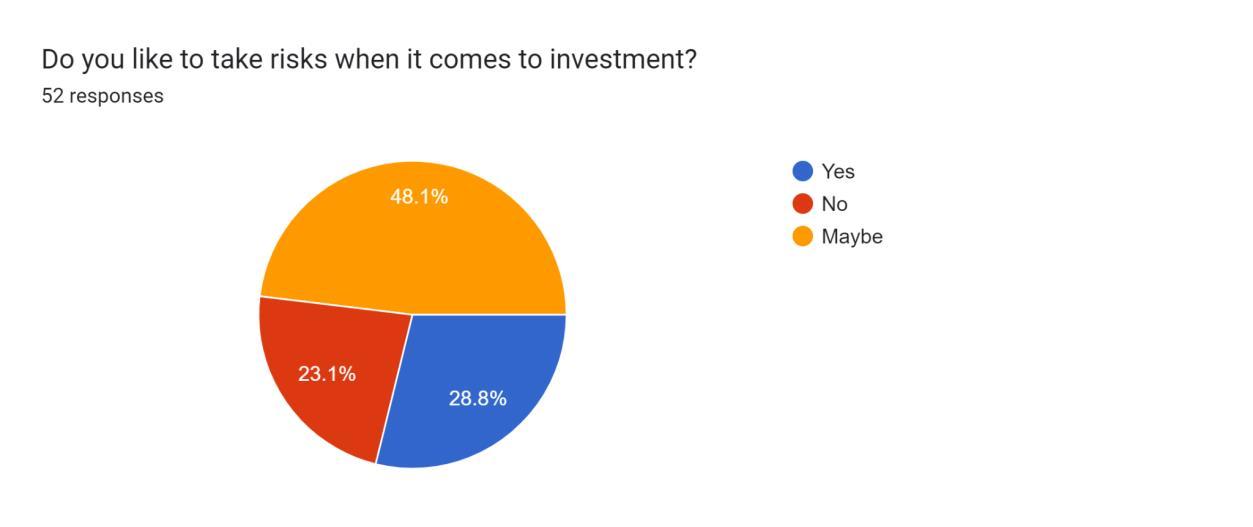
The survey results, as shown in Figure 2, reveal a diverse approach to investment risk among the respondents.Approximately28.8%ofthewomensurveyedareconfidentandwillingtotakeonhigherrisksin theirinvestments.Incontrast,23.1%ofrespondentsexhibitamorecautiousapproach,preferringtominimize risk. These variations in risk tolerance can be attributed to several factors, including the level of financial education, personalexperiences withinvestments,andsocial orculturalinfluences.Whileitisoftenobserved that women, on average, may be more risk-averse than men, this generalization does not hold true for all women. Many women actively participate in and benefit from riskier investment opportunities. The findings underscoretheimportanceofunderstandingone’sownrisktoleranceandseekingappropriatefinancialadvice isessentialformakinginformedinvestmentdecisions.
International Research Journal of Engineering and Technology (IRJET) e-ISSN:2395-0056
Volume: 11 Issue: 09 | Sep 2024 www.irjet.net p-ISSN:2395-0072
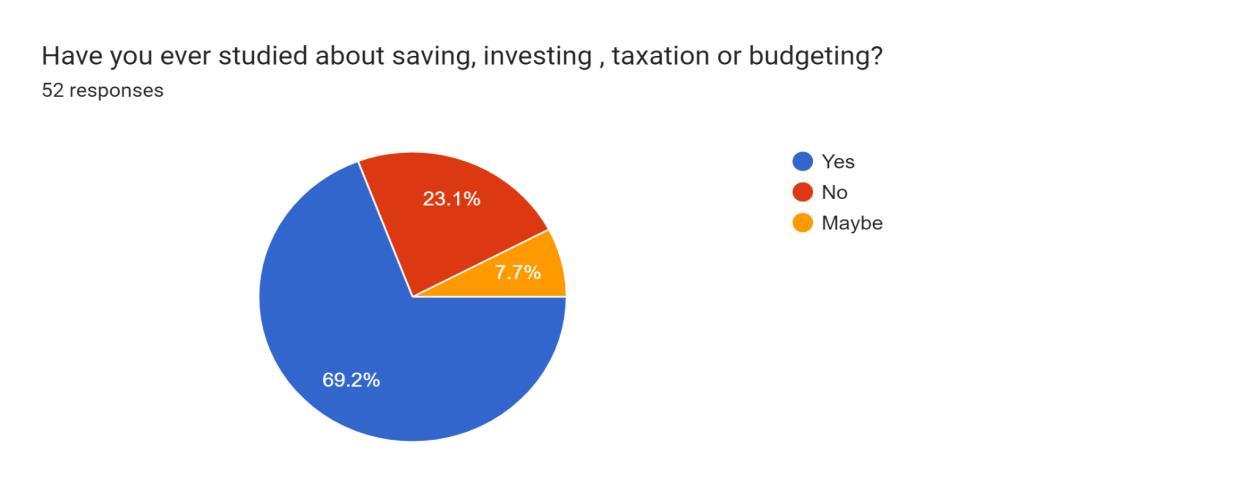
A significant portion of the surveyed women (69.2%) have actively studied financial topics such as saving, investing, taxation, and budgeting, while the remaining 30.8% have not pursued any formal financial education(Figure3).Thisreflectsastronginterestamongthemajorityofwomeninenhancingtheirfinancial knowledge,whichcanpositivelyimpacttheirinvestmentstrategiesandoverallfinancialmanagement.
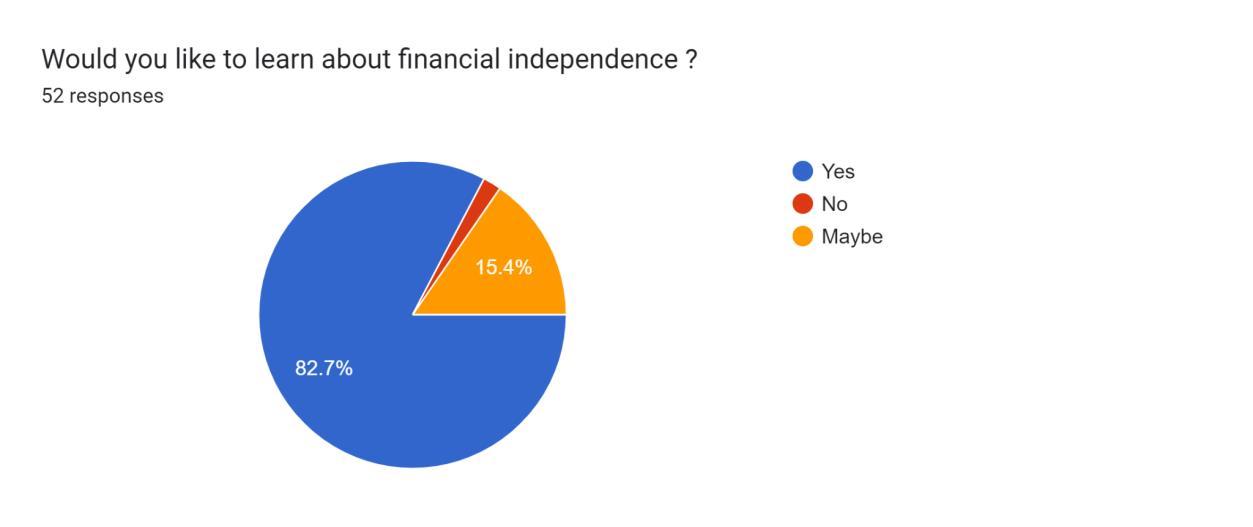
Moreover,whenaskedabouttheirinterestinfurtherlearningaboutfinancialmatters(Figure4),82.7% ofwomenexpresseddefiniteinterest,15.4%wereuncertain,andonly1.9%indicatednointerest.Thisshowsa widespreaddesireamongwomentodeepentheirunderstandingoffinancialmatters.
The primary motivation cited by respondents for pursuing further financial education was to achieve self-reliance and financial independence, indicating a strong link between financial literacy and women’s empowerment.
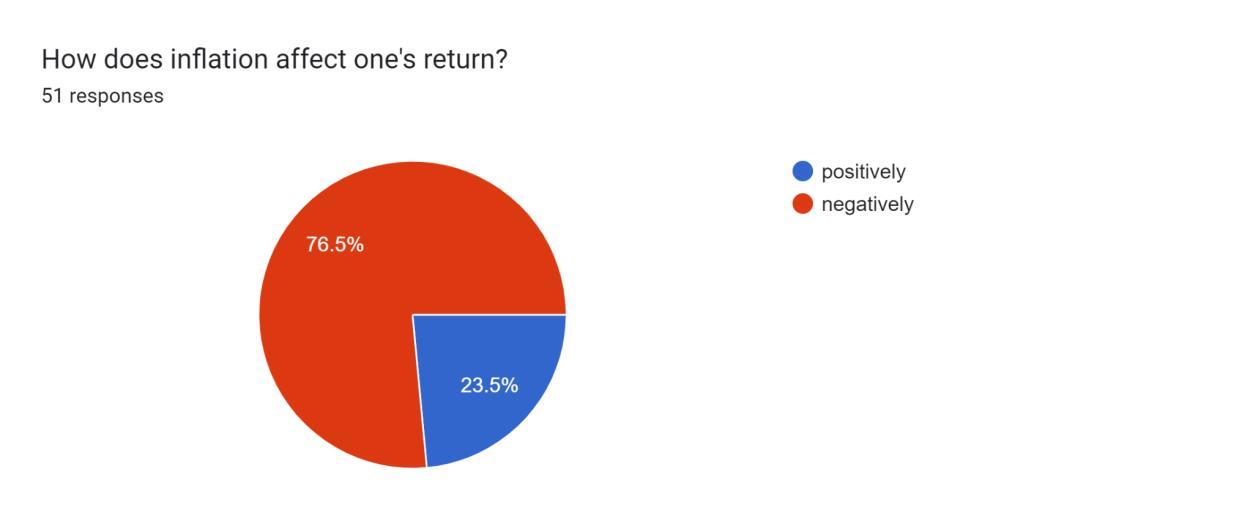
When respondents were asked how inflation affects investment returns (Figure 5), 76.5% correctly answeredthatinflationnegativelyimpactsreturns,indicatinganunderstandingthatinflationtypicallyreduces the real value of investments. Conversely, 23.5% of respondents answered that inflation has a positive effect, indicatingalackofunderstandingofthisfundamentalfinancialconcept.
The majority's correct response reflects a solid awareness of how inflation erodes purchasing power, reducingtherealreturnoninvestmentscomparedtothenominal return.However,themisconceptionheldby
International Research Journal of Engineering and Technology (IRJET) e-ISSN:2395-0056
Volume: 11 Issue: 09 | Sep 2024 www.irjet.net p-ISSN:2395-0072
nearlyaquarterofparticipantssuggestsasignificantgapinfinancialliteracyregardinginflation'simpact.This finding underscores the critical need for enhanced education on inflation to ensure that more individuals are equippedtomakeinformedandeffectivefinancialdecisions.
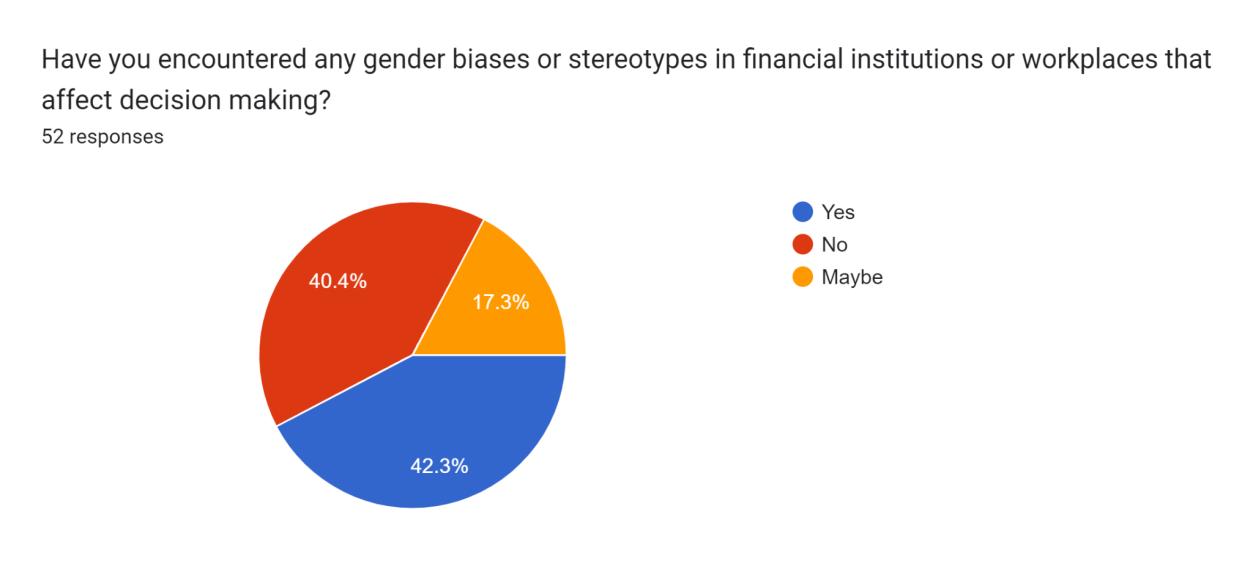
The survey explored women's experiences with gender bias in financial institutions and workplaces (Figure 6). A notable 42.3% of respondents reported encountering gender biases or stereotypes that affected their financial decision-making. Meanwhile, 17.3% indicated they might have experienced such biases, while 40.4% did not perceive gender bias as a factor influencing their decisions. These results highlight that a significant portion of women feel they face gender-related challenges in financial settings, while others are eitheruncertainordonotperceivesuchbiasesimpactingthem.
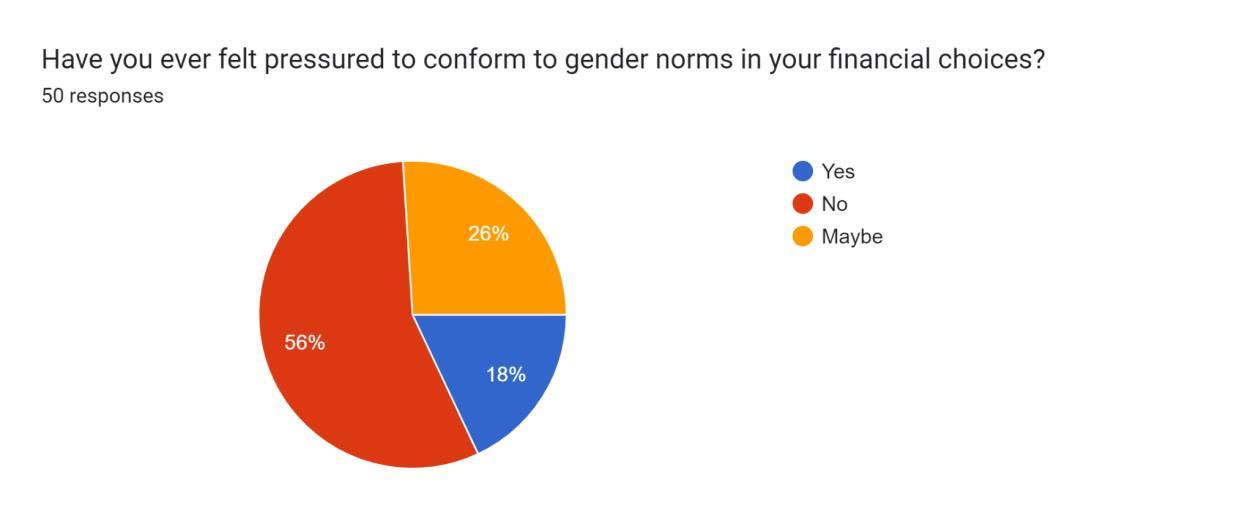
Additionally,whenaskedaboutpressuretoconformtogendernormsintheirfinancialdecisions(Figure 7), 18% of women reported feeling this pressure, 26% were uncertain, and 56% did not feel influenced by societalgenderexpectations.Thissuggeststhatwhileaminorityofwomenperceivesocietalpressuretoalign theirfinancialchoiceswithgendernorms,themajorityeitherdonotfeelthisinfluenceorareuncertainabout itseffectontheirdecision-making.
International Research Journal of Engineering and Technology (IRJET) e-ISSN:2395-0056
Volume: 11 Issue: 09 | Sep 2024 www.irjet.net p-ISSN:2395-0072
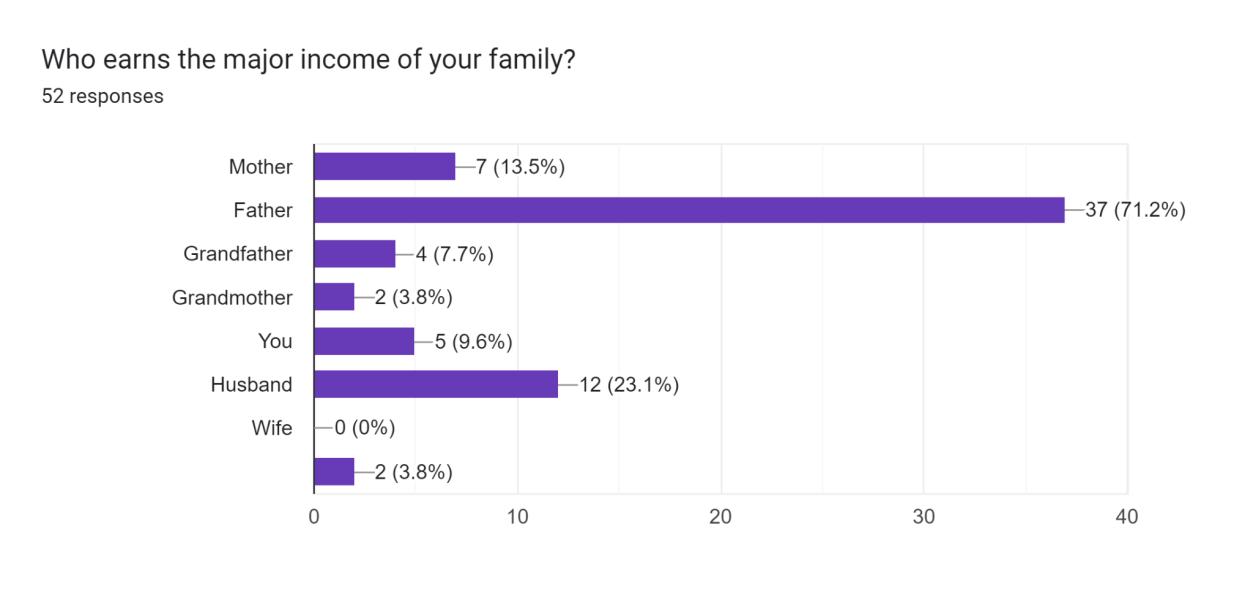
Among the 52 women surveyed, 37 indicated that their father is the primary breadwinner, while 12 identifiedtheirhusbandasthemajorincomeearner.Additionally,4womencitedtheirgrandfatherasthemain source of income, whereas 5 women reported themselves as the primary earners in their households. Interestingly, only2 womenidentified their grandmother as themainincome provider,and7mentioned their mother.
This distribution reflects a traditional pattern where male figures such as fathers, husbands, and grandfathers havehistoricallybeentheprimarycontributorstohouseholdincome.Thesefindingsreflectthat societal norms regarding income and gender roles within families continue to influence financial dynamics, thoughtherearesignsofchangewithsomewomenassumingtheroleofprimaryearners.
International Research Journal of Engineering and Technology (IRJET) e-ISSN:2395-0056
Volume: 11 Issue: 09 | Sep 2024 www.irjet.net p-ISSN:2395-0072
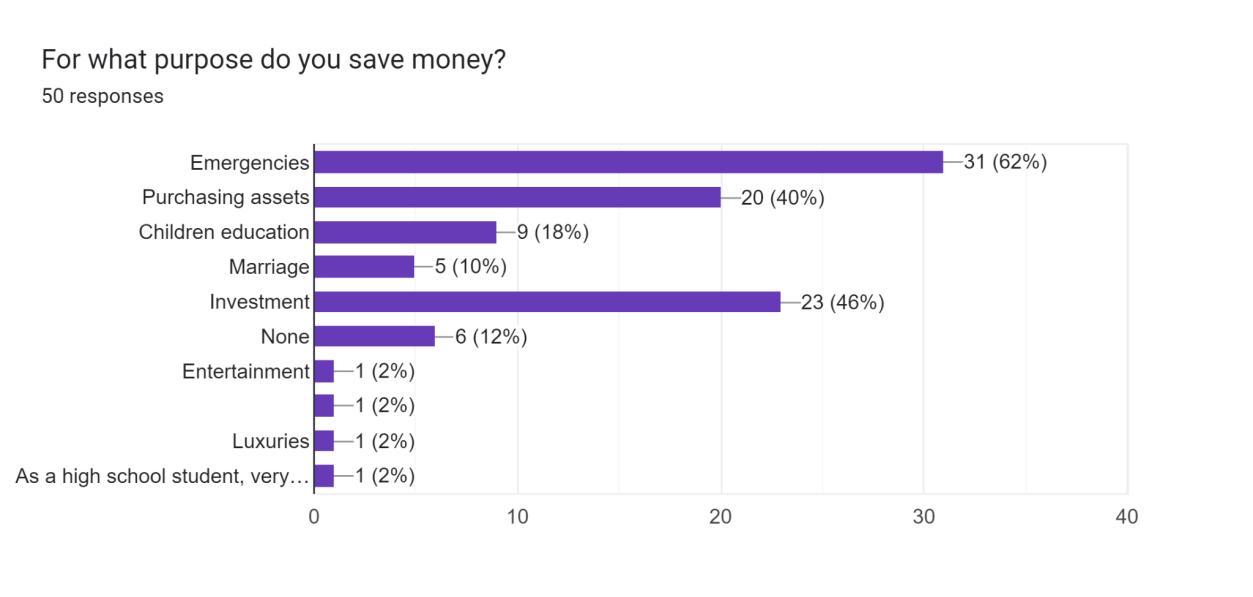
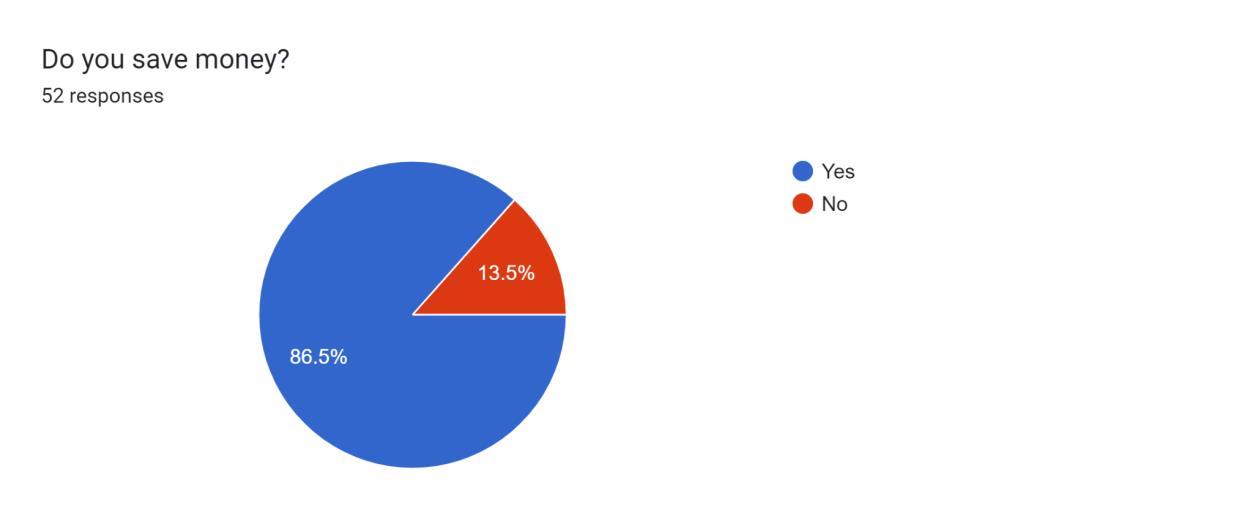
When asked if they actively save money (Figure 9), an overwhelming 86.5% of women responded affirmatively,indicatingthatthemajorityprioritizesavingaspartoftheirfinancialbehaviour.Thereasonsfor saving(Figure10)werevaried,with62%ofwomensavingforemergencies,46%forinvestmentpurposes,and 40% for purchasingassets. Additionally, 18%saved for their child'seducation, 10%formarriage, and smaller percentages(2%each)setasidemoneyforentertainmentorluxuryexpenses.
Thisdataunderscoresastrongcommitmentamongwomentofinancialprudence,withafocusonfuture planning and preparing for unforeseen circumstances. The emphasis on savings for emergencies and investments reflects a responsible approach to managing personal finances and securing financial independence.
International Research Journal of Engineering and Technology (IRJET) e-ISSN:2395-0056
Volume: 11 Issue: 09 | Sep 2024 www.irjet.net p-ISSN:2395-0072
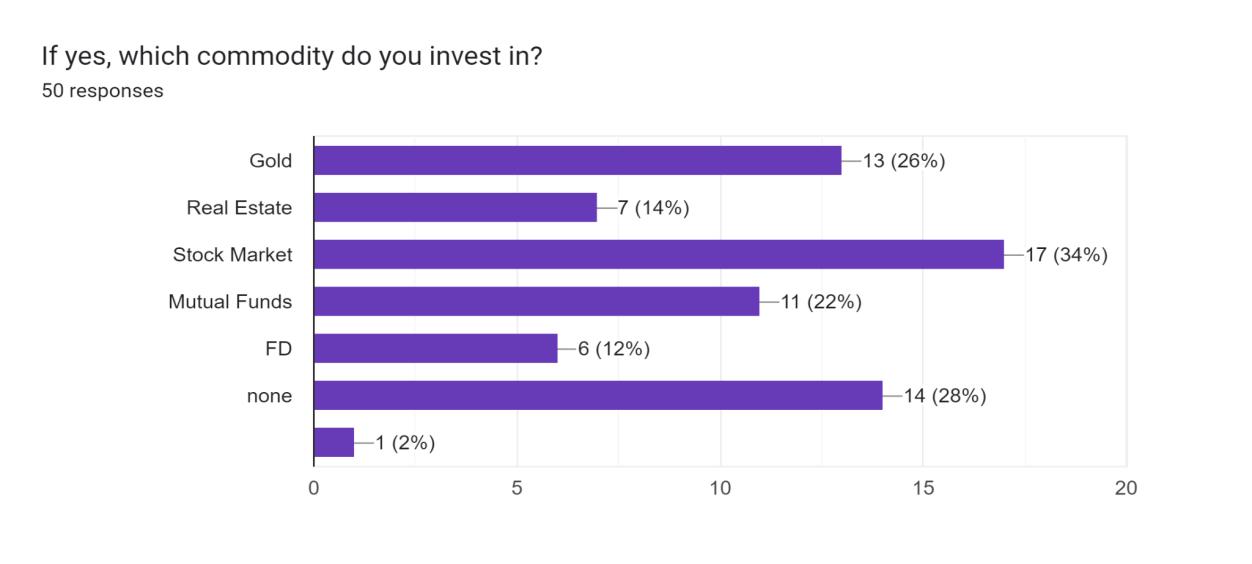
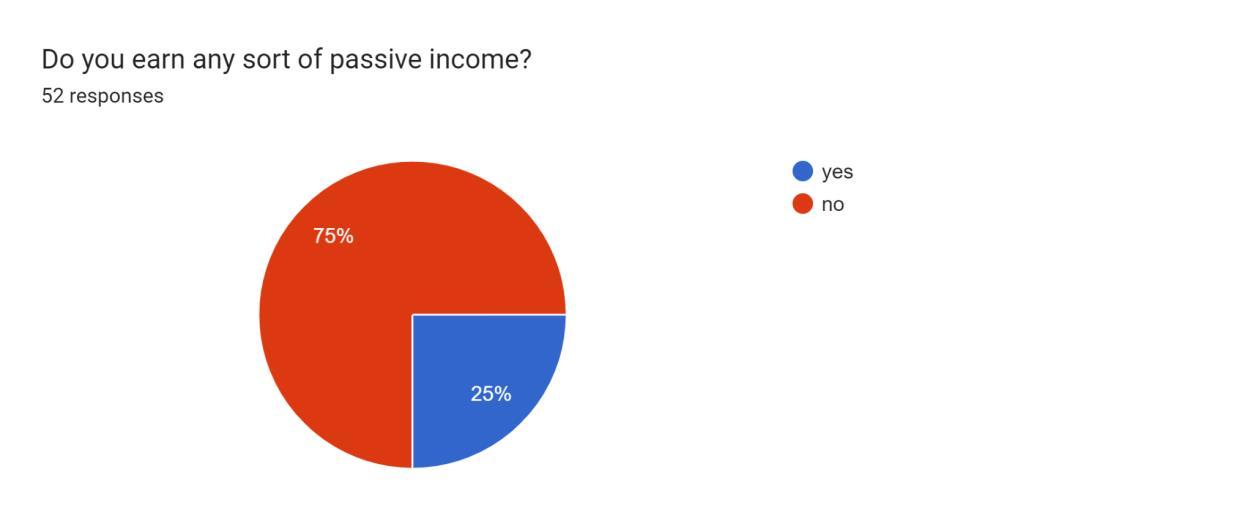
The survey revealed (Figure 11) that only 25% of women earn any form of passive income, indicating that the majority are not actively engaged in income-generating activities outside of their primary earnings. Regarding investment activities (Figure 12), 57.7% of women reported investing in assets such as the stock market,gold,orrealestate.
Amongthosewhodoinvest,thestockmarketemergedasthemostpopularoption,with34%favouring it.Goldfollowedat26%,mutualfundsat22%,realestateat14%,andfixeddepositsat12%.However,30%of women indicated that they do not invest in any form of commodity, reflecting a substantial portion of the populationyettoexploreinvestmentopportunities.Thesefindingssuggestthereissignificantroomforgrowth in promoting investment literacy and encouraging more women to diversify their income streams through variousformsofinvestment.
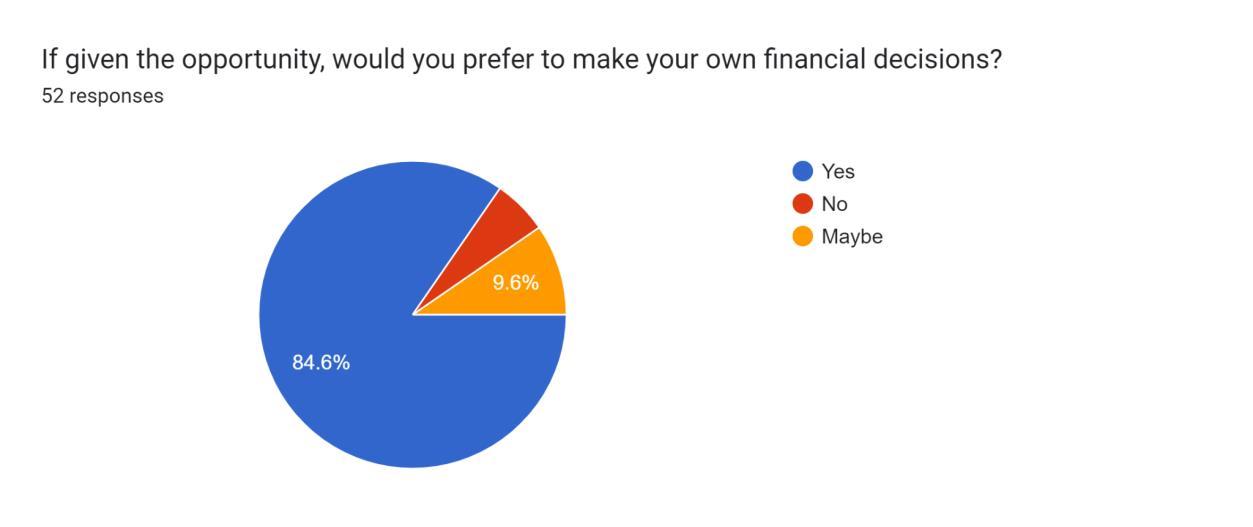
Recent data (Figure 13) reveals that an overwhelming 84.6% of women prefer making their own financialdecisions,indicatingastrongtrendtowardfinancialautonomy.Only5.8%statedtheywouldnotprefer to make their own financial decisions, while 9.6% were uncertain, responding with "maybe." This insight underscoresagrowingdesireamongwomentotakecontroloftheirfinancialplanninganddecision-making.It isanimportantconsiderationforfinancialadvisors,planners,andinstitutionsaimingtoempowerwomenand support their journey toward financial literacy and independence. Encouraging and facilitating this autonomy willbekeytohelpingwomenachievetheirfinancialgoals.
International Research Journal of Engineering and Technology (IRJET) e-ISSN:2395-0056
Volume: 11 Issue: 09 | Sep 2024 www.irjet.net p-ISSN:2395-0072
The survey results reveal a significant gender-based disparity in income contribution within families, withmalemembers fathers,husbands,andgrandfathers beingidentifiedastheprimarybreadwinners.Out of52womensurveyed,only5womenreportedthemselvesastheprimaryincomeearners,andjust7attributed this role to their mothers. This trend reflects deep-rooted societal norms where men have traditionally been responsibleforthefamily’sfinancialwell-being.Priorresearchshowsthatthepresenceorabsenceofsame-sex role models significantly influences women’s ability to make independent financial decisions. Women with strongfemalefinancialrolemodelsaremorelikelytoexhibitconfidenceinhandlingfinancialmatters,whereas those without such figures may defer to male family members or lack confidence in their financial decisionmaking(Brewer&Weber,1994).
The survey uncovered notable gaps in financial literacy. Although 76.5% of respondents correctly identified inflation as reducing the real value of returns, 23.5% mistakenly believed inflation had a positive impact on investments. This gap underlines a fundamental need for better financial education on the relationshipbetweeninflationandinvestmentreturns.RoyandJain(2018)similarlyfoundthatIndianwomen often struggle to differentiate between saving, investment, and insurance products, leading to conservative investment behaviours, such as prioritizing low-risk bank deposits without a clear understanding of the riskreturnrelationship.
In contrast, our findings show that a majority of women (86.5%) are familiar with various financial products like savings accounts, fixed deposits, stocks, and insurance, indicating a growing awareness of these essential tools. However, a small percentage (3.8%) lacked any knowledge of financial products, suggesting there are still pockets of women left out of financial inclusion efforts. Encouragingly, 69.2% of the surveyed women have actively engaged in financial education, reflecting a strong desire to increase their knowledge in areassuchassaving,investing,taxation,andbudgeting.Moreover,82.7%expressedaclearinterestinlearning moreaboutfinancialtopics,showcasingatrendtowardincreasingfinancialliteracyandempowermentamong women.
Asignificantmajority(86.5%)ofwomenreportedthattheysavemoney,withtheprimarymotivations being future security and financial independence. Emergency savings (62%), investments (46%), and asset purchases (40%) were cited as the main reasons for saving, indicating a growing sense of financial prudence amongmodernwomen.Thistrendalignswithshiftsinsocietalnorms,wherewomenareincreasinglyassuming controlovertheirfinancialplanninganddemonstratinglong-termfinancialresponsibility.
Despite this progress, there is substantial room for growth in investment activities. While 57.7% of women reported investing in assets like stocks, gold, or real estate, 30% of respondents admitted to not investinginanycommodity.Thissuggestsaneedforbettereducationontheimportanceofdiverseinvestment portfolios.Amongthosewhodoinvest,thestockmarket(34%)emergedasthemostpopularchoice,followed by gold (26%), mutual funds (22%), real estate (14%), and fixed deposits (12%). These findings reveal that although women are taking steps toward financial independence, many remaincautious and gravitate toward moretraditional,low-riskassets.
The survey also explored the role of gender bias in financial decision-making. 42.3% of respondents reportedencounteringgender biases infinancial institutions orworkplaces, and17.3%were uncertainifbias had impacted them. These numbers reflect the ongoing challenges women face in overcoming traditional gender roles in financial environments. However, a notable 40.4% of women did not perceive gender bias affecting their decisions, suggesting that modernization and changing societal norms are helping to alleviate someofthesebarriers.
Moreover,whenaskedaboutfeelingpressuretoconformtogendernormsintheirfinancialchoices,only18% reported experiencing such pressure, with 26% uncertain. A majority (56%) did not feel that gender norms influenced their decisions, indicating a growing trend toward financial autonomy and independent decision-
International Research Journal of Engineering and Technology (IRJET) e-ISSN:2395-0056
Volume: 11 Issue: 09 | Sep 2024 www.irjet.net p-ISSN:2395-0072
making.Thisisfurthersupportedbythefindingthat84.6%ofrespondentsprefertomaketheirownfinancial decisions,demonstratingastrongdesireforcontrolovertheirpersonalfinances.
Family income distribution also highlights traditional gender dynamics. The fact that fathers (37) and husbands(12)remaintheprimarybreadwinnersformostrespondentsshowsthatmencontinuetodominate the financial landscape within families. However, this long-standing pattern may also contribute to women's hesitation in assuming financial control, as they may not have seen female family members actively participatinginfinancialdecision-making.Thisreflectsaneedforstrongfemalerolemodelstoinspireyounger generationstotakechargeoftheirfinancialfutures.
To address the gender gap in financial literacy, survey respondents identified several solutions that could boosttheirconfidenceinmakingfinancialdecisions:
Comprehensive Financial Education: Respondents emphasized the need for robust financial education, both in formal settings (schools and universities) and through practical, real-world experiences. This should include focused teaching on budgeting, investing, taxation, and financial planning,tailoredtowomen’sneeds.
Government Initiatives: Various government programs such as the Pradhan Mantri Jan-Dhan Yojana, Beti Bachao, Beti Padhao, and the National Center for Financial Education (NCFE) have been instrumental in promoting financial literacy among women. Expanding and improving access to these programscanfurthersupportwomeninunderservedareasandhelpbridgethegendergapinfinancial knowledge.
Technology and Access: Theuseoftechnologytoreachwomeninruralandremoteareasiscrucialfor inclusive financial literacy efforts. Mobile apps, online courses, and digital tools can make financial education more accessible, while also catering to the needs of women with limited access to formal education.
Targeted Financial Literacy Programs: Specialized financial training programs aimed at women can helpbuildtheirconfidenceinnavigatingcomplexfinanciallandscapes,encouragingthemtoparticipate moreactivelyininvestmentopportunitiesandtakecontroloftheireconomicfutures.
7. Conclusion
This study has provided valuable insights into the financial literacy and decision-making patterns of women in Ludhiana, Punjab. While many women are increasingly taking control of their financial futures whether through saving, investing, or pursuing financial education there are still significant challenges. The surveyrevealsthatgender biasesandtraditionalfamilyrolescontinue toshape women’sfinancial behaviours and opportunities. However, the increasing preference for independent financial decision-making among womenisapromisingtrendthatindicatesgradualshiftsinsocietalnorms.
Addressing these issues through targeted financial literacy programs, government initiatives, and enhanced access to financialservicesis crucial. Empoweringwomenwiththe knowledge andtoolsto manage theirfinanceswillnotonlyboosttheirfinancialindependencebutalsocontributetobroadersocietalprogress andeconomicdevelopment.
Byclosingthe gender gapinfinancial literacy, India canunlockthe potential of its women,fosteringa moreequitableandprosperousfutureforall.
[1]. DAVID L. REMUND. (June 2010). Financial Literacy Explicated: The Case for a Clearer Definition in an Increasingly Complex Economy.JournalofConsumerAffairs.
International Research Journal of Engineering and Technology (IRJET) e-ISSN:2395-0056 Volume: 11 Issue: 09 | Sep 2024 www.irjet.net p-ISSN:2395-0072
[2].Hung,Angela&Parker,Andrew&Yoong,Joanne.(2009). Defining and Measuring Financial Literacy.RAND CorporationPublicationsDepartment,WorkingPapers.708.10.2139/ssrn.1498674.
[3].Mitchell,Olivia&Lusardi,Annamaria.(2011). Financial Literacy Around the World: An Overview Journalof PensionEconomicsandFinance.10.497-508.10.2139/ssrn.1810551.
[4].Lusardi,Annamaria,andPeterTufano,(2015). Debt Literacy, Financial Experiences, and Over Indebtedness. (Vol.14,specialissue4)JournalofPensionEconomicsandFinance.
[5].HumanityWelfareCouncil.(Thursday,May26,2022). Why Women's Financial Literacy Is Important for the Future of India?
[6]. Leitao, Ana & Silva, Monica & Abreu, Margarida & Fitas, Filipa & Ricardo, Tiago. (2023). Portuguese Youth Saving Determinants of Financial Literacy. ERBE-EuropeanReviewofBusinessEconomics.III.10.26619/ERBE2023.3.1.5.
[7]. Nikita M. Daga. (2021). Money to Call Her Own: An Empirical Study of the Relative Influence of Factors on Indian Women’s Financial Independence. (Volume8Issue2).SeventhSenseResearchGroup.
[8].AnushreeSrivastava(2020). Role of Financial Independence in Uplifting the Status of women.(Vol.3Issue.7).
IJCIRAS
[9]. Klatt, M. E. (2009). An Assessment of Women's Financial Literacy. Basılmamış Yuksek Lisans Tezi, Wisconsin-StoutUniversitesi,AmerikaBirleşikDevletleri.
[10].Singh,Chetna&Kumar,Raj.(2017). Financial Literacy among Women - Indian Scenario.UniversalJournal ofAccountingandFinance.5.46-53.10.13189/ujaf.2017.050202.
[11]. Behrman, Jere R., Olivia S. Mitchell, Cindy K. Soo, and David Bravo.2012."How Financial Literacy Affects HouseholdWealthAccumulation." American Economic Review,102(3):300–304.
[12]. Abreu, Margarida, and Victor Mendes, (2010). Financial Literacy and Portfolio Diversification (Vol. 10). QuantitativeFinance.
[13].Singh,Maanya.(2022).EqualityMeansBusiness:FactorsAffectingIndianWomen-OwnedSmallBusiness’s Scalability & Impact of Entrepreneurship On Financial Independence. Journal of Student Research. 11. 10.47611/jsrhs.v11i3.3830.
[14].Roy,Blessy&Jain,Ruchi.(2019). Assessment of Financial literacy among Working Women of Udaipur City.
[15]. Brewer, Marilynn & Weber, Joseph. (1994). Self-evaluation effects interpersonal versus intergroup social comparison. Journal of Personality and Social Psychology.66.268-275.10.1037/0022-3514.66.2.268.
[16].IndraNooyi.(2023). My life in full work, family and our future. HachetteBookPublishingIndiaPvt.Ltd.