
International Research Journal of Engineering and Technology (IRJET) e-ISSN: 2395-0056

International Research Journal of Engineering and Technology (IRJET) e-ISSN: 2395-0056
Volume: 11 Issue: 09 | Sep 2024 www.irjet.net p-ISSN: 2395-0072 1SRM University ***
Abstract - In this work, the diagnosis of glaucoma in the early stage using deep learning models has been presented. Glaucoma is a group of diseases which is irreversible and can cause blindness. Manual diagnosis depends on human skills and it is difficult to diagnose at an early stage. Glaucoma classification using deep learning is a challenging task. The concept of feature extraction using deep learning models has been utilized in the current study. An ensemble residual network along with squeeze and excitation block and with BiLSTM (Binary Long Short-Term Memory) has been implemented for sequential feature extraction for faster and more accurate classification of the disease. Aresidualnetwork is used for global feature extraction. The accuracy rate of the validation set was 92.3% for our model. The findings suggest that a cost-effective screening tool for early and cost-effective identification of glaucoma could be developed utilizing deep learning algorithms.
Key Words: Bi-LSTM, Glaucoma Classification, ResNet50, SE block.
Glaucoma is the second progressive worldwide leading cause of eye diseases. The early-stage detection of glaucoma is a challenging task. Currently, around 79.6 million individuals are affected by glaucoma [1] and it has been estimatedthatby 2040 the number of affected individuals will be around 111.8 million [2]. The eye is one of the most complex, sensitive and delicate organs which is responsible for passing visual information to the brain cells in the human body.
The root cause of glaucoma is the elevated pressure in the eye which can be associated with Intra-Ocular Pressure (IOP) [3] Improper drainage of the liquid aqueous humor leads to an increase in pressure in the eye subsequently affecting the retina and optic nerve and human vision. In general, the IOP value should be less than 21mmHg to fight against glaucoma. Manual diagnosis is based on structural changes of the retinal nerve fibre layer and opticnervehead[4]. Primarily, glaucoma can broadly be classified into two categories: 1) Open-angle glaucoma and 2) Angleclosure glaucoma. The effect of Openangle glaucoma disease is not realized until it starts to impair human vision [2]. This type of glaucomadiseaseispainlessand is caused when the drainage canal is not able to drain out the excess aqueous humor. People with high blood pressure and diabetes are more susceptible towards this type of glaucoma. In the Angle-closure glaucoma disease, the iris tends to block
the drainage system by being extremely close to it. It requires immediate attention and can be severely painful.
Manual analysis of glaucoma can be time-consuming and cumbersome. The accuracy of parameter measurement for detection varies according to the doctors. In recent years, various automated techniques and diversity indiceshavebeen proposed for the automatic detection of the disease using retinal fundus images [5]. The Residual Network 50 (ResNet50) model has proven effective for the extraction of features and classifying the fundus image [6]. The accuracy of the model was found to be 93%. The residual network has been used in numerous research for feature extraction including detection of colorectal cancer and insect pest recognition [7, 8]. Taking motivation from the research of Ovreiu et. al. (2020) [9], Residual with squeeze and excitation block has been combined in this research to obtain channelwise recalibrated features. It reduces and discards features based on channel re-calibration and helps to train the model in an efficient way.
In this article, we propose a novel architecture for fully automated binary classification of glaucoma where the Fundus database has been utilized for training and testing purposes. Different databases (e.g., ORIGA, ACRIMA and Fundus) can also be used for glaucoma classification. In the proposed framework, a residual network has been combined with a squeeze and excitation block followed by a BiLSTM block [10]. In addition, different available methods for glaucoma classification have been compared with the proposed model.
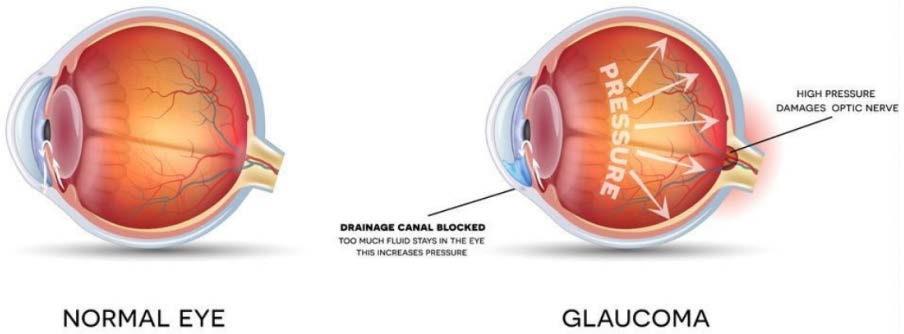
Glaucomadiseaseisthesecondleadingcauseofblindness globally [12]. The critical work of identifying and categorizingglaucomaischallengingwhichmotivatedusto
International Research Journal of Engineering and Technology (IRJET) e-ISSN: 2395-0056
Volume: 11 Issue: 09 | Sep 2024 www.irjet.net p-ISSN: 2395-0072
initiatethisproject.Earlydetectionandtreatmentcanstop irreversible vision loss and enhance the quality of life for those who are affected. Advances in deep learning and artificialintelligenceapproachesforglaucomacategorization areamajorinfluenceonthelivesofmillionsofpeopleatrisk of glaucoma [5]. These techniques also provide intriguing potentialforearlyidentificationandeffectivemonitoringof the condition while preserving vision, enhancing patient lives,andadvancementinophthalmology.
The main objective of this study can be summarized as follows:
The proposed model uses an ensemble method that deals with non-homogeneous and non-linear data elementswhile focusing on producing more accurate results as compared to models with a single level of featureextraction.
Globalfeatureextractionusingtheresidualnetworkis combinedwithsqueezeandexcitationblocktoperform dynamicchannel-wisefeaturere-calibration.Sequential featureextractionusingBiLSTMhelpstoextractevery temporalfeatureoftheimagewithaccuratedetails.
Previousresearchershavedefinedmanyembeddedmodels forfeatureextractionandclassification.In2007,Bolandand Quigley[1]classifiedriskfactorsintosixcategoriesthatare most likely to lead to the development of open-angle glaucomaintheirstudy.In2009,amajoradditiontothefield of ophthalmology was made through the study paper by Nayaket.al.[2]whichdescribesanautomatedprocessfor featureextractionandSVMforclassification.Accordingto theauthors,theopticnervehead(ONH)andretinalnerve fiberlayer(RNFL)featuresthatareknowntobeassociated withglaucomacanbeextractedusingdigitalfundusimages. Ramani et. al. (2012) [3] described a novel method for classifyingnormal,glaucoma,anddiabeticretinopathycases usingretinalimageanalysisanddataminingmethods.The authorsstronglyemphasizeusingcomputationalmethodsto automaticallyforecasttheseeyediseaseswhichcanbedone by utilizing cutting-edge image analysis and data mining techniques.TheGridColorMomentmethodtechniquewas proposed by Ghosh et. al. (2015) [4] for obtaining color information from retinal pictures used in glaucoma classification.Theimagewasdividedintoagridofsmaller sectionsandcolormomentcharacteristicswerecalculated within each grid cell. The characteristics defining the statisticaldistributionofcolorvaluesweresubsequentlyfed intoaneuralnetworkclassifier.Thisapproachdemonstrated encouraging results in reliably distinguishing normal and glaucomatousretinalpicturespotentiallyaidingintheearly detection and diagnosis of glaucoma. Chakravarty and Sivaswamy(2016)[5]introducedaglaucomaclassification
method that integrated segmentation- and imagebased features for binary classification of glaucomatous and normal retinal pictures. The researchers used both segmentation-basedandimage-basedapproachestoextract characteristics from retinal pictures. In 2016, Dey and Bandyopadhyay [6] proposed a support vector machine (SVM) classification method for automated glaucoma detection.Principalcomponentanalysis(PCA)wasusedfor featureextractionandSVMwasusedforclassification.PCA was utilized to decrease the extracted features and the smaller feature set was then used as input for SVM classification.Theproposedmethoddetectedglaucomawith an amazing 96% accuracy rate. Hu et. al. (2018) [8] introducedtheSEblockintheirproposalforsqueeze-andexcitation (SE) networks which models channel dependencies and automatically calibrates channelwise feature responses. By adaptively weighting feature maps basedontheirchannelwiserelevance,theSEblockisasmall andeffectivemethodthatcollectschannelwiseinformation. FerreiraandVinicius(2018)[13]proposedamodelusinga convolution neural network and SVM classifier by using textualdescriptors.TheCNNextractsthefeaturesandthe SVMstagewasusedforclassification.Ahybridfeaturespace forglaucomaclassificationthatintegratestexturedatawith transfer learning utilizing deep learning algorithms was proposedbyClaroet.al.(2019)[7]
The work made use of transfer learning, which uses deep learning models that have already been trained to extract importantfeaturesfrombigdatasets,togetherwithtexturebased features that were recovered from retinal pictures. Theclassificationofglaucomausingthehybridfeaturespace createdbyfusingtextureinformationandtransferlearning producedgoodresults.Theresearchpaperentitled“Early DetectionofGlaucomaUsingResidualNetworks”byOvreiu et.al.(2020)[9]usedresidualnetworkstoextractfeatures andclassifyimagesintonormalorglaucomawhichhad an accuracyofaround93%.Bisnetoet.al.(2020)[12]proposed a model which uses SVM and generative adversarial networks.Theaccuracyofthemodelwasfoundtobe87.5%. Janani and Rajamohana (2021) [11] gave a review of numerous methods for the segmentation of the optic disc andopticcupfordetectingglaucomaatanearlystage.Oza et.al.(2021)[14]proposedamodelforclassificationusinga convolutionneuralnetwork.Theaccuracyofthemodelwas foundtobe95.44%.In2022,ODGNet:adeep-learningmodel for automatic optic disc localization and glaucoma classificationusingfundusimageswasproposedbyLatifet. al.[10].TheresearchintroducestheODGNetdeeplearning model, which uses fundus pictures to automate the localization of the optic disc and the categorization of glaucoma. The suggested model uses deep learning to identifytheopticdiscinfunduspicturesandcategoriesof glaucomacases[10].Inrecentdays,anumberofattempts hasmadeforautomaticclassificationofglaucoma[24, 25, 26].
International Research Journal of Engineering and Technology (IRJET) e-ISSN: 2395-0056
Volume: 11 Issue: 09 | Sep 2024 www.irjet.net p-ISSN: 2395-0072
In the existing model [9], the Residual network used for classification achieved a classification accuracy of 93.28% forthevalidationdatawhereatotalof4convolutionblocks, each consisting of 3 convolution layers are present. The Fundusdatabaseisusedfortrainingandvalidationpurposes inthismodel
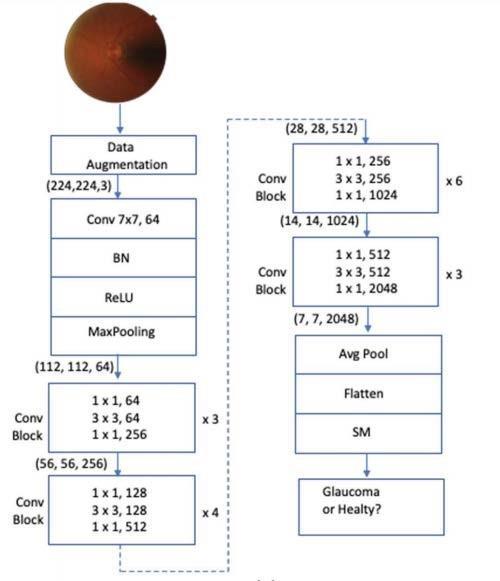
2: Existing residual network model [9]
PROPOSED MODEL
Fourcrucial componentsmakeuptheglaucomadetection strategyinuse.
Step1:DataAugmentationandPre-processing
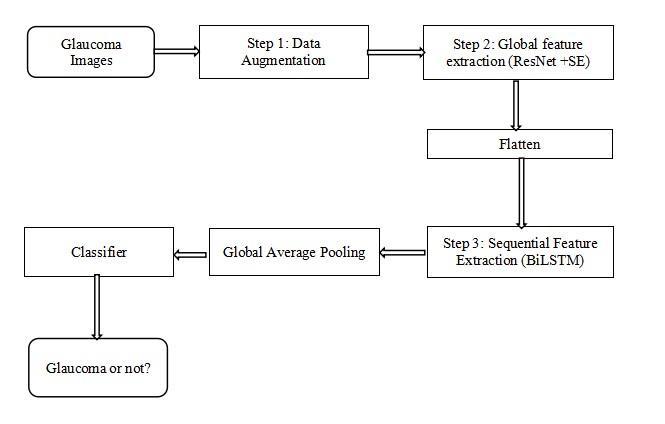
Step 2: Global feature extraction: Residual network in combinationwithsqueezeandexcitationblock(SE).
Step3:Sequentialfeatureextraction:BiLSTM
Step4:Classification
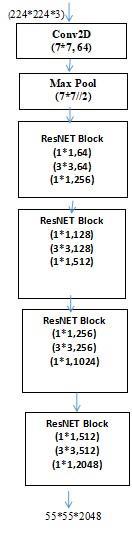
TheImagedatageneratorisused tosynthesizedatausing data augmentation and image quality is improved by resizing.Thetargetimagesizeis224x224x3.Forglobalfeature extraction,theimagesarepassedtotheresidualblockand SEblock.Itextracts2048featuresforeachimage.The 2D imageisflattenedtoserveasinputtothelongshort-term memory for sequential feature extraction. Global average poolingisappliedtocombinetheeffectof2048featuresina single feature for classification. A fully connected layer is used for the classification of images. Figure 3 shows the blockdiagramoftheproposedmodel.
Data Augmentation is a technique of generating synthetic data by rotating, scaling and shuffling the original data images.Thistechniqueisusedtofulfiltherequirements,the variednatureofthetrainingdataandthevolumeofdata.In additiontothese,theclassimbalanceissueinclassification jobscanalsobesolvedusingaugmenteddata.Modelscanbe trainedaccuratelyandefficientlyindeeplearningbytraining withaugmenteddata.
Sincedeeplearningmodelsrequirealargeamountofdata for training and validation, ImageDataGenerator has been employed to generate synthetic data for training and validatingtheproposedmodelwherethetargetimagesizeis maintained at 224x224x3. In the proposed methodology fromtheFundusdataset,554imageshavebeenutilizedfor trainingand130imagesforvalidation.
Global feature is a term used for the entire image and attributesassociatedwithit.Featureextractionisapartof dimensionality reduction to reduce the variables and computing resource usage. A residual network is used for featureextractionindeeplearning.Residualblockprovides a skip connection to minimize the vanishing gradient problem whichcanbeconsideredasa strikingadvantage. ResNet50 architecture has an extra convolution layer to reducethedependencies,numberofparametersandmatrix multiplicationusingbottleneck designforbuilding blocks. ResNet 50 architecture has also been used for malicious softwareclassification.
Squeezeandexcitationblockshavetwostagesofaction.SE block in the first ‘Squeeze’ step applies global average pooling to aggregate the feature map across the spatial dimension.AnimagehavingHxWxCisaggregatedto1x1 x C. In the excitation stage, the channels are reduced by a
International Research Journal of Engineering and Technology (IRJET) e-ISSN: 2395-0056
Volume: 11 Issue: 09 | Sep 2024 www.irjet.net p-ISSN: 2395-0072
factor R = 16 (reduction ratio) according to per-channel weights.Thechannelsarere-calibratedandusingactivation functionsthechannelsaremappedtotheoutputimageto maintaintheconsistencyinthenumberofchannels[8].SE blockhelpstodiscardthefeatureswhicharenotimportant forimageclassificationandalsoitcalculatesthe weightof eachchanneltowardstheclassificationduringthetraining process.
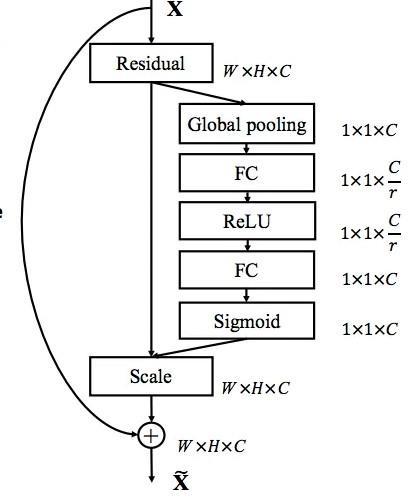
Figure 4: ResidualnetworkandSEBlock
SEblockcombinedwiththeresidualblockprovidesthesame accuracywithmuchlowercomputationalcost.Theinputfor ourmodelis224x224x3andtheoutputoftheglobalfeature extractionblockisintheformof55x55x2048.2048features wereextractedinstep2foreachimage.Figure4andFigure 5 represent the block diagram of the residual network in combinationwiththeSEblock.
Step 3:
Sequential feature extraction
AnadditionalBiLSTMmodelhasbeenensembledthattakes the global features as input and generates the sequential featureswhicharemoreaccuratefrombothdirections[10]. BiLSTM learns the features while extracting sequential featuresfromtheglobalones.EachBiLSTMblockorcellis responsiblefortheextractionofasingleglobalfeaturewhich also focuses on local patterns and features of each global feature extracted. A total of 2048 BiLSTM cells are being usedtocover2048globalfeatures.
Volume: 11 Issue: 09 | Sep 2024 www.irjet.net p-ISSN: 2395-0072
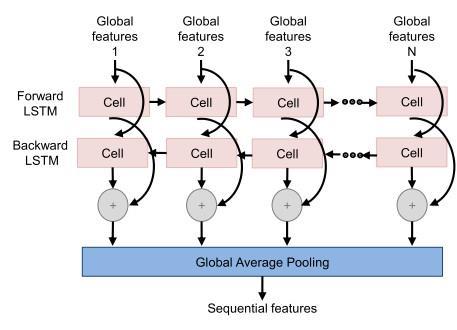
LSTMhasbeenutilizedtostorelongsequencesofdatafora particularamountoftimeoruntiltheforgetgateisactivated thereby reducing the long-term dependencies as it can remember the specific sequence and can be used for classificationwithreducedtime.Duringthetrainingprocess, italsolearnsthefeaturesandallowsustoclassifydatawith theleastpossibletime.
Step 4: Classification
A dense layer or fully connected layer is placed after the globalaveragepoolinglayer.Ittakestheaggregatefeature map of 2048 features generated by the global average pooling and produces an output for binary classification where normal images are denoted as 1 and a glaucomaaffectedimageisdenotedas0.
Intheproposedmodel,globalfeatureswereextractedusing a residual block which was then followed by sequential feature extraction. Classification is done by a single dense layer.TheresultsshowninFigures8and9aretheresultof 50epochs.
Features
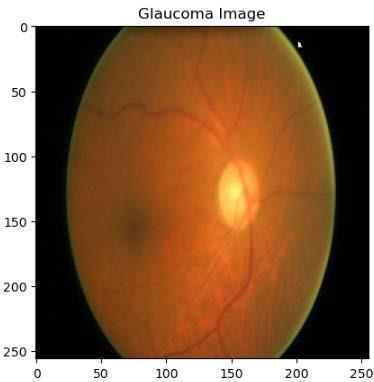
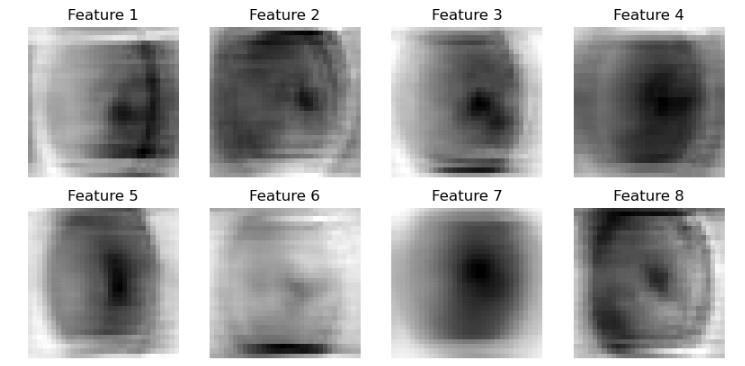
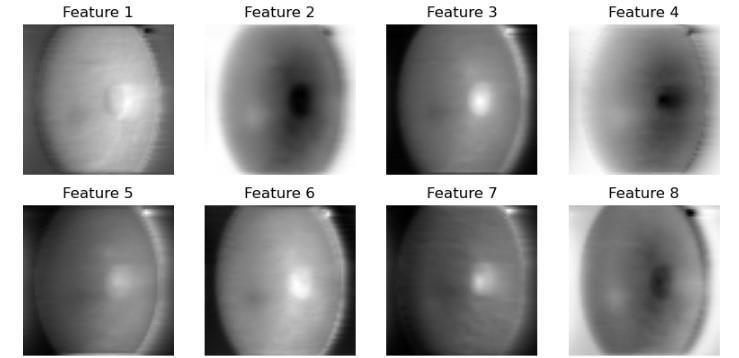
ResidualblockincombinationwithSEblocktakestheinput imageofsize224x224x3andextracts2048featuresforeach intheoutputformat55x55x2048.Afterflatteningtheglobal featureswerefedtotheBiLSTMblockforsequentialfeature extraction. Figure 8 represents 8 features from the 2048 extractedfeatures.
Sequential features:
BiLSTM block takes the global features generated by the residualblockandfocuseslocallyoneachfeaturetogenerate asequentialfeatureorpattern.SinceBiLSTMcanworkon lineardata,flattenisappliedtochangethedimensionofthe featuresgeneratedbytheresidualblock.Figure9showsthe featuresafterpassingeachglobalfeaturefromtheBiLSTM block.
Volume: 11 Issue: 09 | Sep 2024 www.irjet.net p-ISSN: 2395-0072
Quantitative Result and qualitative result
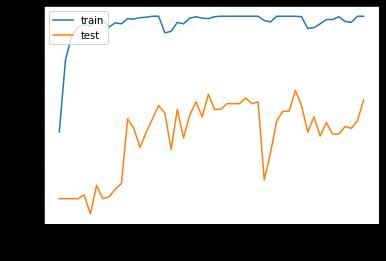
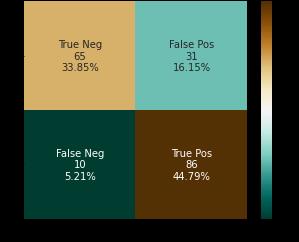
Figure 10: Trainingandvalidationaccuracycurveand confusionmatrix
Figure10showsthetrainingandvalidationaccuracycurves and the confusion matrices for the performance of the proposed model on the glaucoma datasets. These figures provideinsightintohowtheaccuracyofthemodelchanges as the training epoch progresses and how the model performsondifferentclassesofimages.Theaccuracycurves showsthattheperformanceoftheproposedmodelimproves significantly with increasing training epochs, while the confusionmatricesprovidesavisualrepresentationofthe predictionmade by the model ascompared to the ground truthlabels.
Table 2: Comparativeanalysisofproposedtechniquesin termsofvariousmetricswithdifferentdatasets
Table 3: Proposedmodelisevaluatedcomparativelywith variousexistingmethods
Table2summarizestheperformanceoftheproposed modelforglaucomaclassificationusingthreedifferent datasets,i.e.,ACRIMA,FUNDUSandORIGA.
The proposed model is based on an advanced ensemblebasedCNNarchitecturecalledBiLSTMalongwithResNet50 and SE block, which has shown promising results in accuratelydetectingglaucomafromretinalfundusimages. The results of the study demonstrate that the proposed methodachieveshigheraccuracyascomparedtotheexisting methodsforallthreedatasets,withanaverageaccuracyof 94%.Theprecisionoftheproposedmodelisalsohighand rangesfrom84%to96%,indicatingthatthemodelhasalow false positive rate. The recall rate, which measures the proportionofpositivecasesthatarecorrectlyidentifiedby the model, ranges from 92% to 98%, indicating that the modelalsohasalowfalsenegativerate.
with texture descriptor
Resnet50 + SEblock+ BiLSTM 98
Table3showsthecomparativeanalysisfortheperformance of the proposed model to other architectures used in different literatures. The architectures include CNN, ResNet50, Transfer Learning, and the proposed ResNet50 withSEblockandBiLSTMmodel.Theresultsdemonstrates thattheproposedmodelachievedthehighestprecisionat 98% thereby outperforming all other architectures in the comparison.Thesefindingssuggestthattheproposedmodel has the potential to be a valuable tool for accurately detectingglaucomaandpreventingvisionloss.
Glaucoma is a serious eye condition that can cause vision lossandevenblindnessifnotdetectedearly.Toaddressthis issue, a recent study proposed the use of ensemblebased CNNarchitectures,specificallyBiLSTMwithResNet50and SE block, as glaucoma classifiers. The study used only publicly available image datasets and data augmentation techniques to train and evaluate the performance of the proposed model. The results showed that the proposed architectureachievedthebestperformance,withanaverage accuracy of 0.98, an average specificity of 0.94, and an averagerecallof0.92.Thestudyalsofoundthatfine-tuning the proposed architecture led to these impressive results, which were achieved after analyzing 2594 images and implementingasamplingmechanism.Overall,thesefindings demonstrate the potential of using advanced CNN architecturestoimproveglaucomadiagnosisandultimately preventvisionlossandblindness.
[1] Jayaram Nori*1 *1Broadcom Inc, USA.DOI:https://www.doi.org/10.56726/IRJMETS53503
[2] P. Prasad and A. Rao, "A survey on various challengesandissuesinimplementingAIforenterprise monitoring," Journal of Network and Computer Applications, vol. 116, pp. 42-55, 2018, doi: 10.1016/j.jnca.2018.05.005.
International Research Journal of Engineering and Technology (IRJET) e-ISSN: 2395-0056
Volume: 11 Issue: 09 | Sep 2024 www.irjet.net p-ISSN: 2395-0072
[3] Y. Dang, Q. Lin, and P. Huang, "AIOps: real-world challenges and research innovations," in 2019 IEEE/ACM41stInternationalConferenceonSoftware Engineering: Companion Proceedings (ICSECompanion),2019,pp.4-5,doi: 10.1109/ICSE-Companion.2019.00023.
[4] D. Xu et al., "Unsupervised anomaly detection via variational auto-encoder for seasonal KPIs in web applications,"inProceedingsofthe2018WorldWide Web Conference, 2018, pp. 187-196, doi: 10.1145/3178876.3185996.
[5] V.Chandola,A.Banerjee,andV.Kumar,"Anomaly detection:Asurvey,"ACMComputingSurveys(CSUR), vol. 41, no. 3, pp. 1-58, 2009, doi: 10.1145/1541880.1541882.
[6] M.Chenetal.,"Bigdata:Asurvey,"MobileNetworks andApplications,vol.19,no.2,pp.171-209,2014,doi: 10.1007/s11036-013-0489-0.
[7] Y.Lietal.,"Deeplearningforanomalydetectionin cloud native systems," in 2020 IEEE International ConferenceonCloudEngineering(IC2E),2020,pp.106116,doi:10.1109/IC2E48712.2020.00022.
[8] F.Salfner,M.Lenk,andM.Malek,"Asurveyofonline failurepredictionmethods," ACMComputingSurveys (CSUR), vol. 42, no. 3, pp. 1-42, 2010, doi: 10.1145/1670679.1670680.
[9] F.Jiangetal.,"Artificialintelligenceinhealthcare: Past, present and future," Stroke and Vascular Neurology,vol.5,no.2,2020,doi:10.1136/svn-2020000443.
[10] F.Salfner,M.Lenk,andM.Malek,"Asurvey ofonlinefailurepredictionmethods,"ACMComputing Surveys (CSUR), vol. 42, no. 3, pp. 1-42, 2010, doi: 10.1145/1670679.1670680.
[11] X.Liuetal.,"PANDA:FacilitatingusableAI development,"arXivpreprintarXiv:2003.04070,2020.
[12] G. A. Susto, A. Beghi, and C. De Luca, "A predictive maintenance system for epitaxy processes based on filtering and prediction techniques," IEEE TransactionsonSemiconductorManufacturing,vol.25, no.4,pp.638-649,2012,doi: 10.1109/TSM.2012.2209131.
[13] X.Liuetal.,"PANDA:FacilitatingusableAI development,"arXivpreprintarXiv:2003.04070,2020.
[14] E. Cortez et al., "Resource central: Understandingandpredictingworkloadsforimproved resource management in large cloud platforms," in Proceedings of the 26th Symposium on Operating
Systems Principles (SOSP), 2017, pp. 153-167, doi: 10.1145/3132747.3132772.
[15] Z. Yin et al., "An empirical study on configuration errors in commercial and open source systems," in Proceedings of the 26th Symposium on Operating Systems Principles (SOSP), 2017, pp. 159176,doi:10.1145/3132747.3132773.
[16] D. Wang et al., "Failure prediction using machine learning in a virtualised HPC system and application,"ClusterComputing,vol.20,no.1,pp.103115,2017,doi:10.1007/s10586-016-0668-4.
[17] J. Gao, "Machine learning applications for data centeroptimization,"Google White Paper, 2014. [Online]. Available: https://research.google/pubs/pub42542/
[18] R. Sommer and V. Paxson, "Outside the closedworld:Onusingmachinelearningfornetwork intrusion detection," in 2010 IEEE Symposium on Security and Privacy, 2010, pp. 305-316, doi: 10.1109/SP.2010.25.
[19] R.Boutabaetal.,"Acomprehensivesurvey on machine learning for networking: evolution, applications and research opportunities," Journal of InternetServicesandApplications,vol.9,no.1,pp.199,2018,doi:10.1186/s13174-018-0087-
[20] A. Mestres et al., "Knowledge-defined networking,"ACMSIGCOMMComputerCommunication Review, vol. 47, no. 3, pp. 2-10, 2017, doi: 10.1145/3138808.3138810.