
Volume: 11 Issue: 09 | Sep 2024 www.irjet.net
e-ISSN:2395-0056
p-ISSN:2395-0072

Volume: 11 Issue: 09 | Sep 2024 www.irjet.net
e-ISSN:2395-0056
p-ISSN:2395-0072
Sanjay Krishna M1 , Nandhakumar M2 , A C Mariappan3, G Peter packiyaraj4
1,2 Final Year B.E Marine Cadets, PSN CET, Tirunelveli, Tamil Nadu 3,4 Assistant Professor, Department of Marine Engineering, PSN CET, Tirunelveli, Tamil Nadu
The abstract should briefly describe the objective, methodology, results and conclusions of the research. Emphasize the innovation of using morphologically intelligent and less active mechanisms in underwater hull cleaning.
InthispaperwediscussanewtypeofrobotForunderwater hull cleaning on non-magnetized ships. Helm. This robot is based on the concept of cleaning hulls regularly, without waiting to take them out of the water, will improve the efficiency of ships and allow Reduction in use of commonly used chemicals Employed to prevent the growth of marine life on the hull and which are generally harmful to the environment.
The robot described in this paper is less active morphologically adapted robots that through a suitable Using Morphology and Powers and Constraints Solves the toughest problems that arise in the environment When moving with rudders. Some of these are changing Negotiating aircraft, appendages, avoiding portholes, passingcorners,andotherelements.
Key word: Surface Morphological Intelligence Underactuated Robotics, Hull Cleaning Robot Underwater Robotics, Non-Destructive Cleaning Artificial Intelligence (AI).
Discuss the importance of maintenance of ship hulls, the challenges involved in underwater hull cleaning and the needforeffectiveroboticsolutions.
One of the most important and often expensive ships Maintenance operation is cleaning of the hull. Over time, the ship Hulls are prone to barnacles, algae and other marineattackslife.Thisbiofuelgrowsveryfastleadingto two Various problems: from environmental point of view, This, along with ships' ballast water, Main route of introductionofaquaticinvasivespecies.
(AIS) in the local environment of ships' locations From a hydrodynamic point of view, fouling Increases drag, which reducesthespeedoftheship.Thesereductionscanbeupto 10%, leading to increase in fuel consumption, which, accordingtosomeFiguresmayrangefrom30%to40%.
Mechanical design describe the structure of the robot, focusing on its less active elements and how morphological intelligence is integrated into the design. Control System Explain the control algorithms used, emphasizing how they take advantage of the physical structure of the robot to achieve efficient movement and cleaning. Simulation and Modeling: Outline the simulation tools and models used to test robot performance prior Implementation .Prototype Development: Describe the process of building the prototype, including materials used, manufacturing techniques, and assembly. Test Environment: Describe the conditions under which the robot was tested, including tank testing, real-world scenarios, or computationalsimulations
2.ROBOT
The conceptual design of the robot has been taken Keeping in mind when it should take effect Submerged surfaces of boathullscanbecleanedMadeofanymaterial,magneticor nonmagnetic. It is also assumed that these surfaces can be either flat or are curved and they may exhibit sudden changes their orientation. Robots must be able to heal themselves Move across these surfaces and overcome any obstacles Present. It should also be able to be changed to different passing over the edges dividing the two working surfaces Surfaces even in cases presenting high slope changesForexamplewhenfullorfinkeelsarepresent.
A double articulation is used to connect each module Stiff arm. With this configuration, two different Relative rotational motion between connecting arms and each
Volume: 11 Issue: 09 | Sep 2024 www.irjet.net
module is allowed. The first (H2) is A rotation in a plane perpendiculartothebaseplaneofthe flatsurfaceCoincides with the modules and their geometric centers. The second (H3) is a rotation around the axis of the arm. This way, the robot can adapt perfectly to different things Overcoming typesandsuddenchangesinboathullsurfaces
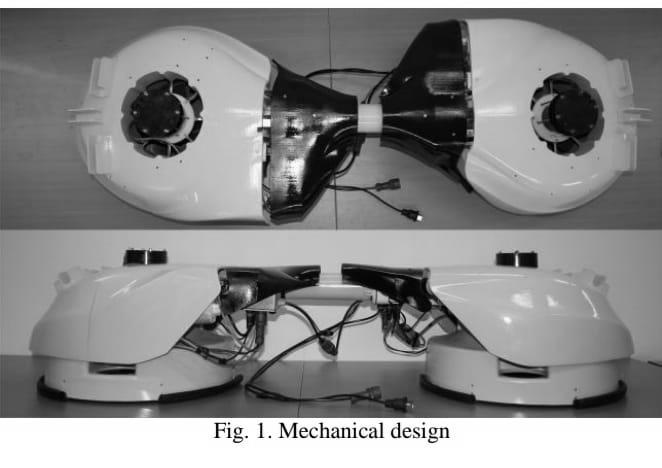
Figure:1 MECHANICAL DESIGN
Table:1 ROBOTCHRACTERISTICS
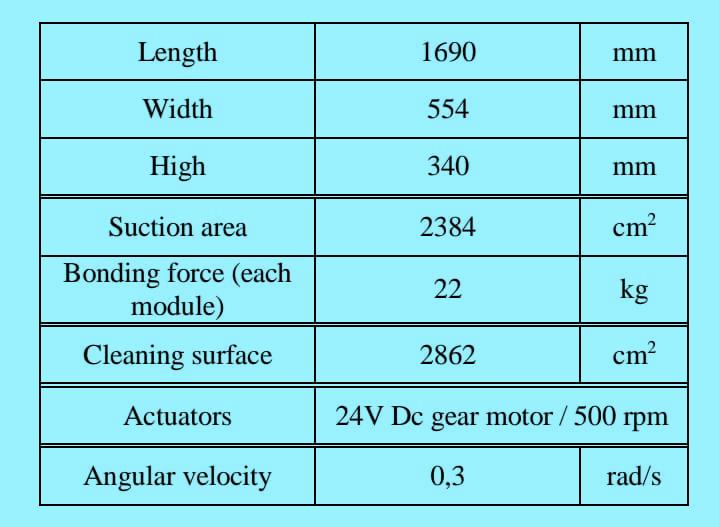
2.GENERAL DESIGN OF MULTIFUNCTIONAL TUGBOAT FOR MONITORING AND CLEANING BOTTOM FILTH
To meet the demand of bottom cleaning of ships, a multifunctional tugboat Designed for monitoring and cleaning thebottomofships.Multi-functionaltugboatinthisdesign Composed of tugboat, robot operation platform, mechanical arms, fouling monitoring module, fouling
e-ISSN:2395-0056
p-ISSN:2395-0072
cleaningmoduleandship balancingmodule.Amongthem, monitoring module it includes underwater camera and distance sensor. Cleaning module contains high pressure waterPumpsetandunderwaterrobot.
The functions of each component are as follows: The monitoring module realizes the monitoring lower contamination; The bottom of the washing machine feels clean; robot operation Robotic underwater detection and control operation; Launching robot is revealed and underwaterrobotmosque;Shipbalancereducesaimingof manualtugboatworkingprocessofmechanicalarm
Accordingtotherequirementsofthetugboatplatform,and considering that multi-functional The tugboat requires sufficient weight and power to realize the loading of monitoring and cleaning equipment, Full cycle swinging harbortugboatwithdisplacementof500tandmainengine powerof3,600kwTheoveralllayoutdesignoftherevised platformwaschosenas
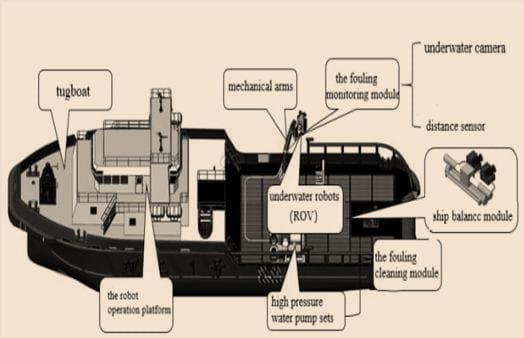
The cleaning process is done by robots only. On the surfaceof the hull. Each module is equipped with a Cleaningsystem with three rotating DC electric motors which arekeptundersuctionroom.
Volume: 11 Issue: 09 | Sep 2024 www.irjet.net
Cost Effective: Fewer components With fewer actuators, thetotalcostofmanufacturing,maintaining,andrepairing the robot is lower. This could make hull cleaning more economicallyviableforshipoperators.
Energy efficiency: Low Actuation Requirements: Low actuation robots have fewer actuators than degrees of freedom, reducing power consumption. This makes them more energy-efficient, which is important for extended underwateroperations.
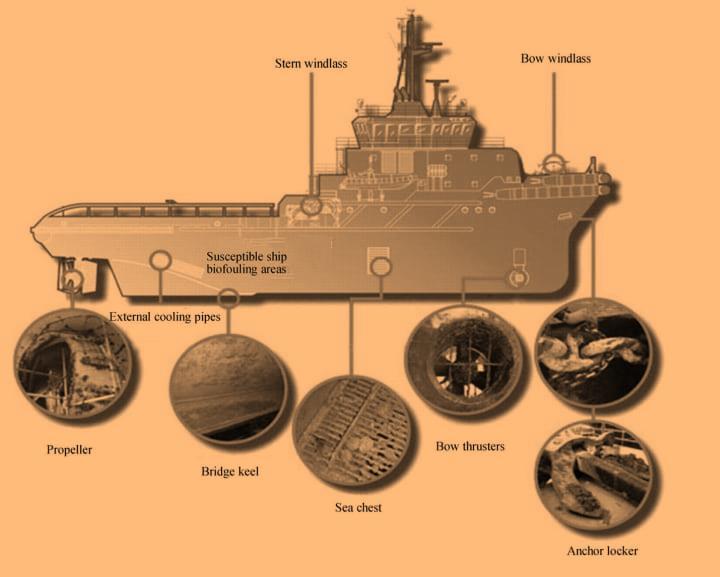
Figure:4 Marine foulingorganisms attach to all subsurfacestructures of the typical ship
e-ISSN:2395-0056
p-ISSN:2395-0072
In this paper we present the design and operation of a Unique design of a robot that is built to perform Cleaning ofnon-magneticandcomplexshiphulls.Wehavedesigned arobotthatcanmovearoundObstaclesonthehullaswell aschangesfromonesurfacetoanotherAnotheronewitha differentorientationinaverysimplewayManner
Inthisway,byKeepingthisinminditsactuatorsarebeing adequately utilized Passive spring element and its positions environment, it can be controlled to clean Working in quite complex circles in addition to overcoming them accidentally be coming detached from therudder
We present a design strategy based on ideas Regarding morphologically intelligent robots Environment Or Stare Adaptation Of robotic Morphology and control. Additionally, we address Economy of operation principle by considering a Under actuated robot with very small numberofactuations
Elements that occur through interaction with their environmentCapableofmeetingalljobrequirements.
In fact, it can even be placed on the hull to clean itself, simplifying its use on recreational vessels. the robot has Designed and tested and the results obtained are quite goodPromising.
[1] Floret, Oliver, et al. "Review of bio security and contaminant risks associated with in-water cleaning."Australian Department of Agriculture, FisheriesandForestry(2010).
[2] "Underwater ship husbandry discharges." United Stated Environmental Protection Agency. Office of WastewaterManagement.November
[3] Bohlander, Jerry. “Review of options for in-water cleaningofships”.MAFBiosecurityNewZealand,
[4] K..Vickery, “Acoustic Positioning Systems: A Practical Overview of Current Systems”, Proceedings Of The 1998 Workshop on AutonomousUnderwater Vehicles (AUV'98),1998,pp.5-17
[5] Pfeifer y Bonnard, (2007), “How the Body Shapes the WayweThink”.MITPress.
Volume: 11 Issue: 09 | Sep 2024 www.irjet.net
BIOGRAPHIES:

IampursuingB.EfinalyearMarine EngineeringcadetatPSNCollegeof Engineering & Technology, Tirunelveli,TamilNadu.
IampursuingB.EfinalyearMarine EngineeringcadetatPSNCollegeof Engineering & Technology, Tirunelveli,TamilNadu
Project Guide cum Assistant Professor PSN College of Engineering & Technology, Tirunelveli, Tamil Nadu. Also having 15years’experiencein Oiland Gasindustries.SpecializationinNDT andworkedvariesGulfCountries.
Project Guide cum Assistant Professor PSN College of Engineering & Technology, Tirunelveli, Tamil Nadu MEO Class-IV Marine Engineer and workedvariesCountries.
e-ISSN:2395-0056
p-ISSN:2395-0072