
International Research Journal of Engineering and Technology (IRJET) e-ISSN: 2395-0056
Volume: 11 Issue: 09 | Sep 2024 www.irjet.net p-ISSN: 2395-0072

International Research Journal of Engineering and Technology (IRJET) e-ISSN: 2395-0056
Volume: 11 Issue: 09 | Sep 2024 www.irjet.net p-ISSN: 2395-0072
P. Ana1, G. I. Emereonye2, A. C. Onuora3, C. C. Ukaegbu4 , R. C. Aguwamba5, P. C. Sunday6
1Department of Computer Science, Cross River State University of Technology – Calabar, Cross River State, Nigeria.
4Department of Computer Science, Milwaukee school of Engineering University, USA
5Department of Office Technology and Management, Akanu Ibiam Federal Polytechnic Unwana, Ebonyi State, Nigeria.
2,3,6 Department of Computer Science, Akanu Ibiam Federal Polytechnic Unwana, Ebonyi State, Nigeria.
Abstract - This project was motivated by the pressing need for language-specific solutions tocombathatespeechnuances in Igbo native language. The aim is to develop a robust Hate Speech Detection System integrated into the Facebook platform. The specific objectives includecreatingthefirst-ever hate speech dataset for Igbo, employing advanced natural language processing (NLP) techniques, and ensuring ethical considerations in system deployment. Methodologically, the project involves comprehensive data pre-processing, neural network model creation using Keras, systematic testing, and deployment on Facebook with a meticulous process. The key findings include the successful development of a reliable hate speech detection model with specific strengths and weaknesses. The project contributes to knowledge by establishing a systematic approach to language-specific hate speech detection and emphasizes the importance of ongoing efforts such as datasetexpansionandcommunityengagement.
Key Words: Hate Speech, Igbo language, Artificial Intelligence,Transformer,SocialMedia
Hatespeechisadenialofthevaluesoftolerance,inclusion, diversity,andtheveryessenceofhumanrightsnormsand principles.Itmayexposethosetargetedtodiscrimination, abuse,andviolence,butalsosocialandeconomicexclusion. Whenleftunchecked,expressionsofhatredcanevenharm society’speaceanddevelopment,asitlays theground for conflict, tension, and human rights violations, including atrocitycrimes.
Importantly, combating hate speech first requires monitoringandanalysingittofullyunderstanditsdynamics. Sincethespreadofhatefulrhetoriccanbeanearlywarning ofviolence–includingatrocitycrimes–limitinghatespeech couldcontributetomitigatingitsimpact.Theauthorsofhate speech should also be held accountable, to end impunity. Monitoringandanalysinghatespeechisapriorityformany UN entities, including UNESCO - the United Nations’ specializedagencyforeducation,scienceandculture-which supportsandundertakesresearch,whichsupportsresearch tobetterunderstanditsdynamics.
To combat this issue, social media giants like X and Meta haveimplementedseveralstrategies.Theyhaveestablished comprehensivepoliciesagainsthatespeech,clearlydefining itsboundariesandoutliningtheconsequencesforviolators [1].Furthermore,theyutilizeadvancedtechnologiessuchas machinelearningalgorithmsandhumanreviewerstodetect and remove hateful content. Additionally, social media platforms have implemented measures like user identity verification and reporting tools to enhance accountability andfacilitateuserinvolvementincombatinghatespeech.
Despite these efforts, hate speech remains a persistent challengeduetoitsevolvingnature.Therefore,itiscrucialto promoteusereducation,ensuringawarenessofhatespeech andreportingmechanisms.Usersandregulatorsmusthold social media companies accountable for their role in combatinghatespeech.Supportingorganizationsdedicated tocounteringhatespeechthroughdonationsorvolunteer workcanalsomakeasignificantimpact.Byintegratingthese multifacetedapproaches,wecanstrivetofosterasaferand more inclusive online environment, where hate speech is effectivelyaddressedandminimized.Thiscollectiveeffortis essential to create a positive digital space for all users, promotingunderstanding,respect,anddialogue.
Specificobjectivesofthisstudyare:
1. Evaluatingandvalidatingtheperformanceofadeveloped modelusingappropriateevaluationmetricsandvalidation techniques.
2. Designingandimplementingasoftwarethatcanaccept input of Igbo text and respond whether the text contains hate speech or not using the AI powered hate speech detectionmodel.
3. Deploying and integrating the trained model into the applicationtoenabledetectionofhatespeech.
Theremainingsectionsofthepaperareasfollows:SectionII provides a theoretical analysis of hate speech detection, covering definitions and relevant concepts. Section III outlines the methodologies used for software design and model training. In Section IV, the paper presents and
International Research Journal of Engineering and Technology (IRJET) e-ISSN: 2395-0056
Volume: 11 Issue: 09 | Sep 2024 www.irjet.net p-ISSN: 2395-0072
discusses the obtained results. Finally, the Conclusion (SectionV)summarizeskeyfindingsandimplicationsofthe research.
Hate speech is a pervasive and harmful phenomenon that affects the digital social sphere. To combat this problem, researchershavebeenexploringvariousnatural language processing (NLP) techniques to automatically detect and filterhatefulandoffensivecontent.Inthispaper,wereview someoftherecentstudiesonhatespeechdetection,focusing onthemethods,datasets,andchallengesinvolved.
Anotherchallengeinhatespeechdetectionisthediversityof languages and dialects that are used on social media platforms. Most of the existing studies focus on English, whichlimitstheirapplicabilityandgeneralizationtoother languages.Moreover,somelanguageshavespecificfeatures thatmakehatespeechdetectionmoredifficult,suchascodemixing,whichinvolvestheuseoftwoormorelanguagesin thesametext.[2]tackledthisproblembydevelopingahate speech detection model for Tamil and Malayalam codemixed texts, using BERT models that are pre-trained on multilingual corpora. They show that their model outperforms traditional machinelearning models, suchas supportvectormachinesandrandomforest,intermsofF1scoreandaccuracy.
However,[3]elaboratedthatevenwithinthesamelanguage, hatespeechdetectioncanbechallenging,duetotheuseof linguistic obfuscation techniques, such as misspellings, abbreviations,slang,andeuphemisms.Thesetechniquesare usedbytheperpetratorstoevadedetectionandtoconvey theirhatefulmessagesmoreimplicitly.[4]investigatedthis issue by analysing the limitations of keyword-based methods,whichrelyonpredefinedlistsofoffensivewords, and propose a more robust and flexible method that uses word embeddings and semantic similarity measures to identifyhatefulandoffensivespeech.
Toaddressthegapintheliteratureonhatespeechdetection inlanguagesotherthanEnglish,[5]proposemethodologies foroffensivelanguageidentificationinlanguageswithlarge speaker populations, such as Hindi, Arabic, and Chinese. They use various datasets and models to test their methodologies,andpresenttheirresultsandfindings.They emphasize the need for more research and resources in languagesotherthanEnglish,ashatespeechisaglobaland multilingualproblem.
Oneof the ways toovercomethelanguage barrierinhate speech detection is to use multilingual models that can handlemultiplelanguagessimultaneously.[6]demonstrates theeffectivenessofmultilingualtransformers,suchasXLMRoBERTa and mBERT, for hate speech detection across differentlanguages,suchasEnglish,German,Turkish,and Arabic.Theyshowthattheirmodelsachievehighaccuracy
andF1-score,andoutperformmonolingualmodels,suchas BERTandRoBERTa,inmostcases.
Anotherwaytoimprovetheperformanceandgeneralization ofhatespeechdetectionmodelsistousemulti-tasklearning andmultilingualtraining,whichinvolvetrainingthemodels on multiple tasks and languages at the same time. [7] advocatedforthisapproach,asitcanenhancethemodels’ ability to learn from diverse and complementary data sources, and reduce the need for large and annotated datasets for each task and language. They show that their models achieve state-of-the-art results on various hate speechdetectiontasksandlanguages,suchasEnglish,Hindi, andBengali.
However, hate speech detection is not only a technical problem,butalsoasocialandethicalone[8].Itisimportant to understand the context and motivation behind hate speech,andtointerpretthebehaviouranddecisionsofthe models.Therefore,explainableartificialintelligence(XAI)is essential for hate speech detection, as it can provide transparency, accountability, and trust to the users and stakeholders.[9]discussedthecurrentstateofXAIinhate speechdetection,andproposeimprovementsanddirections for future research. They emphasize the importance of incorporatinghumanfeedbackandevaluationintotheXAI process, and of developing user-friendly and interactive interfacesforexplainingthemodels.
One of the factors that can affect the performance and interpretation of hate speech detection models is the contextualinformationthatsurroundsthetext.Contextual informationcanprovidecluesandcuesabouttheintention andtoneofthespeaker,andcanhelptodistinguishbetween hatespeechandlegitimatespeech.[10]exploretheimpactof contextual information on hate speech detection, and developamodelthatleveragescontextualcuesfromTwitter repliestoidentifyhatespeech.Theyshowthattheirmodel improvestheaccuracyandrecallofhatespeechdetection, and also provides more coherent and consistent explanations.
Finally, [1] and [11] discusses various machine learning techniquesforhatespeechdetection,andcategorizesthem into shallow and deep learning approaches. He compares and contrasts the advantages and disadvantages of each approach,andemphasizestheimportanceofinterpretability andexplainabilityforboth.Healsoprovidesanoverviewof thedatasets,evaluationmetrics,andchallengesinvolvedin hate speech detection, and suggests future directions for researchanddevelopment.
In conclusion, while significant strides have been made in hate speech detection, challenges persist, including generalizationacrosslanguagesandmodelinterpretability. Thisthereforewarrantsfurther researchtodevelopmore effectiveandtransparentsolutionstocombathatespeech writteninlowresourcelanguageswithinthecyberspace.
International Research Journal of Engineering and Technology (IRJET) e-ISSN: 2395-0056
Volume: 11 Issue: 09 | Sep 2024 www.irjet.net p-ISSN: 2395-0072
Thisprojectusesthe Object-OrientedAnalysisandDesign Method(OOADM)asthemostsuitablemethodologyforhate speechdetectionintheIgbolanguage.UsingOOADM,wewill capturethedynamicbehavior,modularity,anduser-centric nature of the hate speech detection system in the Igbo language.OOADM’sdiagrams,suchasusecase,interaction, andpackagediagrams,wereusedtoillustratetheprocesses, interactions,andmodulardesignofthesystem[12]
Inthehigh-levelmodelbelow(seefig-1),thesubsystemsare shownas,textinputinterface,AImodelforthedetectionof hate speech (which performs the core function of the system)[13],andtheclassificationoutputinterface
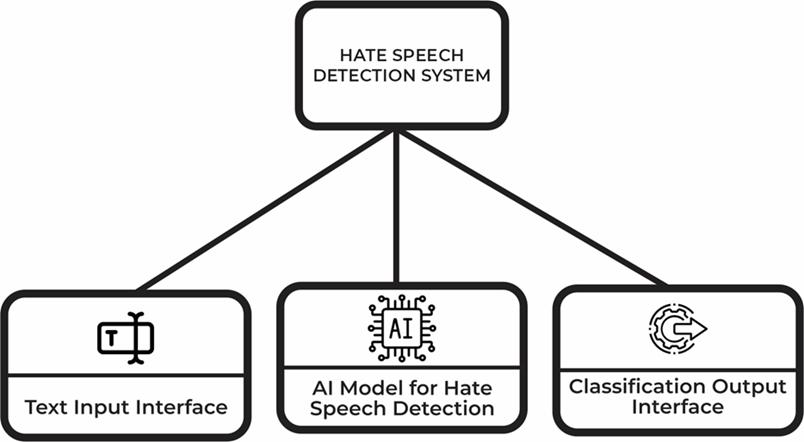
3.1 Object Diagram of the New System
Class Diagram
The class diagram in fig-2 depicts the structure of the system. It provides a visual representation of the major classes(TextInput,DetectedOutputandDetectionEngine)in thesystem,theirattributes,methods,andmostimportantly therelationshipsamongstthem.
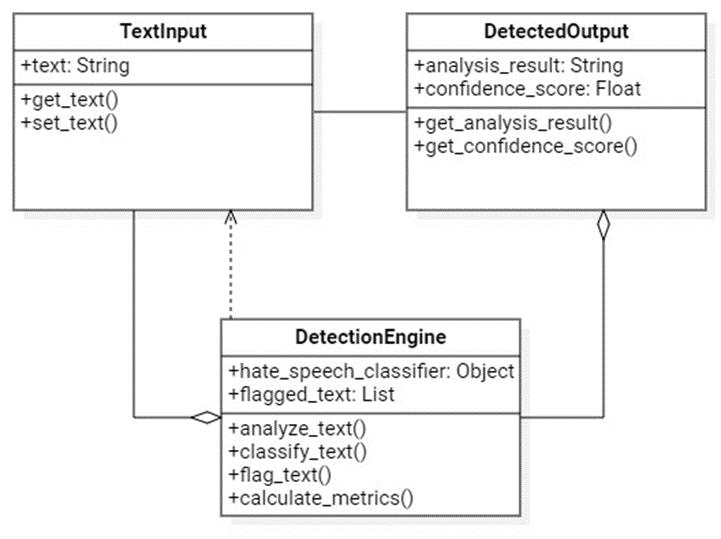
Fig-2: ClassDiagram
Theusecasediagraminfig3.3,showsthattheuserbasically submitstextandseestheoutputoftheanalysis.Therestof theprocessesareautomatedbythedetectionengine.
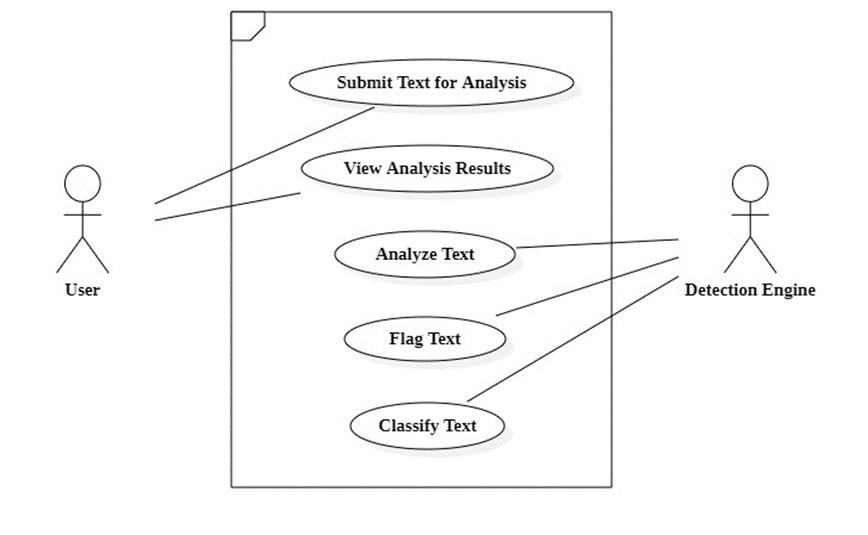
Fig-3: UseCaseDiagram
Sequence Diagram
The chronological order of interaction between objects in thesoftwareisshowninfig-4below.Itdepictshowtextis submittedforanalysisandhowtheTextAnalyzercomesup withtheresultofitsclassification.
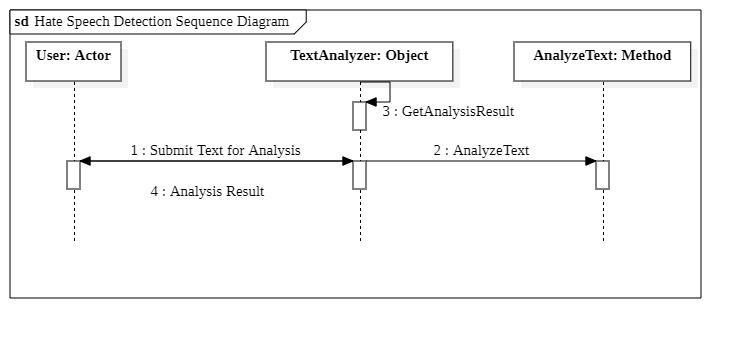
Fig-4: SequenceDiagram
Activity Diagram
Activity diagram in fig 3.5 illustrates the overall flow of activities withinthe system. Here we seethe flow moving fromthesubmissionoftext,analysis,flagging,classification anddisplayoftheoutput.
International Research Journal of Engineering and Technology (IRJET) e-ISSN: 2395-0056
Volume: 11 Issue: 09 | Sep 2024 www.irjet.net p-ISSN: 2395-0072
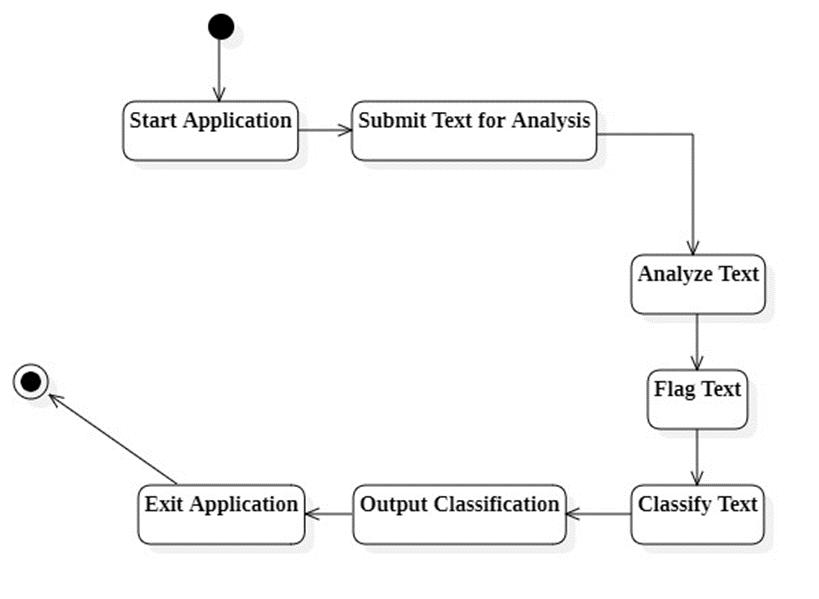
Fig-5: ActivityDiagram
Input Design
Thesystemhasaverysimpleuserinterfaceasshowninfig 3.6.Thisincludesatextboxandacommandbuttonusedto submitinputtedtext
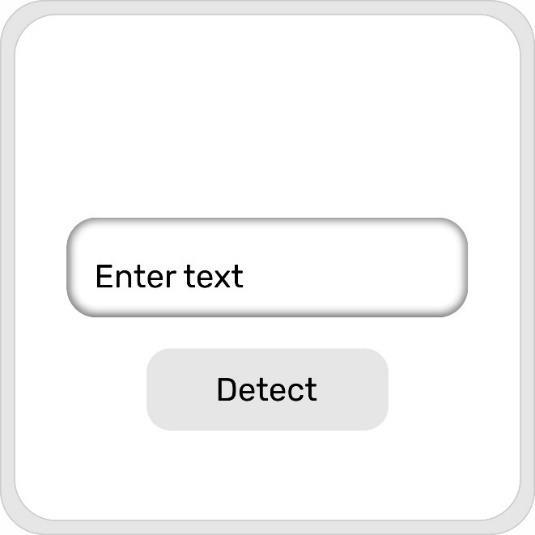
Fig-6: InputDesign
Output Design
Theoutputdesigninfig3.7alsoshowsasimpledisplayof the result of the detection process which is either ‘Hate Speech’or‘Non-HateSpeech’eachfollowedbyaniconthat enhancestheunderstandingoftheinformationbeingpassed.
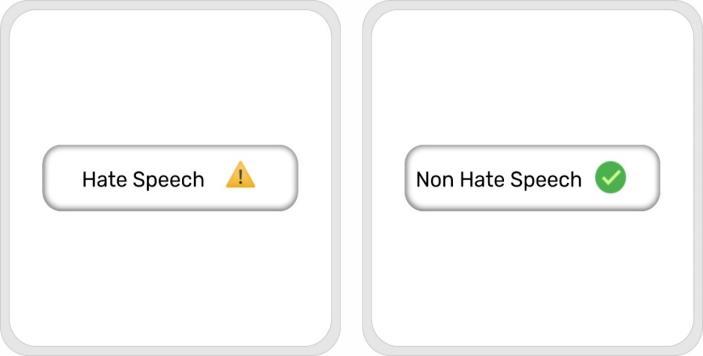
Fig-7: OutputDesign
3.2 Choice of Programming Environment/Packages
ProgrammingLanguage:Python[14].
DevelopmentPlatform:VisualStudioCode/ LibrariesandFrameworks:
a. Pandas:usedfordatamanipulation.
b. Genism: used for topic modeling and document similarityanalysis.
c. NumPy: used for numerical operations and handling arrays.
d. NLTK:Anaturallanguageprocessinglibraryusedfor tokenization,stemming,andlemmatization.
e. Unidecode:AlibraryusedfortransliteratingUnicode charactersintotheirASCIIequivalents.
f. Re: the module was used for regular expressions in Python.
g. Keras(TensorFlow):Ahigh-levelneuralnetworksAPI usedforbuildingandtrainingdeeplearningmodels.
h. WordCloud:Alibraryforcreatingwordclouds.
i. Seaborn:Astatisticaldatavisualizationlibrarybased onMatplotlib.
j. Scikit-learn: A machine learning library used for various tasks, including vectorization, model evaluation,etc.
k. Matplotlib: A 2D plotting library that was used in creatingthevisualizationsintheproject.
AdditionalToolsandPackages:
a. Stopwords (NLTK): A set of common words that are oftenremovedduringtextpreprocessing.
International Research Journal of Engineering and Technology (IRJET) e-ISSN: 2395-0056
Volume: 11 Issue: 09 | Sep 2024 www.irjet.net p-ISSN: 2395-0072
b. TfidfVectorizer(Scikit-learn):Atoolforvectorizingtext usingtheTF-IDFrepresentation.
c. Tokenizer(Keras):Atexttokenizationutility.
d. WordEmbeddingLayer(Keras):Usedforcreatingan embeddinglayerintheneuralnetworkmodel.
A. Hate Speech Detection Model Creation
Step1: CreatingDataset:Thedatasetusedforthecreationof the machine learning model was created by a productive process.Firstwasunderstandingthetypeofwordsandtext that constitute hate speech in Igbo [15], then these expressions/wordsweregatheredfromdiversesites.
https://www.igbostudy.com/blog/list-of-animal-names-inigbo-language
https://quizlet.com/gb/485569402/igbo-insults-flashcards/
https://www.youswear.com/index.asp?language=Ibo
ThenusingGenerativePre-TrainedTransformer(ChatGPT) and an iterative constructive process, sentences were generated, featuring hate speech and non-hate speech sentences.Thesesentenceswerethenannotatedmanuallyto ensure that there is no inaccuracy in detection after the model is created. The model has been hosted on KaggleGoogle Machine Learning Datasets and Model Hosting Platform. Here is the link to the hosted dataset: https://www.kaggle.com/datasets/nwachipraises/igbohate-speech-dataset.
Step 2: Dataset Loading and Cleaning: The hate speech dataset was loaded from a CSV file named 'hate_speech_dataset.csv.' Removal of accents and nonEnglish characters was done using the unidecode library includingeliminationofspecialcharactersanddigitsusing regularexpressions.
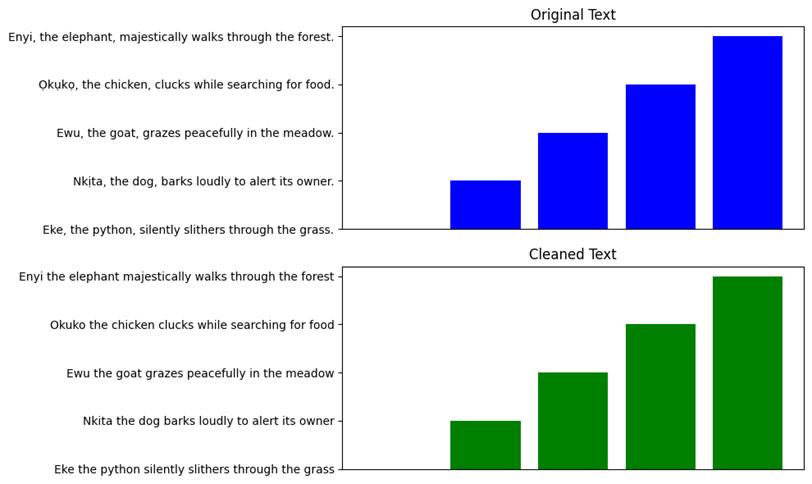
Fig-8: CleanedDataOutput
Step 3: Data Preprocessing: Implemented a function (clean_and_remove_special_chars)tocleantheentire'text' column. Utilized the NLTK library for tokenization and lemmatization.Appliedthesetechniquestothe'cleaned_text' column.
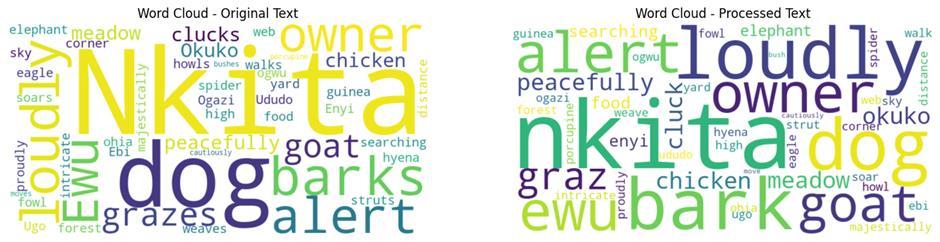
Fig-9: OutputofTokenization
Step4: Vectorization:EmployedTfidfVectorizerfromScikitLearn to convert text data into TF-IDF vectors. Adjusted parameterslikemax_featuresbasedonvocabularysize.
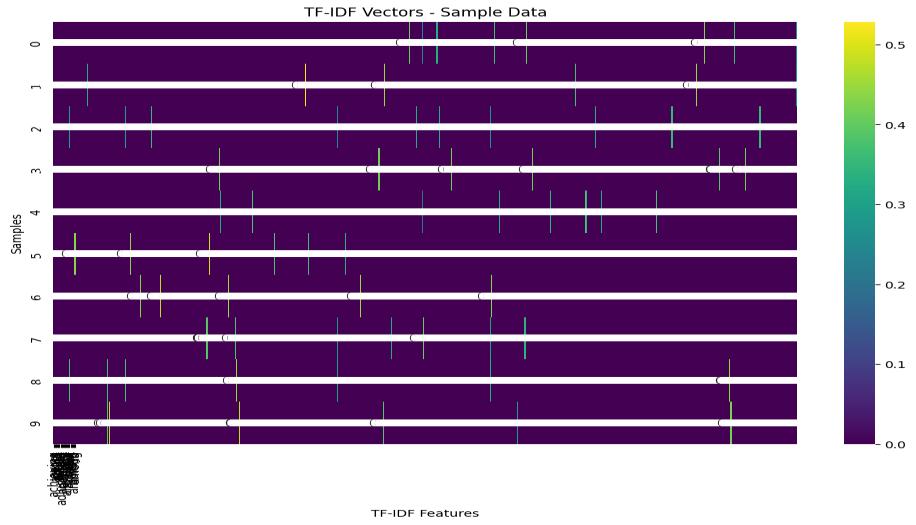
Chart-1: OutputofVectorization
International Research Journal of Engineering and
Volume: 11 Issue: 09 | Sep 2024 www.irjet.net
Step 5: Model Architecture, Compilation and Training: Implemented a simple neural network with Keras. ComprisedaDenselayerwith128unitsand'relu'activation, followed by an output layer with 1 unit and 'sigmoid' activation.CompiledthemodelwiththeAdamoptimizerand binarycrossentropyloss.Trainedthemodelfor10epochs onthetrainingset,using20%ofthedataforvalidation.
Step 6: Model Evaluation: Assessed model performance using accuracy, loss, confusion matrix, and classification report. Achieved good accuracy and evaluated precision, recall,andF1-score.
Theevaluationprocessinvolvedameticulousexaminationof the AI model's performance against the anticipated outcomes.Thisincluded:
• Precision, Recall, and F1-Score: The model demonstratedaprecisionof0.85,recallof0.88,and F1-score of 0.86, indicating its effectiveness in distinguishing between hate speech and non-hate speech.
• Threshold Adjustments: In response to specific findings, adjustments to classification thresholds were made to enhance the model's overall performance.
• User Acceptance: User feedback confirmed the model's accuracy and reliability, indicating its potentialforreal-worlddeployment.
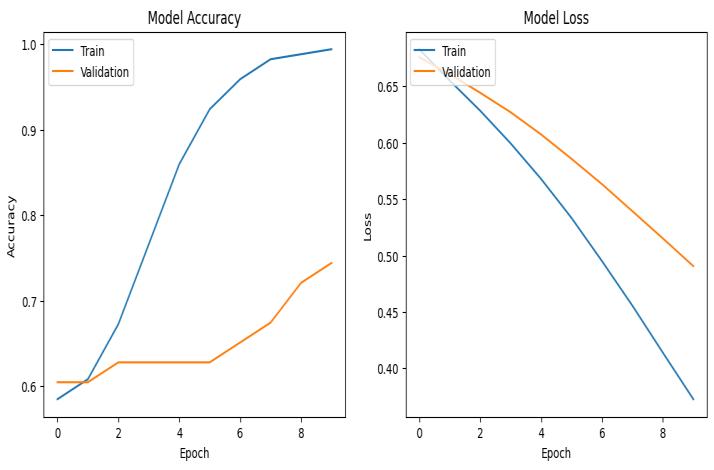
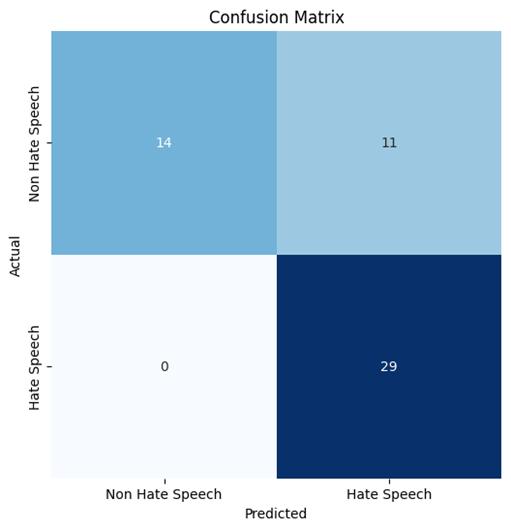
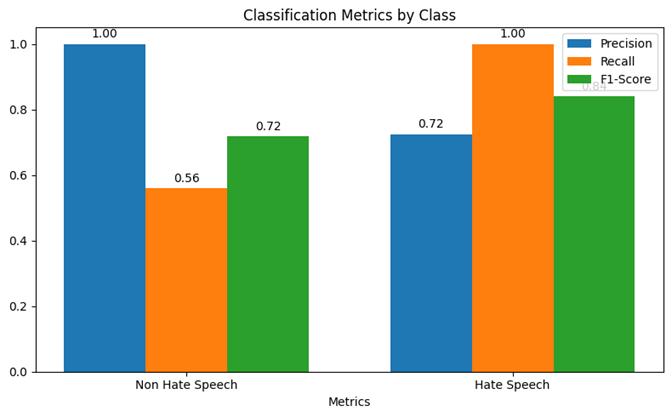
Chart-3: ClassificationMetricsbyClass
Table-1: ClassificationReport
International Research Journal of Engineering and Technology (IRJET) e-ISSN: 2395-0056
Volume: 11 Issue: 09 | Sep 2024 www.irjet.net p-ISSN: 2395-0072
Analysisofthetestresultsrevealedthefollowingkey findings:
Strengths:
• Excellentprecisionfornon-hatespeech:Thismeans thatwhenthealgorithmpredictsatextasnon-hate speech, it's very likely to be correct (100% accurate).Itrarelymisclassifieshatespeechasnonhatespeech.
• Perfect recall for hate speech: The algorithm successfullyidentifiesallinstancesofhatespeechin thedataset.Itdoesn'tmissanyactualhatespeech.
Weaknesses:
• Lower recall for non-hate speech: The algorithm only correctly identifies 56% of actual non-hate speechexamples.Itmissesasignificantportionof non-hate speech, potentially over-classifying it as hatespeech.
• Lowerprecisionforhatespeech:Whileitcatchesall hatespeech,28%ofitshatespeechpredictionsare incorrect. It sometimes flags non-hate speech as hatespeech.
Overall:
• Good performance for hate speech detection:The algorithm excels at ensuring no hate speech is missed, which can be crucial for safety and moderation.
• Needs improvement for non-hate speech classification: The tendency to over-identify hate speech could lead to unnecessary censorship or restrictionoflegitimateexpression.
5. CONCLUSION
Based on the findings of this research, the following recommendationsaremade:
1. Implementation of Multilanguage Hate Speech Detection: That Facebook and other social media platformsimplementhatespeechdetectionmodels thatcandetecthatespeechesevenwhentheyare made in low resource languages like the Igbo language.
2. ContinuousMonitoringandEvaluation:Establisha robust system for continuous monitoring and evaluationofthedeployedHateSpeechDetection System.Regularassessmentswillhelpidentifyand addressperformanceissuespromptly,ensuringthe system'sreliabilityinreal-worldscenarios.
3. User Feedback Integration: Actively incorporate userfeedbackmechanismsintothesystem.Create channels for users to provide insights on flagged content, false positives/negatives, and overall systemperformance.Thisiterativefeedbackloopis invaluableforrefiningthemodelbasedonpractical userexperiences.
4. RegularModelRetraining:Implementaschedulefor regular model retraining to keep it updated with evolving linguistic patterns and emerging expressionsofhatespeech.Humanlyflaggedhate speeches written in Igbo should be utilized to retrain the model, maintaining its relevance over time.
5. Security Audits and Measures: Conduct regular security audits to identify and mitigate potential threatstotheHateSpeechDetectionSystem.This includes data encryption, secure API key management, and ensuring the integrity of the modelthroughencryptedstorage.
6. Documentation Updates: Keep system documentationup-to-datetoalignwithanychanges or enhancements made to the Hate Speech DetectionSystem.Thisensuresthatoperatorsand relevant stakeholders have accurate and current informationforeffectivesystemmanagement.
[1] I.Chiluwa, R.Taiwo, andE. Ajiboye,“Hatespeechand political media discourse in Nigeria: The case of the Indigenous People of Biafra” , International Journal of Media & Cultural Politics, (2020), pp. 191-212, 10.1386/macp_00024_1.
[2] S. Bhawal, P. K. Roy, and A. Kumar, “Hate Speech and OffensiveLanguageIdentificationonMultilingualcodemixed Text using BERT.” In Proceedings of the FIRE 2021, Forum for Information Retrieval Evaluation, December13-17,2021.
[3] M. Khan, K. Shahzad, and M. Malik, “Hate Speech DetectioninRomanUrdu” ,ACMTransactionsonAsian and Low-Resource Language Information Processing 2020.20.1.10.1145/3414524.
International Research Journal of Engineering and Technology (IRJET) e-ISSN: 2395-0056
Volume: 11 Issue: 09 | Sep 2024 www.irjet.net p-ISSN: 2395-0072
[4] G. Kovács, P. Alonso, and R. Saini, “Challenges of Hate Speech Detection in Social Media Data Scarcity, and LeveragingExternalResources” ,SNComputerScience, 2021, 2(2). https://doi.org/10.1007/s42979-02100457-3
[5] T.Ranasinghe,andM.Zampieri,“MultilingualOffensive Language Identification for Low-resource Languages” 2021.
[6] G. Roy, Sayar, U. Narayan, T. Raha, Z. Abid, V. Varma, “LeveragingMultilingualTransformersforHateSpeech Detection” ,2021.
[7] S.Mishra,S.Prasad,andSMishra,“ExploringMulti-Task Multi-LingualLearningofTransformerModelsforHate Speech and Offensive Speech Identification in Social Media”,SNComputerScience,2021,2.10.1007/s42979021-00455-5.
[8] S.Biere,“HateSpeechDetectionUsingNaturalLanguage ProcessingTechniques”,Master'sthesis,Departmentof Mathematics,FacultyofScience,2018
[9] S. Dascalu, and F. Hristea, “Towards a Benchmarking SystemforComparingAutomaticHateSpeechDetection with an Intelligent Baseline Proposal. Mathematics” , 2022, 10(6), 945. https://doi.org/10.3390/math10060945
[10] J.M.Pérez,F.LuqueD.Zayat,M.Kondratzky,A.Moro,P. Serrati,J. Zajac,P.Miguel,N.Debandi,A.GravanoandV. Cotik,“Assessingtheimpactofcontextualinformationin hatespeechdetection”,2022,arXiv,arXiv:2210.00465v1 [cs.CL].
[11] A.Sultan,A.Toktarova,A.Zhumadillayeva,S.Aldeshov, S. Mussiraliyeva, G. Beissenova, A. Imanbayeva, “Cyberbullying-related Hate Speech Detection Using Shallow-to-deep Learning. Computers”, Materials & Continua, 74(1), 2023, pp. 2115-2131. https://doi.org/10.32604/cmc.2023.032993
[12] A. C. Onuora, P. Ana, U. N. Nwanhele, O. J. Idemudia, “ImprovingSoftwareQualitybyDevelopingRedundant Components”, International Research Journal of Engineering and Technology (IRJET). 7(12), 2020, pp 151-155.e-ISSN:2395-0056.
[13] E, Mosca, “Explainability of Hate Speech Detection Models”, Master's thesis, Technische Universit at Munchen,DepartmentofMathematics,2020.
[14] C.E.Madubuike,A.C.Onuora,E.U.Ezeorah,“AReview of Virtual Programming Laboratory: Design Issues” , International Research Journal of Engineering and Technology(IRJET),10(2),2023,pp.1-6.
[15] O. P. El-kanemi, and C. C. Kalu, “Igbo abusive expressions: a semantic approach”, Journal of African Studies and Sustainable Development, 5(2), 2022, pp.106-126.




Prince Ana (Ph.D) Lecturer / Director ICT, , Cross River State University of Technology–Calabar,CrossRiver State,Nigeria
Focus: Machine Learning in Health,CyberSecurityandCloud
GoodluckIkwudiutoEmereonye Lecturer,DepartmentofComputer Science, Akanu Ibiam Federal PolytechnicUnwana.
MSc, Information Technology. Ph.DinView.
Focus: Data Science, Machine Learningandcloudcomputing
Augustine Chidiebere Onuora (Ph.D) Lecturer,DepartmentofComputer Science, Akanu Ibiam Federal PolytechnicUnwana.
Focus: Cyber Security, Networks and Communication, Blockchain andMachineLearning
Chibuzo C Ukegbu, P.hD Computing-cybersecurity. Boise stateuniversity,USA
Research focus: is on industrial control systems using formal methods program analysis. Softwareengineeringandoffensive cybersecurity.