
International Research Journal of Engineering and Technology (IRJET) e-ISSN: 2395-0056
Volume: 11 Issue: 09 | Sep 2024 www.irjet.net p-ISSN: 2395-0072

International Research Journal of Engineering and Technology (IRJET) e-ISSN: 2395-0056
Volume: 11 Issue: 09 | Sep 2024 www.irjet.net p-ISSN: 2395-0072
Dr. M N Dinesh1 , Appaneravanda Lochan Appanna2
1Electrical and Electronics, RV College of Engineering, Bengaluru, India
2Electrical and Electronics, RV College of Engineering, Bengaluru, India
Abstract -Induction cooking devices have rapidly advancedinrecentyears,drivenbytheirnumerousbenefits, including efficient, clean, and safe contactless energy transfer. This technology has already made a significant impact on the market, both in terms of adoption and economic effect. Central to these systems are inverters, which,whenutilizedeffectively,canloweroverallcostsand improve system efficiency. The current focus in power electronic converters is on maximizing efficiency by reducing the number of components, leading to more compact, cost-effective designs with higher performance. However, power electronic switches introduce challenges such as electromagnetic interference (EMI), switching losses, and stress, which can increase costs, reduce efficiency, and necessitate additional maintenance. As a result, engineers are increasingly concentrating on developing converters with minimalcomponents toaddress theseissues.
This paper introduces a multiple-output boosted resonant inverteraimedatimprovingtheefficiencyandperformance ofmoderninductionheatingsystems.Theproposeddesignis capable of powering multiple induction loads while reducing current levels, thereby significantly enhancing converter efficiency. This approach enables a highperformance, cost-effective solution. A prototype has been constructed and tested to confirm the viability of the proposed converter, with simulations conducted using MATLAB/Simulinktosupportthefindings.
Key Words: - Boost Inverter, Induction heating, sMultipleOutput,ResonantConverter.
Induction heating technology has rapidly gained prominence due to its many advantages, such as high efficiency, cleanliness, and safety. These benefits have driven significant advancements in the field, leading to widespreadadoptionandnotableeconomicimpact.Unlike traditional heating methods that rely on direct contact or convection, induction heating works through electromagneticinductiontogenerateheatdirectlywithin the material. This method of contactless energy transfer offersunmatchedprecisionandcontrol,makingitanideal choiceforavarietyofapplications,rangingfromindustrial processes to household appliances like induction cooktops[1]
Attheheartofinductionheatingsystemsliestheinverter, a crucial component that converts electrical energy into the high-frequency alternating current (AC) necessary for efficient induction heating. The performance of the inverter is critical, as it directly affects the overall efficiency, cost, and reliability of the system. In recent years,therehasbeenagrowingfocusinpowerelectronics on maximizing efficiency by minimizing the number of components in these systems[2]. This approach not only leads to more compact designs but also enhances performance and reduces manufacturing costs. However, thispursuitofefficiencypresentsitsownsetofchallenges.
Power electronic converters, particularly those involving high-frequency switching, introduce several undesirable factors that can adversely affect system performance. These factors include electromagnetic interference (EMI), switching losses, and thermal stress, all of which contribute to higher operational costs and lower efficiency. For example, EMI can disrupt the operation of nearby electronic devices, necessitating additional filtering and protective measures. Switching losses occur when power is dissipated during the transition between the on and off states of the electronic switches, which reduces the overall efficiency of the system. Thermal stress, caused by the rapid switching and high power levels, can lead to component degradation over time, increasing maintenance needs and the likelihood of systemfailure.
To address these challenges, modern engineers are increasingly focused on designing power electronic convertersthatusethe fewestpossiblecomponentswhile maintaining high efficiency and performance. The goal is to create systems that are not only cost-effective but also reliable and easy to maintain. This trend has led to the exploration of various inverter topologies and control strategies aimed at optimizing the performance of inductionheatingsystems[3].
One promising development in this area is the multipleoutput boosted resonant inverter, which has shown significant potential in improving the efficiency and performance of induction heating systems. This topology is designed to simultaneously supply multiple induction loads, thereby reducing the current levels required for each load and enhancing overall system efficiency. By distributing the power among multiple loads, the convertercanoperateatlowercurrentlevels,whichhelps
International Research Journal of Engineering and Technology (IRJET) e-ISSN: 2395-0056
Volume: 11 Issue: 09 | Sep 2024 www.irjet.net p-ISSN: 2395-0072
reduce the losses associated with high-current operation. Additionally,theresonantnatureoftheinverterallowsfor soft switching a technique that minimizes switching lossesbyensuringthatthevoltageandcurrentareatzero during the switching transitions. This not only improves efficiency but also reduces thermal stress on the components,leadingtolongersystemlifespansandlower maintenancecosts.
Designing and implementing such a system requires carefulattentiontovariousfactors,includingtheselection of components, circuit layout, and the control strategy used to manage the inverter’s operation. The choice of components is particularly important, as it directly influences the system’s efficiency, cost, and reliability. High-quality components capable of withstanding highfrequency operation and thermal stress are essential to ensuring long-term performance. The circuit layout must also be optimized to minimize parasitic inductances and capacitances,whichcancontribute tolossesanddecrease theinverter’sefficiency[4].
Beyond hardware design, the control strategy is vital to the inverter’s performance. Advanced control techniques, suchaspulse-widthmodulation(PWM)andphase-shifted control,canbeemployedto regulatetheinverter’soutput and ensure optimal operation. These control strategies must be finely tuned to balance trade-offs between efficiency, power output, and system stability. For instance, increasing the switching frequency can reduce the size of passive components and improve the system’s dynamicresponse,butitcanalsoleadtohigherswitching losses and increased EMI. Therefore, the control strategy must be designed to achieve the best possible performancewithinthesystem’sconstraints[5].
The proposed multiple-output boosted resonant inverter hasbeenvalidatedthroughprototypetesting,withresults confirming its viability as a high-performance and costeffective solution for modern induction heating systems. The prototype demonstrated that the inverter could effectively power multiple loads with enhanced efficiency and reduced current levels, supporting the theoretical advantages of the proposed topology. Additionally, simulations conducted using MATLAB/Simulink provided further insights into the inverter’s operation and performance under various conditions, helping to refine thedesignandoptimizethecontrolstrategy.Thisensured that the final implementation met the desired performancestandards.
In summary, the development of efficient and costeffective power electronic converters is essential for advancing induction heating technology. The multipleoutput boosted resonant inverter represents a significant leap forward in this regard, offering a solution that enhances the performance and efficiency of induction heating systems while reducing overall system costs and
complexity.Asthedemandforinductionheatingcontinues torise, the adoption of innovativeinverter topologies like this one will be crucial in meeting the needs of both industrialandconsumerapplications.Futureresearchand development should focus on further improving the efficiency and reliability of these systems by exploring new materials and technologies that can extend the capabilitiesofinductionheating.Bycontinuingtoinnovate in this field, the full potential of induction heating technology can be realized, leading to more sustainable andefficientheatingsolutionsacrossvariousindustries.
This architecture shown in the Fig-1, combines various components that work together to convert, regulate, and distribute power efficiently to multiple inductive loads. The input AC voltage is first processed by the boost resonant converter, which increases and regulates the voltage,whilethepulsegenerationcircuitensuresprecise controlovertheconverter’soperations.Theoutputpower isthendeliveredtothemainandauxiliaryinductiveloads, which utilize the energy for their respective heating functions.Thisintegratedsystemdesignishighlyeffective in meeting the demands of modern induction heating applications, offering a reliable and efficient solution for bothindustrialandconsumeruse.
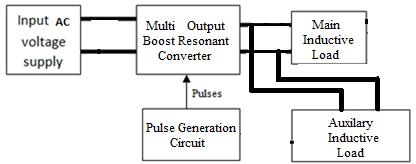
TheInputACVoltageSupplyservesastheinitialsourceof electricalpowerforthesystem.Ittypicallyoriginatesfrom a standard mains supply, delivering alternating current (AC)thatthesystemwillconvertandregulatetopowerthe inductive loads. The importance of this supply cannot be overstated, as it provides the foundational energy needed for the entire operation. The AC voltage is subjected to conversion processes that tailor it to the specific requirements of the inductive loads, ensuring that the systemoperateseffectivelyandefficiently.
At the core of the system is the Multi-Output Boost Resonant Converter. This component is responsible for
International Research Journal of Engineering and Technology (IRJET) e-ISSN: 2395-0056
Volume: 11 Issue: 09 | Sep 2024 www.irjet.net p-ISSN: 2395-0072
convertingtheinputACvoltageintoahigher,moresuitable voltage that can power the system’s inductive loads. The term"boost"referstotheconverter’sabilitytostepupthe input voltage to meet the demands of the loads. This processiscrucialbecausetheinductiveloadsoftenrequire avoltagethatishigherthanwhatissupplieddirectlyfrom themains.The"resonant"aspectoftheconverterrefersto theuseofinductanceandcapacitancetocreatearesonant circuit,whichallowsforenergytobetransferredefficiently at high frequencies. This resonant operation not only enhances energy efficiency but also reduces switching losses and stress on the system’s components. The multioutput capability indicates that the converter can simultaneously provide power to multiple loads,suchas a primary inductive load and an auxiliary one, without sacrificingperformance.
The Pulse Generation Circuit is an essential part of the controlmechanismfortheconverter.Thiscircuitgenerates precisepulsesthatcontroltheswitchingdeviceswithinthe converter, such as MOSFETs or IGBTs. These pulses determine the timing and frequency of the switching actions, which are critical for maintaining the resonant conditionswithintheconverter.Properpulsegenerationis necessarytoensurethattheconverteroperatesatoptimal efficiency, minimizes energy losses, and provides the correct power levels to the inductive loads. Without this precisecontrol,thesystemcouldsufferfrominefficiencies, increasedwearoncomponents,andevenpotentialfailure.
The PWM Generator takes the output from the PID controller and converts it into a Pulse Width Modulated signal. PWM is a technique used to control the amount of powerdeliveredtoanelectricalload,inthiscase,theBLDC motor. The duty cycle of the PWM signal (the ratio of the on-timetothetotalperiodofthesignal)directlycorrelates with the motor speed. A higher duty cycle means more powerisdeliveredtothemotor,increasingitsspeed,while a lower duty cycle decreases the power and slows the motor.
The Main Inductive Load represents the primary applicationofthesystem’soutputpower.Inthecontextof induction heating, this load could be the main heating element, such as a coil used for cooking or an industrial heating process. The performance of this load depends heavilyonthestabilityandqualityofthepoweritreceives from the converter. If the converter operates as intended, the main inductive load will function efficiently, providing consistent and reliable heating performance. This component is the primary beneficiary of the converter’s
output, and its efficiency is directly linked to the overall successofthesystem.
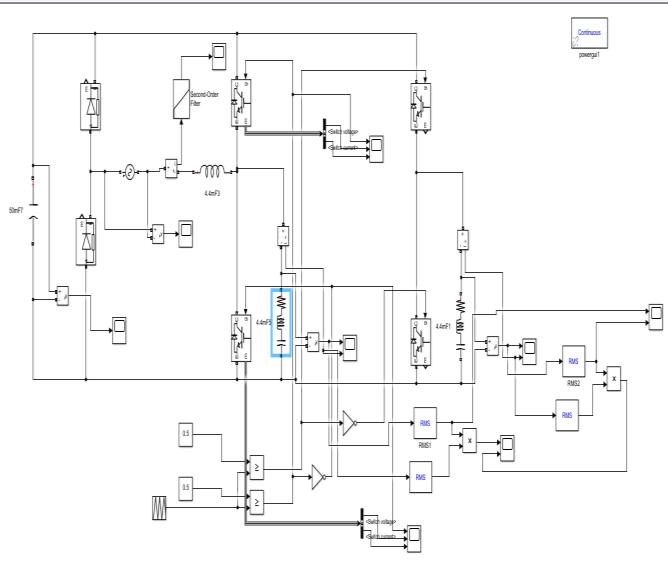
Fig-2: Simulationcircuit
The simulation diagram in Fig 2, shows the MATLAB simulationcircuit
The dual-output inverter system enhances the efficiency and performance of multi-burner induction cooking by convertinginputACpowerintohigh-frequencyACsuitable for driving induction heating elements. It features a dualoutput inverter with two half-bridge structures, allowing independent power distribution totwoseparate induction coils. This configuration efficiently splits power between the outputs, ensuring effective operation of both heating zones. Transistor switches, such as MOSFETs or IGBTs, control the power conversion, while snubber capacitors minimize switching losses by absorbing energy during transitions. Series resonant tanks, comprising inductors andcapacitors,areconnectedtoeachhalf-bridge,enabling soft-switching conditions (zero voltage or zero current switching) that reduce losses and component stress. The resonant frequency of each tank is tuned to match the system's operating frequency, ensuring efficient energy transfer.
The system achieves up to 95% efficiency by managing switching losses and maintaining resonance. A key advantage is the minimal use of components; by integrating two outputs into a single inverter, the system eliminatestheneedforseparateinvertersforeachburner, leadingtoacompact,lightweight,andcost-effectivedesign. The high-frequency AC output generates magnetic fields
International Research Journal of Engineering and Technology (IRJET) e-ISSN: 2395-0056
Volume: 11 Issue: 09 | Sep 2024 www.irjet.net p-ISSN: 2395-0072
that induce currents in cooking vessels, producing heat. Overall, the system offers an efficient, versatile, and affordable solution for multi-burner induction cooking, optimizing performance through reduced losses and componentusage.
The waveform shown in the Fig 3 is the input supply voltagewaveformoftheinverter
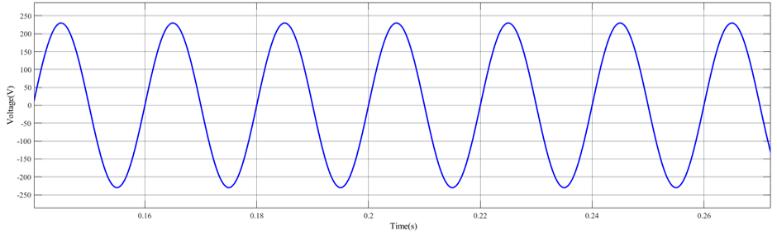
Fig-3: Inputsupplyvoltagewaveformoftheinverter
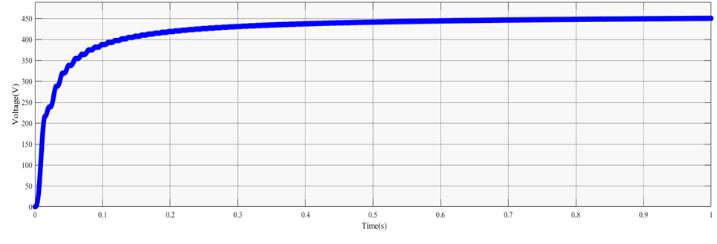
Fig-4: DClinkvoltagewaveformofproposedinverter
Fig4showstheDClinkvoltagewaveformoftheproposed inverter
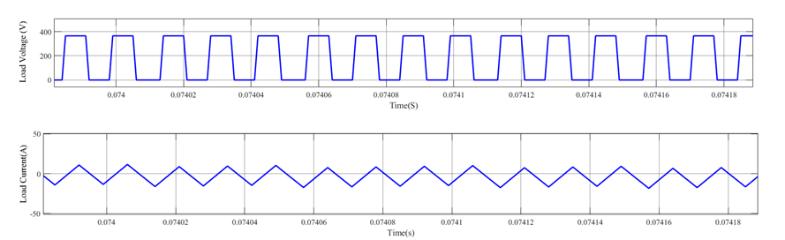
Fig-5: Loadvoltageandcurrentwaveformsofproposed inverter
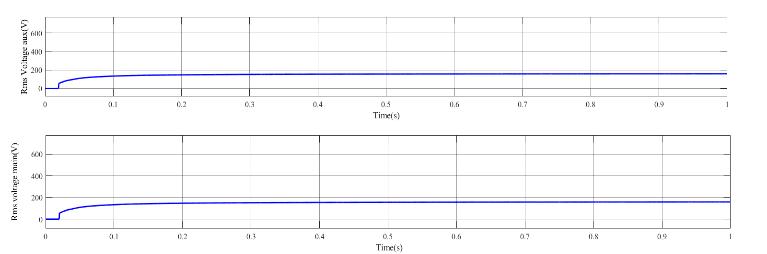
Fig-6: RMSVoltageofLoad1andLoad2fordutyratioof 0.5.
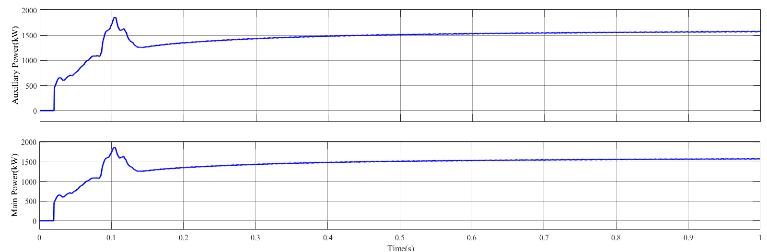
Fig-7: PowerconsumedbyLoad1andLoad2
Fig -5, shows the load voltage and current waveforms of the proposed inverter system, whereas Fig-6 shows the RMSvoltageofLoad1andLoad2forthedutyratioof0.5 .Fig-7,showsthepowerthatisconsumedbyload1andload 2.
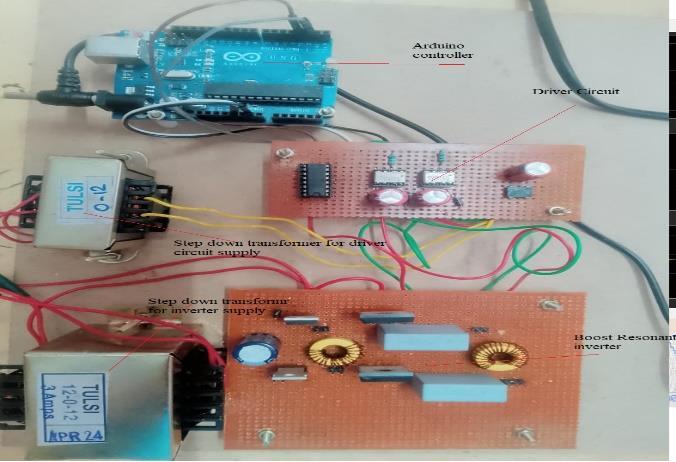
Fig-8: Hardwareprototypeofproposedinverter
Fig-8, shows the hardware prototype of the system.The componentsusedareArduinocontroller,drivercircuit,step downtransformerandboostresonantinverter
This study focuses on developing a dual-output inverter system for induction cooking, eliminating the need for multiple inverters in multi-burner applications. The proposed converter topology incorporates two half-bridge structures and snubber capacitors to reduce switching losses, achieving up to 95% efficiency. Series resonant tanks are employed for safe commutation, further minimizing losses. The design optimizes efficiency by maintaining low total losses, and the use of fewer components results in a lighter, smaller, and more costeffective converter. Compared to conventional singleoutput systems, this approach enhances overall performancewhilereducingthesystem’ssizeandcost.
International Research Journal of Engineering and Technology (IRJET) e-ISSN: 2395-0056
Volume: 11 Issue: 09 | Sep 2024 www.irjet.net p-ISSN: 2395-0072
[1] O. Jiménez, O. Lucía, I. Urriza, L. A. Barragán, and D. Navarro, "Power measurement for resonant power converters applied to induction heating applications," IEEE Transactions on Power Electronics, vol. 29, pp. 6779-6788,December2014.
[2] O. Jiménez, O. Lucía, I. Urriza, L. A. Barragán, and D. Navarro,"AnalysisandimplementationofFPGA-based online parametric identification algorithms for resonant power converters," IEEE Transactions on Industrial Informatics, vol. 10, pp. 1144-1153, May 2014.
[3] O. Jiménez, O. Lucia, I. Urriza, L. A. Barragán, P. Mattavelli, and D. Boroyevich, "FPGA-based gainscheduled controller for resonant converters applied to induction cooktops," IEEE Transactions on Power Electronics,vol.29,pp.2143-2152,April2014.
[4] H. Sarnago, O. Lucía, A. Mediano, and J. M. Burdío, "Analytical model of the half-bridge series resonant inverter for improved power conversion efficiency and performance," IEEE Transactions on Power Electronics,vol.30,pp.4128-4143,August2015.
[5] T. Mishima, C. Takami, and M. Nakaoka, "A new current phasor-controlled ZVS twin half-bridge highfrequency resonant inverter for induction heating," IEEE Transactions on Industrial Electronics, vol. 61, pp.2531-2545,May2014.
BIOGRAPHIES


Dr. M.N Dinesh is currently the Professor of EEE, RV College of Engineering, Bengaluru. His area of interests are Insulators for HV applications, controlsystems and powerelectronics
Appaneravanda Lochan Appanna received the B.E degree in EEE from Ramaiah Institute of Technology. He is currently pursuing his M Tech in Power Electronics in RV College ofEngineering,Bengaluru.