

Exploring the Potential of Stevia Fermentation Liquid and Wastewater in Microbial Fuel Cells: A Sustainable Approach to Enhanced Electricity Production
Junwoo
Park1
Magnus Center for Ethics, Science and Philosophy, Philippines
Abstract – In response to the growing need for eco-friendly and sustainable energy sources, it is crucial to explore alternativesolutions.Microbialfuelcells,orMFCs,provideapromisingavenueforelectricityproduction.Inthispaper,the study aims to find the most efficient combination of microorganisms and organic matter for enhanced electricity productionunderenvironmentalconditions.Aseriesofexperimentsfoundthatthecombinationofsteviaandwastewater at 25˚C and no exposure to UV light proved to be most efficient in electricity production, even when compared to the control variable of Shewanella. The findings underscore the feasibility of utilizing Stevia fermentation liquid and wastewater in MFCs as a sustainable alternative to conventional energy sources, providing insights for future developmentsinenvironmentallyfriendlysolutions.
Keywords:alternativeenergysource,electricityproduction,microbialfuelcell,stevia,sustainableenergy
1. Introduction
Despiteeffortstodiversifyenergysources,itremainsa stark reality that a significant portion of the world relies heavily on energy generated through the combustion of fossil fuels. This practice presents as unsustainable, and mass produces carbon dioxide, intensifying the greenhouseeffectandacceleratingglobalwarming.
In alignment with the growing awareness of the detrimental effects of carbon emissions, exploring alternativesources to mitigatethis impact while meeting the heightened global demand for electricity is imperative. One such avenue is the development of MicrobialFuelCells(MFCs),whicharebioelectrochemical devices that utilize the metabolic activities of microorganisms to convert the chemical energy in organic matter into the release of electrons and, thus, electricalcurrent[1].
1.1.Background Information: Microbial Fuel Cells
A typical MFC consists of three main components: a cathode chamber, an anode chamber, and a separator. These chambers are connected by a proton exchange membrane(PEM)toallowtheprotonsproducedfromthe anode to pass through to the cathode chamber, which is equipped with an electrical circuit, such as copper wires, to facilitate the flow of electrons. The PEM selectively permits the passage of protons while preventing the mixing of gases and other substances between the chambers. The microorganisms in the anode chamber oxidize the organic compound to produce electrons, protons,andcarbondioxide[2].

Figure 1. Diagramrepresentingamicrobialfuelcell (MFC),illustratingkeycomponentsandelectronflow[3]
Electrons are then transferred by microbes to the anode chamber and flow to the cathode chamber through a resistor, producing electricity. The protons also travel through the electrolyte to the cathode chamber, where theypartakeinanoxygen-reducingreactiontoOH- orH2O [2].Atthecathode,electronscombinewithprotonsandan external electron acceptor, often oxygen, to complete the electrochemicalcircuit,formingwaterasabyproduct.The following equations, using acetate, demonstrate the reactionsintheanodeandcathodechambers:
Volume: 11 Issue: 09 | Sep 2024 www.irjet.net
1.2. Background Information: Stevia
Stevia, or Stevia rebaudiana Bertoni, is a perennial herbnativetotheAsteraceaefamily.Its nativehabitat is theSouthAmericanborderregionbetweenParaguayand Brazil. In this region, Stevia is called "Dulce" and has been used for centuries by grinding its leaves into powdertosweetenbeveragessuchasmateteaorcoffee.
Antioxidant action refers to the ability to reduce or inhibit the generation of reactive oxygen species produced in the metabolic processes of cells in plants andanimals.Reactiveoxygenspeciesareassociatedwith aging, atherosclerosis, cancer, and other health issues. Thesehighlyoxidizingoxygenremnants,generatedwhen the oxygen we breathe is converted to energy and reduced to water, can also result from factors such as stress,ultravioletradiation,andbacterialinvasion.
Moderate levels of reactive oxygen species are essential for protecting the body from bacteria and foreign substances. However, excessive production can accumulateperoxidizedlipids,significant components of cell membranes, attacking the body and becoming a culpritinvariousadultdiseasesandaging.
Steviaextractscontainvariouscompoundsthatexhibit antioxidant action. Particularly noteworthy is the presence of diverse polyphenols, with Stevia found to havethehighestamountofpolyphenols,includingatotal of 75 types, among various herbs. Moreover, Stevia is known to possess over 20 times higher antioxidant activity than green tea and demonstrates superior antioxidant ability compared to the potent antioxidant Trolox in experimental comparisons. Due to its antioxidant capabilities, selective antimicrobial effects, and the ability to break down environmental hormones and harmful substances, Stevia is being utilized as an eco-friendlyagriculturalmaterial.
Stevia fermented extract is a concentrated, fermented liquid obtained from Stevia leaves and stems extraction. It enhances the sweetness and unique flavor of various vegetablesandfruitswhileextendingtheirshelflife.
Additionally, it exhibits excellent decomposition effects on environmental hormones, pesticides in the soil, and dioxins, making it suitable for use as a soil microbial agent in environmentally friendly farming practices. Recent studies have identified and characterized effective microorganisms separated from the fermented extract, shedding light on their taxonomic classification. However, despite numerous effective experimental findings related to Stevia extract, the specific components responsible for these effects have not yet beenfullyexplored.
1.3 Objective of research
e-ISSN:2395-0056
p-ISSN:2395-0072
Further research must be conducted to potentially implement microbial fuel cells as sustainable alternatives to the current method of fossil fuel combustion. This can not only serve as a mitigationto carbon dioxide emissions but also a reduction tothe greenhouse gas effect and global warming. It uses non-pathogenic, sustainable, and disposal materialsused in this research, such as stevia, wastewater, orfood waste. Integrating eco-friendly materials as renewable energy development is quintessential. This research aims to explore the feasibility of utilizingmicrobialfuelcells(MFCs)inthismanner.
2. Materials
and
- twosmallcontainers
- Avoltmeter
- Nafion
- Saltwater
- Graphiterod
- Glassknife
- Parafilm (to secure the open ports of the glass
Methodology Materials: container)
- fourdifferentmicroorganisms(Shewanella,Geobacter, Desulfovibrio,Stevia)
- three different organic matter (wastewater, food waste,lignocellulosicmaterial,water)
- refrigerator
- waterbath
- plantchamber
- UVlamp
Volume: 11 Issue: 09 | Sep 2024 www.irjet.net

2.2.Experiment 1:
1) Connect the two containers with a Nafion, using a clippertostabilize
2) Seal the holes in the container with parafilm (2 on eachside)
3) Designate the left container as the anode and the rightasthecathode
4) Useaglassknifetounboxthemicroorganisms
5) Put in 120mL of organic matter (wastewater, food waste, lignocellulosic materials) and mix it with the microorganism (Shewanella, Geobacter, Desulfovibrio,Stevia)intheanodechamber
6) Putin120mLofsaltwaterinthecathodechamber
7) Use a graphite rod to connect the voltmeter to both chambers andobserve the electricalcharge overthe next72hours
This experiment used the microorganisms of Shewanella, Geobacter, Desulfoviborio, and Stevia fermentation liquid. Shewanella, Geobacter, and Desulfoviborio serve as iron-reducing bacteria, while Stevia fermentationliquid wasusedforitsabundance in microorganisms.Intheanodechamber,asiron-reducing bacteria, Shewanella and Geobacter initiated the oxidationoforganic compounds, releasing electrons and protons.
Iron-reducing bacteria play a crucial role in MFCs by facilitating electron transfer processes. These bacteria can transfer electrons to insoluble electron acceptors, which enhances electron flow within the microbial community[4].Inadditiontothis,iron-reducingbacteria act as biocatalysts in MFCs. Their metabolic activities serve as essential components for the electrochemical reactions within the microbial community, promoting efficientenergyconversion.
e-ISSN:2395-0056

3. Visualshowingexperiment1beingconducted
2.3.Experiment 2:
1) Based on the following three factors, expose the MFC toconstant conditions: temperature, precipitation, UV lightexposure
2) Setthetemperature(˚C)as:
a) 4˚C, using a refrigerator with consistent temperature
b) 15˚C, using a water bath to control its temperature
c) 25˚C,leavingitatroomtemperature
d) 36˚C, using a water bath to control its temperature
e) 60˚C, using a water bath to control its temperature
3) Usingaplantchamber,settheprecipitation(%)as:
a) 30%
b) 50%
c) 70%
d) 100%
4) Using a UV lamp (with 395 nanometers), expose the MFCtoUVlight(watts):
a) 0watts
b) 10watts
c) 20watts
d) 30watts
2.4.Experiment 3:
1) Based on the best combinations and conditions explored in experiments 1 & 2, study the long-term effectsof7days
2) Recordtheelectricitybythehour,monitoringforeach group(steviaandwastewaterat25˚Candnoexposure toUV light as group1, stevia and wastewaterat25˚C with10-wattUVexposureasgroup2,andShewanella
p-ISSN:2395-0072 andwastewaterat25˚C and no exposuretoUVlight asgroup3)
Figure 2. Visual showing the materials involved with experiment1
Figure
International Research Journal of Engineering and Technology (IRJET) e-ISSN:2395-0056
Volume: 11 Issue: 09 | Sep 2024 www.irjet.net p-ISSN:2395-0072
3. Result
1. Experiment 1

Figure 4. Visualshowingexperiment1completed
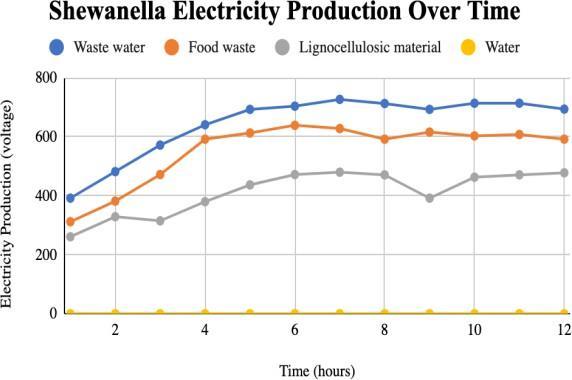
Figure 5. Line graph showing Shewanella electricity productionovertimewithdifferentorganicmatter

Figure 6. LinegraphshowingGeobacterelectricity productionovertimewithdifferentorganicmatter

Figure 7. LinegraphshowingDesulfovibrioelectricity productionovertimewithdifferentorganicmatter

Figure 8: linegraphshowingSteviaelectricity productionovertimewithdifferentorganicmatter
Table 1. Rawdatatableshowingelectricityproduction (voltage)forSteviaandotherorganicmatter
The objective of experiment 1 was to find the most energy-efficientcombinationofmicroorganismsandorganic
International Research Journal of Engineering and Technology (IRJET) e-ISSN:2395-0056
Volume: 11 Issue: 09 | Sep 2024 www.irjet.net
matter. Out of the 16 different combinations, stevia fermentation liquid and waste water exhibited the largest amount of electricity produced. As opposed to the traditional use of Shewanella in MFCs, stevia fermentation liquid poses a strong alternative for MFC electricity production. The data showed a general increasingtrendlineinelectricityevenafter12hoursof initial reaction. The highest voltage measured occurred at 788 volts 11 hours after the initial reaction between steviaandwastewater.

Figure 10. Linegraphshowingwastewaterelectricity productionovertimewithdifferentmicroorganisms
In terms of which organic matter was most effective, the combination of a microorganism + wastewater produced the most electricity consistently throughout the experiment. Apart from stevia, wastewater showed an increasing trend until 5 hours after initial exposure, yet steadily remained at a constant voltage over the next7hoursmeasured.
Theorderinwhichorganicmatterproducedthemost electricity relative to the others was consistent throughout all trials, with wastewater being the most efficient, food waste being the second, lignocellulosic material being third, and water being last. Water could beobservedasananomalyasitproducednoelectricity. (reasontobeexplainedinthediscussions)
2. Experiment 2

p-ISSN:2395-0072
Theaimofexperiment2wastofindthebestconditionin whichtheMFC produced themost electricity byexposing it to various conditions. The best condition in which stevia fermentation liquid and wastewater reaction was found to beat25˚C,approximatelyatroomtemperature.Theaverage volts for this condition was 680 across the 12 hours, with themaximumoccurring6hoursafterinitialexposureat833 volts.
For exposure to UV light, 0 and 10 watts were the most successful. As seen in the graph below, there was a constant turnover each hour for electricity produced. The maximum of the 2 occurred 10 hours for 10 watts, withtheMFCproducing807volts.

Figure 12. Line graph showing Stevia & wastewater electricity production over time with exposure to differentUVlight
A significant result was that the temperature condition of 25˚C was closely followed by high precipitation levels. The data revealed that 30%, 50%, 70%, and 100% precipitation conditions showed average volts of 668, 661, 663, and 676, respectively. The voltage differences were not substantial, as mentionedinthediscussionbelow.

Figure 13. Line graph showing Stevia & wastewater electricity production over time with exposure to differentprecipitationlevels
Figure 11. Line graph showing Stevia & wastewater electricity production over time with exposure to differenttemperatures
International Research Journal of Engineering and Technology (IRJET) e-ISSN:2395-0056
Volume: 11 Issue: 09 | Sep 2024 www.irjet.net p-ISSN:2395-0072
3. Experiment 3

Figure 14. Linegraphshowinglong-termelectricity productionofdifferentcombinationsandconditionsof MFCs
The data from the experiment showed that the combination of stevia and wastewater at 25˚C and no exposure to UV light proved to be the most ideal conditioninMFC electricity production.Thisexperiment aimedtodeterminethelong-termimpactsandelectricity production. As shown in the graph above, stevia and wastewater at 25˚C and no exposure to UV light (group 1) were consistently higher than the other conditions of steviaandwastewaterat25˚Cwith10-wattUVexposure (group 2) or shewanella and wastewater at 25˚C and no exposure to UV light (group 3). This is evidenced by the datashowninthetablebelow,inwhichthecombination of stevia and wastewater at 25˚C and no exposure to UV light had 55 hours of over 80% of the maximum, as opposed to 43 and 40 for stevia and wastewater at 25˚C with 10 watt UV exposure, and Shewanella and wastewater at 25˚C and no exposure to UV light, respectively. This also aligns with the fact that the data showed similar voltage measurements compared to its maximum for all three groups before it underwent a significantfallinelectricity.Group1hadthehighestwith 60 hours, while groups 2 and 3 showed a significant decreaseafter50and43,respectively.
Table 2. Rawdatatableshowingthenumberofhours electricityproducedwasover80%ofthemaximum
Several hours of electricity produced was over 80% of the maximum.
Steviaandwastewaterat 25˚Cwith0UVlight
Stevia and wastewater at25˚Cwith10wattsof UVlight 43
Shewanellaand wastewater at 25 ˚C with0UVlight 40
4. Discussion
The results obtained from Experiment 1 provided emphasis on the significance of the right combination of organic matter and microorganisms. As demonstrated in the experiments, Stevia's electricity efficiency can be attributed to its unique combination of abundant microorganismsandpotentantioxidantproperties.
Stevia is primarily known for its sweetening compounds, such as stevioside and rebaudioside. Microbial communities in any given environment, including within plant materials, can vary widely. Stevia fermentation liquid contains diverse microorganisms, including bacteria, yeast, and fungi. By breaking down organic matter and producing byproducts, these microorganisms may contribute to the fermentation process,includingelectricityinthecontextofMFCs.
The rich polyphenol content in Stevia contributes to enhanced microbial activities in the anode chamber, fostering increased electron production [5]. The polyphenol content can act as electron shuttles or mediators in microbial fuel cell reactions. These compoundsmayfacilitateelectrontransfer, enhancingthe efficiency of the electricity generation process. Antioxidants can also protect microbial cells from oxidativestress,promotinglongevityandactivity[6].
While stevia itself is not agar, which is a gelatinous substance derived from seaweed, it may provide a supportive environment for microbial growth in a manner similar to agar. Agar is commonly used in microbiology as a solidifying agent for culture media. It provides a stable andnutrient-rich matrixfor microorganisms toproliferate and form colonies [7]. Similarly, the liquid or extract from stevia fermentation could offer a conducive environment for the growth of microorganisms, supporting their metabolic activity in microbial fuel cellexperiments.
It could be concluded that room temperature conditions (25, 36˚C) were ideal for electricity productioninMFCs.LowexposurewasidealforUVlight, with 0 and 10 watts presenting as the most efficient electricity producers. In particular, no exposure to UV light revealed the best results. This can partly be explained by the potential influence of UV metagenesis on DNA within the microbial community. UV light is known to induce genetic mutations through processes like UV metagenesis, which can alter the DNA structure of microorganisms [8]. As a result, this may impact the efficiency of microbial fuel cells by affecting the electrogeniccapabilitiesofthemicroorganismsinvolved.
The sensitivity of microorganisms to UV-induced DNA changes may disrupt their metabolic processes and electron transfer mechanisms, leading to a decline in electricity production. The observed efficiency in MFCs under low UV exposure conditions suggests that minimizing UV-induced genetic alterations may be
International Research Journal of Engineering and Technology (IRJET) e-ISSN:2395-0056
Volume: 11 Issue: 09 | Sep 2024 www.irjet.net
conducivetomaintainingoptimalmicrobialfunctionality and,consequently,electricitygenerationinmicrobialfuel cells.
However, unlike the 25˚C condition, every precipitationcondition presented high electricity values, potentiallysignifyinginsignificance.
It is also worth noting that the data showed that electricityinvoltagemaintainedafairlyconstantvoltage after a significant drop for all three groups, with the voltagestayingaround100-200forbothgroups1and2. Such also occurred for group 3, with all its data points between 80-100. This poses another point of further research,astheelectricitydoesnotentirelydepleteafter acertainperiod.
5. Conclusion
The research concentrated on investigating Microbial Fuel Cells (MFCs) as a sustainable alternative to conventional energy sources, with a specific focus on addressing the environmental repercussions associated with the combustion of fossil fuels. Throughout the study, the researchers explored the potential of Stevia fermentationliquidasanorganicmaterialforMFCs.
The method used in this research yielded several strengths: it identified an unexplored combination of Stevia fermentation liquid and wastewater, shedding light on its potential for electricity production within MFCs. Particularly compared to the traditional control group,
Shewanella showed prominent results and could emerge as an alternative soon. The research also delved into the long-term effects of the identified combination, highlighting its consistent and sustained electricity production.Additionally,thecombinationstudyfoundthat the combination of Stevia and wastewater proved to be non-pathogenicasopposedtopathogenicmicroorganisms suchasShewanella,addressingenvironmentalandhuman safety concerns. Furthermore, the research considered various environmental variables, including UV exposure, temperature,andprecipitation,providingseveralpointsof comparison that aided the understanding of their impact onMFCperformance.
However,theresearchdidpossesslimitations:thestudy focusedonalimitedsetofmicroorganisms,involvingonly fourtypes.Thislimitationunderscorestheneedforamore diverse exploration, particularly in the context of ironreducing bacteria. Availability constraints posed challenges, as some bacteria could not be included due to issues related to their accessibility. The study also conducted only a single experiment without engaging in multiple trials, potentially reducing the robustness of the findings, which occurred due to time constraints and the author’sstudentstatus.
p-ISSN:2395-0072
The research suggests avenues for further exploration, such as accurately identifying microorganisms in Stevia fermentation liquid, which may necessitate applying advanced techniques such as metagenomic analysis, microbial isolation, or 16S rRNA gene sequencing. Additionally, a more detailed exploration of Stevia is needed, considering that existing studies have primarily focused on its phytochemical composition rather than the specific microorganisms within its fermentation liquid, which could significantly change future results of electricityproductionofMFCs.
The potential implications are also highly significant. If MFCsprovetobeareliablesubstituteforthecurrentfossil fuel-based resources, they have the potential to establish themselvesasanovelandeco-friendlyenergysource.This result is in harmony with both economic and environmentally conscious practices, as the study employed materials designated for disposal with easy accessibility, such as wastewater or Stevia, to generate electricity, illustrating a tangible application of sustainabilityprinciples.
Reference
1. KumarR,SinghL,ZularisamAW.Microbialfuelcells: Typesandapplications.WasteBiomassManagement – A Holistic Approach. 2017 Mar;367–84. doi:10.1007/978-3-319-49595-8_16
2. Roy S, Marzorati S, Schievano A, Pant D. Microbial FuelCells. Encyclopedia of Sustainable Technologies. 2017 Oct;245–59. doi:10.1016/b9780-12-409548-9.10122-8ucational-resources/stemexplained/microbial-fuel-cells
3. Microbial Fuel Cells. (2019, July 23). Let’s Talk Science.https://letstalkscience.ca/ed
4. Khaloufi YE. Microbial fuel cells for electricity generation. School of Science and Engineering CapstoneDesign-Spring2019.2019Apr;1–61.
5. Ruiz-Ruiz JC, Moguel-Ordoñez YB, Matus-Basto AJ, Segura-Campos MR. Antidiabetic and antioxidant activity of stevia rebaudiana extracts (var. Morita) and their incorporation into a potential functional bread. Journal of Food Science and Technology. 2015;52(12):7894–903. doi:10.1007/s13197-0151883-3
6. Pandya Y,Bakshi M,Sharma A.Agar-agarextraction, structuralpropertiesandapplications:Areview.The Pharma Innovation Journal. 2022 Apr 15;SP11(6):1151–7.
7. Garcia-MierL,Meneses-ReyesAE,Jimenez-GarciaSN, Mercado Luna A, García Trejo JF, Contreras- Medina
International Research Journal of Engineering and Technology (IRJET) e-ISSN:2395-0056
Volume: 11 Issue: 09 | Sep 2024 www.irjet.net p-ISSN:2395-0072
LM,etal.Polyphenolcontentandantioxidantactivity of stevia and peppermint result from organic and conventional fertilization. Journal of Food Quality. 2021;2021:1–6.doi:10.1155/2021/6620446
8. Ikehata H, Ono T. The mechanisms of UV mutagenesis. Journal of Radiation Research. 2011 Mar1;52(2):115–25.doi:10.1269/jrr.10175