
International Research Journal of Engineering and Technology (IRJET) e-ISSN:2395-0056
Volume: 11 Issue: 09 | Sep 2024 www.irjet.net p-ISSN:2395-0072

International Research Journal of Engineering and Technology (IRJET) e-ISSN:2395-0056
Volume: 11 Issue: 09 | Sep 2024 www.irjet.net p-ISSN:2395-0072
1,2Student, Department of Civil Engineering, NMAM Institute of Technology, Nitte, Udupi, Karnataka, India. 3Assistant Professor, Dept. of Civil Engineering, NMAM Institute of Technology, Nitte, Udupi, Karnataka, India
Abstract -Non-Newtonian fluids exhibit variable viscosity dependent on applied stress or shear rate, distinguishing them from Newtonian fluids like water, which maintain a constant viscosity. This variable behavior can be described through complex rheological properties and is often measured using advanced instruments such as rheometers. In practical applications, such as road maintenance, the challenge of effectively repairing potholes is exacerbated by delays in traditional methods and the severe impact on safety and infrastructure. This study investigates the application of non-Newtonian fluids combined with waste rubber tubes as a novel solution for pothole repair. By integrating these materials, we aim to create a costeffective, durable, and environmentally friendly repair method. The use of waste rubber tubes enhances the composite's strength and weather resistance, while the nonNewtonian fluid properties allow for adaptive filling and better handling of road stresses. This innovative approach seeks to address the inefficiencies in current pothole repair methodsandimproveroadsafetyandpassengercomfort.
The study of fluid dynamics encompasses a range of behaviorsexhibitedbydifferentfluids,withthedistinction between Newtonian and non-Newtonian fluids being a fundamental aspect. While Newtonian fluids, such as water, have a constant viscosity that simplifies their behavior analysis, non-Newtonian fluids present a more complex challenge. Their viscosity changes with applied stress or shear rate, which necessitates more advanced methods to describe their behavior accurately. NonNewtonianfluids,characterizedbytheirvariableviscosity and complex flow behavior, are of significant interest in variousindustrialapplications,includingmaterialscience, biomedical engineering, and environmental management. The ability to model and manipulate these fluids can lead to innovations in diverse fields, from enhancing manufacturing processes to improving environmental remediation strategies.The studyofthese fluidsiscrucial forapplicationswheretraditionalviscositymeasurements fall short. In the realm of civil engineering and transportation, potholes represent a significant challenge, particularly in regions prone to heavy rainfall and fluctuating temperatures. Potholes, which result from the combination of water infiltration and vehicular stress, poseseriousriskstoroadsafety.Theexistingmethodsfor
pothole repair often face delays due to bureaucratic processes, exacerbating the risks and inconveniences for drivers.Notably,in India,theconsequences ofinadequate potholemaintenancehavebeensevere,withthousandsof fatalitiesreportedoverrecentyears.Addressingthisissue, our research explores the potential of utilizing nonNewtonian fluids as temporary fillers for potholes. This innovative approach leverages the unique properties of non-Newtonianmaterialstoprovideamoreadaptableand effective solution for road repairs. To enhance the effectiveness and sustainability of this method, we propose the use of waste rubber tubes as a packing material. Rubber tubes, with their high elasticity and durability, offer a cost-effective and environmentally friendly alternative. The combination of synthetic and natural rubber in these tubes provides the necessary strength and weather resistance, making them an ideal candidate for this application. By integrating nonNewtonian fluid mechanics with recycled rubber materials, our research aims to improve both the safety and comfort of road users while addressing the pressing issueofpotholerepairinamoresustainablemanner.
To make an attempt in using non-Newtonian fluid as acompositefillerforpotholes
To improve the safety and comfort level of the passengers
To determine the optimal combination of nonNewtonianfluidforpotholefilling
TofindtheappropriatepackingmaterialforthenonNewtonianfluid
To evaluate the performance of non-Newtonian fluid bycomparingitwiththelaboratorytestresults
To obtain a composite filler material for potholes which is economical when compared to bituminous patchwork
International Research Journal of Engineering and Technology (IRJET)
Volume: 11 Issue: 09 | Sep 2024 www.irjet.net p-ISSN:2395-0072
3.1 Preliminary survey of the site
The survey was conducted near the college premises, approximately 3 km from NMAMIT, Nitte. Given that the area is industrial, it experiences significant vehicular traffic. On average, about 3 two-wheelers and 1 fourwheeler pass through the road each hour. The road in question is approximately 90 meters long and 3 meters wide. Its GPS coordinates are 13.1831202, 74.9383543. Thisroadwasidentifiedasanideallocationforinstallinga speedbreakerandconductingfurthertestsonthesample.
3.2 Materials
3.2.1 Packing Material
Attempt 1
The rice bags were stitched professionally, but the procedure had a problem: fluid started leaking from the bags, which compromised their durability and reduced theirlifespan.
Attempt 2
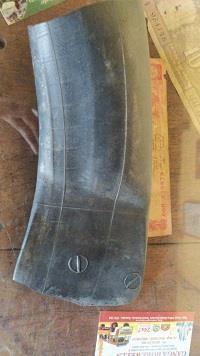
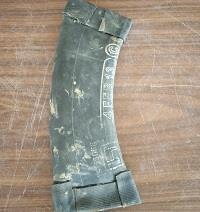
Inthisattemptwedecidedtouserubbertubeasapacking material. First we decided to cut the rubber tube into suitable size and decided to use rubber tube as a packing materialthroughouttheprocess.
3.2.2 Sealing
Attempt 1
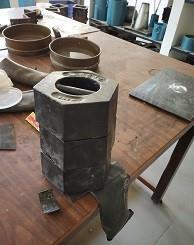
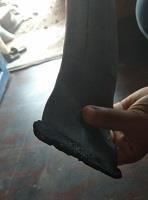
One end of the rubber tube was sealed with synthetic rubber-based adhesive glue, and a load was applied to ensure it was securely closed. We then began filling the fluidinsidetherubbertube,applyingadhesivegluetothe other end and applying a load to seal it. However, the procedure had a problem: fluid began leaking from both endsoftherubbertube.
Attempt 2
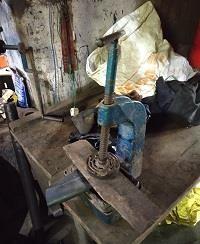
In this attempt, we used the rubber tube as a packing material. The tube was cut to a suitable size, and a black vulcanizing solution was applied to the inner side. Bonding gum was then applied to the tube to create a strong bond. Finally, we employed specialized heatpressingtechniquestosealoneendoftherubbertube.
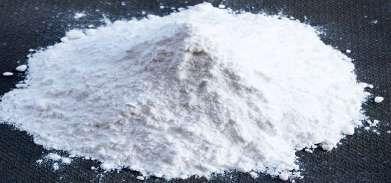
Corn starch: Corn starch or maize starch is the starch deducefromthecorn(maize)grain. Thestarchisderived from the endosperm of the kernel. Chemical Formula C27H48O20
AppearanceAmorphousWhitePowder
MolecularWeight692.661g/mol
Density1.5g/cm³
International Research Journal of Engineering and Technology (IRJET) e-ISSN:2395-0056
Volume: 11 Issue: 09 | Sep 2024 www.irjet.net p-ISSN:2395-0072
3.3 Procedure
Add0.5kgofdrycornstarchtothebowlandabout1 liter of water to the cornstarch. Stir slowly, maintaining a 2:1 ratio of water to cornstarch. Add the water gradually while stirring until all the cornstarchisfullywetted.
Continue to add water until the cornstarch mixture behaves like a liquid when stirred slowly. When you tap the liquid with your finger, it should not splash but should become hard. If the mixture is too liquid, add more cornstarch. The goal is to create a mixture that feels like a stiff liquid when stirred slowly but feels like a solid when tapped with your finger or a spoon.
Scoop the cornstarch mixture into the palm of your hand and slowly work it into a ball. As long as you apply pressure by rubbing it between your hands, it remains solid. When you stop rubbing, it will "melt" intoa puddleinyourpalm.Usethispackingmaterial tofillthepothole.
Pour the freshly prepared fluid into the rubber tube after sealing one end. Fill the tube up to threequartersofitscapacity,thensealtheotherendusing thesameheat-pressingtechniques.
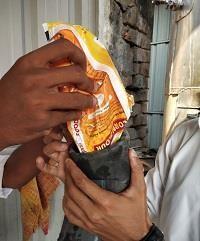
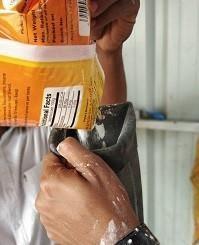
Fig:Fillingthefluidinsidethetube
Once the liquid is poured into the rubber tube, the other end is sealed in the same manner. Specifically, blackvulcanizingsolutionisappliedtotheinnerside of the tube, followed by bonding gum to create the bond. Specialized heat-pressing techniques are then usedtosealtheotherend.
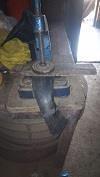
Fig:Heatpressingtechniquetosealotherend
3.4 Selection of the potholes and installation
Proper site is selected for filling the potholes using non-Newtonian fluid which is mostly applicable in ruralbituminouspavement.
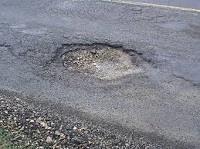
Fig: Selectionofpotholes
Once the potholes are cleaned the packing material are placed in the centre of the potholes. Since differentsizes of packing materials are prepared, the bigger one is placed at the centre and smaller one at thesidealongwiththecoveringmaterial.
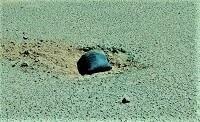
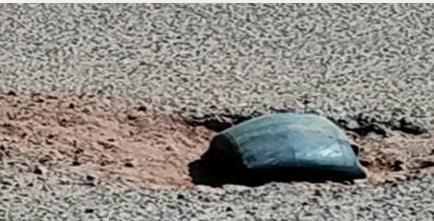
Placingthepackingmaterial
Thesignificanceoftheresultisassessedwithreferenceto thetestscarriedout.
Theliquidpreparedhasbeentestedforchangesoccurring initsphysicalcharacteristicswithtime. Asmallamountof
International Research Journal of Engineering and Technology (IRJET) e-ISSN:2395-0056
Volume: 11 Issue: 09 | Sep 2024 www.irjet.net p-ISSN:2395-0072
liquid has been prepared and placed in an air tight container and stored in a dark place. It is being checked fortimeperiodsof1day,2day,5daysand10days.Itwas foundouttobestablethroughoutthetesttime.Thesolid part started to settle down after 3 days. With a small vibration the liquid was behaving like it was freshly prepared.
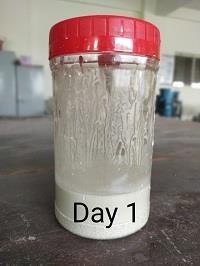
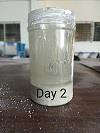
Fig:Non-Newtonianfluidstoredinacontainer
4.2 Water Absorption Test
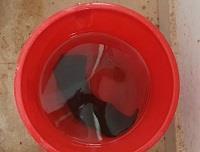
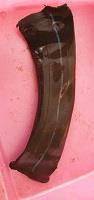
In this test the specimen is dried first and weighed, the recorded weight is taken as (W1). Then it is immersed in water for 24 Hours. Then remove the specimen from the waterand weigh it, the recordedweightis takenas(W2). i.e,(Weightofwaterabsorbedrubber).
4.4
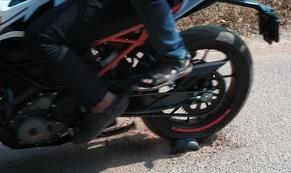
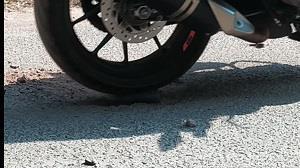
Basedonthetestscarriedoutonvariousspeedsitcan be concluded that the safe approach speed at which the packing and covering materials works efficiently can be setas35Kmph.
5.1 PROS
Eco-Friendly: The preparation of this packing materialdoesnotcausepollution.Thematerialsused are biodegradable, non-toxic, and do not pose any threattotheenvironment.
Reduces Wear and Tear on Shock Absorbers: Potholes cause vehicle shock absorbers to wear out and require frequent repairs. By providing a temporary solution to fill or patch potholes, the material helps reduce this wear and tear, making shockabsorbersmoreeffectiveovertime.
EasyInstallation:Thismaterialisportableandcanbe shifted based on the user’s needs. Installation takes upto30minutesatmost.
Increased Comfort for Passengers: The ride height of thevehicleremainsunchanged,resultinginincreased comfortforpassengersandreducedbackpain.
Reduces Fuel Consumption: Properly patched potholes help prevent vehicles from having to climb over rough terrain, which in turn reduces extra fuel consumption.
1
Result :Waterabsorption(%)= 0.747
4.3 Temperature Test
Temperature test refers to perform extreme temperature testsonproductsorsamples.Temperatureforcingsystems allow users to set a precise thermal environment and temperature cycling, with units that can quickly increase temperature. First, packing material was kept in oven till 100:C,rubbermaterialdidnotshowasignofmelting.
Simple Setup: The setup is completely mobile and maintenance-free, and the installation process does notrequiretechnicalexpertise.
Economical: The cost of the fluid and packing material is lower compared to bituminous patchwork.
ReducesAccidents:Potholesareasignificantcauseof accidents. In India, potholes have been linked to an average of 9 deaths per day, based on data from the RoadTransportMinistrysince2014.
International Research Journal of Engineering and Technology (IRJET) e-ISSN:2395-0056
Volume: 11 Issue: 09 | Sep 2024 www.irjet.net p-ISSN:2395-0072
Reduces Noise Pollution: Potholes cause continuous bumping, which leads to noise pollution and vibrationsinthesurroundingarea.
Vulnerable to Vandalism: The packing material is susceptible to damage from vandalism. For example, it can be easily cut by someone with a knife, and people wearing spiked shoes might not be able to walkoveritwithoutcausingdamage.
Wear and Tear: The packing material is not permanentandissubjecttowearandtearovertime, whichmayreduceitseffectiveness.
Speed Limitation: The material is effective only for vehicles traveling at speeds of 35 km/h or higher. Vehicles traveling below this speed may experience noticeablejerks.
Concept Stage: The material is still in the concept stage and may require further development and testingbeforeitcanbewidelyimplemented.
6. What if no vehicle passes over it for 3 days ?
Intheliquidtestwehaveseenthatthesolidsettlesdown inaperiodof3daysifitisundisturbed.Butwhenasmall vibrationwasprovidedthe liquidstartedtobehavelikeit wasfreshlyprepared.So,itwillnotbeeffectiveonthefirst vehiclepassingoveritafter3daysbutwillworkperfectly fineonthesucceedingvehicles.
Basedonourattemptonmakinganon-Newtonianfluidas a composite filler for potholes the following conclusion canbedrawn:
The composite filler is not suitable for all vehicle types. It has a maximum bearing capacity above whichitfails.Soonlyspecificvehiclescarryinglighter loadscanoperateonthese.
The advantages include comfort of the passengers andreducedloadontheshockabsorbers
If there are any sharp stone in the potholes, the packingmaterialmaytear
Only vehicles which move with speed of 35kmph or abovewillnotexperienceanyjerk
The packing material is eco-friendly and doesn’t causepollution.Itis biodegradable, non toxicand do notposeanythreattofuture
It also economical when compared to bituminous patchwork
To obtain smooth surface to the vehicles and passengers
1. Pooja J. Chavhan, Runal Pawar, Shruti Donode, Rehan Pathan, Himanshu Damahe, “Non-Newtonian Fluid Speed Breaker”, International Journal of Innovations in EngineeringandScience,Vol.4,No.5,pp.4-10,(2019).
2.M. Liua,S. Hana, W. Shangb, X. Qia, S. Donga,Z. Zhanga, “New polyurethane modified coating for maintenance of asphalt pavement potholes in winter-rainy condition”, Progress in Organic Coatings, Vol. 133, pp. 368–375, (2019).
3. Aleksandar Hejna, Jersy Korol, Marta ,Lukasz Zedler, Krzysztof Formela, “Waste tire rubber as a low cost and environmentally-friendly modifier in thermoset polymer”, Wastemanagement,Vol.108,pp.106-118,(2019).
4. M Nuzaimah, S M Sapuan, R Nadlene, M Jawaid, “ Recycling rubber as filler ” , Material science and engineering,Vol368,pp.1088-1757,(2018).
5. Rafiqul A Tarefder, Mohiuddin Ahmad, Mohammad I. Hossain “Pavement maintenance procedures with and withoutmillingmaterials”pp.21-29(2016).
6. Experiment on the viscosity and freezing point of a starch water and mixtureChunyang Ding , Alice Huang (2015).
7.Non-NewtonianFluidsinCircularpipeflow–J.P.Harnett &Y.I.Cho(2014).
8.AmirHeydari,IranAlemzadeh,ManouchehrVossoughi” Functional properties of biodegradable corn starch nanocompositesforfoodpackagingapplications”pp.954961.(2013).
9. Davide Lo Presti, “Recycled tyre rubber modified bitumens for road asphalt”, Construction and Building material,Vol49,pp.863-881,(2013).
10.V. Tserki, P. Matzinos, C. Panayiotou, “Novel biodegradablecompositesbasedontreatedlignocellulosic wasteflourasfillerPartII.Developmentofbiodegradable compositesusingtreatedandcompatibilizedwasteflour”, Composites:PartA37,pp.1231–1238,(2006).
11.http://dro.dur.ac.uk/305/1/305.pdf