
International Research Journal of Engineering and Technology (IRJET) e-ISSN: 2395-0056
Volume: 11 Issue: 09 | Sep 2024 www.irjet.net p-ISSN: 2395-0072

International Research Journal of Engineering and Technology (IRJET) e-ISSN: 2395-0056
Volume: 11 Issue: 09 | Sep 2024 www.irjet.net p-ISSN: 2395-0072
Dhairyashil Meshram1 , Siddhi Shitole2 , Aagam Bothara3, Archana Chaugule4
123 Student, Dept. of Computer Engineering, Pimpri Chinchwad College of Engineering and Research, Ravet, Pune, Maharashtra, India
4Professor, Dept. of Computer Engineering, Pimpri Chinchwad College of Engineering and Research, Ravet, Pune, Maharashtra, India ***
Abstract - The tender allocation process in government projects is often plagued by inefficiencies, corruption, and a lack of transparency, leading to significant delays and mistrust.Thispaperproposesablockchain-basedframework for government tender allocation, leveraging the decentralizedandimmutablenatureofblockchaintechnology toaddresstheseissues.Byimplementingsmartcontractsona consortium blockchain, the system ensures secure, transparent, and automated bidding processes, minimizing human intervention and reducing the potential for manipulation. The proposed system also incorporates cryptographic techniques such as Advanced Encryption Standard (AES) to safeguard sensitive data. Additionally, the use of machine learning algorithms is explored to optimize bidder selection by analyzing historical data, predicting potentialrisks,andensuringthemostsuitablecontractorsare chosen. This framework aims to revolutionize the traditional tenderingprocessbyenhancingefficiency,reducingcosts,and fosteringpublictrustthroughatransparentandsecuredigital platform. The system's adaptability makes it suitable for variousgovernmentalandindustrialapplications,pavingthe way for smarter governance and improved public sector operations. Through this research, we demonstrate the potentialofblockchaintechnologyintransformingthetender allocation process, ensuring fairness, and enhancing overall efficiency in government projects.
Key Words: Blockchain,TenderAllocation,SmartContracts, Bidding,Transparency
Government tendering is a cornerstone of public procurement,enablingtheallocationofcontractsforawide rangeofprojects,frominfrastructuredevelopmenttopublic services.Theprocessisintegraltothefunctioningofmodern economies,ensuringthatpublicfundsareutilizedefficiently to meet the needs of society. However, the traditional tenderingsystem,aswidelypracticedtoday,isfraughtwith challenges that hinder its effectiveness. These challenges, includinginefficiencies,delays,andalackoftransparency, notonlydisrupttheprocurementprocessbutalsofosteran environmentripeforcorruptionandmismanagement.
One of the most significant issues with the conventional tendering system is its lack of transparency. Theprocessoftenoccursbehindcloseddoors,withlimited oversight from external parties. This opacity can lead to favoritism,wherecertaincontractorsareunjustlyfavored overothers,regardlessofthemeritsoftheirbids.Moreover, thislackoftransparencycanalsoresultinbiaseddecisionmaking, where the criteria for awarding contracts are not applied consistently, leading to unfair outcomes. Such practicesnotonlyunderminetheintegrityofthetendering process but also erode public trust in governmental institutions.
Corruption is another pervasive problem in traditional tendering systems. Government officials, entrustedwiththeresponsibilityofoverseeingthetendering process,mayengageincorruptpracticessuchasbriberyor bid manipulation. These actions distort the procurement process, resulting in the allocation of contracts to less qualified contractors, often at inflated costs. The consequencesofsuchcorruptionarefar-reaching,leadingto substandardprojectoutcomes,wastageofpublicfunds,and a general decline in the quality of public services. Additionally,thepresenceofcorruptionmakesitdifficultfor small and medium-sized enterprises (SMEs) to compete fairly, as they may lack the resources to engage in such unethicalpractices.
Thebureaucraticnatureofthetraditionaltendering systemfurtherexacerbatestheseissues.Theprocessisoften slowandcumbersome,involvingmultiplelayersofapproval andextensivepaperwork.Theseadministrativehurdlescan leadtosignificantdelaysintheawardingofcontracts,which in turn delays the initiation and completion of public projects. For SMEs, these delays can be particularly challenging, as they often lack the financial reserves to withstandprolongedperiodswithoutrevenue.Furthermore, thecomplexity of the tendering processcan detersmaller firms from participating altogether, reducing competition andlimitingthepoolofpotentialcontractors.
Inrecentyears,blockchaintechnologyhasemerged as a promising solution to the challenges faced by the traditionaltenderingsystem.Blockchain,adecentralizedand immutableledger,offersenhancedtransparency,security,
International Research Journal of Engineering and Technology (IRJET) e-ISSN: 2395-0056
Volume: 11 Issue: 09 | Sep 2024 www.irjet.net p-ISSN: 2395-0072
and accountability, making it an ideal tool for reforming public procurement processes. By recording every transactiononablockchain,allparticipantsinthetendering process can have real-time visibility into the proceedings, ensuring that the process is conducted fairly and transparently. This transparency significantly reduces the opportunities for corruption, as any attempts to alter the recordeddatawouldbeimmediatelyevidenttoallparties involved.
Smart contracts, a key feature of blockchain technology,furtherenhancetheefficiencyandintegrityof the tendering process. These self-executing contracts can automatevariousstagesofthetenderingprocess,frombid submissiontoevaluationandawarding.Byeliminatingthe need for manual intervention, smart contracts reduce the riskofhumanerrorandensurethattheprocessisconducted according to predefined criteria. This automation also speeds up the tendering process, reducing delays and minimizing administrative overhead. For SMEs, the streamlinedprocessprovidedbysmartcontractslowersthe barrierstoentry,enablingthemtocompetemoreeffectively forgovernmentcontracts.
Moreover, blockchain’s cryptographic security ensuresthatsensitiveinformation,suchasbiddetailsand contractor qualifications, is protected from unauthorized accessandtampering.Thissecurityisparticularlyimportant in a tendering process, where the integrity of the data is crucial to ensuring fair competition. By safeguarding this information, blockchain helps to maintain the trust of all participants in the system, including contractors, governmentofficials,andthepublic.
Thispaperproposesaweb-basedframeworkthat integratesblockchaintechnologytoaddressthelimitations ofthecurrenttenderingsystem.Theproposedframework aims to create a decentralized, transparent, and secure platform for government tender allocation. By leveraging blockchain’s capabilities, the framework seeks to enhance the efficiency, fairness, and integrity of the tendering process, ultimately contributing to better governance and increasedpublictrust.
In conclusion, the integration of blockchain technologyintogovernmenttenderingprocessesrepresents asignificantstepforwardinpublicprocurementreform.By addressingthekeychallengesoftransparency,corruption, and inefficiency, blockchain can transform the tendering systemintoamoreeffectiveandtrustworthymechanismfor allocating public contracts. As governments around the world continue to explore the potential of blockchain, the adoptionofsuchtechnologiesinpublicprocurementislikely tobecomeincreasinglycommon,pavingthewayformore accountableandefficientgovernance.
Research on the application of blockchain technologyingovernmenttenderingprocessesisstillinits nascentstages,withonlyafewstudiesexploringthisspecific domain. The relatively low adoption of blockchain in government-related applications highlights an adaptation gapcomparedtoitsuseinothermajordomains.Despitethis gap, the potential of blockchain in enhancing government tendersisincreasinglyrecognizedasanareaofinterest.
Several studies have identified the opportunities and benefits of integrating blockchain into government processes.Forinstance,JoeAbouetal.haveexploredvarious usecasesacrossdifferentdomains,emphasizingthebroad applicabilityofblockchaintechnology.Theintroductionof smartcontractshasbeenhighlightedasapromisingsolution to reduce corruption and bribery within government workflows. These contracts automate processes, reduce servicecompletiontimes,andimprovetheoverallQualityof Service(QoS)deliveredtocitizens.Furthermore,Sveinetal. have discussed the potential of blockchain to enhance transparencybetweengovernmentsandcitizens,enabling anonymized data transactions that are auditable and monitoredtoensurejusticeandaccountability.
Specific projects have also demonstrated the practicalimplementationofblockchainintenderallocation. The European Union’s Horizon 2020 research program developed the "Smart Tenders" platform, which uses blockchaintoautomatebidevaluationsandincorporatesa reputation system as a contract assessment criterion. Similarly, the "Blockchain-based Public Procurement Platform" by the Republic of Korea aims to increase transparency and reduce fraud in public procurement by recording all activities on a blockchain, accessible to all participants.ThegovernmentofAndhraPradesh,India,has also implemented a "Blockchain-based e-Procurement System"toautomatethetenderallocationprocess,ensuring transparency, security, and the ability to track goods and servicesthroughouttheprocurementlifecycle.
Academic research has supported these practical implementations,underscoringthepotentialofblockchainto bring transparency, immutability, and security to the tendering process. Studies have proposed various blockchain-based frameworks to enhance government operations,fromsecureidentitymanagementsystemstoevoting platforms that mitigate the risks associated with centralized authorities. The decentralized nature of blockchain has been recognized as a crucial factor in reducing the risk of corruption and fraud in government processes.
Despitetheseadvancements,thereremainsalackof comprehensive, decentralized applications specifically tailored for the government tender process that fully consider the interests of both government bodies and
International Research Journal of Engineering and Technology (IRJET) e-ISSN: 2395-0056
Volume: 11 Issue: 09 | Sep 2024 www.irjet.net p-ISSN: 2395-0072
contractors.Theproposedframeworkinthispaperaimsto addressthisgapbycreatinganend-to-end,edgecomputingbased system that ensures all entities within the network operatetransparentlyandwithoutbias.Thisapproachnot onlystreamlinesthetenderingprocessbutalsoenhancesthe overallexperienceforconstructorsandgovernmentofficials, promoting a more efficient and just system for public procurement.
The integration of blockchain technology into government tender allocation systems offers a transformativeapproachtoaddressinglongstandingissuesof transparency,efficiency,andsecurity.Thisliteraturereview synthesizes findings from recent studies on blockchain applicationsinprocurement,highlightingboththepotential benefitsandexistingchallenges.
Traditional tendering processes are frequently criticizedfortheirlackoftransparencyandsusceptibilityto corruption. Ghosh et al. (2022) underscores the impact of manual and centralized record-keeping systems on tender allocation.Theirresearchdemonstrateshowthesetraditional methods contribute to inefficiencies and potential biases, which can undermine public trust. Similarly, the work by Jiang et al. (2022) reveals that bureaucratic red tape and complex regulatory requirements in government procurementprocessescanhindercompetitionandinflate costs,furtherexacerbatingissuesintendering.
Blockchain technology, with its decentralized and immutable ledger, offers a promising solution to these challenges. As noted by Wang et al. (2022), blockchain's abilitytoprovideatransparentandtamper-proofrecordof transactions can significantly improve the integrity of the tenderingprocess.Theirstudyexploreshowblockchaincan mitigateissuesrelatedtofraudandcorruptionbyensuring thatalltransactionsarerecordedinasecureandverifiable manner. This is supported by the research of Nakamoto (2008), who introduced the foundational concepts of blockchain and emphasized its potential to enhance data securityandtransparency.
Smartcontracts,anessentialfeatureofblockchain technology, further enhance the efficiency of tendering processes.AccordingtoChristidisandDevetsikiotis(2016), smartcontractsautomatetheexecutionofagreementsbased onpredefinedconditions,whichcanstreamlineprocurement processesandreduceadministrativeoverhead.Theirfindings alignwiththeworkofWangetal.(2022),whichhighlights how automated processes can lower costs and accelerate tendering.
Inadditiontobenefits,theliteraturealsoaddresses challenges associated with implementing blockchain in government tendering. Narayanan et al. (2016) highlight
scalability issues as a significant concern for blockchain systems, which may impacttheir effectiveness in handling largevolumesoftransactions.Theirresearchsuggeststhat while blockchain holds promise, practical implementation requires addressing these scalability concerns to ensure efficientoperation.
Furthermore, regulatory and legal considerations playacrucialroleintheadoptionofblockchaintechnology. Catalini and Gans (2016) discuss the need for regulatory frameworks that accommodate blockchain-based systems while ensuring compliance with existing laws. This perspective is essential for integrating blockchain into government procurement processes, as it underscores the importance of aligning technological innovation with legal andregulatoryrequirements.
Inconclusion,theliteratureindicatesthatblockchain technology offers substantial potential for revolutionizing government tender allocation processes. By addressing transparency,efficiency,andsecurityconcernsinherentin traditionalsystems,blockchaincanenhancetheintegrityand effectivenessofpublicprocurement.However,tofullyrealize thesebenefits,ongoingresearchmustaddressscalabilityand regulatory challenges, ensuring that blockchain-based solutionsarepracticalandcompliantwithexistingstandards.
Thetraditionalgovernmenttenderingsystemoften suffers from a lack of transparency. Tender processes are frequentlymarredbyopaquedecision-makingandlimited accesstoinformation,leadingtoallegationsofcorruptionand favoritism. The absence of a clear, accessible record of decisionsandbidevaluationsunderminespublictrustand candistortcompetition.Thisopacitypreventsstakeholders from verifying the fairness of the process and the criteria usedforawardingtenders,whichcandiscouragequalified bidders and diminish confidence in the integrity of the procurementsystem.
Government tendering processes are notoriously bureaucratic, involving numerous regulations, documentation requirements, and procedural steps. This complexitycanbeoverwhelming,particularlyforsmalland medium-sizedenterprises(SMEs)thatlacktheresourcesto navigate the intricate requirements. The excessive paperworkandadministrativehurdlescontributetodelays andinefficiencies,makingthetenderprocesstime-consuming and costly. This bureaucratic red tape not only restricts participation but also limits the ability of businesses to competeeffectively,reducingoverallmarketdynamismand potentially leading to higher procurement costs for the government.
International Research Journal of Engineering and Technology (IRJET) e-ISSN: 2395-0056
Volume: 11 Issue: 09 | Sep 2024 www.irjet.net p-ISSN: 2395-0072
The traditional tendering system can restrict competitionbylimitingthenumberofparticipantswhoare invited or whocan afford tocompete. High entry barriers, suchasextensivedocumentationrequirementsandthecosts associatedwithpreparingbids,canexcludesmallerorless well-resourced companies. This limited competition can result in inflated prices and reduced quality of goods and services. When fewer bidders are involved, there is less incentiveforcompetitivepricingandinnovation,whichcan ultimately lead to less favorable outcomes for the governmentandtaxpayers.
Tenderspecificationsintraditionalsystemsareoften rigid, leaving little room for innovative solutions or alternativeapproaches.Thisinflexibilitycanstiflecreativity andlimitthepotentialbenefitsthatmightarisefrommore adaptable or customized proposals. The inability to accommodate varied approaches can result in suboptimal solutionsthatdonotfullyaddresstheneedsoftheproject. Thelackofflexibilityinadaptingtenderrequirementstonew technologies or evolving project needs may also lead to missed opportunities for improving project outcomes or reducingcosts.
Participating in government tenders can be prohibitivelyexpensiveformanycompanies,especiallySMEs. The costs associated with preparing comprehensive bids, complyingwithdetailedrequirements,andmeetingstringent deadlines can be significant. These expenses can act as a deterrentforsmallerfirms,limitingtheirabilitytocompete andreducingthediversityofbidders.Highparticipationcosts notonlyaffectthecompetitivenessofthetenderprocessbut also place a financial burden on companies, which maybe passedontothegovernmentintheformofhigherpricesfor goodsandservices
We are implementing a secure, blockchain-based website to manage government tenders. Our approach leverages advanced cryptographic methods to ensure the integrity and confidentiality of the tendering process. Specifically, we utilize the Advanced Encryption Standard (AES)toencryptdata,protectingtheinformationstoredin ourdatabasefromunauthorizedaccess.
Inoursystem,governmenttenderswillbepublicly disclosedinaccordancewithstrictnormsandregulationsto maintaintransparency.Byintegratingblockchaintechnology, wecreateasecureandefficientplatformformanagingtender submissionsandevaluations.Allactivitiesrelatedtotenders
are recorded on the blockchain, ensuring that every transactionistransparentandimmutable.
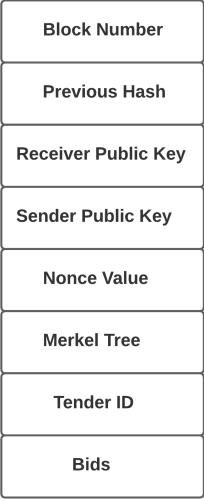
Ourblockchainnetwork isstructuredwitha main chainconsistingofinterconnectedblocks.Theseblocksare linkedusingcryptographichashes,whichcreateasecureand tamper-proof ledger. We use a Merkle tree to streamline transactionverification,allowingustoquicklyandaccurately confirmthedetailsofeachtransaction.Thisstructurehelps us track and document every step, from the initiation of a transaction(input)toitsfinaloutcome(output).
Toensurethattenderproposalsareconsidered,we requiretimelysubmissions.Ourblockchainframeworknot only secures all submissions but also manages the timesensitiveaspectsofthetenderingprocessefficiently.Oncea tenderisaccepted,wemakethedetailsavailableforpublic review. Any updates or changes to the tender plans are continuously recorded on the blockchain,ensuring thatall modificationsaretrackedandvisibletoauthorizedusers.
Through this system, we aim to enhance the efficiency,security,andtransparencyofgovernmenttender allocation, leveraging blockchain technology and cryptographicmeasurestoachievethesegoals.
Our proposed system incorporates a blockchainbased approach to streamline government tender managementthroughastructuredblockdiagram:
International Research Journal of Engineering and Technology (IRJET) e-ISSN: 2395-0056
Volume: 11 Issue: 09 | Sep 2024 www.irjet.net p-ISSN: 2395-0072
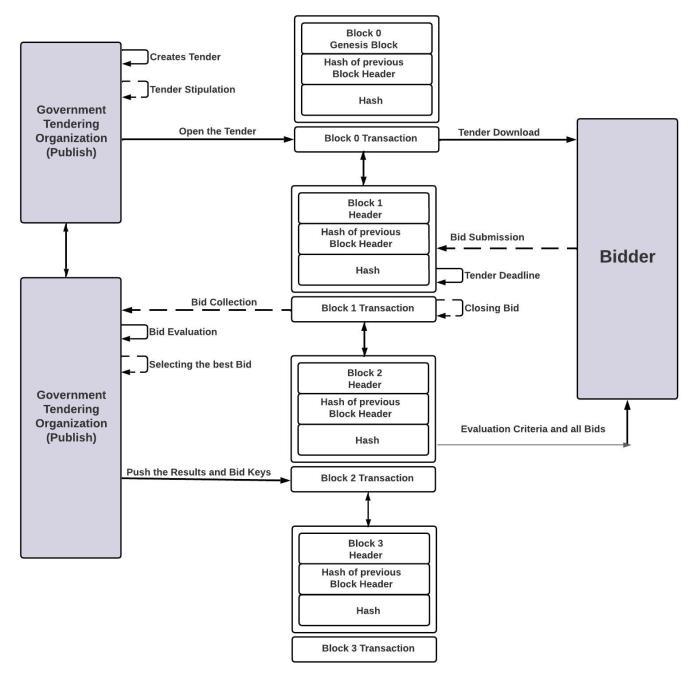
Theprocessbeginswiththegovernmentuploading thetenderdocument,whichincludesessentialdetailssuchas deadlinesandspecificrequirements.Thisdocumentisstored securelyinthesystemasa"miningblock,"andthisactionis performedfromtheadministrativesideoftheplatform.The blockchaintechnologyensuresthattheinitialblock,known asthe"genesisblock,"establishesthefoundationalrecordfor allsubsequenttransactions.
ii) Contractor View and Apply for GR
Oncethetenderdocumentisuploaded,contractors, bidders,oruserswiththeappropriatevalidationcanaccess anddownloadthedocuments.Afterreviewingthetermsand conditions,bidderscansubmittheirproposals.Thesystem employsblockchainblocksthatarelinkedtopreviousblocks tosecurelystoreandtrackthesesubmissions.Additionally, our platform includes a cost optimization feature to help biddersdeterminethemostcompetitiveproposalvalue.
Afterreceivingbids,thesystemutilizesacostoptimization algorithm to automatically select the most suitable bidder basedonpredefinedcriteria.Thisautomatedprocessensures efficiencyandfairness.Thegovernmentalsohastheoptionto manually review and select from the submitted tenders if desired,addingalayerofoversightandflexibility.
Oncethereviewprocessiscomplete,theresultsare made available on the website for public viewing. This transparencyallowsinterestedthirdpartiestosubmittheir bids and review the outcomes of the tender process. Authorized individuals can also monitor and evaluate the bids that have been filed. This comprehensive approach ensures that the tender allocation process is transparent, efficient,andaccessibletoallstakeholdersinvolved.
Inmanytransactions,variousdocumentsmustbe securely processed and stored, necessitating a robust document storage system. A three-layer file encryption model is employed to provide secure and decentralized storage for these documents, ensuring they are accessible and protected across the network. This model eliminates singlepointsoffailureandfacilitatesquickaccesstoupdated documentversionsthroughoutthenetwork.
Forexample,considerascenariowhereatenderproposal must move from Department A to Department B for finalization.Theprocessinvolvesseveralkeysteps:
1. Digital Signature: An authorized individual from Department A digitally signs the proposal using theirprivatekeygeneratedbytheEllipticalCurve DigitalSignatureAlgorithm(ECDSA).Thissignature guaranteestheidentityofthesignerandmaintains theintegrityofthedocument.
2. Symmetric Encryption: The signed document is then encrypted using the Advanced Encryption Standard(AES-256)witharandomlygenerated32byte passphrase, ensuring its protection while awaitingnetworkapproval.
3. Asymmetric Encryption: The passphrase is encryptedusingtherecipient'spublickeythrough RSA-512,ensuringthatonlythedesignatedperson in Department B can decrypt and access the document.
4. Decentralized Storage and Verification: The encrypteddocumentisaddedtothedecentralized storagenetworkandsynchronizedacrossallnodes. It remains there until it is verified by the smart contractandapprovedbytheothernodesthrougha consensusmechanism.
5. Final Storage and Use:Aftersuccessfulverification andapproval,thedocumentisupdatedandstored forfuturereferenceoruse.
International Research Journal of Engineering and Technology (IRJET) e-ISSN: 2395-0056
Volume: 11 Issue: 09 | Sep 2024 www.irjet.net p-ISSN: 2395-0072
This multi-layered cryptographic encryption process ensures that the document remains secure, tamper-proof, and accessible only to authorized recipients. The transparency of the workflow, visible to all channel members,discouragesmaliciousbehaviourandensuresthat allactionswithinthenetworkareaccountable.Despitethe openvisibilityoftransactions,theblockchain'simmutable nature prevents any unauthorized tampering with the transactionstatus.
In the proposed network model, multiple constructors,governmententities,andtendersinteractina decentralized environment. Government entities propose tenders by specifying their expected timelines, costs, and maintenancerequirements.Constructorsthenbidonthese tenders by providing their own timelines, costs, and maintenance capabilities. To ensure the accuracy and validityofthisinformation,aconsensusmechanismisused toreachagreementamongtheparticipatingnodes.
Once a transaction is proposed, it must be verified before being added to the blockchain. Unlike traditional systems where a central authority would verify participants, the peer-to-peer nature of blockchain relies on consensus algorithms to perform this verification. In this model, the proof-of-workconsensusalgorithmisemployedduetothe relatively limited number of transactions. This algorithm ensuresthatonceatransactionisaddedtotheblockchain,it cannot be altered, maintaining the integrity of the information.
This algorithm focuses on ensuring that the proposedtendervaluesfromgovernmentlendersfallwithin anacceptablerangedeterminedbyasetofconstructors.The algorithm adjusts the time period, cost, and maintenance period proposed by the lender until they align with the medianvaluesprovidedbytheconstructors.Thisprocessis repeatedforeachtendertoensurethatthelender’svalues areclosetothemedianvalues,ensuringtheyarewithin a reasonable range. By optimizing these values, the governmentensuresthattendersarecompetitiveandfair.
Thisalgorithminvolvestheconstructorsbiddingfor a government tender. Each constructor updates their proposed values for time, cost, and maintenance period iterativelyuntiltheymeetcertainthresholdcriteria.During eachiteration,thecumulativecostofalltheconstructorsis calculated.Theconstructorwiththelowestcumulativecost is considered the winner for that iteration, and their win
count is incremented. This process continues until all constructorsmeetthethresholdcriteria.Attheendofthe biddingprocess,theconstructorwiththehighestwincount isconsideredtohaveprovidedthemostcompetitivebid,and theywinthetender.
AllocationofTendertoConstructor
This algorithm allocates the tender to the constructor with the highest win count after the bidding process.Ifonlyoneconstructorhasthemaximumwincount, the tender is awarded directly to them. If multiple constructors share the highest win count, the algorithm comparestheircumulativecosts.Theconstructorwiththe lowestcumulativecostamongthetiedbiddersisawarded thetender.Thisensuresthatthetenderisallocatedtothe constructor who not only won the most rounds but also providedthemostcost-effectivebid.
In conclusion, our blockchain-based framework for governmenttenderallocationaddresseskeyinefficienciesin current systems by enhancing transparency, security, and efficiency. By leveraging cryptographic methods and blockchain technology, we ensure secure storage and transparentmanagementoftenderdocumentsandbids.The use of cost optimization algorithms and a structured blockchain system facilitates fair and efficient tender allocation while maintaining public trust. This innovative approachnotonlystreamlinesthetenderprocessbutalso mitigates issues related to corruption and inefficiency, setting a new standard for government procurement practices.
[1] DeniesKiyeng,SimonMainaKarume,NelsonMasese,A Design of Blockchain Based Smart Contract for Tendering, International Journal of Computer Applications Technology and Research Volume 10–Issue10,2021.
[2] RavinaMore,PratikshaKadam,TejalPhadtare,Ketaki Bhagat, Secure Framework for Government Tender Allocation using Blockchain, International Journal of Advanced Research in Science, Communication and Technology(IJARSCT),Volume2,Issue1,March2022
[3] Logith S, Nitish PS, Raghul S, Tamilarasan T, SECURE FRAMEWORK FOR GOVERNMENT TENDER ALLOCATION USING BLOCKCHAIN, International Research Journal of Modernization in Engineering Technology and Science, Volume:04/Issue:06/June2022
International Research Journal of Engineering and Technology (IRJET) e-ISSN: 2395-0056
Volume: 11 Issue: 09 | Sep 2024 www.irjet.net p-ISSN: 2395-0072
[4] Vikas Hassija, Vinay Chamola, Senior Member, IEEE, Dara Nanda Gopala Krishna, Neeraj Kumar, Senior Member, IEEE and Mohsen Guizani Fellow, IEEE, A Blockchain and Edge Computing-based Secure Framework for Government Tender Allocation, IEEE InternetofThingsJournal,October2020.
2024, IRJET | Impact Factor value: 8.315 |