

Design for Manufacturing and Assembly of a BAJA Steering Knuckle
Claudimir Jose Rebeyka1, Guilherme Matheus Sviech Pontarolo2 , Marcelo Arceno2 , Ravilson
Antonio Chemin Filho1 , Sérgio Fernando Lajarin1
1Professor, Department of Mechanical Engineering, Federal University of Parana. Brasil
2Student, Department of Mechanical Engineering, Federal University of Parana. Brasil
Abstract: This study aims to demonstrate the application of Design for Manufacturing and Assembly (DFMA) principles to the steering knuckle of the all-terrain Baja vehicle developed by the UFPR Baja SAE team. The steering knuckle typically presents challenges in manufacturing and assembly, often resulting in parts with incorrect dimensions and higher rate of scrap. To address these issues, DFMA concepts from the literature that are most applicable to the design of this component were selected and implemented in the redesign of the steering knuckle. As a result, a 33% reduction in the number of parts and a 6.49% reduction in part costs were achieved, leading to significant improvements in the assembly process, as well as in the subsequent mechanical adjustments and maintenance of the knuckle.
Keywords: DFMA,steeringknuckle,BAJA
1. INTRODUCTION
The Baja SAE BRASIL program presents a challenge to engineering students, providing them the opportunity to apply classroom knowledge obtained in a practical envorinment, thereby enhancing their preparation for the jobmarket.(SAEBRASIL,2022)
Inthiscontext,thedesign ofcomponentsusedinthe Baja vehicleprototypemustconsidercriteriasuchasefficiency forcompetitiveness,cost-effectiveness,manufacturingand assembly feasability, among other desired characteristics typical of competition and series production vehicles. To achieve this, methodologies such as Design for Manufacturing and Assembly (DFMA) are particulary relevant,astheyareused to optimizedesigns focusingon manufacturingandassemblyprocesses.Thismethodology is grounded in concepts and criteria at streamlining, simplifying, and reducing costs in product development. (BERTIN,2019)
1.1 Steering knuckle
The steering knuckle was selected for the application of DFMA in the Baja project due to its relative complexity in manufacturingandassembly.Thesteeringknuckleisakey component that connects the suspension to the vehicle's wheel. Figure 1 ilustrates the assembly of the Double A-
arm suspension system used by the UFPR Baja SAE team, highlighting the steering knuckle along with some other componentsofthesuspension.
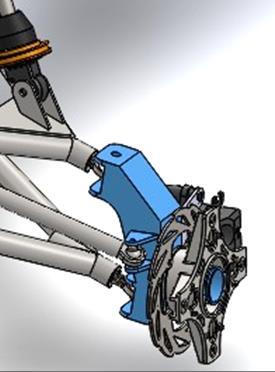

Figure 1:Steeringknucklea)project;b)asbuilt
Figure 1 presents: a) the current design of the steering knuckle for the UFPR Baja SAE prototype, and b) the manufactured version. The project encountered manufacturing and assembly difficulties, as reported by themanufacturingteam.Severalpartshadtobediscarded due to manufacturing non-conformities, wich rendered themincompatibleforassembly.
2. DESIGN FOR MANUFACTURING AND ASSEMBLY
DFMA is a methodology applied in product design to optimize manufacturing and assembly processes. (BOOTHROYD,DEWHURST, KNIGHT,2011).Itis primarly divided into three main applications: supplier costing, productcosting,andproductsimplification(Figure2).
The focus of product simplification shifts from individual componentestotheproductasawhole.Bysimplifyingthe overalldesign,thenumberofpartsisreduced,leadingtoa decreaseinoverallcosts.(DEWHURST,2019)
International Research Journal of Engineering and Technology (IRJET) e-ISSN: 2395-0056
Volume: 11 Issue: 09 | Sep 2024 www.irjet.net p-ISSN: 2395-0072

2:DesignForManufacturingandAssembly
ThemainprinciplesofDFMAare:
Minimization of Parts: Reducing the number of unique parts in a product simplifies manufacturing and assembly processes. It lowers inventory costs, reduces the likelihood of assembly errors, and decreases the overall complexityoftheproduct.
Design for Manufacturing (DFM): This principle focuses on designing products considering the capabilities and limitations of the manufacturing processes involved. Engineers can avoid features that are difficult or costly to produce when considering manufacturing constraints earlyinthedesignprocess.
Standardization: Standardizing components and processessimplifies manufacturing and reduces costs. Using standardized parts not only streamlines procurement but also facilitates interchangeability and compatibility between different products or product variants.
Simplicity: Simplifying the design of a product reduces manufacturing complexity and production costs. It involves minimizing the number of parts, reducing the number of manufacturing operations, and utilizing standardcomponentswherepossible.
Design for Assembly (DFA): DFA aims to minimize the complexity of assembling the product. This involves designing parts with features that facilitate easy and efficient assembly such as standardized interfaces, selfaligningcomponents,andmodularconstruction.
Material Selection: Choosing materials wisely can significantly impact manufacturing and assembly processes. Designers should consider factors such as material availability, cost, ease of machining or forming, durability,andenvironmentalimpact.
Design for Disassembly (DFD): DFD focuses on designing products considering their end-of-life. By making products easier to disassemble, components can be more readily recycled or reused, which contributes to sustainabilitygoalsandreduceswaste.
3. DESIGN OF A STEERING KNUCKLE ACCORDING TO DFMA
This study focused on redesigning parts without altering the assembly itself, analyzing one component at a time. The analysis considered the potencial effects of changing the material, the manufacturing process, or both, providing an opportunity to reduce production costs for thesamepart.
DFMA establishes design requirements that facilitate manufacturingandassembly.Amongitsrecommendations isminimizingthenumberofcomponentsineachassembly. AsshowninFigure3,theapplicationofDFMA allowedfor areductioninthenumberofsteeringknucklepartsfroma) currentdesign-9piecestob)proposeddesign-6pieces.


Changeswereproposedwithconsiderationofthewelding capabilities and the limitations outlined by DFM requirements to facilitate manufacturing. Figure 4 illustrates a) the integration of the sides and plate into a single piece, and b) the steering wheel holder. These modifications are designed to streamline the welding process.
Figure
a) b)
Figure 3:Steeringknucklea)current;b)proposed
International Research Journal of Engineering and Technology (IRJET) e-ISSN: 2395-0056
Volume: 11 Issue: 09 | Sep 2024 www.irjet.net p-ISSN: 2395-0072
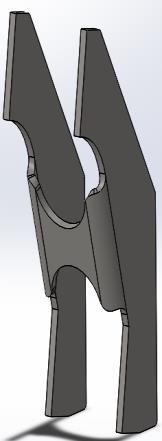
a) b)
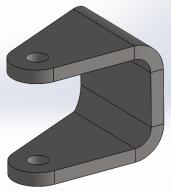
Figure 4:a)Reinforcementplateb)Steeringwheelholder
The positioning features project illustrated in Figure 5 facilitatesthecorrectlylocatingpartsforwelding.
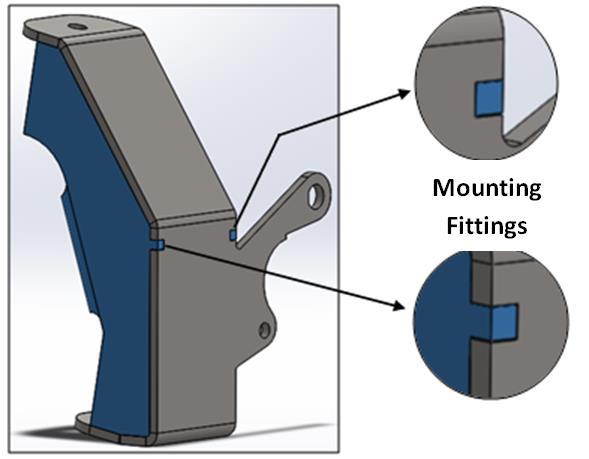
Figure 5:Positioningfeatures
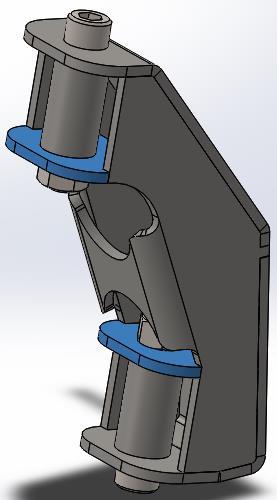
Figure6showsa)armholdersandb)aweldingjigusedto keep the right position for welding. This way, there is no needforsubsequentkuckleadjustmentswhenassembling thejoint
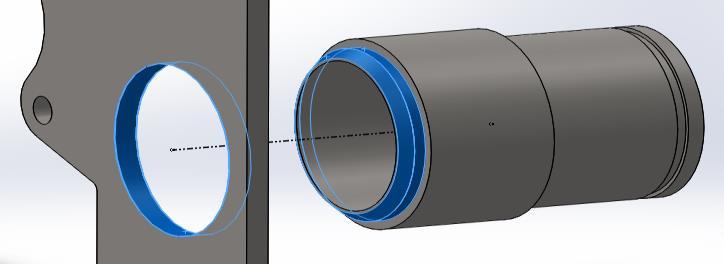
Figure 7:Self-aligningcomponents.
The standardizing of components was achieved for 4 components.Inthisway, Figure8,interchangeabilityand compatibilityofrightandleftsideknucklesarepossible.
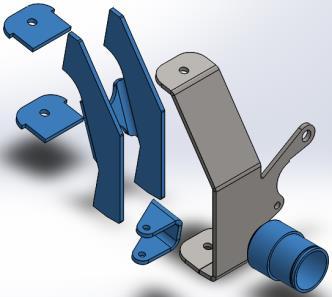
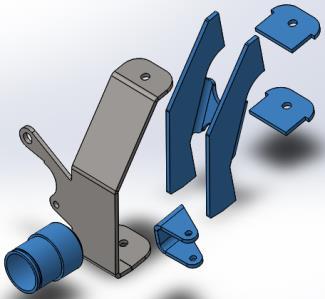
Figure 8:a)rightsideknuckleb)leftside
DFA aims to minimize the complexity of assembling the product. This involves designing parts with features that facilitateeasyandefficientassembly suchasstandardized interfaces, self-aligning components, and modular construction.
Figure 9 and Figure 10 show an assembly study carried outinavirtualenvironment.Onlytwotoolsareneededto mountallsteeringknucklestothecarsuspension.
a) b)
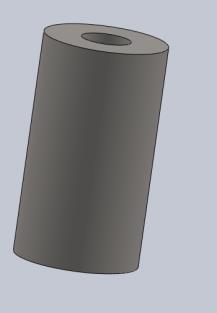
Figure 6:a)Armholds b)weldingjig
A hole was designed in the main body (Figure 7), and a chamfer in the shaft to allow welding positioning. This ensures the correct location of the shaft in the main body duringtheweldingoperation.
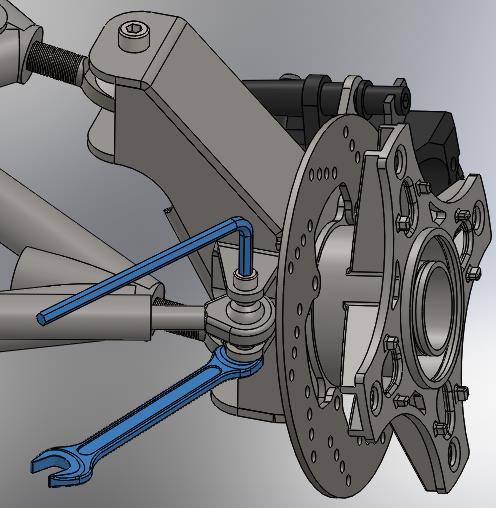
Figure 9:Steeringarmassembly
Volume: 11 Issue: 09 | Sep 2024 www.irjet.net

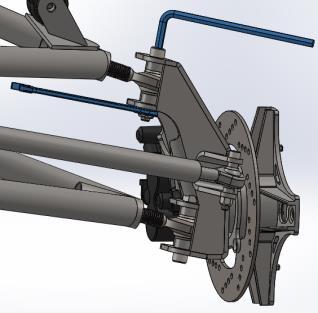
Figure 10:Assemblya)lowerarmb)upperarm
Subsequently, an analysis of the production costs for the current steering knuckle model was conducted. The resultscanaspresentedinTable1.
The application of DFMA concepts in the redesign of the current steering knuckle resulted in a 6.49% reduction in productioncosts.
4. CONCLUSIONS
The principles of DFMA were applied to redesign the currentsteeringknuckleoftheUFPRBajaSAEvehicle.The keyoutcomes included a 33%reduction in the number of parts and a 6.49% decrease in parts costs, along with significant improvements in the assembly process and subsequent mechanical adjustments and maintenance of the joint. These results demonstrate that DFMA is well suitedforapplicationinBajaprojects
ACKNOWLEDGEMENT (Optional)
The authors would like to thank to the Programa de Extensão Núcleo de Engenharia Automotiva from DEMEC Department of Mechanical Engineering and COEX –Coordenadoria de Extensão at UFPR – Federal University of Parana, for their support in universitary extension activities
REFERENCES
[1] SAE BRASIL. Available on: https://saebrasil.org.br/programas-estudantis/baja-saebrasil/.Acess:26aug.2024.
[2] BERTIN,R.Implementaçãodométodoeconceitos DFMA em projetos para construção de equipamentos. 2019.
Table 1: Costanalysis–currentmodel
Similarly,ananalysisofthe productioncosts oftheDFMA steering knuckle model was conducted. The results are presentedinTable2.
Table -2: Costanalysis–DFMAmodel
[3] BOOTHROYD,G.;DEWHURST,P.;KNIGHT,WINST. A.Product design for manufacture and assembly. Third Edition.BocaRaton:CRCpress,2011.
[4] DEWHURST, N. I. P. DFMA: An overview and a design story. In: International Forum on Design for ManufactureandAssembly,2019.
BIOGRAPHIES


Prof. Claudimir José Rebeyka, UFPRBaja SAE teamcoordinator, Programa de Extensão - Núcleo deEngenhariaAtumotivaUFPR

Guilherme Matheus Sviec Pontarolo, UFPR Baja SAE team member
Programa de Extensão - Núcleo deEngenhariaAtumotivaUFPR
International Research Journal of Engineering and Technology (IRJET) e-ISSN: 2395-0056
Volume: 11 Issue: 09 | Sep 2024 www.irjet.net p-ISSN: 2395-0072

Marcelo Arceno, UFPR Baja SAE teammember
Programa de Extensão - Núcleo deEngenhariaAtumotivaUFPR

Prof. Ravilson Antonio Chemin Filho, UFPR Fórmula SAE team coordinator
Programa de Extensão - Núcleo deEngenhariaAtumotivaUFPR

Prof. Sérgio Fenrnando Lajarin, Engenhar-MECteamcoordinator
Programa de Extensão - Núcleo deEngenhariaAtumotivaUFPR