
International Research Journal of Engineering and Technology (IRJET) e-ISSN:2395-0056
Volume: 11 Issue: 09 | Sep 2024 www.irjet.net
p-ISSN:2395-0072

International Research Journal of Engineering and Technology (IRJET) e-ISSN:2395-0056
Volume: 11 Issue: 09 | Sep 2024 www.irjet.net
p-ISSN:2395-0072
Anmol K A, K D Sruthi
Anmol K A , Msc. Computer science, St.Thomas(Autonomous)College, Thrissur 680001,Kerala , India
K D Sruthi , Msc. Computer science, St.Thomas(Autonomous)College, Thrissur 680001,Kerala, India
Abstract - In today’s world, credit scores are essential to determine credit worthiness for lending institutions, and theyimpacteverythingfromgettingamortgagetorenting anapartment.Thisthesisaddresseskeychallengesincredit scorecard development, focusing on three main contributions. Firstly, it evaluates the performance of supervised classification techniques on imbalanced credit scoring datasets. Secondly, it explores the low-default portfolioproblem,asevereformofclassimbalanceincredit scoring. Thirdly, it quantifies differences in classifier performanceacrossvariousimplementationsofareal-world behavioral scoring dataset. Additionally, the thesis demonstrates the use of artificial data to overcome challenges associated with real-world data, while acknowledging the limitations of artificial data in evaluatingclassificationperformance.
Keywords: Credit scoring, Machine learning, Deep learning,FE-Transformer,Featureselection.
Credit scoring models play a crucial role in the business landscape, providing a numerical assessment of an individual's creditworthiness based on diverse financial factors.Lendersandcreditcardcompaniesheavilyrelyon thesescorestomakeinformeddecisionsonloanapprovals or credit extensions. Typically ranging from 300 to 850, higherscoressignifybettercreditworthiness.Scoresabove 700aregenerallyconsideredgood,whilethosebelow600 are seen as poor. Despite meticulous verification processes, there's no absolute assurance that credit cards aregrantedonlytodeservingcandidates,emphasizingthe ongoing importance of refining credit assessmentstrategies. Credit scoring serves as a conventional decision model, primarily focusing on risk assessmentrelatedtocreditproductslikecreditcardsand loans.Financial institutions are increasingly embracing diverseriskassessmenttools,includingstatisticalanalysis, to minimize potential risks. The utilization of deep learning algorithms, specifically transformers, based on
online behavioral data has demonstrated superior performance compared to LSTM and traditional machine learning models. Our innovative end-to-end deep learning credit scoring framework incorporates both credit feature dataanduserbehavioraldata.Theframeworkcomprisesa wide part and a deep part, enabling automatic learning from user data to enhance decision-making in creditgranting.
Creditscoringwhichisaconventionaldecisionmodeland it is mainly focusing on risk approximation approach associated with credit products such as credit card, loans, etc. and is estimated based on applicant’s historical data whichhelpscreditlenders ingrantingcreditproducts.The following diagram illustrates the flow of data through the credit scoring process, from data collection to the final creditscoreoutput.
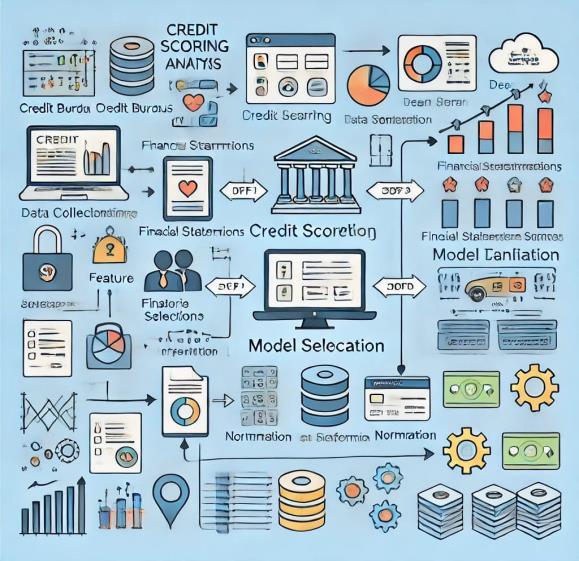
Fig-1:DataFlowDiagram
International Research Journal of Engineering and Technology (IRJET) e-ISSN:2395-0056
Volume: 11 Issue: 09 | Sep 2024 www.irjet.net p-ISSN:2395-0072
Probability of Default (PD) analysis is carried out for generating credit scores for individual customers to identify default when he visited a bank for a loan and check theircreditscore.Thecreditscoreisused bybanks forcreditbureaus.
IRR is a crucial method for assessing investment profitability. While there are alternative strategies to gauge expected returns, the internal rate of return (IRR) stands out as the widely employed calculation. This rate playsapivotalroleindeterminingtheinterestassignedto loans for borrowers. It's noteworthy that IRR was historicallyassociatedwithnegativetrainingexamples.[3]
Creditriskscoringinvolvesvariouscomponentstoassess a borrower’s creditworthiness: Credit history is used to examining the borrower’s past credit behavior, including payment history, defaults and delinquencies. Credit utilization is the ratio of current credit usage to the total available credit, indicating the borrower’s reliance on credit. Debt-to-Income Ratio(DTI) is assessing the borrower’s ability to manage additional debt based on their income compared to existing debt obligations [5] Length of credit history is the duration of the borrower’s credit accounts, as a longer credit history provides more data for evaluation. New Credit is used to monitoring recentcreditapplications,asmultipleapplicationswithina shortperiod maysignal financial stress. Typesofcredit in use in considering the variety of credit accounts, such as credit cards, mortgages and installment loans, in the borrower’s portfolio. Public records for to identifying any bankruptcies, liens or legal judgements that may impact creditworthiness. Payment behavior is to assessing the consistency and timeliness of payments on existing credit accounts.Incomestabilityistoevaluatingthestabilityand reliability of the borrower’s income source. Employment history be the stability and continuity of the borrower’s employment can provide insights into their financial stability. Combining these components through statistical models, machine learning or deep learning techniques helps create a comprehensive credit risk score, aiding lenders in making informed decisions. Regular updates and refinements to the scoring model are crucial to adapt tochangingeconomicconditionsandborrowerbehaviors.
Increditscoringsystemtwophasesarebeingusedtofind out the best practices for filtering the customers’ matches for a particular credit score. In the first phase, application
scoring is an initial assessment made based on the information provided by the borrower in their credit application. Commonly used models in this stage include rule-based systems or simpler analysis models to quickly filter and categorize applicants. In the second phase, behavioral scoring is done after passing the initial stage, borrowers undergo a more in-depth evaluation based on theirbehaviorandcredithistory.Thisstageinvolvesmore sophisticated models such as machine learning or neural networks, to analyze historical data and predict future credit behavior. Our research is to build a reliable predictivemodel forcredit scoring whichhelpslenders to allocate funds in financial institutions based on the credit score. The accurate outcome is produced by the model evenifthedatasetisimbalancedandimprovesthefeature selection process by adopting a deep neural network which makes a balanced dataset. In this scheme, the decision tree classifier is used to assign new weight for every class in the predictive model with respect to accuracy.Themodelisvalidatedondifferentcreditscoring dataset in real-world scenarios and which is capable of improvingtheeffectivenessandaccuracyfortrainingdata andensuresthatthetrainingdataisbalanced.
Machine learning algorithms have transformed credit scoring, offering enhanced accuracy in assessing creditworthiness. Trained on extensive datasets, these models excel in pattern recognition, outperforming traditional credit scoring methods. A key advantage of machinelearningliesinitscapacitytomitigatebias.Unlike traditional models, which may exhibit biases based on factors like race or gender, machine learning algorithms aredesignedtobeunbiased,relyingsolelyondatawithout incorporating preconceived biases. This contributes to fairer credit-scoring decisions. Moreover, machine learning excels in efficiency compared to traditional models. Rapid analysis of vast data sets enables nearinstantaneous credit-scoring decisions, streamlining the lending processforboth borrowers and lenders. Inrecent years, deep learning has demonstrated its efficacy across various applications such as text sentiment classification, image classification, and recommendation systems. Applying deep learning to credit scoring has shown promise, particularly in automatically learning features from data. The large volume, high dimension, and sequential nature of user online behavioral data pose challenges for traditional machine learning algorithms, motivating researchers to explore deep learning methods. Notably, Hidasi et al. enhanced recommendation systems using a recurrent neural network based on user online behavioraldata,showcasinganimprovementoverexisting
International Research Journal of Engineering and Technology (IRJET) e-ISSN:2395-0056
Volume: 11 Issue: 09 | Sep 2024 www.irjet.net
methods. Long Short-Term Memory network (LSTM) to analyze consumer activity on e-commerce websites, yielding favorable experimental results. Existing models, such as the LSTM, exhibit long-term dependence but lack parallelizationcapabilities, warrantingfurtherexploration of deep learning algorithms. Notably, there is a research gap in the development of end-to-end neural network models for credit scoring,combining both user behavioral dataandfeaturedata.
4.1 LSTM
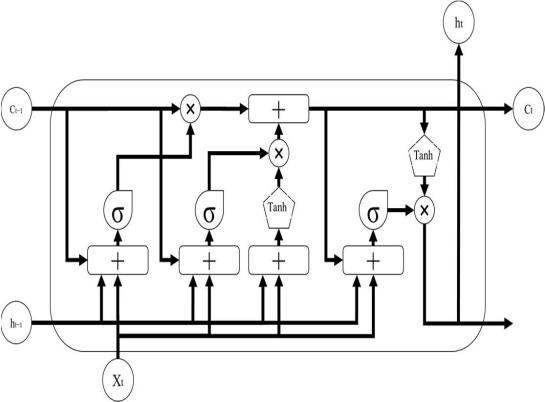
LSTM is widely used for processing sequential data like text classification and machine translation. It addresses long-termdependenciesthroughgatestructures,makingit suitable for credit scoring analysis to capture temporal patterns.LSTMsfindapplicationsinvariousareasliketime series prediction, handling variable-length sequences, feature representation, and default prediction. The forget gate, input gate, and output gate play key roles in managing information flow. However, LSTMs have limitations in parallel processing due to sequential calculations and may not entirely eliminate long-term dependencyissues.
4.2 Transformer
The transformer model, initially employed by Google for machinetranslation, adopts an encoder-decoder structure with six layers in total consisting of an encoder and a decoder. Unlike traditional models, it doesn't utilize a recurrentstructure.Througha6-layerencoder,inputdata progress to the decoder for attention calculation. The transformer comprises four modules: input, encoding, decoding, and output. Leveraging self-attention and parallel processing, it excels in machine translation,
surpassing RNNs and CNNs as the current mainstream feature extractor. Addressing LSTM limitations, it utilizes attentiontoreducesequencepositiondistancesandallows parallel computation, showcasing superior feature extraction capabilities in machine translation tasks. Consequently, attention-mechanism-based LSTM has transitionedtothetransformermodel'snetworkstructure [1,4]
Fig-3: Deepneuralnetworkwithhiddenlayersusedin proposedapproach.
The model effectively predicts new instances even with missing data, employing the ReLU activation function as a threshold mechanism. This boolean method classifies instances based on input and weight vectors, with a cost functionminimizingsquarederror.Additionally,adecision tree contributes to classification, resulting in optimal predictionsforcreditrating.[3]
4.3 Feature Embedded Transformer
In this research study, we integrate a transformer into credit scoring, presenting an end-to-end deep learning creditscoringframeworkknownastheFeatureEmbedded Transformer (FE-Transformer). A FE-Transformer in credit scoring would involve incorporating both the temporal aspects ofa borrower’sfinancial historyandthe static features into a unified model. The model contains joint representations for both sequential and static features, leveraging the strengths of transformers in capturing long-term dependencies and feature embedding inhandlingcategoricalornumericalaspects.
International Research Journal of Engineering and
Volume: 11 Issue: 09 | Sep 2024
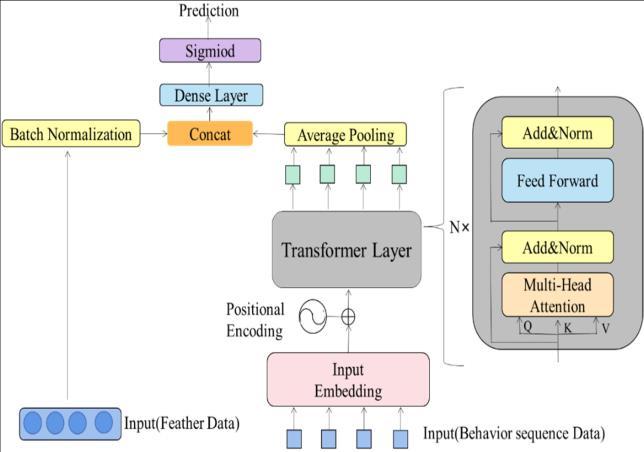
Fig-4: NetworkarchitectureoftheFE-Transformer.
The input data models consist of two types: feature data and behavioral data. Feature data containing gender, age, credit record, and other credit-related information, undergo processing before serving as model input. Behavioral data is inspired by NLP treats each behavior event as a word, forming a sequence resembling a sentence. Raw online operation behavior records are transformed into chronological event sequences. Through embedding and position encoding, behavioral data is encoded for model input. Events are converted to vectors using word embedding, and positional encoding is employed to capture event positions within the sequence. The resulting position vectors are added to the event vectors,creatingthemodelinput.
Layer consists of stacked encoders, each containing a multi-head attention layer and connected feed-forward layer. The embedding layer's output is processed through the multi-head attention and feed-forward layers in the encoder.Theresultingencodinginformationmatrixforall events in the behavior sequence is obtained after one or more encoders. The transformer architecture employs a self-attentionmechanism,improvingthemodel'sabilityto capture internal correlations without relying heavily on external information. Scaled dot-product attention is used in the attention layer, offering faster computation and space efficiency. The self-attention mechanism calculates the relatedness between events by projecting each event into query (Q), key (K), and value (V) vectors. These vectorsareusedtoquerycandidatepositions, andthedot products are scaled, normalized using softmax, and weightedtodeterminethefinalself-attentionresult
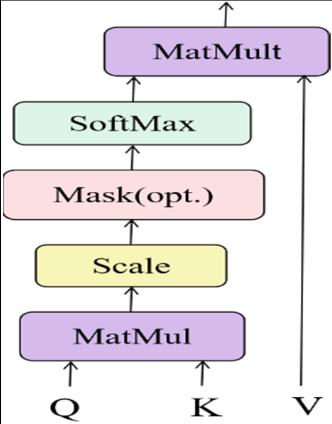
Fig-5: Scaleddot-productattention.
The multi-head self-attention mechanism in transformers allows the model to simultaneously capture diverse information from various positions and representation subspaces, enhancing its ability to understand the structure and relationships within sequences of events. This feature plays a crucial role in enriching the model's comprehension of both semantic and syntactic information
In evaluating the model's performance for credit scoring, commonly used indicators include AUC and KS. AUC measures the model's ability to discriminate between defaulters and non-defaulters, with a higher value indicating better performance. KS assesses the maximum difference between cumulative distributions of good and bad credit applicants, emphasizing the model's ability to distinguish between defaulting and on-time borrowers. Precisionandrecallofferinsightsintopositivepredictions, and accuracy, while assessing overall correctness, may be misleading in imbalanced datasets.The table below provides a comparison of the different models based on these metrics, illustrating their effectiveness in predicting creditworthiness.
Table-1: ComparisonofModelPerformanceBasedon EvaluationMetrics
International Research Journal of Engineering and Technology (IRJET) e-ISSN:2395-0056
Volume: 11 Issue: 09 | Sep 2024 www.irjet.net p-ISSN:2395-0072
Thistablehighlightstheperformancedifferencesbetween the models, with the FE-Transformer generally showing the best result in both AUC and KS, followed by AMLSTM,LSTM,XGBoost, and finally Logistic Regression.At present, the ROC curve is often used to evaluate the predictive ability of models.The ROC curve, based on true positiverate(TPR)andfalsepositiverate(FPR),visualizes model performance, with a curve closer to the upper left corner indicating better classification. The AUC value quantifiestheROCcurve'sproximitytoperfection,offering amorepreciseevaluation[1,2]
The initial phase involves collecting and preparing data from diverse sources, including credit bureaus, financial statements, and loan applications. This study utilizes a dataset from an anonymous P2P lending company in China, encompassing 100,000 borrowers with feature and behavioraldata.Labels(1or0)indicateborrower default. Sorting loans by date, the last month's data form the test set (20% of the dataset) to assess model stability. The remaining data constitute training sets for model development. User behavioral data, varying in sequence length, is standardized to fixed-length sequences through preprocessingandcoding.
Inthe proposedcreditscoring model,theFE-Transformer utilizes 2 transformer coding layers with 4 heads in the multi-headattentionmechanism.Tomitigateoverfitting,a dropoutof0.3isappliedtoneuralunitsinthetransformer coding layer. Model training utilizing adaptive motion estimation rules for parameter updates. The training processincorporatesanearlystoppingstrategytoaddress potential overfitting issues in deep learning model training.
FeatureSelectionisthemethodinvolveschoosingasubset of the most pertinent features from the initial se, eliminating redundant, irrelevant, or noisy ones to enhancemodelefficiencyandinterpretability.
Table-2: FeatureImportanceRankingAcrossDifferent Models
To demonstrate the performance superiority of the FETransformerapproachsuggestedinthisstudy,threetypes of experiments were conducted using different datasets. The first type focused on feature data only, employing traditionalmodelslikelogisticregressionandXGBoostdue to the low dimensions unsuitable for training deep learning models. The second type used a dataset exclusively with behavioral data, where deep learning models directly utilized user event sequences as input, while traditional models (LR and XGBoost) required manualfeatureextraction.Thethirdtypeutilizedadataset withallavailabledata,employingLR,XGBoost,LSTM,AMLSTM,andFeatureSelection.Experimentalresultsindicate that the FE-Transformer model outperforms LR, XGBoost, LSTM,andAM-LSTMintermsofAUCandKS.Thissuggests that the FE-Transformer deep learning model accurately predicts user default risk, contributing to reduced loan default rates and credit risk for financial enterprises, fostering their healthy and sustainable development, especially in scenarios where user behavior events may changepost-APPupgrades.
The advancement of big data and artificial intelligence technologyhasshiftedtheresearchfocustowardsmachine learning and deep learning models in credit scoring. This study delves into the credit scoring methods of financial enterprises, highlighting the significance of the FETransformer neural network model. Key findings include the innovative use of user online behavioral data as a credit scoring source, enhancing the effectiveness of user default analysis models. The FE-Transformer model outperforms other comparison methods, affirming its efficiency and feasibility in credit scoring. The model's outputofuserdefaultprobabilitiesservesasa foundation
International Research Journal of Engineering and Technology (IRJET) e-ISSN:2395-0056
Volume: 11 Issue: 09 | Sep 2024 www.irjet.net p-ISSN:2395-0072
for the loan approval decisions and risk solving, empowering financial institutions to enhance their credit risk management capabilities. As machine learning and deep learning continue to progress, the model's accuracy in risk analysis is expected to improve, along with enhancedinterpretability.
Forfutureresearch,severalconsiderationsemerge.Firstly, addressing the challenge of data acquisition, this experiment relies on the datasets of a single enterprise. Future work aims to explore datasets from various enterprises to enhance the generalizability of findings. Secondly, the credit scoring model in this study is static, and there is a growing interest in dynamic updates. Leveraging blockchain technology for secure, transparent, and efficient sharing of credit-related information among financial institutions is a potential avenue. This not only aids in reducing fraud but also contributes to improved model accuracy through dynamic updates. Additionally, there is a need to emphasize cybersecurity measures to safeguard sensitive credit-related data, given the rising sophisticationofcyberthreatsinthefinancialsector.
[1]DRDShanti,PranavaBhattacharyaAmity,”Credit ScorePredictionSystemusingDeepLearningandKMeansAlgorithms”,August2021
[2] C. Liberati and F. Camillo, “Personal values and creditscoring:newinsightsinthefinancialprediction, “Journal of the Operational Research Society, vol. 69, no.12,pp.1–21,2018.
[3]AshwaniKumaretal2021J.Phys.:Conf.Ser.1998 012027, Credit Score Prediction System using Deep LearningandK-MeansAlgorithms
[4] TSAI, C. & WU, J. (2008). Using neural network ensembles for bankruptcy pre- diction and credit scoring. Expert Systems with Applications, 34, 2639–2649.126
[5] WEST, D. (2000). Neural network credit scoring models. Computers & Operations Research, 27, 1131–1152.5,7,105,113,126