
International Research Journal of Engineering and Technology (IRJET) e-ISSN:2395-0056
Volume: 11 Issue: 09 | Sep 2024 www.irjet.net p-ISSN:2395-0072

International Research Journal of Engineering and Technology (IRJET) e-ISSN:2395-0056
Volume: 11 Issue: 09 | Sep 2024 www.irjet.net p-ISSN:2395-0072
Aditya Ingole1, Yuvraj Patil1, Yashraj Wawkar1, Aboli Deole2
1Student, Dept. of Artificial Intelligence and Machine Learning, PES’s Modern College of Engineering, Pune, Maharashtra, India
2Assistant Professor, Dept. of Artificial Intelligence and Machine Learning, PES’s Modern College of Engineering, Pune-05, Maharashtra, India.
Abstract - Pulmonary illnesses pose an enormous healthcare challenge globally, necessitating accurate and well-timed prognosesforeffectiveremedies.DeepknowledgeofPulmonaryailmentDetectionusingChestX-raysprovidesaprogressive strategytodecoratediagnosticaccuracyandperformance.Leveragingdeepneuralnetworksandacarefullycurateddatasetof chest X-ray photos, this assignment aims to automate the identification of pulmonary illnesses consisting of pneumonia, tuberculosis, emphysema and many more. The deep mastering version, educated and first-rate-tuned on this dataset, offers the potential to not only most effectively detect illnesses with high precision but additionally help healthcare specialists in earlydiagnosis,intheendenhancingpatientresults.Thechallenge'smultifacetedtechniqueconsistsofrecordspreprocessing, model choice and training, interpretability, deployment in a scientific place, and non-stop collaboration with medical examiners to ensure both technological robustness and ethical compliance. As pulmonary disorder detection and healthcare technologieshold toadapt, thismission standsattheleading edgeof innovation,presentinga promising methodtoincrease theabilitiesofhealthcarepractitionersanddeliverextratimelyandaccuratediagnoses.
Keywords: Pulmonary diseases, healthcare, diagnosis, deep learning, chest X-ray, diagnostic accuracy, efficiency, deep neural networks
Nearly 545 million individuals currently live with a chronic respiratory condition, representing 7·4% of the world's population, whichprovidesadditional evidenceofthe largehealthcontributionofchronicrespiratory diseases topremature morbidity and mortality. Consequently, there has been substantial growth in the field of automated medical image classification.
This endeavour seeks to categorise medical images into specified groups. Lately, Deep Learning (DL) has emerged as a prevalentandextensivelyappliedtechniqueforcreatingmedicalimageclassificationtasks.
Further,DLmodelsproducedmoreeffectiveperformancethantraditional techniquesusingchest X-rayimages from patientssufferingfrompulmonarydiseases.
The DL architectures illustrated effective predictive ability. On chest X-ray images, multiple tasks were performed on DL models, including tuberculosis identification, tuberculosis segmentation, large-scale recognition, and Radio-graph classification. The automated classification of chest X-ray images using DL models is growing rapidly and choosing an appropriate region of interest (ROI) on chest X-ray images was used to treat. Furthermore, applying the DL modes helps to avoidproblemsthattakealongtimetosolveintraditionalapproaches. However,thesemodelsrequirelargevolumesofwelllabelled training samples. The DL architectures illustrated effective predictive ability. On chest X-ray images, multiple tasks can be performed on DL models, including tuberculosis identification, tuberculosis segmentation, atelectasis, pneumonia, silico-tuberculosis,fibrosis,EmphysemaRadiographclassificationandmanymore.Manyresearchershavedoneinvestigations torelatemachinelearningschemesforpredictionofX-rayimagediagnosticinformation.Withthecontrolofcomputersalong withthehugevolume ofrecordsbeingunrestrictedto thepublic,thisis high timetoresolvethiscomplication. Thissolution canputupdecreasingmedicalcostswiththeenlargementofcomputerscienceforhealthandmedicalscienceprojects.Forthe implementation,theNIHchestX-rayimagedatasetiscollectedfromKagglerepository,anditisfullyanopen-sourceplatform. Anewhybridalgorithmisintroducedinthispaperand thisalgorithmissuccessfullyappliedontheabove-mentioneddataset toclassifylungdisease.Themaincontributionofthisresearchisthedevelopment ofthisnewhybriddeeplearningalgorithm suitableforpredictinglungdiseasefromX-rayimages.
International Research Journal of Engineering and Technology (IRJET) e-ISSN:2395-0056
Volume: 11 Issue: 09 | Sep 2024 www.irjet.net p-ISSN:2395-0072
Theprimarygoalofthisprojectistodeveloparobustsystemthatcandetectandanalyzedifferentlungdiseasesusing chest x-ray images. Traditional methods can make it difficult to diagnose lung diseases such as pneumonia, tuberculosis,lungcancer,andCOPD.Themodelisdevelopedwithsophisticatedmachinelearninganddeeplearning methodsto detectunusual patternsandabnormalities in chest x-rays,revealingdifferentlung illnesses. Thissystem aims to improve diagnostic precision, minimize human mistakes, and speed up the diagnostic procedure, ultimately leadingtoimprovedpatientresults.
This model is valuable for both diagnosing patients and conducting statistical analysis in hospitals and medical research facilities. Researchers can use the model to collect and analyze extensive collections of chest x-ray images, makingit easier to conduct epidemiological studiesand clinical trials.The model helpsmedical research by offering informationondiseasefrequency,advancement,andresponsetotreatmenttoaidindecision-making.Thisthorough examination helps to identify trends, comprehend patterns of diseases, and create new treatment guidelines, ultimatelypushingforwardthefieldofpulmonarymedicine.
This invention was created to aid physicians and radiologists in their routine medical duties. Doctors can improve their clinical assessments by incorporating an extra perspective from automated analysis, boosting their certainty when diagnosing patients. For radiologists, it acts as a quick initial assessment tool, identifying possible areas of concernthatneedmoredetailedexamination.Themodeleffectivelyunderstandsandanalyzesextensivex-rayimages, leading to a notable decrease in the workload of healthcare professionals. This enables them to concentrate on intricate cases and provide personal attention to patients. In the end, the goal of this technology is to enhance the efficiencyandeffectivenessofdiagnosingandtreatinglungdiseases,ultimatelyresultinginimprovedoutcomes
Image classification involves assigning a predetermined category label to an image and is a component of computer vision.CNNsandDNNshaverevolutionizedtheprocessofimageclassificationbyhavingthecapabilitytoextractfeaturesfrom hierarchical image data. EfficientNet-B2 and Inception V3 are two well-known CNN structures that have demonstrated outstandingperformanceindifferentimageclassificationassignments.ImagemanipulationindeepCNNsincludesavarietyof methods and procedures that ready images for efficient analysis and feature extraction. This procedure is important for varioususes,suchasmedicalimaging,wherepreciseandthoroughanalysisofimagesisnecessary.CNNssuchasEfficientNetB2 and Inception V3 are crucial for improving the effectiveness of Image processing tasks in the identification of pulmonary diseases through chest X-rays (CXRs) analysis. Inception V3, is an advanced version of the Inception architecture, it was developedbyetalSzegedy.Itusesvariousmethodstoimprovenetworkperformance,suchasfactorizedconvolutions,batch normalization,andauxiliaryclassifiers.InceptionV3isoptimizedtoeffectivelyprocesshigh-resimages,makingitappropriate formedicalimaginguses.
3.1Maincharacteristics
Factorized Convolutions: Converts convolutions into smaller operations for decreased computational complexity. Auxiliaryclassifiers are additional classifiers that offer extra gradientsignalsinthe training process, enhancing convergence andreducingthevanishinggradientissue.NormalizationofeachlayerisimplementedusingBatchNormalizationtoenhance andspeedupthetrainingprocess.Designofbuildingsandstructures.ThestructureofInceptionV3includesseveralInception modules, which have concurrent convolutions with various kernel sizes. This capability of extracting features at multiple scalesenablesthenetworktocaptureavarietyoffeatures,improvingitscapacitytoclassifyintricateimages.
3.2EfficientNet-B2:
Overview
EfficientNet-B2, introduced by Tan and Le, is a subset/subtype of the EfficientNet family, which uses a compound scaling method to balance network depth, width, and resolution. This systematic scaling approach results in models that achievehighaccuracywhilemaintainingcomputationalefficiency.
International Research Journal of Engineering and Technology (IRJET) e-ISSN:2395-0056
Volume: 11 Issue: 09 | Sep 2024 www.irjet.net p-ISSN:2395-0072
KeyFeatures
Compound Scaling: Simultaneously scales depth, width, and resolution using a set of predefined coefficients, optimizingthemodelforperformanceandefficiency.
MBConv Blocks: Mobile Inverted Bottleneck Convolution blocks with squeeze-and-excitation (SE) optimization, enhancingfeaturerepresentationandreducingthenumberofparameters.
Swish Activation Function: This activation function improves training stability and model performance compared to thetraditionalReLUfunction.
Architecture
EfficientNet-B2employsMBConvblocks,whichincludecomplexdepth-wiseseparableconvolutionsandsqueeze-andexcitationcomponents. These blockshelp in capturing fine-grained features while maintaining computational efficiency. The compoundscalingmethodensuresthatthenetworkis efficientlybalancedintermsofitscapacitytolearnfromdatawithout overfitting.
Inception V3, EfficientNet-B2, VGG16, VGG19, and ResNet-50 showcase a range of convolutional neural network (CNN)designs, eachpossessingunique qualitiesand features. Inception V3is renowned for itscomplex structureanduseof inception modules, making it highly effective in capturing features at various levels, thus being well-suited for tasks demandingdetailedfeatureidentificationlikeimageclassificationandobjectdetection.EfficientNet-B2,fromtheEfficientNet familyknown for its efficientscaling,findsa middleground between model sizeandperformance, making itappropriatefor environmentswithlimitedresourceswhilestillmaintainingaccuracy.Incontrast,VGG16andVGG19,althoughlesscomplexin design than the rest, are famous for being easy to comprehend and put into practice. Despite their deep structure, they are relatively straightforward, consisting of sequential layers with small convolutional filters. These models are often used as baselinearchitecturesorfortransferlearningduetotheirsimplicityandeffectiveness. Meanwhile,ResNet-50introducesthe concept of residual learning, which addresses the vanishing gradient problem in deep networks, enabling the training of significantlydeeperarchitectures.Thisresultsinimprovedperformanceandconvergencespeedcomparedtoearliermodels. ResNet-50iswidelyadoptedinvariouscomputervisiontasks,especiallywhendepthandaccuracyareparamount.
ThemainchallengesfacedbyconventionalmethodsofPneumoniadetectionsuchaschestradiographsisthattheyare subjecttointer-classvariabilityandultimatelythediagnosisisdependentontheexpertiseoftheclinicianindetecting earlytracesofpneumonia.
One limitation of Emphysema detection is the lack of reference standard for the emphysema label based on CT imagingorconfirmedemphysemadiagnosis.Themodelspresentedherearetrainedonlytoemulatetheperformance ofaradiologistidentifyingemphysemaonachest X-Rayandareevaluatedinthatcontextalso.Thisdoesnotprovide anyindicationofhowwellCXR-basedanalysiscompareswithmoreaccuratereferencestandardssuchasquantitative CTand/orclinicaldiagnosis.
TheauthorsacknowledgesomelimitationsoftheirstudyonthemodelofLungCancerdetectionsystem,suchasthe use of a single hospital dataset, the potential increase of false positives in a screening cohort, the need for an observer’sperformancestudyandtheexclusionofbenignnodules/massesfromtheirmodel.
Themaingapinthe researchpaper andmoduleonCF-ILDsisthedatasettheyused totrainandtestthemodel was collectedfromasinglesource,whichlimitsthegeneralizationofthealgorithm.Theothergapwasthatthealgorithm was not validated on other types of ILDs. The algorithm did not provide any information on the location, extent or severityofthedisease,anditdidnotincorporateanyclinicalorlaboratorydatawhichmayimprovetheaccuracyand confidenceoftheCF-ILDsdetectionmodel.
3.5IntegratingInceptionV3andEfficientNet-B2
Inception V3,created by Google, isa sophisticatedConvolutional Neural Network (CNN)structurespeciallymade to effectively capture complex features across various scales. This approach at multiple scales enables the network to gather
International Research Journal of Engineering and Technology (IRJET) e-ISSN:2395-0056
Volume: 11 Issue: 09 | Sep 2024 www.irjet.net p-ISSN:2395-0072
varied and abundant features from input images. Additionally, Inception V3 employs factorized convolutions, where larger convolutionsaresplitintosmaller,sequentialoperations(e.g.,a3x3convolutionisdecomposedintoa1x3followedbya3x1 convolution).Thisfactorizationreducesthecomputationalcostwhilemaintainingperformance.Anotherimportantfeatureis the use of auxiliary classifiers during training, which provide intermediate gradient signals to improve convergence and training stability using batch normalization extensively aids in standardizing the inputs for every layer, which in turn decreasesinternalcovariateshiftandspeedsupthetrainingprocess.Dropoutandlabelsmoothingareregularizationmethods usedtoavoidoverfittingandenhancethemodel'sabilitytogeneralize.ThecombinationofthesefeaturesmakesInceptionV3 very successful in achieving precise results in various image classification assignments, such as intricate tasks like medical imaging. EfficientNet-B2 belongs to the EfficientNet series, praised for its outstanding blend of performance and computational efficiency. The hallmark of EfficientNet-B2 is its use of compound scaling, a method that uniformly scales the network's depth (number of layers), width (number of channels), and resolution (input image size) using a compound coefficient. This balanced scaling ensures optimal performance while minimizing computational cost. The architecture employsMobileInvertedBottleneckConvolutions(MBConv)asitscorebuildingblocks,whichcombine depthwiseseparable convolutionsandinvertedresiduals.TheseMBConvblockssignificantlyreducethenumberofparametersandcomputational load without compromising the ability to learn complex features. Additionally, EfficientNet-B2 integrates Squeeze-andExcitation (SE) optimization, where SE blocks recalibrate channel-wise feature responses adaptively by modelling interdependencies between channels. This enhances the network's representational power. The use of the Swish activation function further improves training stability and performance. Overall, EfficientNet-B2 achieves high accuracy with fewer resources,makingitanexcellentchoiceforapplicationsthatrequirebothperformanceandefficiency,suchasdeploymentin resource-constrainedenvironmentsortransferlearningtasks.
The performance of image classification tasks greatly improves with the implementation of convolutional neural networks (CNNs) utilizing important techniques like Pre-training and fine-tuning in the realm of deep learning. Pre-training consistsoftraininganeuralnetworkonaflexible,universaldatasetlikeImageNet toacquireadiversesetoffeaturesthatcan beappliedtodifferenttasks.Thisprocesscreatesarobustsetofinitialweightsthatcapturefundamentalvisualpatterns. After being pre-trained, the model can be adjusted on a smaller dataset specifically for the task. Fine-tuning the model requires swappingoutthelastlayersofthepre-trainedmodeltoalignwiththeattributesinthenewdataset,followedbytrainingthe entirenetworkonthenewdata.Thisapproachleveragesthegeneralfeatureslearnedduringpre-trainingwhileallowingthe modeltoadapttothespecificcharacteristicsofthenewtask.
During fine-tuning, early layers of the network, which capture generic features like edges and textures, are often frozentoretaintheirpre-trainedweights.Thelaterlayers,whichcapturemoretask-specificfeatures,areupdatedtolearnthe new data's intricacies. This gradual unfreezing, combined with a reduced learning rate, helps in refining the model without overfitting.Optimizersplayacriticalrolein bothpre-trainingandfine-tuningstages.TheAdamoptimizeriscommonlyused duetoitsadaptivelearningratecapabilities,whichmakeiteffectiveforawiderangeoftasks.Adamcombinestheadvantages ofbothAdaGradandRMSProp,adjustingthelearning rateforeachparameter based onthefirstandsecondmomentsofthe gradients,whichacceleratesconvergenceandimproves performance.Additionally,learningrateschedulingtechniques,such as step decay or reduction on the plateau, are employed to fine-tune the learning rate during training, ensuring stable and efficientconvergence.Thesecombinedstrategiesofpre-training,fine-tuning,andadaptiveoptimizationenabledeeplearning modelstoachievehighaccuracyandgeneralizationonspecifictaskswithlimiteddata.
CNNs have transformed the field of image classification by showcasing incredible abilities in autonomously learning andidentifyingpatternsandfeatureswithinimages.CNNscancapturehierarchicalfeatures,frombasicedgesandtexturesto intricate shapes and object parts, due to their layered architecture that imitates the human visual system. CNNs are very effective for various image classificationtasks,suchas identifying handwritten digitsand complex objectsin high-resolution images, due to their capacity to learn hierarchical representations. Cutting-edge designs like Inception V3, EfficientNet, and ResNet have elevated performance levels by integrating new design aspects such as multi-scale feature extraction, effective utilizationofcomputationalresources,andenhancedgradientflowviaresidualconnections.Thesemodelshavebeentrained inadvanceonextensivedatasetssuchasImageNet,allowingthemtoperformeffectivelyonawiderangeofdatasetsandtasks. Moreover, by employing transfer learning and fine-tuning, these models can be customized for specific tasks even with a scarcity of labelled data, leading to a remarkable decrease in training time and computational resources. Optimization methods like Adam, along with practices such as batch normalization and dropout, improve the training procedure by promoting quicker convergence and increasing resistance to overfitting. The result is highly accurate and reliable image
International Research Journal of Engineering and Technology (IRJET) e-ISSN:2395-0056
Volume: 11 Issue: 09 | Sep 2024 www.irjet.net p-ISSN:2395-0072
classification systems that are now integral to numerous applications, including medical diagnosis, autonomous driving, and real-timevideoanalysis.
Inception V3 and EfficientNet-B2 are two sophisticated convolutional neural network designs that provide notable benefitsintasksrelated toimageclassification. InceptionV3 enables us to effectivelyidentify bothfineand coarsedetailsin images, making it highly accurate in diverse classification tasks. Additionally, the model employs factorized convolutions to reducecomputationalcostsandauxiliaryclassifierstostabilizetrainingandenhanceconvergencespeed.Batchnormalization and regularization methods like dropout and label smoothing enhance its performance by avoiding overfitting and ensuring seamless training. EfficientNet-B2 is known for its combination of efficiency and performance, which is achieved through a compoundscalingstrategy.Thismethodscalesdepth,width,andresolutioninacoordinatedmanner,optimizingthemodelfor bothaccuracyandresourceusage.ThecoreofEfficientNet-B2consistsofMobileInvertedBottleneckConvolutions(MBConv) withdepthwiseseparableconvolutionsandsqueeze-and-excitation(SE)optimization,whichenhancefeatureextractionwhile keeping the parameter count low. The use of the Swish activation function contributes to training stability and overall performance.EfficientNet-B2'sdesignisveryefficient,allowingittobeusedinenvironmentswithlimitedresourceswhilestill achievingtopaccuracylevels.Bothmodelsaregreatchoicesfortransferlearning,enablingthemtobe efficientlycustomized fortaskswithminimaldata,highlightingtheirflexibilityandstrengthinimageclassificationtasks.
InceptionV3operatesbyutilizingacomplexyetefficientarchitecturedesignedtocapturerichanddiversefeaturesat multiplescales.Thismethodwithmultiplebrancheshelpsthenetworktodetectfine-grainedandcoarsefeaturesatthesame time. The module then concatenates these parallel outputs, creating a comprehensive feature map that represents various aspects of the image. To enhance computational efficiency, Inception V3 employs factorized convolutions, which decompose larger convolutions into smaller, sequential operations, significantly reducing the model’s computational burden without sacrificingaccuracy.Moreover,InceptionV3incorporatesextraclassifierswhiletrainingtogiveintermediategradientsignals thathelpstabilizethetrainingprocessandspeedupconvergence.Batchnormalizationiswidelyappliedtostandardizeinputs foreverylayer,enhancingboththespeedoftrainingandtheoverallperformanceofthemodel. EfficientNet-B2,amemberof theEfficientNetgroup,utilizescompoundscalingtouniformlyadjustthenetwork'sdepth,width,andresolutionbyemploying a compound coefficient. This method ensures a balanced increase in model size and complexity, leading to optimal performance and efficiency. The architecture of EfficientNet-B2 is built around Mobile Inverted Bottleneck Convolution (MBConv)blocks,whichincludedepthwiseseparableconvolutionsandinvertedresiduals.Theseblocksreducethenumberof parameters and computational load while maintaining high feature extraction capabilities. Furthermore, EfficientNet-B2 incorporates Squeeze-and-Excitation (SE) optimization, where SE blocks adaptively recalibrate channel-wise feature responses,enhancingthenetwork’sabilitytocaptureessentialfeatures.TheSwishactivationfunctionusedinEfficientNet-B2 improvesmodelperformancebyallowingsmoothergradientflowduringtraining.Thiscombinationofadvancedarchitectural elements enables EfficientNet-B2 to achieve high accuracy with reduced computational resources, making it an efficient and powerfulmodelforimageclassificationtasks
International Research Journal of Engineering and Technology (IRJET) e-ISSN:2395-0056
Volume: 11 Issue: 09 | Sep 2024 www.irjet.net p-ISSN:2395-0072
4. Methodology
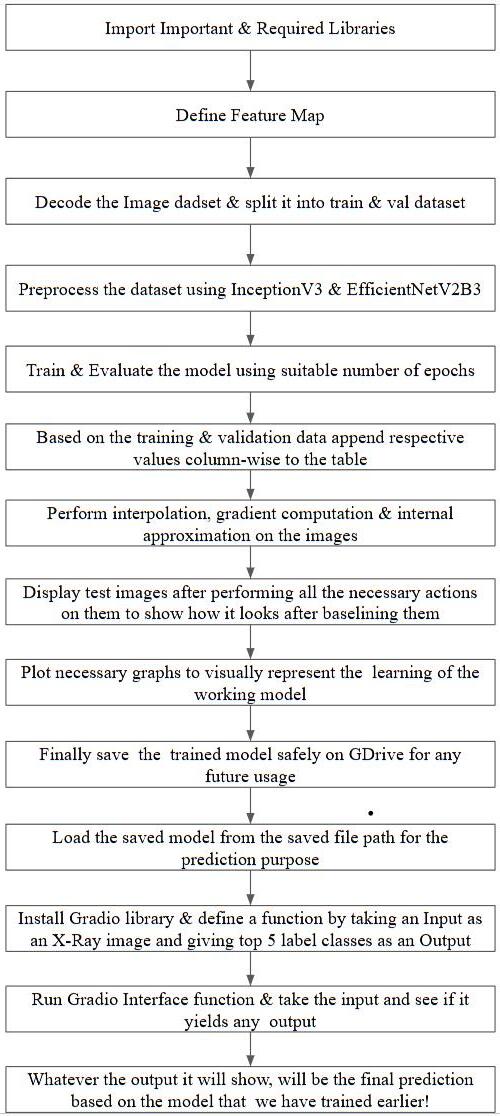
4.1DataCollection
ThedatasetutilizedforthisstudycontainschestX-rayimagesextractedfromapubliclyavailablerepositoryi.e.NIHChestX-
rayDataset.ThisdatasetisavailableonkaggleandprovidesacollectionoflabelledchestX-rayimages,includingnormallung samples and the ones in which the disease is detected. The images are preprocessed to ensure consistency in size and resolution,resizedto150x150pixelsforEfficientNet-B2andforInceptionV3.
© 2024, IRJET | Impact Factor value: 8.315 | ISO 9001:2008 Certified Journal | Page105
International Research Journal of Engineering and Technology (IRJET) e-ISSN:2395-0056
Volume: 11 Issue: 09 | Sep 2024 www.irjet.net p-ISSN:2395-0072
4.2Preprocessing
PreprocessingstepsaresignificantforpreparingtheX-rayimagesasinputintotheneuralnetworks. Thefollowingstepsare followedbelow:
Normalization:Pixelvaluesarenormalizedintherangeof[0,1]toensureconsistencyoftheinputdata.
Data Augmentation: To enhance the efficiency and performance of the models and solve the problem of low scalability various data augmentation techniques are applied, also we use an image generator for this purpose. These variations helpinsimulatingreal-worldvariationsandpreventoverfitting.
4.3ModelArchitecture
EfficientNet-B2
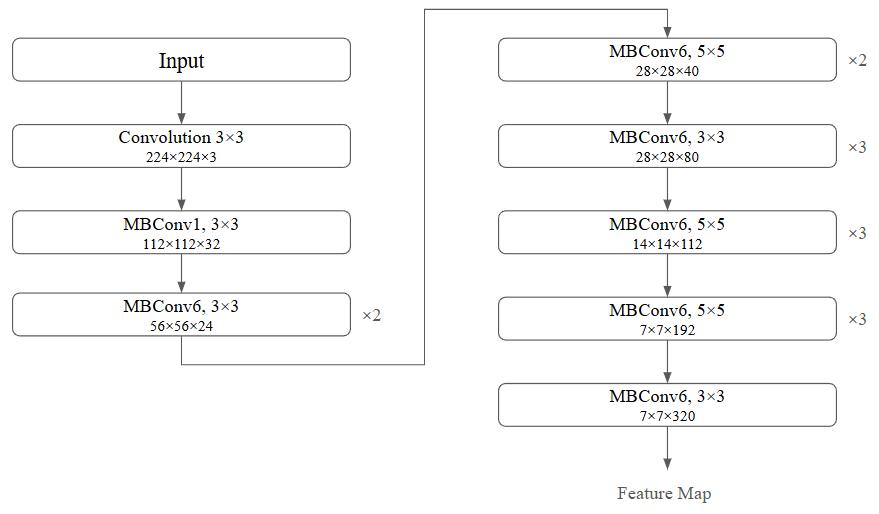
EfficientNet-B2, a subtype of the EfficientNet family, uses compound scaling to balance network depth, width, and resolutionintheneuralnetworks.Thearchitectureincludes:
MBConvBlocks:MobileInvertedBottleneckConvolutionlayerswithdepthwiseseparableconvolutionsandinvertedresiduals toreduceparametersandcomputationalload.
Squeeze-and-Excitation(SE) Optimization:SEblocksrecalibratechannel-wisefeatureresponsestoimproverepresentational power.
SwishActivationFunction:Enhancestrainingstabilityandmodelperformance.
InceptionV3
International Research Journal of Engineering and Technology (IRJET) e-ISSN:2395-0056
Volume: 11 Issue: 09 | Sep 2024 www.irjet.net p-ISSN:2395-0072
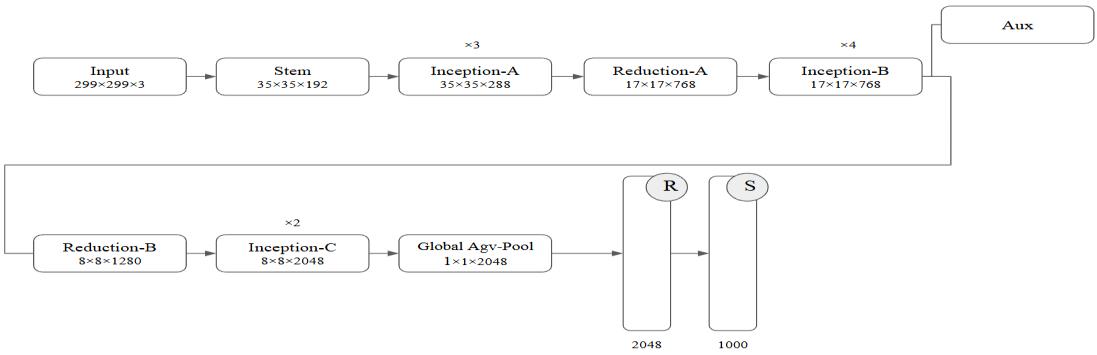
InceptionV3employsasophisticatedarchitecturedesignedformulti-scalefeatureextraction:
Inception Modules: Parallel convolutions with various filter sizes (1x1, 3x3, 5x5) and pooling operations to capture diversefeatures.
FactorizedConvolutions:Decompositionoflargerconvolutionsintosmalleronestoreducecomputationalcosts.
Auxiliary Classifiers: Intermediate classifiers that provide additional gradient signals during training, aiding in convergenceandstability.
BatchNormalization:Appliedthroughoutthenetworktonormalizeinputstoeachlayer,reducinginternalcovariateshift andacceleratingtraining.
Both models are pre-trained on the ImageNet dataset to leverage the learned feature representations Pre-training involves training EfficientNet-B2 and Inception V3 on ImageNet, a massive dataset containing millions of labeled images in thousands of categories. Fine-tuning involves adjusting the pre-trained models using data from the NIH Chest X-ray dataset. (e.g., normal, pneumonia and other pulmonary diseases). Early layers are initially frozen to retain general feature representations, while later layers are updated to learn task-specific features. Gradually, more layers are unfrozen for completefine-tuning.
4.5TrainingProcedure
DataSplitting:Thedatasetisdividedintotraining,validation,andtestsetswithan80-10-10distribution. TheAdam optimizer is utilized for its ability to adjust the learning rate adaptively. Initial learning rates are set low and adjusted using learningrateschedulers.
LossFunction:Cross-entropylossisemployedformulti-classclassification.
Batch Size and Epochs: Batch sizes of 32 and 50 epochs are set for training, with early stopping based on validation performancetopreventoverfitting.
4.6EvaluationMetrics
Modelperformanceisevaluatedusingstandardmetrics:
Accuracy:Proportionofcorrectlyclassified instances.Precision,Recall,andF1-Score:Thesearecalculatedclass-wiseto measurehowwellourmodelcandetecteachoftheconditions.
4.7Implementation
ThemodelsareimplementedusingdeeplearningframeworkssuchasTensorFlowandKeras.Trainingandevaluation are conducted on GPU-accelerated environments to expedite the computational processes. The trained models are then evaluatedonthetestsettodeterminetheirfinalperformancemetrics.
4.8ResultAnalysis
Results are analyzed to compare the performance of EfficientNet-B2 and Inception V3 in detecting pulmonary diseases. Key insights and comparative analysis are provided, highlighting strengths and potential areas for improvement in each model. This methodology outlines a comprehensive approach to leveraging EfficientNet-B2 and Inception V3 for the detection of pulmonary diseases using chest X-ray images, ensuring robust and accurate model development through pretraining,fine-tuning,anddetailedevaluation.
International Research Journal of Engineering and Technology (IRJET) e-ISSN:2395-0056
Volume: 11 Issue: 09 | Sep 2024 www.irjet.net p-ISSN:2395-0072
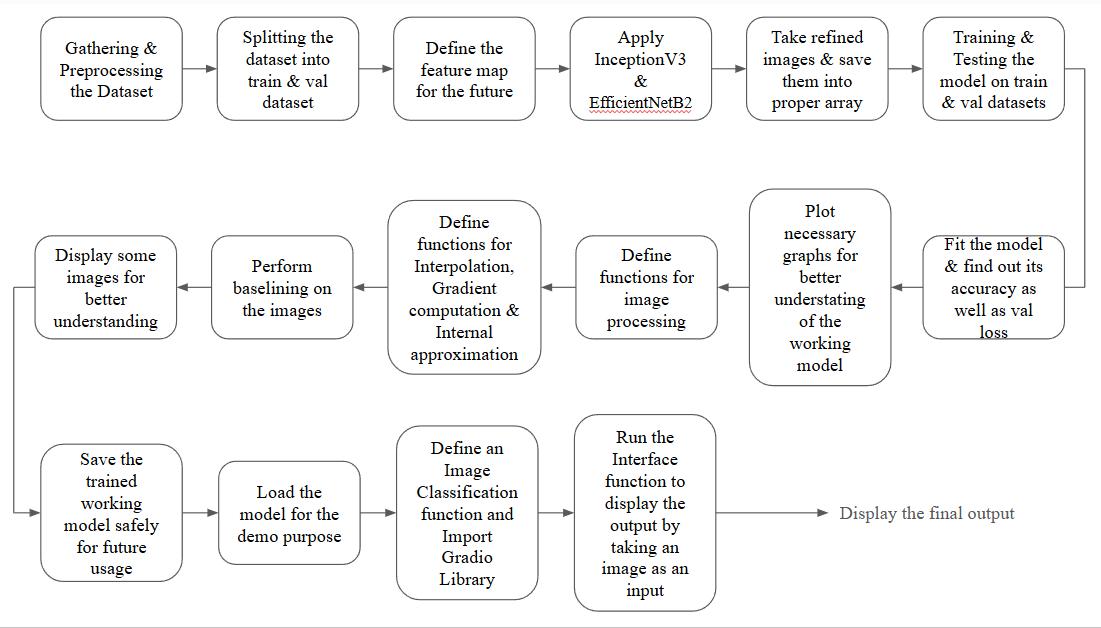
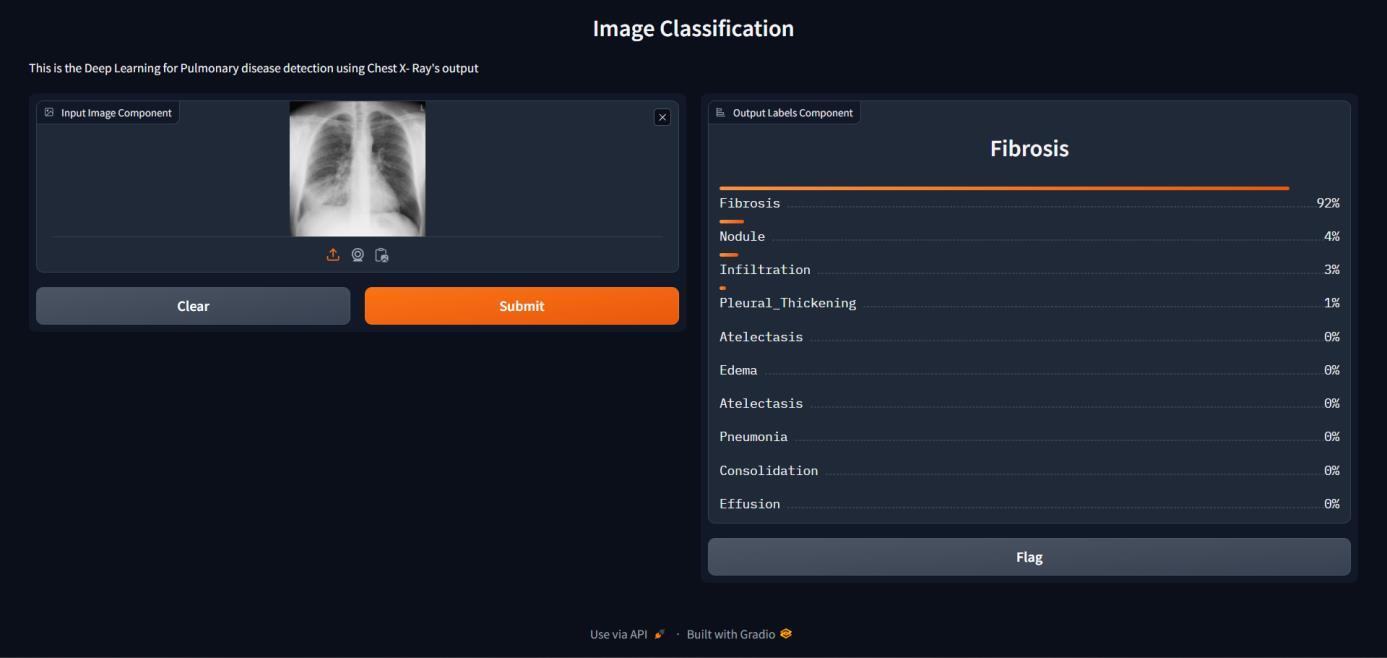
ImageOutputwithDiseaseClassificationandImageSegmentation
International Research Journal of Engineering and Technology (IRJET) e-ISSN:2395-0056
Volume: 11 Issue: 09 | Sep 2024 www.irjet.net p-ISSN:2395-0072
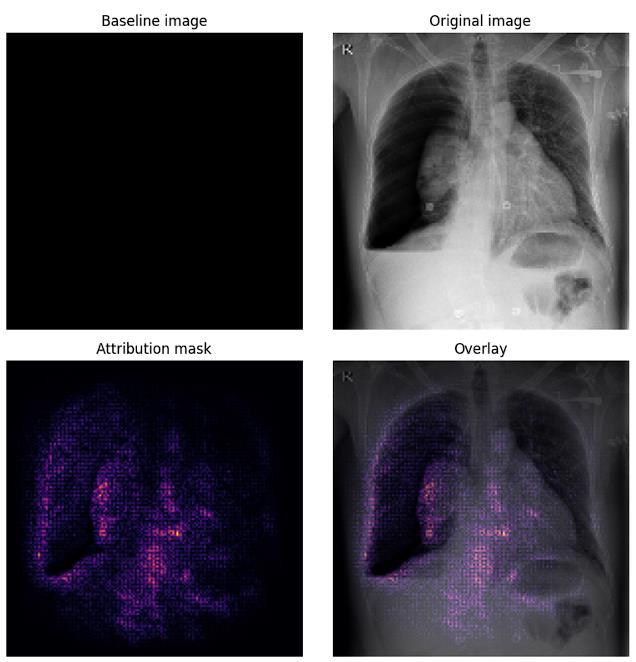
To provide visual interpretability of the model's predictions, integrated gradients are calculated for the input image. Integratedgradientshighlighttheimportantpixelsthat contributetothemodel'sdecision,whichhelpsinunderstandingthe model's focus areas. The integrated gradients are normalized and visualized alongside the original image, showing how different parts of the X-ray contributed to the classification made by EfficientNet-B2 and Inception V3. This step enhances transparencyandtrustinthedeeplearningmodel'sdecision-makingprocess.
Inthisarticle,ourgoalistoproposeadeeplearning-basedapproachtoclassifypulmonarydiseasesfromchestX-ray images using CNN based algorithms such as the EfficientNet B2 and Inception V3. In this framework, we pretrained the architectureusingtheImageNetdataset.ForModeltrainingweusedtheNIH(NationalInstituteofHealth)ChestX-raydataset.
Whilemostpulmonarydiseasesarecommonlyconfirmedbyasingledoctor,allowingforthepossibilityof error,our model can be regarded as a two-way confirmation system. Our results suggest that our CNN based models can be used to improvediagnosisrelativetotraditionalmethods,whichmayimprovethequalityoftreatmentandreducethetimeconsumed. Whencomparedwiththepreviousmethods,ourapproachcaneffectivelydetecttheinflammatoryregion.
7.
[1] Patrik Szepesi, László Szilágyi, “Detection of pneumonia using convolutional neural networks and deep learning”, Biocybernetics and Biomedical Engineering, Volume 42, Issue 3,2022, Pages 1012-1022, ISSN 0208-5216, https://doi.org/10.1016/j.bbe.2022.08.001
(https://www.sciencedirect.com/science/article/pii/S0208521622000742)
[2] Çallı E, Murphy K, Scholten ET, Schalekamp S, van Ginneken B (2022) Explainable emphysema detection on chest radiographswithdeeplearning.PLoSONE17(7):e0267539.https://doi.org/10.1371/journal.pone.0267539
[3] Shimazaki, A., Ueda, D., Choppin, A. et al. Deep learning-based algorithm for lung cancer detection on chest radiographs usingthesegmentationmethod.SciRep12,727(2022).https://doi.org/10.1038/s41598-021-04667-w
© 2024, IRJET | Impact Factor value: 8.315 | ISO 9001:2008 Certified Journal | Page109
International Research Journal of Engineering and Technology (IRJET) e-ISSN:2395-0056
[4]H.Nishikiori,K. Kuronuma,K.Hirota, etal.,“Deeplearningalgorithm todetect fibrosing interstitial lungdiseaseonchest radiographs,” Eur. Respir. J., vol. 4, no. 1, Art. no. e02269-2021, Sep. 2022, doi 10.1183/13993003.02269-2021. https://erj.ersjournals.com/content/early/2022/09/30/13993003.02269-2021
[5]WangX,PengY,LuL,LuZ,BagheriM,SummersRM.ChestX-Ray8:hospital-scalechestX-raydatabaseandbenchmarkson weakly-supervised classification and localization of common thorax diseases. In: 2017 IEEE Conference on computer Vision andpatternrecognition(CVPR);2017.p.3462–71.https://doi.org/10.1109/CVPR.2017.369
[6] Gu Y, Lu X, Yang L, Zhang B, Yu D, Zhao Y, Gao L, Wu L,.Automatic lung nodule detection using a 3D deep convolutional neural network combined with a multi-scale prediction strategy in chest CTsScienceDirecthttps://www.sciencedirect.com/science/article/abs/pii/S001048251830310X
[7] Setio AAA, Traverso A, de Bel T, Berens MSN, van den Bogaard C, Cerello P, Chen H, Dou Q, Fantacci ME, Geurts B, et al. Validation, comparison, and combination of algorithms for automatic detection of pulmonary nodules in computed tomography images: The LUNA16 challengeScienceDirecthttps://www.sciencedirect.com/science/article/abs/pii/S1361841517301020
[8]ZhuW,LiuC,FanW,XieXDeepLung.Deep3Ddualpathnetsforautomatedpulmonarynoduledetectionandclassification. In:ProceedingsoftheIEEEwinterconferenceonapplicationsofcomputervision(WACV);12–15March2018.p.673–81.Lake Tahoe,NV,USA.https://ieeexplore.ieee.org/document/8354183
[9]KongW,etal.YOLOv3-DPFIN:adual-pathfeaturefusionneuralnetworkforrobustreal-timesonartargetdetection.IEEE SensorJ1April1,2020;20(7):3745–56.https://doi.org/10.1109/JSEN.2019.2960796
[10] Ronneberger O, Fischer P, Brox T. U-net: convolutional networks for biomedical image segmentation. In: International conference on medical image computing and computer-assisted intervention, vol. 9351. Berlin/Heidelberg, Germany: Springer;2015.p.234–41.http://refhub.elsevier.com/S2352-9148(20)30029-0/sref15
[11]C. Szegedy etal.,"Goingdeeper withconvolutions," 2015IEEE Conference on Computer VisionandPatternRecognition (CVPR),Boston,MA,USA,2015,pp.1-9,doi:10.1109/CVPR.2015.7298594.
keywords: {Computer architecture; Convolutional codes; Sparse matrices; Neural networks; Visualization; Object detection; Computervision}https://ieeexplore.ieee.org/xpl/conhome/7293313/proceeding
Volume: 11 Issue: 09 | Sep 2024 www.irjet.net p-ISSN:2395-0072 © 2024, IRJET | Impact Factor value: 8.315 | ISO 9001:2008