
International Research Journal of Engineering and Technology (IRJET) e-ISSN: 2395-0056 p-ISSN: 2395-0072

Volume: 11 Issue: 09 | Sep 2024 www.irjet.net


International Research Journal of Engineering and Technology (IRJET) e-ISSN: 2395-0056 p-ISSN: 2395-0072
Volume: 11 Issue: 09 | Sep 2024 www.irjet.net
Niharika N1 , Akhila S2
1PostGraduateStudent,DepartmentofECE,BMSCollegeofEngineering,Bengaluru,India
2Professor,DepartmentofECE,BMSCollegeofEngineering,Bengaluru,India
Abstract - Vehicular Ad-Hoc Networks (VANETs) drive the development of the Internet of Vehicles (IoV), Intelligent Transportation Systems (ITS), and Vehicles to Everything (V2X) connectivity by providing a multitude of commercial and safety applications. Though VANETs have potential advantages, they are open, distributed, and dynamic making them vulnerable to a range of security threats, including inherent protocol design vulnerabilities. The infamous Gray- Hole Attack (GHA), which comes in two versions: Smart GHA and Sequence Number-based GHA, is one such attack. The malicious node in Sequence Numberbased GHA begins acting strangely throughout the route discovery process, whereas in Smart GHA, the maliciousnodeactsnormallyduringthis phase.Inboth thecases,thepacketsaredroppedimmediatelyafterthe route is successfully established. In this paper, a novel security approach called ‘‘Prevention of GHA’’ (PGHA) is proposed to detect and prevent both variants of GHA in Ad Hoc On-Demand Distance Vector (AODV) based VANETs. The approach is based on the generation of dynamic threshold values that identify abnormal differences in received, forwarded, and generated control or data packets among nodes and their sequencenumbers.TheproposedPGHAisimplemented and tested in MATLAB and its performance is compared with the most relevant benchmark approaches.TheresultsshowedthattheproposedPGHA performed better than the benchmark approaches in terms of increased detection accuracy of 97% on an average.
Key Words: — GHA,PGHA,RREP,RREQ,RSU,MRT, DSN,NTS.
VehicularAdHocNetwork(VANET)isaspecifictypeof ad hoc networkinwhicha groupof movingvehicles and fixed Road Side Units (RSUs) are connected togetherthroughawirelessmediumtoprovideasafe andsecuretrafficenvironment[1],[2],[3].

Owingtoitspracticality,easeofuse,andadaptability, newcarswithintegratedonboardsensorsallowthem tointeractwithoneanotherandmakebestuseofthe advantages offered by VANET's. These kinds of technologiesworkbestinavarietyofdomains,suchas fleetandtrafficmanagement,entertainment,andsafety [4]. Three components make up a VANET from an architectural perspective: Trusted Authority (TA), RSUs, and OBUs (On-Board Units). Three communicationmodesproducedbythesecomponents are infrastructure-to-infrastructure (I2I) communications,vehicle-to-vehicle(V2V),andvehicleto-infrastructure(V2I)communications[14].TheITS's backbone, VANET, is essential for giving real time information to drivers, passengers, and traffic administrationauthorities[7],[8].
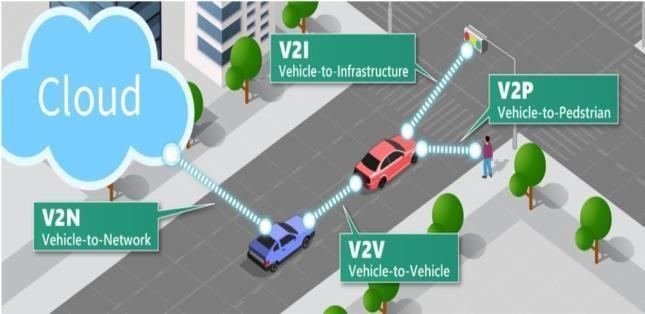
Security Problems with VANETs: Because of their unique features, VANETs face a number of security problemsandchallengesinspiteoftheirremarkable applications, importance, and adaptability. VANET communicationsareparticularlyvulnerabletovarious securitythreatsowingtotheirlarge-scale,rapidpace, open access medium, a highly dynamic network architecture, frequent disconnection, and protocol designflaws[2],[4],[9],[10].Thoughthereareseveral routing protocols available for establishing paths between nodes, AODV is one of the most popular choicesforVANETs[12],[13].

International Research Journal of Engineering and Technology (IRJET) e-ISSN: 2395-0056 p-ISSN: 2395-0072
Volume: 11 Issue: 09 | Sep 2024 www.irjet.net
TheAODVroutingprotocolisawell-suitedprotocolfor theextremelydynamicnatureofVANETsinceitoffers aquicker,moredynamicnetworkconnectionwithless
computing and storage needs. However, it has a number of serious security flaws that increases the vulnerability to various assaults, such as Wormhole Attack, GHA, and Black-Hole Attack(BHA) [15],[16] VANET applications and services are constantly vulnerable to security risks and assaults because of theirspecialqualitiesandcharacteristics.AGHAisone such difficult attack that jeopardizes the security messagestransmittedacrossVANETs.SometimesGHA behaves normally, but later starts dropping packets entirely, selectively, or partially. Second, while forwarding packets to all other nodes, it sometimes rejectspacketscomingfromaparticularnode.These packetscouldincludeimportantalertsandinformation about safety. Moreover, deleting these packets can impairthesecurityandfunctionalityofthenetworkas a whole, causing accidents, traffic fatalities, and congestion.
Because of this, mitigation of GHA in AODV-based VANET gains importance. Unlike other attacks, identifying a GHA is very challenging due to its contradictorybehaviour.Thoughseveralauthorshave made efforts to solve GHA, ithas resulted in a lower throughputandpacketdeliveryratios(PDR)
Contributions:Thisworkaimsatprovidingasolution for the detection and prevention of GHA with the followingnotablecontributions:
Effective Detection and Prevention:Aneffective method for detecting and preventing GHAs has beenproposedtoenhancethesecurityandgeneral functionalityofAODV-basedVANET.
Dynamic Thresholds: The suggested method is based on creating dynamic thresholds of anomalousdifferencesofreceived,forwarded,and created control/data packets and their sequence numbers, incontrast to the previous approaches thatwerebasedonstaticthresholds.
Dual-Purpose Approach:Theproposedmethodis versatile, as it is capable of recognizing and preventingbothSequenceNumber-basedGHAand SmartGHA.
The paper is structured as follows: Section II brieflydescribes the background of GHA;related works are discussed; Section III, Section IV
describestheproposedPGHA;adiscussiononthe resultsobtainedispresentedinSectionVfollowed bytheconclusioninSectionVI.
Compared to conventional networks using wireless communication,thegeneralsecurityandperformance of VANETs are significantly influenced by the nodes behaviour.Thiscanbe attributed to the factthat the nodefindsitchallengingtoestablishwhetherthedata it receives comes from a malicious or trustworthy source.
Forinstance,intheAODVprotocol,anodebroadcasts theRouteRequest(RREQ)toallofitsnearbynodesin order to start the route discovery process when it wishes to speak with another node. A bidirectional path is formed and packets are transferred by the sourcenodetothedestinationafteritreceivesthefirst Route Reply (RREP). In an AODV-based VANET, the sourceisneverawareofthedestination,so,itismore vulnerabletovarioussecuritythreats,suchasGHA.A malicious node can drop packets entirely in a GHA, which is a variant of BHA. GHA may function maliciouslybydroppingpacketsentirely,selectively,or partially,oritmayactnormallyattimes.GHAcanbe broadly divided into two types: Smart GHA and SequenceNumber-basedGHA.Fig.2.
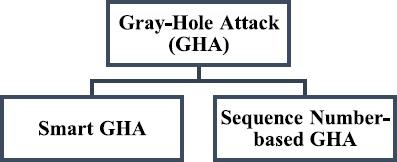
The malicious node in the Smart GHA acts normally whileitsearchesforaroute.Butassoonastherouteis successfullycreatedandthedatapacketsstartmoving, it either starts honestly forwarding the packets or drops them entirely. In contrast, the malicious node usesSequenceNumber-basedGHAtodrawpacketflow towarditselfbyrespondingtoRREQwithafalseRREP that has a higher sequence number. In this scenario, thepacketsareentirelydroppedbytherouteonceitis built.Agray-holenode(eitheraSmartoraSequence Number-basedGHA)takesonthequalitieslistedbelow wheninteractingwithothernodesintheAODV-based VANET.
© 2024, IRJET | Impact Factor value: 8.315 | ISO 9001:2008
| Page 90
International Research Journal of Engineering and Technology (IRJET) e-ISSN: 2395-0056 p-ISSN: 2395-0072
Volume: 11 Issue: 09 | Sep 2024 www.irjet.net
The number of RREPs (in response to RREQs) generatedbyagray-holenodeisveryhigh.
• The number of RREQsgenerated bya gray-hole nodeisverylowandoftenequaltozero.
• Thenumberofdatapacketsreceivedbyagrayholenodeisveryhigh.
• Thenumberofdatapacketsforwardedbyagrayholenodeislowerthanitsreceivedpackets.
• TheRREPofagray-holenode(sequencenumber based)containsalargersequencenumber.
• Due to presence of GHA in a VANET, the PDR of suchanetworkissignificantlydecreasedwhilethe PacketLossRatio(PLR)increases.
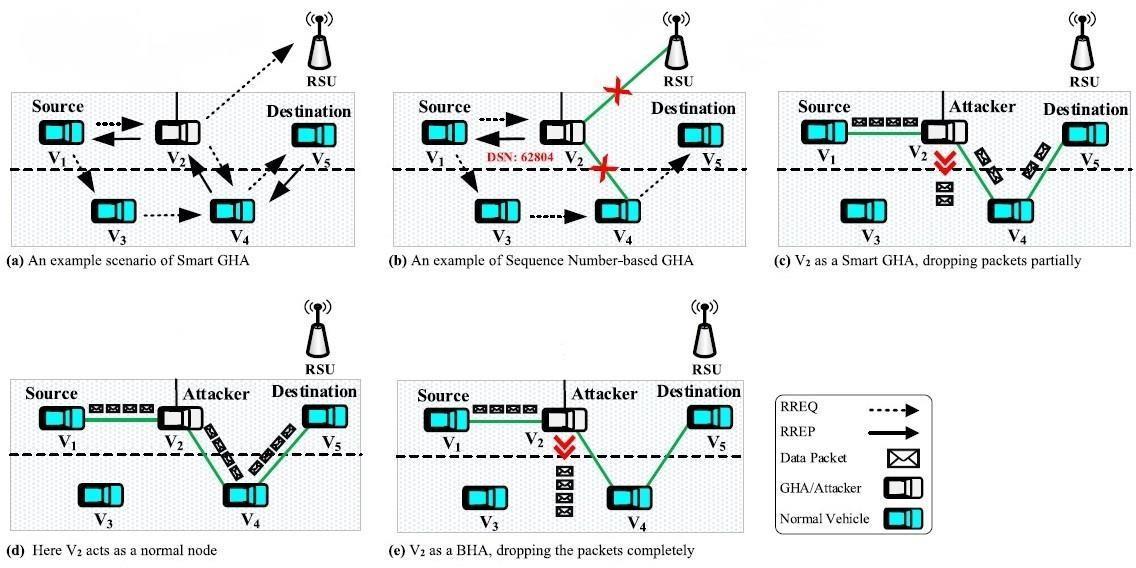
Figure3(a-e)showsseveralGHAscenarios.Vehicles V1 and V5 are assumed to be the source and destination nodes, respectively, andV2 to be a grayhole node, with the remaining vehicles being normal intermediary nodes. To construct a route toward the destination vehicle V5, source V1 broadcastsanRREQpackettoallofitsnearbynodesas in Figure 3(a). This starts the routing discovery process. In this scenario, V2 takes on the role of a Smart GHA, participating as usual and exchanging controlpacketswithnearbynodes.Subsequently,V2 functionsasaSequenceNumber-basedGHAinFigure 3(b)byrespondingtoV1'sRREQwithafalseRREPthat has a higher Destination Sequence Number (DSN).
ButasFigure3(c)illustrates,aftertherouteissetand the data packets start to move in the direction of destinationV5,V2(aSmartGHA)partiallydropsthe packets.Comparably,V2inFigure3(d)exhibitstypical nodebehaviorbyforwardingallpacketsreceivedfrom source V1. Lastly, V2 (perhaps a Smart or Sequence Number-basedGHA)entirelydiscardseachandevery packetreceivedfromsourceV1asdepictedinFigure 3(e). AvisualrepresentationoftheeffectofGHAina VANETisshowninFigure4.Thegray-holevehicle,V4, receives an accident alert message from V3, but it choosesnottorelayittotheoncomingvehicles,V5and V6. V4purposefullyskipsthiscrucialmessagerather than sending it on to other vehicles, which leads to increasedcausesofaccidentsandtrafficcongestion.
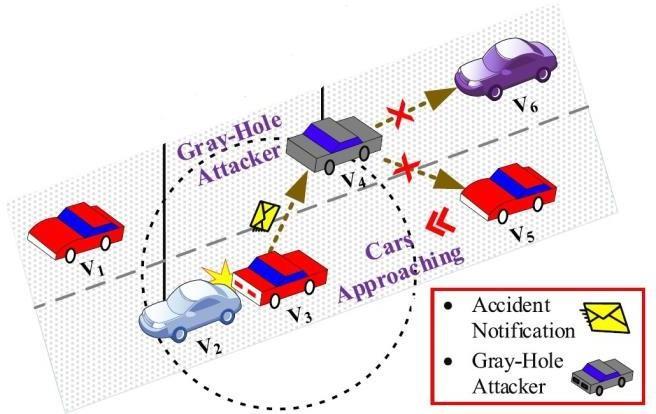
Fig 4. AVisualRepresentationofImpactofGHAon aVANET[13]
International Research Journal of Engineering and Technology (IRJET) e-ISSN: 2395-0056 p-ISSN: 2395-0072
Volume: 11 Issue: 09 | Sep 2024 www.irjet.net
TheconceptofV2Xcommunicationbegantotakeshape withtheaimofenhancingroadsafety,trafficefficiency, and overall transportation systems. The early ideaof vehicle communication dates back to the late 20th centurywhenresearchersandtechnologistsenvisioned the possibility of vehicles communicating with each other and with roadside infrastructure. Early discussions focusedonthe potential benefits of such communicationforimprovingroad safetyandtraffic flow.
Theconceptgainedmomentumwiththeemergenceof VehicularAd-HocNetworks(VANETs)inthelate1990s andearly2000s.VANETswereconceptualizedasselforganizing networks where vehicles could communicate with each other in an ad-hoc manner, formingadynamicnetworkwithouttheneedforafixed infrastructure.ThedevelopmentoftheIEEE802.11p standard, a modification of the Wi-Fi standard specifically designed for vehicularcommunication in the 5.9 GHz band, played a pivotal role in the formalization of V2X communication protocols. This standard addressed the unique requirements of communicationbetweenfast-movingvehicles.
In[1],theauthorsintroducedathree-phasealgorithm forthedetectionofBlackHoleAttack.Underthefirst phase,RSUplaystheroleofacertificateauthority(CA) which maintains and generates a public and private keyaswellascertificatesforthevehicles.Beforethe start of any communication, vehicles have to be verifiedfromtheRSU.Inthesecondphase,thesource broadcasts RREQ along with the correct certificate, nonce encryption, and destination's public key. The destinationsendsRREPbackwiththesource'spublic key.Inthethirdphase,BlackHolevehiclesaredetected based on the threshold of the destination sequence numbers,extractedfromtheRREPs,whicharestored in the data structure used in the algorithm called Heaps.
In [2], AODV routing algorithm is considered by the authors. The Process starts with collecting the DestinationSequenceNumberandHopCountValues for the incoming RREPs of the nodes in the network andthenpre-calculatingthethresholdsfromthedata setcollectedforthetwoparameters.
IftheSequenceNumberandtheHopcountisgreater thanthethresholdthenitiscategorisedassuspicious node and based on pre calculated the thresholds for PacketDeliveryRate,iftheSequenceNumberandthe Hopcountgreaterthanthethreshold,thencategorised as BlackHole and the entire network is flooded encapsulatingtheNodeIDofBlackHoleintoRREQ.
In[3],theauthorsconsiderroutediscoveryprocessby AODV routing algorithm. The authors here take into considerationofbothBlackholeandgrayholeattacks. Abnormal communicating nodes are separated into twosubcategoriesnamedasaBlackholeandGrayHole AttackernodesusingABC(artificialbeecolony)asan optimizationtechnique with a novelfitnessfunction. ThosenodesthatsatisfytheABCfitnessfunctionare consideredasnormalnodeotherwiseconsideredasa malicious node. If [Source Node, Hop Count, DestinationNode]==NeighbourNodes[SourceNode, HopCount,DestinationNode]then,Route=Neighbour Node is an Destination Node.Trained by Artificial NeuralNetwork,theinputlayercomprises50numbers ofnodesasinputdata,theinformationofwhichsuchas delay, energy consumption is being carried by 10 numberofneuronsasdepictedunderthehiddenlayer. Attheoutputlayer,thereare47numbersofnodeshas been attained, which demonstrates the class of communicatingnodes.Thenetworkhasbeentrained onenergyconsumptionandthedelayproducedbythe nodes.Lateron,theseparametersareusedtodecide thattowhichnodethedataisforwarded.
In this research, the route formation has been performedusingAODVroutingalgorithm,whichisan on-demand routing protocol along with Dynamic Source Routing. Using this protocol, the source node sends the RREQ packet to the nearby node, which contains the address of the destination node. If the adjacentnodeisnotthedestinationnode(notfoundits address)intheRREQpacket,thenforwardthepacket to the next node, which comes in its communication range. After receiving the RREQ packet by the black holenode,theaffectednodeinstantlysendsanRREP packet towards the source node with a higher hop count to attract the request known as fake routing response (FRREP).The route is established from the sourcetothedestinationnodethroughtheblackhole node,andhencetheentiredatapacketsaredroppedby theblackholeasanintermediatenode,whichinreturn decreasethethroughputofthenetworkin[4].
Volume: 11 Issue: 09 | Sep 2024 www.irjet.net
International Research Journal of Engineering and Technology (IRJET) e-ISSN: 2395-0056 p-ISSN: 2395-0072
Aself-cooperativedetectionschemetodetectsimple andcollaborativeblackholeattackersisproposedin [5]. Self-detection process is used for identifying the simple black hole attackers, and the collaborative detection process is used for determining the collaborativeblackholeattackersinthenetwork.Trust valuesofthevehiclesarepredictedusingtheprevious destination vehicles through which attackers are detected. It has high overheads because of the exchangeoftrustinformation.
[6] proposed a hybrid solution based on the assumption that a malicious node always sends the first RREP. The first RREP is ignored by the source node, and the second RREP is chosen for data transmissiontowardthedestination.Inthisway,the likelihood of a malicious node on the second RREP’s path is decreased, resulting in a safer route for transmission.However,thistechniquefailsinthecase whenamaliciousnodeisinthevicinityofthesource nodeandthedestinationisfaraway.Likewise,anendtoenddelaywilloccurifthesecondpathisselected, voidingthepresenceofanymaliciousnode.
A DPMV (Detection and Prevention of Misbehaving Vehicles)approachbasedoncachingmechanismsthat
improves the Detection of Malicious Vehicles (DMV) scheme is presented in [7]. It first examines all the availableroutesforthepresenceofmaliciousnodes.If aroutecontaininganattackerisdiscovered,theroute isignored,andanewroutetowardthedestinationis established. In comparison to DMV, this approach detectsmaliciousnodesefficientlywithhighmobility. However, the approach requires more time for its processing,resultinginahighend-to-enddelay[8].
In[9],theauthorsproposedadynamicthresholdvalue schemeagainstcooperativeblackholeattackers.The threshold value is determined by using linear regression.Eachnode’sanalysisofthelostpacketsis carried over by using the proposed technique. Using linearregressionalsoreducesthefalsepositiverateto agreaterextentbutstillhashighoverheads.
Theauthorsin[10],proposedaSmartBlackholeand Gray hole mitigation scheme. It uses dynamic time wrappingtoanalysethetimedifferencebetweenthe droppedpackets.Attackersareidentifiedbyusingthe analysedtimedifference.ItcanbeusedinAODVand OLSRprotocols,butmonitoringallvehiclesbyRSUsis mandatorytoanalysethetimeseriesdifferenceofthe droppedpackets
The authors in [11] proposed an updated AODV protocolfordetectingBlackHoleAttack.Theproposed modifications are in RREP and RREQ messages. Cryptographic encoding and decoding enhance security,whichauthorizesthesenderandreceiver.It detects the black hole attackers efficiently but can’t preventthemfromintrudingonthenetwork.Further the authors proposed a novel approach combining Signature-based and Anomaly-based IDS. Though it achieves higher accuracy, it increases the overheads usingtwointrusiondetectionschemes.
In[12]ahybridapproachisconsideredusingdynamic thresholdvalueandnodecredibilityforearlydetection ofblackholeattackers.RSUsperiodicallycomputethe dynamic threshold value and categorize the vehicles intocategories1,2,and3.RSUsareresponsibleforthe monitoringmodule,whichmonitorthevehiclesintheir rangeusingawatchdogapproach.Throughmonitoring, RSUsclassifythevehiclesintothreecategoriesbased on their forward rate, computed using a dynamic threshold value. It thensends the information to the vehiclesinitsrange. Inthedetectionphase,vehicles use the classification information and the node credibility value to identify the black hole attackers. Theidentifiedattackersareisolatedfromthenetwork intherecoveryphase.
Theauthorsin[13]havedividedthegrayholeattack intoSmartGHAandSequencenumber-basedGHA.In Smart GHA, the malicious node behaves normally duringtheroutediscoveryprocess.However,oncethe routeissuccessfullyestablishedandthedatapackets begintotransfer,iteitherstartsdroppingthepackets partially, or fully, or forwards them honestly. In Sequence Number-based GHA, the malicious node sendsafakeRREPwithahighersequencenumberin response to the RREQ in order to attract the flow of packetstowardsitself.
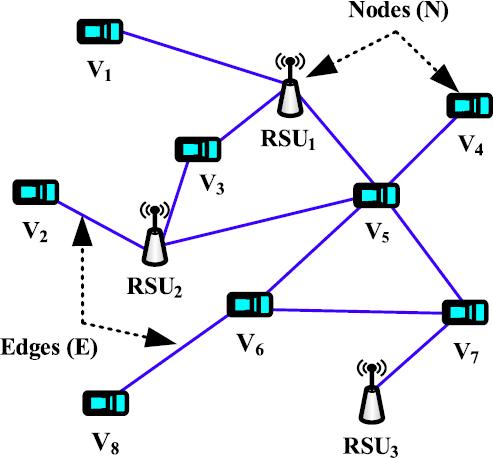
AVehicularAdhocNetworkisrepresentedasagraph G =(N, E),where N isafinitesetofnodes(vehiclesor RSUs) and E is a finite set of edges connecting these nodes. The edges provide the communication links amongnodesintheVANET,showninFigure5.Insuch a dynamic network the cardinality of nodes |N| remains constant over a specific time while the cardinalityoflinks|E|canbechangedduetothehigh mobilityofnodes.
International Research Journal of Engineering and Technology (IRJET) e-ISSN: 2395-0056 p-ISSN: 2395-0072
Volume: 11 Issue: 09 | Sep 2024 www.irjet.net
Theoverallsystemdesignframeworkoftheproposed preventionofGrayholeattackinIoVconsistsof3main phases.
1. PrimaryPhase
2. DetectionPhase
3. PreventionPhase
The first step begins with the initialization of the networkwithnumberofnodesconsideredas50and thecommunicationrangewithinwhicheachnodecan communicate as 100 and specific time interval as 1 secondforsimulationupdatesandtotaldurationofthe simulationintimestepsas100.Lastly,initializationof the position of the nodes randomly within 500x500 grid.
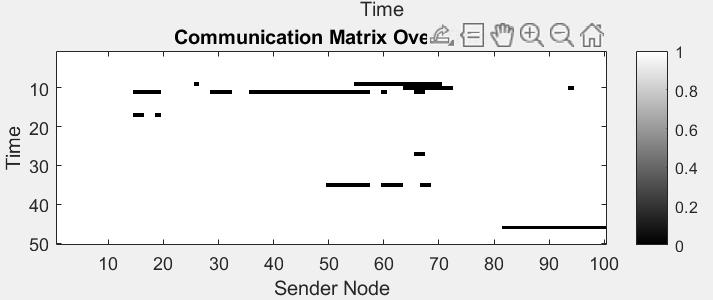
For each time step, each node checks the communicationbetweeneachpairofnodeswithinthe communication range, if the communication is established,amessageissentbetweenthenodes.The node checks for the presence of a GHA using a placeholder function is ‘GrayHoleAttackDetected’. Increments the ‘numAttacks’ counter if an attack is detected. Updates the communication matrix to indicatesuccessfulcommunicationbetweennodes.
Thecommunicationmatrixovertimeusinganimage plot, shown in the below Figure 6. Once the communication is established between each pair of nodes,a message “This isa VANETmessage”is sent
between the nodes. Further, randomly adjusts the positionsofnodestosimulatemobility.
NextstepistocheckforthepresenceofaGray-Hole attackusingthefunctionis‘GrayHoleAttackDetected’. If a GHAis detected, itdisplays amessage indicating theattack,mentioningthetimeandthenodesinvolved. The simulation then continues to the next pair of nodes. A while loop is considered to simulate the transmission of packets until all packets are transmittedordiscarded.Selectsapackettotransmit “Msg”fromthepacketlistandrandomlyselectssource anddestinationnodesfromthenetwork.Findsallthe paths fromsource anddestinationandevaluates the bestpath.
Thevisualizationoftheresultsisintermsoftimeand energyofthepacketstravellinginthenetwork.Ifthere is presenceof attackincertainnodes, thencomplete packetsaredroppedindicatingthatthereisnoenergy inpacketsbetweenthosenodesandnotimetakenfor thepacketstobetransmittedinthatregion.
Twoemptyarrays,dataandlabels,areinitialized.These arrays will storethefeaturesextractedfromthenetwork paths (data) and the corresponding labels indicating whetherthepathisvalidornot(labels),alongwiththe totalnumberofRREQ,RREP,DSNiscontainedinthe arrays.Thenextstepisconsiderationofmobilityofthe network.100iterationsisconsideredforthenetwork todynamicallychangealongwiththedifferentposition oftheattack.Ineachiteration,anetworkisgenerated usingthemakenetfunctionwith50nodes.
For each path found in the network, features are extracted using the path feature’s function. These featurescharacterizethepropertiesofeachpath.The networknodes are simulated tomoveoverthis time interval.Foreachpath,itisdeterminedwhetherthe
Volume: 11 Issue: 09 | Sep 2024 www.irjet.net
International Research Journal of Engineering and Technology (IRJET) e-ISSN: 2395-0056 p-ISSN: 2395-0072
pathisvalidornot.Ifthepathcontainstheattack,itis markedasinvalid.Otherwise,itsvalidityisdetermined usingthe‘path_isvalid’function.Theextractedfeatures (Vectors) and corresponding labels indicating path validity(validation)areappendedtothedataandlabels arrays,respectively.
Afeedforwardneuralnetwork(net)isinitializedusing thefeedforwardnetfunctionwith10hiddenneurons and the Levenberg-Marquardt backpropagation algorithm for training. The activation functionof the neuronsinthesecondlayeroftheneuralnetworkisset to 'tansig', which is the hyperbolic tangent sigmoid function.Thischoiceofactivationfunctioniscommonin neuralnetworksforitspropertieslikeboundedoutput andefficientlearning.
The neural network (net) is trained using the train function with the feature data (data) as input and corresponding labels (labels) as target outputs. The accuracyofthetrainedneuralnetworkiscalculatedby comparing the rounded predictions of the network withtheactuallabels.Theaccuracyiscalculatedasthe ratio of correct predictions to the total number of predictions,expressedasapercentage.Foraparticular iteration of a network, the output graph is obtained showing the best possible route from source to destinationavoidingtheattackregions.
RSU node is invoked in the promiscuous mode that periodically monitors all neighboring vehicles to determinewhethernumbersofpacketsreceivedbya nodearepassedtotheirnext-hopnodesornot.Atotal of8vehiclesundertheobservationofasingleRSUis considered. Inpromiscuousmode, a networkdevice, suchasanadapteronahostsystem,caninterceptand readinitsentiretyeachnetworkpacketthatarrives. Thismodeappliestobothawirednetworkinterface card(NIC)andwirelessNIC.Inbothcases,itcausesthe controller to pass all traffic it receives to the central processing unit instead of just the frames it is specificallyprogrammedtoreceive.
To detect Smart GHA, an RSU counts the number of packets received, forwarded, and generated by each neighbouring node and stores them in the Master RoutingTable.TheRSUfirstcalculatesthePacketLoss Rate(PLR)valueofallthereceivedandforwardeddata packets of each node in the MRT according to the followingequations-
DPD(Vni) = ∑DPR - ∑DPF [1]
PLR(Vni) = DPD / ∑DPR * 100 [2]
where DPD = Data packets dropped, DPR = data packetsreceived,DPF=datapacketsforwarded. IfthePLRvalueofavehicleisfoundtobegreaterthan thethreshold(δ)i.e. PLR (Vk )>δ,thentheRSUmarks it as a suspicious vehicle. In this model, the value of threshold(δ)issetat3%,becausethestandardAODV protocol for a normal node has a PDR of 97–98% Next, the RSU checks the amount of abnormal differentiationoftheRREQandRREPcontrolpackets ofeachvehicleandthencomparesitwiththethreshold value (λ). If an intermediate vehicle is not the destinationitselfandneverforwardsanRREQpacket foragivenroute,butinsteadrespondswithanRREP packet, its suspicious value is recorded in the MRT. To determine the rate of abnormal differences in control packets the RSU node calculates the Ratio of RREQreceivedandRREPgeneratedusingtheequation
RRR(Vni) = ∑RREPG / ∑RREQR * 100 [3]
Ifavehicle’sRRRvalueisfoundgreaterthanorequal tothethresholdvalue(λ)i.e., RRR≥λth,thentheRSU marks it as a suspicious vehicle. An RSU declares a vehicleasaSmartGHAifits RRR≥λth and PLR > δth, andthenmovesittotheblacklist. Themaximumvalueforλisassumedtobe70%inthis model. This is obviously an abnormal indicator of generatingalargenumberofRREPsinresponsetothe RREQsdifferentiatingtheharmfulpropertyofaSmart GHAfromthegroupofnormalnodes.
Next,theRSUnodechecksthefakeRREPwithahigh sequencenumberstoredintheMRT.DSNisincludedin every RREP packet to identify the route’s freshness. Despite having a fresh route to the destination, a SequenceNumber-basedGHAgeneratesafakeRREP with a higher DSN to get involved in the route and attract the flow of traffic towards itself. To identify suchamaliciousnode,anRSUcomputesthemean(μ) value of all the recorded RREPs’ DSN exchanged by each node in its MRT table according to the below equation
μ = ∑DSNni(Vi) / n [4]
whereμ(DSNni) isthemeanvalueoftheDSNofallthe RREPs of an ith vehicle recorded in the MRT. After computing the μ(DSNni) value, the RSU calculates a thresholdvalue(β)accordingtothebelowequation–
Volume: 11 Issue: 09 | Sep 2024 www.irjet.net
International Research Journal of Engineering and Technology (IRJET) e-ISSN: 2395-0056 p-ISSN: 2395-0072
β = mean(μ(DSNni(Vi))) [5]
whereβisadynamicthresholdvaluethatfrequently changeseachtimeanewprocessofGHAdetectionis initiatedand n isthetotalnumberofvehiclesrecorded intheMRT.
NowtheRSUnodecompareseachvehicle’sμth value withβth value.Ifavehicle’sμth valueisfoundgreater thanorequaltotheβth value,thentheRSUmarksitas a suspicious vehicle. An RSU declares a vehicle as a SequenceNumber-basedGHAifitsμ(DSNni)≥βth,and eitherits PLR >δth orits RRR ≥λth,andthenmovesitto theblacklist.
SupportVectorMachine(SVM)isasupervisedlearning algorithm used for classification. It works by finding the hyperplanethat bestseparates theclassesinthe featurespace.SVMforclassificationrelyonthesame thresholds (λ, β, δ) from the main algorithm to determinethelabelsfortrainingdata.SVMlearnsthe decisionboundarybetweendifferentclassesbasedon the features provided(e.g., PLR, RRR, DPD, DSN, and NTS).Itdoesn'tdirectlyusethethresholds,instead,it learns the relationship between features and labels fromthetrainingdatawhichisobtainedfromvehicles, here8vehiclesareconsidered.
NetworkTrustScore(NTS)foreachvehicleisafeature thatrepresentstheoveralltrustworthinessofavehicle in the network. NTS is calculated based on various factors such as the number of request and response packets received, detection packets received and forwarded,anddatasequencenumbers.Thepurpose ofNTSistoprovideadditionalinformationaboutthe behaviorofeachvehicleinthenetwork.Itcanhelpin distinguishing between genuine nodes and potential attackersbasedontheiroverallactivityandbehavior. InthecontextofSVMclassification,NTSservesasone oftheinputfeaturesalongwithotherfeatureslikePLR, RRR, DPD, and DSN. SVM learns the relationship betweenthesefeaturesandthecorrespondinglabels (Smart GHA, sequence-based GHA, or genuine node) duringthetrainingphase.
Asinthedetectionphase,onceanRSUdetectsaGHA (either Smart or Sequence Number-based GHA), it broadcasts the identity of that vehicleto all its neighboring nodes (RSUs or vehicles) via an alert Message. The alert message contains the issuing
identityofanRSU,theidentityoftheGHA,thetypeof GHA.Whenanode(RSUorvehicle)receivesanalarm message from an RSU, it first examines its blacklist tableforaGHAentry.
Thealertmessageisdiscardedifanentryforthegrayhole node already exists; otherwise, the node’s ID is addedtotheblacklist.Subsequently,theparticipation ofthegray-holenodeintheroutediscoveryprocessis prevented by checking the blacklist table. A node ignorestheRREPfromanother node if itsidentityis found in the blacklist table. During route discovery time,avehicledropstheRREQorRREPpacketifitsID isfoundintheblacklisttable.TheMRTtablekeepsthe records of all packets received, forwarded, and generatedandtheRREPs’DSNsofeachone-hopnode. Whiletheblacklisttableisusedtokeeptherecordof gray-holenodes
TheFigure7showsthesampleofnetworktopology.
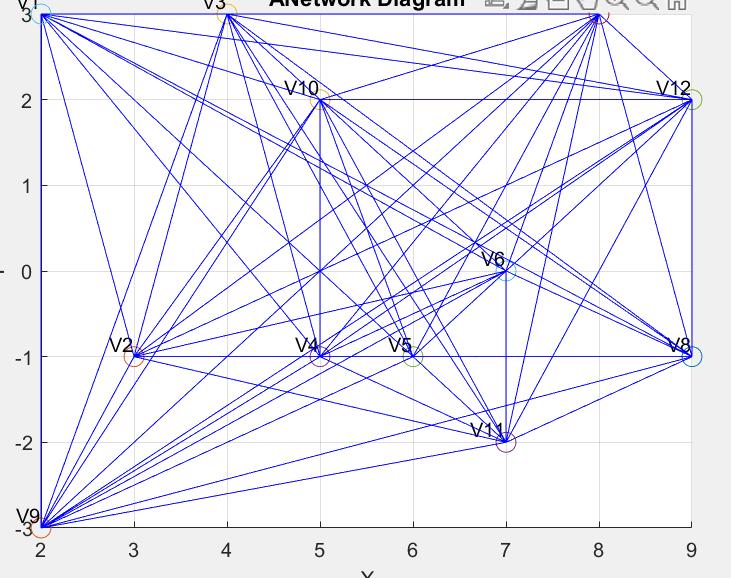
AstheRSUcanoperateinpromiscuousmode,whereit listenstoallthepacketswithinitsrange.Byanalyzing the packet headers, it can identify RREQ and RREP packets, andcountthe number of these packets sent andreceivedbyeachvehicle.Eachpackethasheaders thatincludethesourceanddestinationaddresses.The RSU can maintain a log of these packets to track the activityofeachvehicle.
Volume: 11 Issue: 09 | Sep 2024 www.irjet.net
International Research Journal of Engineering and Technology (IRJET) e-ISSN: 2395-0056 p-ISSN: 2395-0072
Thebelowtable,Table1.showsthetotalRREQ–Route Request, RREP – Route Reply, DPR – Data Packets Received, DPF – Data Packets Forwarded and DSN –Destination Sequence of each of the Vehicles maintainedinthemasterroutingtableinRSU.
Table 1.DSN,RREQ,DPR,DPFofVehicles Vehicle
V1
V4 18 45 12 640 630
V5 200 80 75 1400 1370
V6 32 65 40 960 895
V7 60 41 25 1620 1590
V8 17 39 19 210 205
For classification of Smart GHA, Sequence Number Based GHA, and Normal Vehicles Support Vector MachineModelisusedtotrainandtestthemodelfor efficientclassification.
HerethelabeleddataforRREQ,RREP,DSNandDPR and DPD is randomly generated for the purpose of classificationinthetrainingphaseandthencompared with the new data from Table 1 to test for efficient classification and Figure 8, shows the efficient classification under “Label” for the new data from Table1.
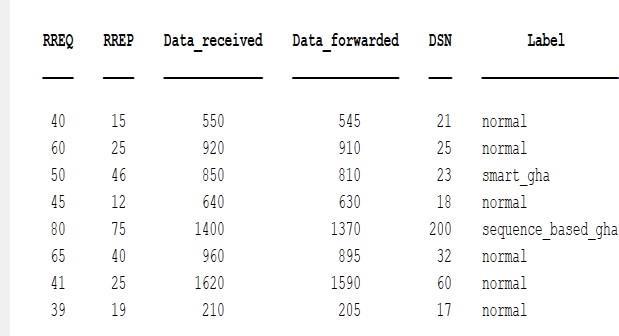
Fig 8.LabelofDatasetusingSVM
Table2showsthecompletetableofRREQ,RREP,DSN andDPRandDPDofallthe8vehiclesalongwiththe calculationofthePLRandRRRandtheconditionsfor categorizing the Vehicles as Smart GHA, Sequence Number Based GHA, Normal Vehicles. Here the thresholdconsideredisδ–5%, λ –70%,NTS – 0.5
Table 2 EntryinMRT
HereitcanbenoticedthatforVehiclenumber3,whose the Packet Loss Rate (PLR) < δ and RRR > λ and the NTS > NTS threshold (0.5), this vehicle will not be broadcastedasSmartGHAsincethethreshold δ isset to5%whichallowsmorenumberofpacketstobelost and still is not considered as malicious node. While Vehiclenumber5has,DSN>βandRRR> λ theNTS> NTS threshold (0.5), hence this vehicle will be broadcastedasSequenceNumberbasedGHA.
Fig9,showsthescreenshotoftheoutputbroadcasting the vehicles number under Sequence number-based GHAforthethresholdconsideredis δ –5%, λ –70%, NTS – 0.5
Fig 9. Broadcastingthevehiclesnumberunder Sequencenumber-basedGHA
Table3showsthecompletetableofRREQ,RREP,DSN andDPRandDPDofallthe8vehiclesalongwiththe calculationofthePLRandRRRandtheconditionsfor categorizing the Vehicles as Smart GHA, Sequence NumberBasedGHA,NormalVehicles.
Volume: 11 Issue: 09 | Sep 2024 www.irjet.net
International Research Journal of Engineering and Technology (IRJET) e-ISSN: 2395-0056 p-ISSN: 2395-0072
Herethethresholdconsideredis δ –3%, λ –70%, NTS – 0.5

V1 × × × 0.2025
V2 × × × 0.2444
V3 × Yes Yes 0.7650
V4 × × × 0.2315
V5 Yes × Yes 0.5505
V6 × × × 0.4969
V7 × × × 0.4242
V8 × × × 0.3471
FromTable3,itcanbenoticedthatforVehiclenumber 3,whosethePacketLossRate(PLR)> δ andRRR> λ andtheNTS>NTSthreshold(0.5)hencethisvehicle will be broadcasted as Smart GHA while Vehicle number 5 has, DSN > β and RRR > λ the NTS > NTS threshold(0.5), hencethisvehiclewillbebroadcasted asSequenceNumberbasedGHA.
Figure 10, shows the screenshot of the output broadcastingthevehiclesnumbersunderSmartGHA andSequencenumber-basedGHA.
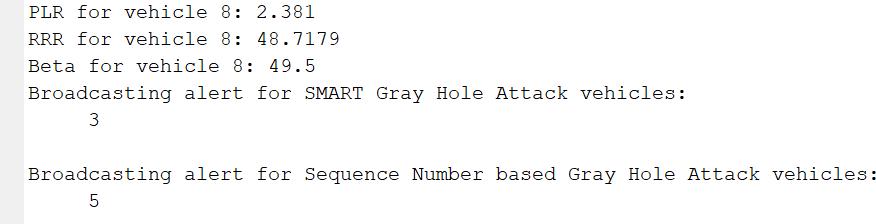
Fig 10.Broadcastingthevehiclesnumbersunder SmartGHAandSequencenumber-basedGHA.
The below Figure11, gives thecomparativestudyof the Detection Accuracy vs Number of nodes for different algorithms. Here detection accuracy is the correctidentificationoftheactualattacker/gray-hole nodes.ItiscalculatedastheratioofTruepositiveto true positive plus false negative. The False Negative measures the number of attacker nodes that are identifiedasnormalnodes.
AttackDetectionofBlack-holeandGray-holeSecurity Attacks (DDBG) approach has a lower chance of detectingamaliciousnode,witharecordeddetection accuracyof92%.Finally,inthecaseoftheSmartBlackhole and Gray-hole Mitigation (SBGM) approach, the average detection rate is recorded as 95%, which is approximately3%higherthantheDDBGapproach.The proposedPGHAwithsolutionhasthebestperformance withthehighestdetectionrate,thatis,anaverageof 97%.
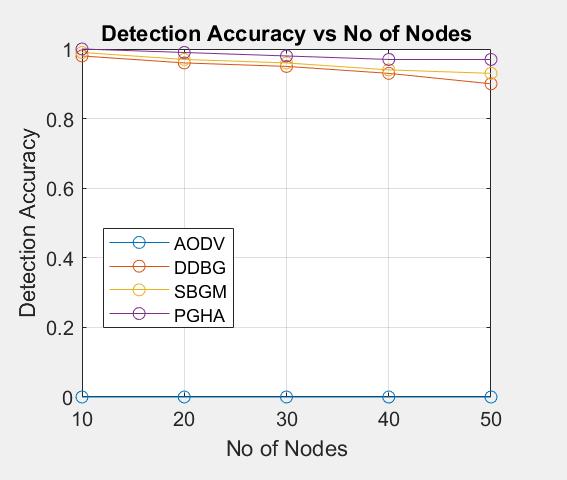
Fig 11.comparativestudyoftheDetectionAccuracy vsNumberofnodes
AGHAinVANETisatypeofsecurityattackinwhicha malicious node exhibits unpredictable behavior. Initially it acts as an honest node, but later it starts misbehaving by partially, selectively, or completely dropping packets. This work presented a new and efficientapproachforthedetectionandpreventionof gray-holeattackscalledPGHAtoimprovetheoverall securityandperformanceofAODVbasedVANETs.
The approach relies on multiple thresholds of abnormaldifferencesamongreceived,forwarded,and generated control/data packets and the sequence number of RREPs. PGHA detects both types of GHA, namelySmartGHAandSequenceNumber-basedGHA.
A comparison in terms of performance evaluation metricsoftheproposedPGHAwiththemostrelevant benchmarkapproachiscarriedoutbyimplementingit inMATLABtool. Vehicle DSN>β
TheconventionalAODVseverelysuffersfrompacket drop attacks because it has been designed without taking into account the security aspects, thus its detectionaccuracyis recordedas00.0%.TheDual-
International Research Journal of Engineering and Technology (IRJET) e-ISSN: 2395-0056 p-ISSN: 2395-0072
Volume: 11 Issue: 09 | Sep 2024 www irjet net
ThefindingsshowedthattheproposedPGHAwithNTS performs better than the benchmark approaches in termsofachievingamaximumdetectionaccuracyof 97%.
[1] R.Abubakar,A.Aldegheishem,M.FaranMajeed, A.Mehmood,H.Maryam,N.A.Alrajeh,C.Maple, and M. Jawad, ``An effective mechanism to mitigatereal-timeDDoSattack,'' IEEEAccess,vol. 8,pp.126215_126227,2020.
[2] Z.Hassan,A.Mehmood,C.Maple,M.A.Khanand A.Aldegheishem,"IntelligentDetectionofBlack Hole Attacks for Secure Communication in Autonomous and Connected Vehicles," in IEEE Access,vol.8,pp.199618-199628,2020
[3] P. Rani, Kavita, S. Verma and G. N. Nguyen, "MitigationofBlackHoleandGrayHoleAttack UsingSwarmInspiredAlgorithmWithArtificial Neural Network," in IEEE Access, vol. 8, pp. 121755-121764,2020
[4] A.Kumari,M.Singhal,andN.Yadav,``Blackhole attack implementation and its performance evaluation using AODV routing in MANET,'' in Inventive Communication and Computational Technologies. Singapore: Springer, 2020, pp. 431 438.
[5] Z.Hassan,A.Mehmood,C.Maple,M.A.Khan,and A.Aldegheishem,‘‘Intelligentdetectionofblack hole attacks for secure communication in autonomous and connected vehicles,’’ IEEE Access,vol.8,pp.199618–199628,2020.
[6] Z.Hassan,A.Mehmood,C.Maple,M.A.Khan,and A.Aldegheishem,‘‘Intelligentdetectionofblack hole attacks for secure communication in autonomous and connected vehicles,’’ IEEE Access,vol.8,pp.199618–199628,2020.
[7] P. Rani, Kavita, S. Verma, and G. N. Nguyen, ‘‘Mitigation of black hole and gray hole attack using swarm inspired algorithm with artificial neuralnetwork,’’ IEEEAccess,vol.8,pp.121755–121764,2020.
[8] H.Gao,C.Liu,Y.Li,andX.Yang,‘‘V2VR:Reliable hybrid-networkorientedV2Vdatatransmission androutingconsideringRSUsandconnectivity probability,’’ IEEETrans.Intell.Transp.Syst.,vol. 22,no.6,pp.3533–3546,Jun.2021.
[9] R. Krishnan and P. A. R. Kumar, ‘‘A dynamic threshold-based technique for cooperative blackholeattackdetectioninVANET,’’ Intelligent DataCommunicationTechnologiesandInternetof Things (LectureNotesonDataEngineeringand Communications Technologies), vol. 101, D. J. Hemanth, D. Pelusi, and C. Vuppalapati, Eds. Singapore:Springer,2022,pp.599–611.
[10] P.R.KrishnanandP.A.R.Kumar,‘‘Detectionand mitigation of smart blackhole and gray hole attacksinVANETusingdynamictimewarping,’’ WirelessPers.Commun.,vol.124,no.1,pp.931–966,May2022.
[11] L.Yang,A.Moubayed,andA.Shami,‘‘MTH-IDS:A multitieredhybridintrusiondetectionsystemfor InternetofVehicles,’’ IEEEInternetThingsJ.,vol. 9,no.1,pp.616–632,Jan.2022.
[12] S.Lakshmi,E.A.M.AnitaandJ.Jenefa,"AHybrid Approach Against Black Hole Attackers Using DynamicThresholdValueandNodeCredibility," in IEEEAccess,vol.11,pp.91595-91603,2023
[13] A.Malik,M.Z.Khan,S.M.Qaisar,M.FaisalandG. Mehmood, "An Efficient Approach for the DetectionandPreventionofGray-HoleAttacksin VANETs," in IEEE Access, vol. 11, pp. 4669146706,2023
[14] 5,6,Hemavathi;Akhila,S.R.;Alotaibi,Y.;Khalaf, O.I.; Alghamdi, S. Authentication and Resource AllocationStrategiesduringHandofffor5GIoVs Using Deep Learning. Energies 2022, 15, 2006. https://doi.org/10.3390/en15062006
[15] Veena S, Akhila S, “Detection Of Blackhole In Under Water Acoustic Sensor Networks”, InternationalJournalForTechnologicalResearch InEngineeringVolume5,Issue12,August-2018, ISSN(Online):2347–4718.],
[16] Anitha S Sastry; Chitlapalli, Sadhana; S, Dr. Akhila, “A Novel approach for Detection and avoidSybilattackinMANET”,16thInternational ConferenceonRemoteEngineeringandVirtual Instrumentation,REV2019,Feb.2019